

Vesti
Vučićević tvrdi da je u Informeru talačka kriza: „Svi policajci su zauzeti“
U programu TV Informer od 18 časova Dragan J. Vučićević tvrdi da je u toku talačka kriza, dok se u telefonskoj vezi čuje poruka da su svi policijski službenici zauzeti

A new movement must sever all ties with compromised opposition parties. The second message is that it must unite the nation rather than remain caught up in traditional ideological divisions and debates. If you want to rid your country of a mafia state, what matters is not whether you support the left, liberals, conservatives, or the Greens. What matters is whether you want to dismantle a state criminal organization—the mafia state. In that context, ideological divisions are secondary
Bálint Magyar is a leading Hungarian sociologist who has had a distinguished academic career in Hungary, as well as a significant political career. He served as a Member of the Hungarian Parliament from 1990 to 2010 and held the position of Minister of Education twice (1996–1998 and 2002–2006). He also served as president of the Alliance of Free Democrats – Hungarian Liberal Party (SZDSZ). Since 2020, he has been a researcher at the Democracy Institute of Central European University in Budapest, where he currently holds the position of Senior Research Fellow.
His book Post-Communist Mafia State: The Case of Hungary was first published in Hungarian in 2013 and subsequently in English by Central European University Press in 2016. In 2020, he co-authored, with Bálint Madlovics, an 800-page book entitled The Anatomy of Post-Communist Regimes: A Conceptual Framework. A condensed version of this book was published in 2022 under the title A Concise Field Guide to Post-Communist Regimes. In recent Hungarian elections, the concept of the “mafia state” became a central accusation levelled by the Tisza Party against the Fidesz regime.
Last week, Dr. Bálint Magyar and Bálint Madlovics delivered a lecture in Belgrade entitled “How Did We Replace the Authoritarian Regime in Hungary?”, which prompted nervous reactions from some pro-government tabloids.
„VREME”: In 2013, you published your now-famous book, Post-Communist Mafia State: The Case of Hungary. In it, you described a new type of polity. Could you explain to our readers what a “mafia state” is and what its main features are?
BÁLINT MAGYAR: In fact, back in 2001, during Fidesz’s first term in government, I wrote an article entitled “The Hungarian Octopus: The Organized Upperworld,” which described this mechanism. At the time, however, Fidesz lacked the power needed to establish a mafia state, because it did not have the parliamentary super majority required to adopt a new constitution. So this was still an embryonic form of the mafia state. It was only after 2010, once Fidesz had acquired that constitutional majority, that it could begin to build the mafia state in its fully developed form.
A brief definition of a mafia state is that it is a privatized form of a parasite state, in which a political enterprise captures the state, the economy, the oligarchs, and society as a whole. It has twin motivations: monopolizing political power on the one hand, and accumulating personal and family wealth on the other.
At the same time, this is a form of autocracy that differs from other autocracies. If we compare it, for example, with Kaczyński’s attempt to establish an autocracy in Poland, we see that his was an ideology-driven project, whose twin motivations were the concentration of power and ideological indoctrination. Orbán’s system, by contrast, is ideology-applying. Unlike ideology-driven autocratic systems, its ideological elements have no value coherence; they have only functional political coherence. In other words, it is a system that uses even entirely contradictory ideological elements to serve its political objectives.
For a regime to qualify as a mafia state, it must meet certain criteria along four dimensions. The first concerns the structure of the ruling elite: who actually exercises power in this regime? Political analyses that say parliament, the government, or Fidesz decided this or that are misleading, because these formal institutions do not actually decide anything. They merely rubber-stamp and serve as transmission belts for decisions made elsewhere.
The actual decision-maker is that type of ruling elite that I call the “adopted political family”: a clan-like formation in which even non-kinship ties are consecrated as kinship ties. In a mafia state, the same person must simultaneously occupy the role of godfather within an informal network and the role of head of the formal executive power—in this case, prime minister—within a formal organization. It is the combination of these two roles in one person that made Viktor Orbán the chief patron in Hungary. He controlled both the formal institutions of power, dismantling the system of checks and balances through his two-thirds parliamentary majority, and the clan-like adopted political family, bound by quasi-kinship ties, which he headed as its godfather. Therefore, it could be called – focusing on the ruling elite, a clan state.
If we focus on how power is exercised, we can describe it as a neopatrimonial state, characterized by the appropriation of public authority for private use. This term is widely used in the scholarly literature, but it focuses solely on how power is exercised, overlooking the regime’s other dimensions.
If we focus on the dimension of property relations, we can call it a predatory state. These regimes are also frequently described as rent-seeking or kleptocratic. It is important, however, to distinguish between these three levels. Rent-seeking can take the form of legally sanctioned extraction through formal taxation. In this case, the question is simply whether society is being taxed excessively; the legality of the practice itself is not at issue. Kleptocracy generally refers to theft through the appropriation of current income flows as a defining feature of the regime. This takes us a step further: income is channeled to the elite through illegal means. The predatory state goes one step further still. Here, the ruling elite does not merely divert income; it also targets and seizes assets and enterprises through the bloodless means of state coercion.
The fourth dimension distinguishes between different levels of corruption. It is not enough simply to speak of a corrupt state. Corruption may be extensive and, in that sense, endemic, without necessarily being systemic—that is, organized hierarchically and encompassing the highest levels of power.
The next level is what is commonly called a “captured state.” In the literature, this generally refers to a form of state capture in which criminal groups or oligarchs take control of particular segments of the state through a bottom-up process. The third level, however, is the “criminal state,” in which the state as a whole operates as a single criminal organization, subordinated to a political enterprise. This is the level we observe in a mafia state.
We can therefore speak of a mafia state when a regime meets these “criteria” across all four dimensions: it is simultaneously a clan state, a neopatrimonial state, a predatory state, and a criminal state. Hungary is such a mafia state. No other EU member state has exhibited this type of regime, but Russia after 2003, as well as some former Soviet republics in Central Asia, can also be placed in this category.
In June, Ferenc Bíró, President of the Integrity Authority, estimated that systemic corruption during Viktor Orbán’s time in power (2010–2026) may have cost Hungary as much as €150 billion. Meanwhile, István Kapitány, Minister of Economy and Energy, suggested on his Facebook account that Hungary’s GDP could be 8–10% higher if corruption had not occurred. How was corruption on this scale possible?
This was possible because we are no longer dealing with classical corruption. In classical corruption, a transaction takes place between two actors—usually a political actor and an economic actor—who enter into an illicit relationship while retaining their respective roles. The politician does not become an entrepreneur, and the entrepreneur does not become a politician.
In a mafia state, by contrast, we are dealing with the operating logic of a traditional mafia rather than individual corrupt transactions. A traditional mafia occupies an intermediate position between state power and society: it uses blackmail and bribery in its dealings with those above it, and may use violence against those below it. It remains, however, an informal organization. A mafia state is effectively a traditional mafia elevated to the level of state power as a whole.
The politician thus becomes a “poligarch”—someone who holds a formal political position and an informal economic one—while the entrepreneur becomes an oligarch, holding a formal economic position and an informal political one.
Contrary to the common explanation, however, it is not the oligarch who captures the state. Instead, the supreme political authority claims the power to “appoint” oligarchs while accumulating assets for itself. This means that once you bring legislative power, executive power, and the oversight institutions under unified control, and also take control of the prosecution service and the courts, you can begin the unrestrained plunder of society for personal gain.
There has been considerable debate about the ideology of Orbánism. Some see it as a right-wing ideology that has even influenced right-wing movements in the West. However, you have repeatedly argued that the regime lacked substantive ideological content. How, then, would you characterise Orbánism in ideological terms?
As I mentioned earlier, Orbán’s regime is ideology-applying rather than ideology-driven. This is why I consider the left–right distinction somewhat meaningless in this context. I regard Orbán’s regime as populist, but my understanding of populism differs considerably from the mainstream interpretation. Without entering into that debate, let me simply explain what I mean by populism.
In my understanding, populism is a challenge to the legal-rational legitimacy underpinning liberal democracy, in the name of substantive-rational legitimacy. This means challenging and dismantling the institutional mechanisms of liberal democracy through which the national interest and the common good are defined through the institutions of public deliberation. Populism is the ideological instrument of the political program of morally unconstrained collective egoism. This formulation integrates five elements into a unified causal structure, each element connecting to the next in a logical sequence that can be traced either from supply side (left to right) or demand side (right to left).
The political program is the systematic replacement of legal-rational with substantive-rational legitimation. This isn’t merely rhetoric or strategy; it’s a concrete institutional project targeting the specific mechanisms through which liberal democracies constrain power and aggregate diverse interests. The program has both destructive and constructive dimensions: destroying existing institutional constraints (court independence, electoral integrity, media pluralism, civil society autonomy) while constructing alternative structures (patronage networks, direct mobilization mechanisms, subordinated pseudo-institutions).
The morally unconstrained element means the removal of ethical obligations toward stigmatized out-groups through systematic fear and hate campaigns.
Collective means the construction of an imagined community—“the people,“ „the nation,“ „the folk“—serving as the vehicle for group interest. This collectivization performs two functions. First, it transforms individual selfishness into group loyalty, making the pursuit of narrow interests appear as defense of communal identity rather than mere greed. Second, it creates an emotional bond transcending material calculation, providing psychological rewards (belonging, dignity, purpose) that sustain mobilization even when material payoffs decline.
Egoism means the ultimate goal is pursuing in-group interests without solidarity toward others. This is the demand-side foundation—populist voters seek to concentrate benefits within their group while externalizing costs onto stigmatized out-groups. The appeal of populism isn’t merely emotional or psychological but material: it promises redistribution from „them“ to „us“.
Some scholars have discussed the possibility of an autocratic breakthrough—a point beyond which autocratisation can no longer be reversed. Some Western scholars have even used mathematical models to argue that democracy could not be restored in Poland, Hungary, and Serbia. Yet democracy has since been restored in both Hungary and Poland. What does this tell us about the limits of such models and the prospects for reversing autocratisation?
The point of no return requires the regime to maximize its capacity to use physical violence. Fortunately, EU membership in the cases of Poland and Hungary, and the aspiration to join in Serbia’s case, place limits on the use of physical violence. Where such constraints are absent, as in Russia or the former Soviet republics in Central Asia mentioned earlier, the regime is virtually impossible to remove by peaceful means.
Nevertheless, in the two years following Péter Magyar’s emergence in February 2024, the government did resort to violent operations. Some of these may have involved assistance from the Russian intelligence services. Examples included bomb threats against around 250 schools, explosive devices placed near the Serbian-Hungarian border, and an act of state terror carried out by the Hungarian security forces and tax office, ordered by Orbán against Ukrainian cash couriers operating entirely legally. These actions, however, were aimed more at “persuading” public opinion than at eliminating potential opponents.
However, there were also signs that Orbán was preparing for the possibility of having to rig the election—something that is exceptionally difficult in Hungary, since independent organizations have observers at polling stations throughout the country. One such sign was the constitutional amendment allowing the military to be deployed domestically to “restore order.” This was clearly intended to prepare for a situation in which Orbán might try to annul the election results following a narrow defeat—as, for example, the Romanian Constitutional Court did in the presidential election. Given the unpopularity of the government and the organizational strength of the Tisza movement, such an attempt could have triggered an uprising. Orbán apparently believed he might then need to deploy the military.
During the final months of the election campaign, however, it became clear that the personnel of the military, the police, and the intelligence services would not side with Orbán’s government in such a coup. Former officers stated publicly that 80–90 percent of personnel in their respective services wanted change. This, together with the scale of the Tisza Party’s electoral victory, may have contributed to Orbán’s decision not even to attempt to falsify the election results.
Under Orbán, universities in Hungary lost much of their autonomy. How did this process unfold, and what did it mean in practice for academic freedom and university governance?
Naturally, all of this restricted freedom of research and expression. I myself, for example, was effectively barred from giving lectures at Hungarian universities for sixteen years. But these changes served not only ideological indoctrination; they were also intended to facilitate cleptocracy. Through this organizational restructuring, Orbán and his associates sought to ensure that EU research funding would be distributed within their own circle. The EU, however, suspended funding for the universities restructured in this way.
The recent Hungarian elections demonstrated that the only way to defeat Fidesz was by gathering around a single political movement. The opposition rallied behind a single movement and party, Tisza. How did Hungarians from different political backgrounds and ideological persuasions come to unite behind a single political force?
Orbán’s regime in the elections of 2014, 2018, and 2022, running in different configurations—sometimes separately, sometimes in alliances. Yet, largely thanks to the disproportionate electoral system, Fidesz secured a two-thirds parliamentary majority on all three occasions.
Over this period, the opposition parties steadily lost credibility. This was hardly surprising, since they, too, had become part of the corrupt political and economic ecosystem built by Fidesz. We could distinguish four types of opposition parties: marginalized parties; domesticated parties, drawn into corrupt deals and so subjected to blackmail; financially crippled parties; and, finally, fake opposition parties such as the extra-right wing Mi Hazánk (Our Nation), which Fidesz effectively helped create and supported. These parties collected protest votes against Fidesz, but their personnel and organizations had become entrenched and incapable of renewal. There was little hope that they could offer a credible prospect of political change.
Meanwhile, by 2024, the economic situation had also deteriorated considerably. This was not simply because the economy had effectively stagnated since Covid, with no GDP growth and the enormous amount of resources withdrawn by corruption schemes. The European Union had also withheld a substantial share of its funding in response to Orbán’s autocratic rule. This pushed many oligarchs connected to Orbán to encroach on the markets and economic space previously occupied by medium-sized businesses outside Budapest, squeezing them out and taking over their opportunities. At the same time, entire public service systems—healthcare, social welfare, transport, and others—were falling apart as a result of substantial funding withdrawals and the predatory practices imposed on them.
The third major factor was a moral collapse, exposed by the so-called pardon scandal. The president had pardoned a convicted offender who had helped cover up the sexual abuse of children in a children’s home.
Together, these three factors—the discrediting of the opposition parties, the dismal economic performance, and the moral collapse—created an opening for a new movement challenging the regime. Following the pardon scandal, social media influencers organized a rally attended by 100,000–120,000 people. By contrast, demonstrations called by the opposition parties attracted only a few hundred people, or at most one or two thousand. This demonstrated with absolute clarity that there was demand for regime change, but no political force capable of meeting it.
Péter Magyar burst into this vacuum and built his movement of Tisza-islands remarkably quickly. He first appeared in a podcast interview. His former wife, Judit Varga, had served as justice minister and had herself been implicated in the pardon scandal. The interview within two days attracted more than a million views on social media. Less than a month later, on the national holiday of March 15, more than 100,000 people gathered at his call. This revealed the extraordinary demand for a movement that could move beyond the failures of the established opposition parties; namely, that there was a demand for regime change, but there was no supply for it.
A few months later, in the European Parliament elections of June 2024, his party won 30 percent of the vote, effectively draining the established opposition parties of their electoral support. As this shift demonstrated, those parties’ voters had effectively been political hostages. They were people determined not to vote for Fidesz who, for lack of a better alternative, voted for parties that called themselves opposition parties but were, in reality, partly incompetent and corrupt.
Understandably, a central element of Péter Magyar’s campaign strategy was to reject all ties with the parties and politicians of the “old opposition,” rather than entertain the possibility of future cooperation with any of them. He wanted to make a clean break and offer a fresh start to citizens dissatisfied with Orbán’s regime. This also ensured that voters’ previous sympathies or antipathies toward particular parties would not hinder the growth of his own camp—the camp seeking regime change. As a result, support for the “old opposition” parties rapidly collapsed to just one or two percent in opinion polls.
What are the main lessons Hungary offers for the processes of de-autocratisation and re-democratisation?
A new movement must sever all ties with compromised opposition parties.
The second is that it must unite the nation rather than remain caught up in traditional ideological divisions and debates. If you want to rid your country of a mafia state, what matters is not whether you support the left, liberals, conservatives, or the Greens. What matters is whether you want to dismantle a state criminal organization—the mafia state. In that context, ideological divisions are secondary.
The third lesson is that when you are rebelling against an entire regime, you have to reclaim your homeland. You have to reclaim the nation.
Fidesz had been quite successful in appropriating primary, integrative ideological themes such as God, nation, and family, while using them as instruments of exclusion. It invoked Christianity to claim an inherently superior moral standing, thereby narrowing the scope for public debate over any policy. As for the nation, Orbán declared as early as 2002 that “the nation cannot be in opposition.” The implication was that anyone outside his adopted political family was not part of the nation. Finally, it promoted a patriarchal model of the family and presented that same model as the basis for how the country should be ruled.
By contrast, the left-wing, liberal, and Green opposition parties represented only fragmented secondary identities. But the sum of fragmented identities together does not produce an identity capable of competing with integrative primary identities, which provide the basic—and, one might say, natural—frameworks of belonging for a substantial proportion of citizens.
Péter Magyar therefore very deliberately brought the national flag to every rally and adopted a center-right national rhetoric. I would emphasize “national,” not “nationalist”: he invoked the nation in an inclusive, unifying sense, rather than an exclusionary one. This was how he presented himself, and it formed a major part of his campaign.
Hungary’s electoral system is highly disproportionate. It combines 106 single-member constituencies with 93 seats allocated through party lists. Within this system, Fidesz had traditionally drawn much of its strength from smaller towns and villages, where it built disproportionately strong support.
Péter Magyar understood that the issues and language important to the largely urban liberal intelligentsia could provide easy ammunition for Fidesz. He knew that he had to win the election primarily in communities with fewer than 5,000 inhabitants. That is why he held more than 700 campaign rallies over two years. In the final month or two before the election, he was holding five to seven rallies a day, regularly attracting thousands rather than hundreds of people, even in small communities. He understood that the fate of Budapest’s residents would be decided in the villages; that the fate of the middle class would be decided by the poor; and that the fate of university graduates would be decided by citizens with only eight years of primary education. The language and framing of his campaign were therefore aimed primarily at these voters.
His left-wing, liberal, and Green supporters accepted this with remarkable discipline. A survey conducted in early March 2026 found that 43 percent of Tisza supporters identified as liberal, 22 percent as left-wing, 10 percent as environmentalist, and just 11 percent as right-wing or conservative. Péter Magyar’s communication combined two distinct approaches. His verbal messaging largely stayed within a center-right frame, while his overtures to liberal and left-wing values took the form of nonverbal symbolic gestures. This made it difficult for Fidesz’s propaganda to put those gestures into words and attack the values they conveyed, since he expressed them through gestures rather than explicit ideological language.
How do you view the student and democratic movement in Serbia, and what similarities do you see between the situation in Serbia and Hungary’s recent political experience?
What do the Serbian and Hungarian situations have in common? First, prolonged autocratic rule and, for a long time, a sense that escaping it was impossible. Second, in both countries, resentment toward the regime and frustration with poor economic conditions erupted over an issue of profound moral significance: the pardon scandal in Hungary, and the railway station disaster caused by corruption in Serbia.
A third similarity is that the opposition parties had lost credibility and proved incapable of mounting an effective challenge to the regime. In both countries, the new political force consequently refused to cooperate with the parties and politicians of the “old opposition.”
Fourth, a crucial feature of both movements is that, unlike earlier opposition movements, they demanded not simply a change of government but regime change. That was their objective. They also named the regime in terms that captured its essence. In a way no previous opposition party had done, Péter Magyar consistently described Orbán’s regime as a “mafia state,” a “mafia government,” and the “Orbán mafia,” referring to Orbán himself as the “godfather.” In Serbia, too, the slogan is “Serbia or the mafia.” Both movements recognized that you cannot replace a regime by speaking its language.
The two challengers, however—Péter Magyar on the one hand and the students on the other—developed very different forms of organization. Magyar emerged as a single leader who attracted mass support, effectively sweeping aside the established opposition party structures. In Serbia, by contrast, a student movement without a prominent individual leader is ambitiously assembling a parliamentary candidate list through broad, democratic structures, although much of its organizing takes place clandestinely. The students have deliberately chosen not to stand as candidates themselves. They nevertheless claim and exercise the right to select the experts who will represent them following what they hope will be the removal of Vučić’s regime.
I can only wish this fresh, youthful movement every success. Hungary’s freedom-loving people look forward to the Serbian elections with great anticipation.
U programu TV Informer od 18 časova Dragan J. Vučićević tvrdi da je u toku talačka kriza, dok se u telefonskoj vezi čuje poruka da su svi policijski službenici zauzeti

RTV se izvinio gledaocima jer nisu emitovane brojne scene proslave Studentske liste nakon izbora. „Javni servis dugo godina nije izvršavao svoju funkciju“, poručio je voditelj Goran Eror na početku Dnevnika

Studentska lista osvojila je većinu na parlamentarnim izborima, a pred njom je sada formiranje nove vlasti. Kako se konstituiše Narodna skupština, ko predlaže mandatara i koji su rokovi za izbor nove Vlade?

Građani su uklonili metalne ograde i banere sa parcele u parku Ušće na kojoj je planirana izgradnja akvarijuma

Posle razgovora zaposlenih i sindikalnih predstavnika sa rukovodstvom RTV Vojvodine, glavni urednik Nenad Ćaćić podneo je ostavku.
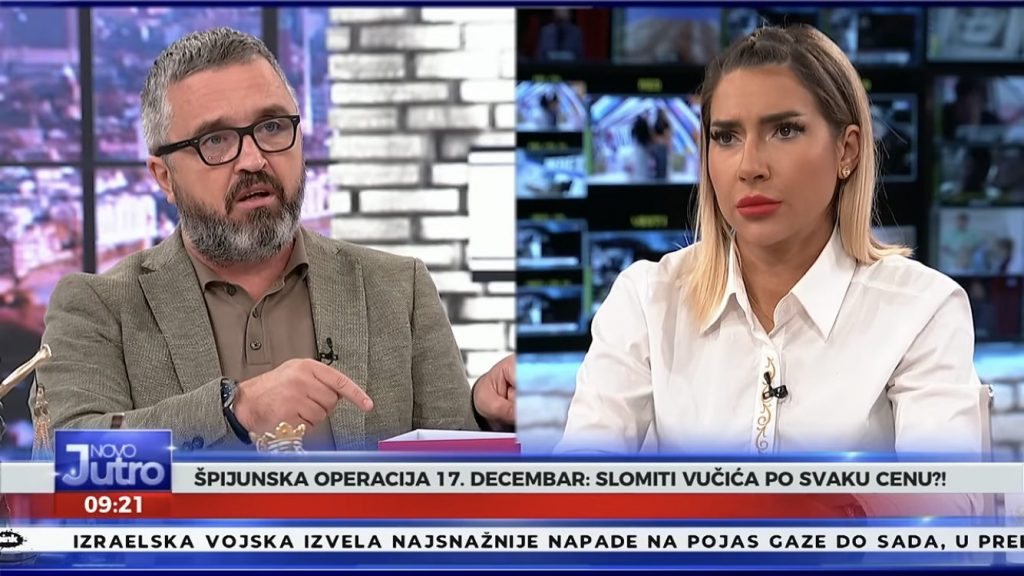
Rekvijem za zlo ne mora da bude svečan. Ponekad zvuči kao drhtav glas u jutarnjem programu i kao priča o zimskim gumama.

Potrebno je, najpre, nekako se dovući do čina primopredaje vlasti, ako s esenesovske strane bude bilo koga ko bi vlast predao. Hoćemo reći: Vučiću i njegovoj ekipi ne sme se verovati ni dve sekunde sve dok se vlast ne konstituiše

Većinska Srbija nošena studentima sada mora naći snage da oprosti običnim ljudima i umiri one koji su godinama glasali za Vučića. A za više ešalone – sud i Zabela

Arhiva nedeljnika Vreme obuhvata sva naša digitalna izdanja, još od samog početka našeg rada. Svi brojevi se mogu preuzeti u PDF format, kupovinom digitalnog izdanja, ili možete pročitati sve dostupne tekstove iz odabranog izdanja.
Vidi sve



