The number of Protestants in Serbia is slightly higher than 70.000. The Law on Churches and Religious Communities recognizes three traditional Protestant churches - the Slovak Evangelical Church av, the Reformed Christian Church and the Evangelical Christian Church av However, very little is known in the general public about their teachings and attitudes. On the other hand, Protestant churches that do not belong to the traditional ones have their own challenges that they face in their activities.
Finally, when it comes to a broader, global plan, the jubilee is approaching, for which preparations have already begun in some European countries - five hundred years since the Reformation will be celebrated in 2017. In front of the town hall in Wittenberg, the city where Martin Luther hung the famous 95 thesis, there is already a globe on which the whole world is red, the color of the Reformation, where it says "Reformation 2017", and Luther's garden, which should have 500 trees. It is rumored that Pope Francis may visit the city, in the spirit of the reconciliation process between Catholics and Protestants.
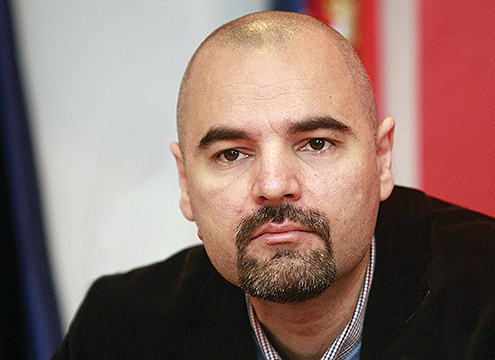
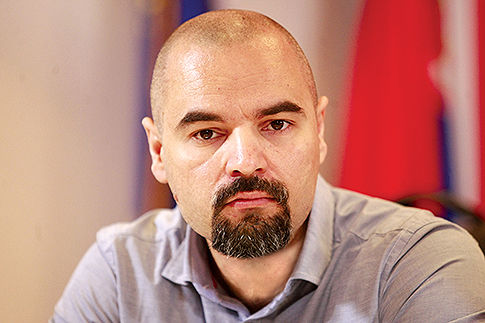
We talk to Nikola Knežević, president of the Center for Research on Religion, Politics and society.
"WEATHER": What is the position of traditional Protestant churches in Serbia??
NIKOLA KNEZEVIĆ: It is fully regulated by the Law on Churches and Religious Communities (2007). Their position is good, they are not deprived of their religious rights in any way, they have the right to their religious education classes in schools, certain activities are financed from the budget. The truth is that the budget itself is much smaller than it was before, and the Ministry of Religion was abolished and reduced to one office for cooperation with churches and religious communities. But when it comes to traditional Protestant churches, there are no complaints, while the position of the so-called small religious communities of the Protestant province, as they are called, is more problematic.
This is why the Law from 2007 is usually criticized. years. What are the problems of those communities that were not included in the Law as traditional?
The rhetoric itself is already discriminatory in a certain way. They are not called churches but, as I said, small religious communities of the Protestant province. In Croatia, they are called churches of the Reformation heritage, which is a better solution. Considering their position in Serbia, they are not equal to traditional churches and religious communities, they do not have the right to hold their religious education in schools, of course no funds are allocated for them from the budget, their clergy do not have the right to receive contributions from the budget. To be precise, certain funds were allocated for publishing activities, for example the Protestant Faculty of Theology in Novi Sad or for certain conferences, but nothing more than that.
You mention Croatia. Is there a situation, when it comes to this issue, better or similar to the one here?
The situation is similar, but in Croatia it is slightly better. There are more Protestants there and the Law itself is better regulated. Although of course there is some discrimination, the majority, the Roman Catholic Church, of course has the most rights there. The difference is that the representatives of the Protestant churches are much more represented in the media than here, but this is more a reflection of the choice of editors and the type of shows that are shown there than of state policy.
There are very few Protestant representatives in our media. And sometimes it's hard to get to them. How do you explain that?, to call her, absence in the media space?
When it comes to traditional Protestant churches in Serbia, they are ethnically homogeneous and rather hermetic and closed. Protestant priests can be seen at certain gatherings organized by the state or the Serbian Orthodox Church, and at some meetings of an ecumenical character, and almost somewhere else. They are not in the media, not because of discrimination, but because, with some exceptions, they are exclusively focused on pastoral work within their communities. I did not find any article by a priest who belongs to traditional churches here, where he would announce, express, explain something. It is different in Croatia, where they are much more socially involved. The situation here is such that due to their internal problems, due to the language barrier, this is the case. There are a lot of priests, Reformed, Lutheran, who do not speak Serbian at all or speak it in such a way that they are unsure of going out in public. And then you have a closed story, which does not go beyond the scope of the parish. With the exception of a few priests who are communicative and willing to cooperate.
Does it have consequences for their mission?? Because if they are so closed, how will they spread their learning at all, how will society accept them?
When we look at historical data, they have always been like that. The mission was weak before. Simply speaking, they were not missionary active, they had their own parishes and functioned within them. Unfortunately, the number of Protestants is also decreasing, starting with the number of believers and ending with their visits to churches. For example, there are about 2000 reformed people in Novi Sad, but there are about ten people at the service, when it's Christmas or Easter, about a hundred come and that's it. The publishing activity, if there is any, is in the native languages, Hungarian, Slovak or German. If we say that Protestants who belong to traditional religious communities are discriminated against, it is because of themselves, because of their closedness. Non-traditional ones are more open, especially in recent years.
On the other hand, society did not always open its arms either. The word sect has a very negative connotation here. How do you see the way society views Protestant churches?, especially on small religious communities?
When I'm talking about small religious communities, I'm talking about Baptists, Pentecostals, they're all mostly Protestant evangelical communities. My experience is that society is primarily uninformed and misinformed. It was misinformed because of various self-proclaimed experts who wrote various texts in a malicious way. In those texts, flat assessments were given about small Protestant communities. Not only were sects talked about in a negative context, which the word itself does not originally imply, but they were written about as foreign agents, mercenaries, and very often they were put in the same basket with oriental sects, with Satanists. That is changing lately because these communities have gone public and are trying to inform people more. And they are quite active in the mission, so what we call proselytism often happens, and thus there is conflict and collision with the Serbian Orthodox Church and various, negatively colored interpretations in the public. But I repeat, lately those small communities are better organized, they try to inform the public, and the mood of the society towards them is slowly changing.
It seems to me that the public is not even informed about the teachings of the traditional Protestant churches. What is the difference in their learning in relation to the world and modernity?
Differences in the teachings of Lutherans, Reformed and Methodists are small today, they are united in many countries and work together, while throughout history these differences have created big problems and bloody conflicts. Only social teaching in Protestantism is very pronounced. Protestantism, looking historically, has a great influence on the development of human rights and democracy. Protestant churches were and are great fighters for human rights, sometimes they are even too liberal in this regard. In all countries, the Lutherans and the Reformed, and of course the Anglicans, have a very pronounced social and charitable activity and are very active in the defense of human rights. In Serbia, this is not the case, it may even be the opposite. Here, for example, whenever the Serbian Orthodox Church, or its spokesperson, comes out with an appeal, a statement, they always stand behind it. That's interesting. Although in other countries these attitudes are different, for example on homosexuality, they are extremely conservative here. In Germany, the situation is completely opposite. They are the first when it comes to defending any of the spectrum of human rights. There are no such cases here. Perhaps the position of certain priests or bishops is different, but in their statements they usually agree with the spokesperson of the Serbian Orthodox Church and do not express their position.
500 will be celebrated soon. anniversary of the Reformation. Preparations for that jubilee are ongoing in Germany. When we look at the world today, what impact did protestantism have on present day europe?
We know that the Reformation processes played an important role in the creation of modern European society, modern and secular states, economic models and, as I mentioned, in the development of human rights. The Protestant principle of individuality strengthened individual freedom and affirmed freedom in general, while the principle of universal priesthood influenced the equality of all people. As is known, Max Weber wrote about the Protestant ethic as a prerequisite for the creation of a modern capitalist society, although polemics about his thesis are still present today. Calvin's doctrine of predestination is the central point on which rests the utilitarian rationalism that was important for the development of capitalism. Material prosperity was seen as a reflection of God's blessing, and Calvin's teaching later spread to a wider social context.
There is a lot of talk about secularization and its connection with Protestants with snow, and from that, both praise and criticism of the Reformation and its consequences are drawn.
Everything depends on how we look at the processes of secularization. If we look at them in a negative context and consider that secularization is the enemy of the Church and faith, then it is a bad process that we should fight against. If we look positively, that the secular context is the most ideal context for freedom, pluralism, democracy that allows all religious communities to be able to express themselves, then we see that this process is good and has its positive side. Protestant ethics led to a kind of secular thinking and Christianity itself influenced the process of secularization, but not in the sense that religion was put on the back burner, but rather influenced the development of freedom of thought and speech. Of course, the problem with traditional Protestantism is primarily that it has relativized many of its religious principles and deviated from them. These rather watered-down, divergent interpretations deviate greatly from the principles of Luther and Calvin. Regarding certain social events, regarding certain ethical issues, traditional Protestantism deviated somewhere from its original teachings and relativized Christian values. And that is a danger for them as well. The churches themselves are falling apart because of this, the number of believers in those churches is decreasing and the process of secularization is destroying the very body of the church in that sense. All this does not come from secularization but from themselves, because they deviated from certain teachings, relativized them and turned their social activity exclusively into the defense of human rights, not religious, Christian principles.
In a simple way, with an obviously wrong logic, one could conclude that those churches are therefore more attractive to modern people because they fit into some desirable, the western social mainstream. Forwards...
But they relativize certain issues of Christianity, faith, relativize the very concept of family. Generally speaking, that's a big problem, that other extreme of adapting to the world. Europe will still be faced with the consequences of a certain nonsense of church teaching. And migrations will have a significant impact on how Protestant, as well as other religious communities, will have to harmonize their social activities with their teachings, if they want to survive.
Yet, the number of Protestants in the world is not decreasing?
This is thanks, first of all, to those churches that we call here small religious communities. They are the most numerous in the world. The number of evangelical believers is growing, their missions and their organization are very strong in the world. In America, Protestants make up about 52 percent, of which more than half are evangelical believers. The rest are Methodists, Episcopalians, Lutherans, Reformed. Their number is growing in South America, Africa. And they belong to churches with more conservative views. And in the Anglican Church there is a current which is large and which opposes the basic position of the Anglican Church on, for example, same-sex marriages, women bishops. The number of Protestants is growing, but thanks to the newer Protestant churches, they also have a slightly more conservative stance on bioethical issues.
How do, according to you, I can find that limit and balance between adapting to the spirit of the times, that everyone is talking about, and staying true to that basic source?
In my opinion, adapting to the spirit of the times means adapting to today's way of communicating the Gospel, adapting our Gospel narrative to the spirit of the times and the language of today. This does not mean relativizing one's own teachings and values and going against one's traditional teachings on which only Christianity stands. Because making sense of one's own teaching ultimately leads to a kind of euthanization of the church itself. And that can be applied to all religious communities, both Orthodox and Roman Catholic.