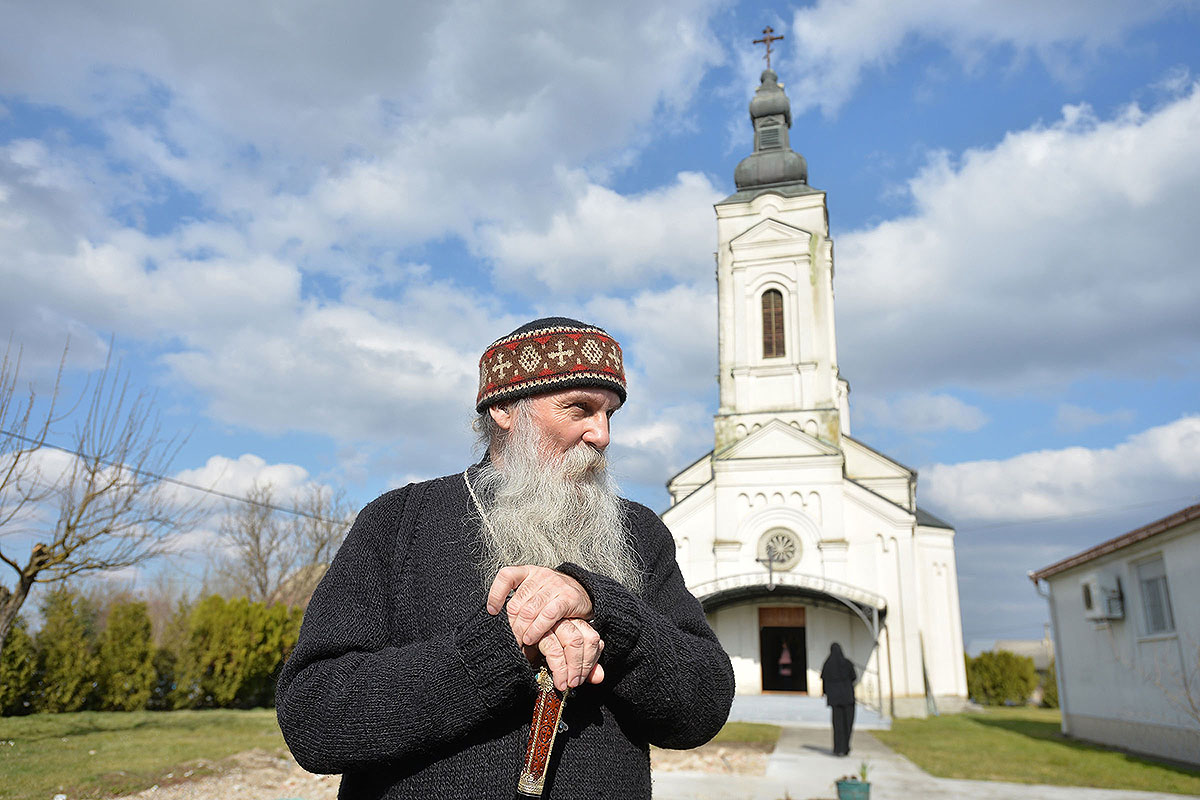
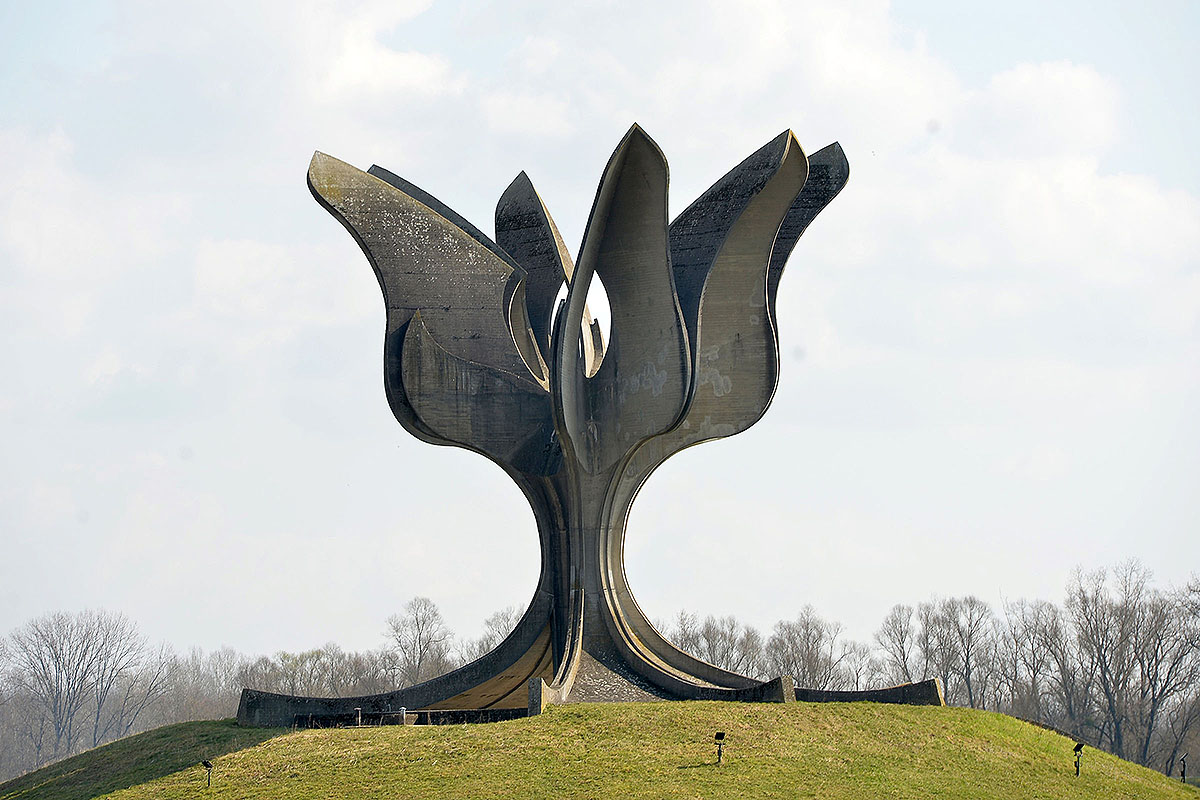
First, in Bosnia and Herzegovina, the statement of Bishop Jovan (Ćulibrka) from 2019 at a closed gathering of historians on revisionism in the scientific and public space of Serbia and Republika Srpska was extracted. Then came an invitation to the Serbian Orthodox Church with about fifty signatures to remove the bishop from "all duties related to Jasenovac and the suffering of Serbs in the NDH - primarily from the position of chairman of the Committee for Jasenovac and other SAS SPC killing grounds". It didn't end there: the SPC Synod then issued a statement that since "Bishop Jovan of Slavonia several years ago presented his private, in our opinion arbitrary, historically unfounded assessment of the number of Jasenovac victims, the Synod officially deprived him of the right to publicly announce that question".
All in all, Bishop Jovan should have been shut up. Why? Precisely because he deals with Jasenovci, the Holocaust and numerous other topics related to the culture of memory in a truly scientific and extremely conscientious manner. And in the general politicization of both Jasenovac and the victims of the Second World War, this clearly cannot go unpunished.
WEATHER: Despite everything you have done regarding the culture of memory especially for Jasenovac today you experienced being accused of historical revisionism by the Synod of the Serbian Orthodox Church based on an obscure petition. How did it come about?? And what is the message of all these attacks?
VLADIKA JOVAN: The message is very clear: a world passes and passes before our eyes, and it passes with much noise and fury, as Faulkner would say, and even more confusion and confusion, as if fulfilling the famous words of the Nobel laureate Robert Alan Zimmerman from his poem The Ballad of a Thin Man: "Something is happening here, but you don't know what, do you, Mr. Jones?”
To be precise: not only did one generation turn an assumed number of victims of Jasenovac into a dogma, deifying it and turning it into a secular religion, but it reduced dealing with Jasenovac only to an abstract defense of that dogma, where no memory of the victims - neither liturgical nor secular, neither research, nor the arrangement of places of suffering, nor the creation of museums, nor education about suffering are necessary, or at best irrelevant. That is why there are almost none of them here today: there are no doctorates on Jasenovac, the Museum of Genocide Victims has only been expanding and acquiring its function for two years, education about the genocide in the NDH and in general about Serbian suffering in the Second World War is just beginning. Something is better when it comes to the Holocaust, but also the attempt to destroy the European Jews has yet to get its central museum in our country, within the Staro Sajmište Memorial Institution.
The second part of the announcement of the Synod precisely describes this situation in detail, that is, it gives the profile of the fighters for this secular dogma; it is described even more precisely by the reactions to the announcement of the Synod, as well as the reactions of all those who recognize themselves when the director or president of the Board of Directors of the Museum of Genocide Victims - that is me - point out that one of the main problems surrounding Jasenovac and the suffering in the Second World War is that until yesterday, it was almost exclusively and very aggressively dealt with by dilettantes.
The terrible reduction of Jasenovac and the general suffering to one number is that in their minds, if that number falls, so does Jasenovac - it then ceases to exist. Let's imagine that there was no Yad Vashem and no Holocaust memorial, that there was no research, no trial of Eichmann, that not a single class in schools, neither in Israel nor in the world, was held about the Holocaust, that there was no Holocaust Day, that there was no "Schindler's List" or Wiesel's "Nights", and that the truth about the Holocaust was based solely on the defense of the originally estimated number of four million victims in Auschwitz? People would die of apocalyptic restlessness and fear of what will happen if it turns out that that number is not true - and that is what a generation has reduced itself to, that for it the truth about the genocide of Serbs, the Holocaust and the genocide of Roma in the NDH depends only on a secular dogma. We never see those people in Jasenovac, Ustica, Donja Gradina, Banjica or Jajinci.
You have been engaged in systematic scientific work for several decades. Your book "Historiography of the Holocaust in Yugoslavia" capital is also an indispensable work in the world. Yet, science has little or almost no say when it comes to war suffering both in the Second World War and in the wars of the nineties on the territory of the former Yugoslavia. Why?
This is where the "original sin" can be found at the very beginning of the 1980s, namely at the moment when, after Tito's death, "damned" questions began to be raised, i.e. topics that were either not treated at all (Bleiburg, for example) or were treated one-dimensionally in SFRY, such as Jasenovac and suffering in NDH. At the same time, Jasenovac, as the late Jovan Mirković, probably our most serious connoisseur of Jasenovac, said, was not a taboo topic, but a taboo approach was applied to it.
All these questions were opened by publicist Vladimir Dedijer, and after him, to paraphrase Kosta Nikolić, came journalists and poets. The absence of historians was resounding, as it is today. Dedier confused Yugoslav intellectuals for a number of decades by introducing Sartre's definition of genocide, which is much broader than the one coined by Rafael Lemkin and adopted by the United Nations. Today, certainly, a large number of younger historians deal with the Second World War, some of them also with the subject of suffering. They were preceded by a generation of very serious experts, including Milan Koljanin, Milan Ristović, Krinka Vidaković-Petrov. However, both generations appear only sporadically in the public narrative.
If it were not so, it would not be possible for the public to be misled even these days with the story of how there are some magical German sources for the number of victims of Jasenovac, while every historian is well aware that German sources talk exclusively about the number of victims in the NDH and that German sources for the number of Jasenovac victims - none, as Veljko Đurić Mišina, former director of the Museum of Genocide Victims, clearly showed recently. What morals and what expertise guides someone who in 2023 misleads the public hungry for the truth that such sources exist??
With this, unfortunately, I only elaborated and confirmed your question. You will have to look for the answer to it from the historians themselves - heads of departments and institutes from 1945 until today, especially from the first head of the Department for the History of Yugoslavia (from 1979) Jovan Marjanović onwards. The basic question is very simple: why is there no doctorate or monograph on the Jasenovac concentration and death camp system in Serbian historical science?
Finally, there is only one such monograph written by a historian at the top of his field, Ivo Goldstein (not a historian from the scholarly fringes or at least not from the mainstream), which is therefore indispensable, however rightly criticized; personally, I think his monograph "Holocaust in Zagreb" is more successful, about which not many expert reports have been written. However, I do not remember any particular critical reception of Goldstein's other books in Serbian science either; I hope I'm wrong.
The fact that the official institution in SFRY that was assigned to investigate Jasenovac was - forgive me if I am not completely precise in the title - the department for the history of the Croatian labor movement in Slavonski Brod tells us how bizarre this topic is. Worthy of Monty Python.
How is it possible that Gideon Greif, a man of dark reputation who gave the number of one million and four hundred thousand killed in Jasenovac, is treated by a good part of our public as a relevant researcher? For what reason, except for yourself, almost no one commented on his scandalous claims?
I would not agree that Gideon Greif arrived in our region as a man of dark reputation; on the contrary, although he was and remains a narrow specialist (he dealt with Auschwitz prisoners who served directly in the process of destruction, and wrote the excellent book "We cried without tears"), he was a very important name in that segment. But Greif's "dealing" with Jasenovci and NDH destroyed his academic reputation. In this sense, he is a victim of the person who brought him from Israel and his own certainly non-academic goals with which he came to us. The goal of bringing Gideon Greif was most similar to the operetta engagement of Daniel Schiffer, whom we remember from the nineties, although in Croatia there is a much more similar example to Greif, which could have served as a model for his engagement. Namely, the American Jew Esther Gitman made a similar "career" trying to wash away Alojzij Stepinac: she received her doctorate - after retiring - at the City University of New York, with a thesis full of tragicomic parts that indicate that she knows almost nothing about Yugoslavia in the Second World War nothing, but she received a standing ovation in Croatia.
In all three cases (Schiffer, Greif, Gitman) it is exclusively internal propaganda: a foreigner is brought in to confirm local pseudo-historical theses and convince the hosts that they are right in everything, while convincing the local public that the one who brought him leads who knows what kind of campaign for "our cause" around the world. While Gittman never had any credibility in science to lose it, nor did anyone take her involvement seriously, Greif also had something to lose and did it in a big way: it became the topic of all international forums dealing with the Holocaust, and it took a lot of effort to convince them that Greif was not a project of the state policy of Serbia and Republika Srpska, but a para-state project that tried to impose itself on Serbia and Srpska.
What Greif's "handler" failed to recognize is the fact that there is no such internationalized and networked thing on the planet (apart from crime, of course) as Holocaust remembrance: from Israel, through the US, the International Holocaust Remembrance Alliance to UN. There is no lying and everything is known, quickly and precisely. The moment when the eyebrows of the doyen of Holocaust science, Jude Bauer, darkened at the mention of Greif's involvement in Jasenovac, Greif's academic and "diplomatic" fate was sealed.
You never stated the number of victims in Jasenovac, but only the results of scientific research. Why do the circles that attack you pass over that fact, they forge it and use it for insidious calculations. What do they want to achieve with it?? Isn't that true historical revisionism? At the same time, the majority of independent media and organizations dealing with human rights in Belgrade and, at least verbally, they share your views, they remained silent during the wanton attacks on you. How do you interpret that??
I have never stated my views on the number of victims in Jasenovac, and I do not state them, just to give the word to the profession, namely the institutions and experts who deal directly with the numbers. Of course, I am precisely informed about the current state of world science when it comes to the victims of Jasenovac, which does not mean that I agree or disagree with someone's views.
Whether someone should defend me or not, the more important question is why those you mention in the question kept silent about the appearance of Gideon Greif and that with deep anguish. One part of the answer is clear: they do not care about Jasenovac, just as their supposed ideological opponents from the right do not care about Jasenovac - as much as the left and the right even exist today. Both have exclusive interests. No, high moral ground i self righteousness with which those circles are proud, they have gone into the gutter, from which they will not come out.
You have repeatedly indicated yes "without long-term and dedicated work, we will never have even an approximate number of victims". Is he, after all, possible?
Look, when I came to Israel in 2003, Yad Vashem had three million names out of the supposed six million victims of the Holocaust, a million and a half were being verified, and some one and a half million victims were thought to never be identified. In twenty years, digitization and networking have unexpectedly led to another million and a half confirmed names, while another million and a half are being researched. It shows that progress is still possible today.
In Yugoslavia and after it, censuses of the victims of the Second World War were carried out several times and on various scales - locally, regionally, at the republican and federal level. The SPC listed the victims on three occasions: only the census carried out in several villages around the Orahovica monastery in the 129s by Father Leontija Alavanja added XNUMX previously unknown names to the general list of victims. The results of many of these censuses have never been systematized; in order to do that, the Museum of Genocide Victims, whose job it is to deal with this, needs to be strengthened, we need to cooperate with each other and with world institutions, we need to digitize the materials and network. We have a lot of work ahead of us, probably we will never know all the names, but it is certain that we can know much, much more than what we know now. We have a big job ahead of us.