


News
Final election results: Victory with a margin of 623.094 votes
The student list won 140 mandates, United Serbia 103, and minority lists the remaining seven, according to the final results of the REC. Seven election lists enter the parliament
The student list won 140 mandates, United Serbia 103, and minority lists the remaining seven, according to the final results of the REC. Seven election lists enter the parliament

The student list and part of the opposition are against the government, but they are not going to the extraordinary parliamentary elections on October 25 with the same strategy. Who is running for election, who supports students, who will pass the census and who will not and where the disagreements within the opposition parties arose were discussed in "Impression of the Week".

Ilija Srdanović, the holder of the Student List, says that instead of responding to tabloid attacks, he will concentrate on the problems of citizens and their solution.

Each electoral list must have at least 40 percent members of the underrepresented sex

Prime Minister Đuro Macut said that the elections are not a sign of the state's weakness, but a confirmation of its democratic strength and trust in citizens

On one list will be the Serbian Progressive Party with its list, on the other all other political options, Aleksandar Vučić said

Aleksandar Vučić uttered the word "elections" countless times and in every appearance during the four days surrounding his own political rally. The only thing he did not say is - when they will take place

In Kosovo and Metohija, extraordinary elections for the assembly of temporary institutions of self-government are being held. Polling stations open at 7 a.m. and close at 19 p.m. Serbs are guaranteed ten parliamentary seats in the assembly

The President of Serbia, Aleksandar Vučić, said that the parliamentary elections will be held immediately after the summer and invited supporters to a rally on June 27 in Belgrade, where they will discuss "all important matters that interest the citizens".

On May 5, Aleksandar Vučić said that in "about ten days" he will say when the elections will be held. If he does not announce the decision today, it is possible that he will wait for the student protest

Tens of thousands of people euphorically greet the man who blew Viktor Orbán into history. Peter the Hungarian exclaims: "We did it!" Massa answers him: "Russia, go home!"

How to defeat an autocracy similar to the Serbian one was shown by Peter the Magyar with his young Tisa party. He convincingly defeated Viktor Orbán, who was supported by both Vladimir Putin and Donald Trump, despite the regime's control of the media in the misuse of state resources
What does political science say - what should be done in the pre-election period, apart from preparing the infrastructure for the election day itself, in conditions of lawlessness, media blockade and satanization? How to reach as many voters as possible in difficult conditions, build their trust and encourage them to go to the polls? It requires an army of trained people and a serious strategy. The potential exists, but to use it, it will take a lot of Ali Sirotanović

In the parliamentary elections in Slovenia, the liberal Freedom Movement of Prime Minister Robert Golob narrowly defeated the right-wing Slovenian Democratic Party of Janez Janša

Aleksandar Vučić will call early elections only if he thinks he can win. Are the opposition actors ready for a possible blitzkrieg? And who will stand against Vučić's candidate for President of the Republic?

It is certain that Aleksandar Vučić will run for Prime Minister of Serbia, according to the interlocutors of "Vremen". Nothing new, both Đukanović and Putin and Erdogan jumped from the prime minister to the presidential office and vice versa

The President of Serbia, Aleksandar Vučić, announced again that the elections will be held in 2026, but this time he left the possibility for combining the presidential and parliamentary elections.

Postponing the elections will not bring anything to Aleksandar Vučić, says political scientist Dejan Bursać. The sovereign can still only hope for a split in the opposition scene

What could force Aleksandar Vučić to call for extraordinary parliamentary elections? And, if none of that happens, when the regular parliamentary and presidential elections fall

"Vremen" interlocutors agree that political dialogue is impossible in the current situation. What then is the way out of the deep political crisis and wave of violence

Despite various announcements and findings, at this moment it is not known when Aleksandar Vučić might think of calling parliamentary elections - extraordinary or regular at the beginning of 2028.

Without a broad and fundamentally unified front of "hard", "soft", "left", "right", "party" and "non-party", "student lovers" and "student skeptics", us anti-progressive veterans and those "recently seen" - there is not and will not be the change that we all wish for and which seems to be within reach. After all, they don't have to and probably won't all be in the same column and on the same list. But if there is a real and sincere desire to change this freak regime, all those who are against it must be on the same team and on the same front.
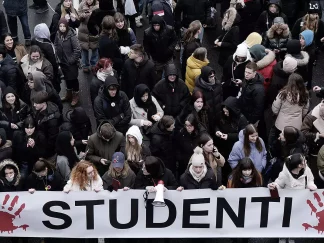
Students of the Faculty of Technical Sciences in Novi Sad demand the calling of extraordinary parliamentary elections. Political analyst Dragoljub Anđelković tells "Vreme" that striving for elections at some point makes sense, but not under the existing conditions, and individual statements only bring discord and benefit Vučić.

The French certainly voted for changes, but what kind? It is clear that the vast majority did not want the right-wing National Rally and no longer support Emmanuel Macron's policies. But what kind of politics do they want? The security and future of the European Union largely depends on who will lead France and in what direction

The Labor Party, led by Kier Starmer, beat the Tories, who had been in power for fourteen years, to their feet. The British voted for change. Prime Minister Rishi Sunak congratulated his rivals on their victory

How an obscure neo-fascist group from the right-wing margins from the beginning of the seventies, in a little more than 50 years of existence, grew into almost the strongest group on the French political scene today and found itself on the very threshold of a historic conquest of power in extraordinary parliamentary elections

Parliamentary elections in Croatia started in the middle of the week. Prime Minister Andrej Plenković and his Croatian Democratic Union (HDZ) and President Zoran Milanović, who, despite criticism, leads the opposition Social Democratic Party are weighing their forces against them. Research shows that Croatia is facing an uncertain election race