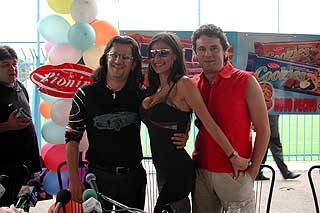
ON TOP: Aca Lukas, Svetlana Ražnatović and Željko Šašić
The media in charge of variety performing works reported that Ceca Ražnatović is her current album A decade, with which he intends to set Maracana on fire on Saturday night, sold 200.000 cassettes and 70.000 CDs in the first month. They did not specify the source. All attempts to verify this information proved to be unsuccessful, and no official data on sales of Ceci's album can be found. Although it is the publisher's obligation to report the circulation of their editions to SOKOJ, the publisher's report on sales Decades did not reach this copyright agency. And if you ask the publishers about the success of their editions, you will get an incredible answer, unimaginable in any regulated country - circulations are a "trade secret"! This bizarre fact is the best indicator of the state of the domestic variety show, which can be characterized as - chaotic. However, if you scratch a little below the surface, it turns out that there is some system in the chaos.
In normal countries, the main source of income for pop stars is circulation, royalties and concerts, which are transparent to both the media and the tax authorities. What about us?
NOT MY CIRCULATION: If circulation is a trade secret, it practically means that there is no realistic indicator of success for anyone involved in the business - be it a label, producer or artist. "For us, circulation as a category is unknown. It exists, but no one knows how realistic it is because the houses are forced to work partially irregularly due to the legal disorder in this area. So there is work in black and white, plus piracy," explains Maksa Ćatović, owner of the Komuna publishing house.
Hiding circulation, which should be an indicator of the popularity of a certain type of author, has the effect of creating a virtual music market. Slađana Milošević says that "one should not pay attention to the false inflated figures of the performers themselves. Circulations are at the level of thousands of copies sold, not tens or hundreds of thousands. No one has a precise insight into that, except for a couple of record company executives. It is important to lie to the people and create a false image of greatness. There were cases of highly advertised artists whose editions were only a few hundred pieces. Watching them on private TV stations, one had the impression that they had conquered the world. No one ever talks about that."
Publishers are required to report circulation to the SOKOJ agency, on the basis of which it allocates 20 percent of the tax for copyright protection. However, hardly any label for a singer reports a circulation of more than 500 copies. Thus, in the first quarter of this year, the publishing house City records reported the largest circulation for the edition under order no. 016 and a total of 203 pieces!
"The most tragic thing is that even those publishers who signed the standard BIEM-IFPI contract with SOKOJ on the right to record musical works do not respect and do not fulfill the obligations from that contract, or do so symbolically," says Ivan Tasić, director of SOKOJ. "You formally register the audio carrier, get a permit from SOKOJ, and then you don't fulfill the obligations from that contract, or if you do, you do it symbolically." That is, you report the sale of 200 pieces out of a circulation of 5000, but in fact it sold 15.000, or the circulation you reported is false. The biggest victim in this story is the state, which could collect about thirty million DM per year from music releases alone, and about fifty million DM from video releases. This is how earnings are distributed through gray channels." These estimates, SOKOJ's director points out, are valid for conditions in which the price of CDs ranges from DM 15 to DM 30 and cassettes DM 10, and at these prices our market could count on they sell half a CD and three cassettes per year per capita. At the recently held SOKOJ assembly regarding this problem, a proposal for a regulation on the circulation of sound and image carriers was presented, which was addressed to the authorities and which foresees the introduction of excise stamps for each audio and image carrier. The adoption of this provision and the proposal to amend the Law on Copyright and Related Rights, which refer to the non-fulfillment of the obligation to provide data on used works and the fight against piracy, as well as their consistent implementation, should solve the problems of circulation and piracy.
ROYALTIES: In addition to the circulation, an important source of income in pop music should also be copyright fees. Namely, in addition to reporting the circulation, publishers are obliged to pay SOKOJ copyright in the amount of eight percent of the wholesale price of the audio carrier, and SOKOJ then distributes that income in the appropriate ratio to the authors of the text, music and arrangements. In addition, this agency has the authority to negotiate on behalf of the author with users of copyrighted works, from radio and television to cafes and discotheques, and to collect certain income from all of them. There are different tariff classes. For example, the monthly copyright fee for radio and television broadcasting is determined according to the representation of the musical repertoire in relation to the total duration of the program and according to the number of potential listeners and viewers and amounts to three to four and a half percent of the user's income. The problem is that, with only a few exceptions, no one paid anything to SOKOJ for ten years, so SOKOJ did not pay the authors either. Ivan Tasić says that the tendency to increase the number of users and increase billing in the last year is constant, but still insufficient. At the same time, RTS contributed the most to the increase in income, which for years, according to Tasić, was an obstacle to the realization of authors' rights, and which today can serve as an example to all other broadcast companies in terms of respecting these rights. As for other broadcasting companies, the main problem is that there is no accurate data on their number. SOKOJ has business relations with about 550 radio and television stations, and only half fulfill their obligations to it. Of the others, collection is also achieved through the court system. Much is expected from the long-announced Law on Broadcasting, which should finally bring order to this area as well.
Average fee from copyright ie. broadcasting and public performance for 2001 was about 4000, and the highest was about 300.000 dinars. Last year, Saša Vasić received DM 900 from SOKOJ, which in his opinion is almost nothing compared to what he should have received. Vlado Georgiev, currently the most popular pop singer in Yugoslavia, says: "I did not receive a single dinar from SOKOJ for any song." No one paid me anything, even though the album was completely registered with SOKOJ. The last time I got something for some songs was five or six years ago that could cover two or three drinks." Slađana Milošević says that it was possible to live on copyright until the 90s. "TV, radio media, cafes, discotheques, pubs, bars, all should report and pay author's and performer's royalties, but they don't. No one forces them to do so, although the Law obliges them to do so. "Reform is needed within the SOKOJ agency itself, which should pay more attention to work in the field, through its agents and direct actions, with the support of executive authorities," she believes.
PIRATES: So, there is no real institutional record market in our country. "And since the market does not exist, a large part is covered by pirates," says Maksa Ćatović. "Since the state is not doing its job, record companies are forced to not report a part of the circulation. Namely, the author says: since SOKOJ is not working, I want money in advance, so he charges DM 2000 for the song and that's where it all starts. The productions then compensate by taking money from weaker performers for recording, publishing... It's a vicious circle that is difficult to get out of, but through market regulation and piracy it would come into its own. When SOKOJ starts charging for the use of author's works from television, radio, discotheques, airplanes, buses, these will be large figures and then the authors will be interested in sharing that cake, and if they want to participate in it, they will have to respect that beginning - from eight percent of the records go to the authors," Ćatović believes.
"Discographers themselves say that 90 percent of domestic productions are pirated within 24 hours of release. These percentages are much lower in developed countries, up to 30 percent, but still very high," explains Slađana Milošević. Every publisher and publishing house complains about piracy and demands strong measures from the state. In return, they promise tax discipline. The slowness of the state in solving this problem is incomprehensible. Milić Vukašinović claims that if he were an American citizen, he would live to this day from the songs written by Hanki Paldum and journalists would not ask him because the song is his. "I prepared an album for Djindjic." When he sings, he will protect the copyright," says Milić Vukašinović, "and then 80 percent of these authors will disappear because they are just stealing Turkish and Egyptian songs."
GDE SU PARE: If there is no money from circulation and royalties on the show, then where is it? Since concerts are the privilege of the few biggest ones, which can be counted on the fingers of one hand, the biggest hunt is on the stands abroad. The entire entertainment industry is subordinated to them, so the only profitable branch of the music industry is still - folk music with its satellites.
Fees at the counters depend of course on the caliber of the star, which is manufactured by publishing houses in cooperation with the media. How?
Publishing houses rent slots on televisions with the greatest possible range, and the best ones are those that have a satellite program, so they can reach people who work temporarily abroad. Thus, Narodnja publishers Grand, Best, Gold have leased time slots on the most powerful Pink television, and JUVE komerc and ZAM on YU info television. In specialized shows, they present their stars, who, with the width of their hips, the depth of their cleavage and the ugliest possible howls of an increasingly sexual, and less often patriotic, character, are recommended to the owners of bars and discotheques around the world. And the songs are made by masters to strike a chord with the guest worker's native sadness.
Whoever asks local "pop artists" how they achieved "fame" will get the answer - "through their own work". Many singers have gone through the "sieve and sieve" from pub tablecloths and wedding tents to stadiums and solo concerts. In pop houses, you can find out that there are approximately four categories of singers who perform under a certain "label". The first includes the "mega" stars (Ceca, Baja, Aca Lukas, Željko Joksimović...) who are paid just for coming to the house, plus the album, plus expenses, plus videos and commercials. Just keeping them under the roof of the house is a matter of prestige and at the same time a bait for those categories of singers who pay for everything themselves. The second category of singers is covered for the costs of recording albums and commercials, but they do not receive a fee for coming to the house. The third category are those who pay all the recording costs and receive a "CD and cassette" as a gift, while the fourth category pays everything themselves.
A more serious "project", as pop stars like to call their work of art, cannot be entered into without DM 20.000, say connoisseurs of events. Namely, that's how much is paid to the record company, which then pays the authors, composers, studios. The average price of a finished song is therefore 2000 DM. On average, text costs DM 500 and music costs DM 1000. The biggest industry of instant hits of all genres and profiles is represented by the author tandem Futa Radulović-Marina Tucaković, who don't even know how many songs and stars they have created, and they sign the biggest hits of megastars Ceca Ražnatović, Željko Samardžić and many others. A doctor of rock and roll, who has been in the world of variety shows for a long time and who successfully earns money from songs for folk songs, Milić Vukašinović is asking DM 3000 for a turnkey song. "A real song must strike a chord with the singer," asserts Milić Vukašinović. "In the old South, songs were looking for singers, and today my father's and mother's daughters come to me." They don't even pay for a good song, but save the money to appear in Granduplata, so it wobbles. There, for DM 20.000, you get an album, an advertisement and stalls abroad. A man sells a cow, pays an album to a publishing house, comes on private TV and talks, and we listen to it. Well, that's freedom of the media today," states Milić Vukašinović.
How is the invested money returned?
STALLS: In the former Yugoslavia, the biggest incomes came precisely from concerts, some in the country, some abroad. Lepa Brena and Slatki greh, Halid Muslimović, Miroslav Ilić, Vesna Zmijanac filled halls and stadiums, and the ticket price ranged from five to seven DM. In the 20s, the ticket price rose to 100 DM, and recently, at Cece's concert in Paris, it reached a record 500 DM. Today, however, only the biggest stars can hold big concerts, and there aren't many of them. There are stalls for the others. Fees at stalls range from 100.000 to 39 DM, with eighty percent of singers singing for less than a thousand marks, and only a few can take a guest worker's five-figure fee, say insiders. The stalls abroad are contracted by managers and publishing houses, who take a certain percentage for it. Some do it this way: "My boss Mile Bass from Juvex advertises the phone numbers of his pets via satellite." In France, the XNUMXth channel is leased, and then the bosses from abroad make offers directly to us", folk star Vesna Vukelic tells Wendy.
According to many folk stars, Switzerland is currently the most profitable market, due to countless discotheques and excellent attendance. Austria is also fertile ground, America is the privilege of the more successful, and Australia is uncertain because of inconvenient bosses, as they say. The once inviolable German market is in crisis. Namely, many singers can no longer enter Germany. Previously, they obtained visas at a cheap rate through a certain manager Jovanovic, which turned out to be forged. When this manager allegedly appeared in a German bank with DM 100.000 in cash, he drew the attention of the police, ended up in prison and ruined many people's jobs. Many people got burned in the search for "crazy" earnings. Dara Bubamar, as she stated in the press, was cheated by the landlady Slavica Momaković (USA) for 15.000 DM, so her boyfriend had to steal the ring from her until she paid back the debt. Dragan Kojić Keba did not steal rings, but a few seasons ago he returned from Australia with no income. Those in the know also mention Romani weddings in Italy as particularly lucrative, where fantastic sums are known to disappear into the singer's cleavage. With performances in clubs, discotheques, folk music halls and concert halls around the world, folk musicians return the money they invested in their stellar career at the beginning and finance a new "project". It is necessary to be constantly present on the satellite. And so on.
PATRIOTISM: Although in Era Ojdanić's office, in his office on the Čukarička slope, it says "Wedding in June 2500 DM" and "Farewell 3000 DM", he, like most of the respondents, still claims that in Yugoslavia "there is no bread for entertainment workers". The only ones remaining are less and less celebrations, farewells, weddings, and as particularly lucrative, the Roma festivities and the so-called Vlach weddings in eastern Serbia.
VESNA VUKELIĆ VENDI: "I hit the performances fixed"
Vesna Vukelic conveys her impressions of a Wallachian wedding to Wendy: "The total tip of the orchestra for three days of non-stop playing was 25.000 DM. My colleague and I guessed right. My fee was 2000 DM." Wendy explains that there are different ways to bargain with the boss, illustrating it with an example: "The boss pays nothing to the music, but guarantees a tip of 30.000 DM. In case the music takes 20.000, the boss pays an additional 10.000. It's called a guarantee. Noting that the main stars in Eastern Serbia are local singers who sing on the so-called in the Wallachian language, Wendy says that the most sought-after celebrity from pop is Živkica Miletić. The unmistakable choice for Roma weddings, everyone says, is Šaban Šaulić, who is the only one who can ask for more than DM 20.000. The queen of Roma festivities is, according to Wendy, Verica Šerifović, and according to others, Zlata Petrović.
Taught by the folk song "today you are a flower and tomorrow a faded rose", the singers invest all their hard-earned money in safe businesses - real estate (each of them has a substantial square footage), but also in a small economy. Favorites are boutiques (Željko Šašić, Aca Lukas), motels (Era Ojdanić, Lela Andrić), cafes (Neda Ukraden), flower shops (Radiša Urošević), furniture salons (Gala), hairdressing/cosmetic salons (Nada Obrić), i.e. beauty salons (Nada Topčagić). Era Ojdanić opened a chicken farm, Lepa Brena, among other things, with her husband Bobo Živojinović, owns a Ford dealership for Yugoslavia, and Ceca Ražnatović owns the Obilić football club and stadium, the Delije housing cooperative, and some other things. The feeling for business, but also the search for an appropriate status symbol, led the folk singer Vera Matović to painting, so her collection of works of art includes canvases by Sava Šumanović, Nadežda Petrović, Milan Konjović, while her colleague Branka Sovrlić prefers stylish furniture. Lately, the shadow of Božidar Đelić has loomed over the well-being of music artists, but at the very mention of taxes, the stars start rolling their eyes and whine about the terrible crisis in society that they share in everything with their suffering people.
Non-revenues are there and it is not difficult to cut a tax on them, but the value system that has been extended for decades by this kind of entertainment, thanks to which it has gained wealth, is another, much harder, sadder and, unfortunately, still current story.
GDE SAINT: "In our country pop music is identified with turbo-folk and the nationalist-war profiteering negative avant-garde, dominant during the nineties," says Ivan Kronja, author of the book, in an interview with "Vreme" Deadly shine mass psychology i aesthetics turbo folk. This, as she calls it, "negative vanguard", after the political changes in 2000, it was established, strengthened, uniformed and gained in quality, so that turbo-folk culture today is very difficult to define and clearly perceive. "Turbo-folk has grown into a way of making money, which means that the patterns of the old ideology still exist, in parallel with the attempts to create new ones," Cronja is categorical and notes that, just like in the past period, the state of pop music is a reflection of the state of society.
The problem of pop music in today's Serbia is much deeper and more layered than the simple identification of that term with the culture of "turbo-folk", which many people wash their hands of today. In the 1990s, the entertainment sky was covered primarily by private televisions (Pink, Palma), from which citizens were showered with a certain type of entertainment that required identification with such and such a way of life, all under the slogan "everything you need will come from heaven" and under the famous with the populist cry that "the people love it". The recent appearance of ZAM and JUVE commercials on the budget YU info television, theater performances, television series, circulating in Serbia (and beyond) warn that in the 90's pop music is camouflaged and dressed in a new mondialist-global outfit, but with unchanged content. Ivana Kronja believes that today a hybrid of Western mass media and newly composed Serbian urbanity has been created, which under the slogan of "entertainment" offers young people the same patterns under which they suffered until recently. Avant-garde art is atomized and denounced in Serbia today. All new trends, from music to theater, are measured by the rich elite who, by allegedly modernizing their taste, want to show that they have absolutely nothing to do with the war years and a war in which Serbia did not participate. For this purpose, the generic notion of urban-folk and even cyber-folk was created!
Milić Vukašinović is loathe to use the word "variety" because he believes that the situation there is a consequence of the quasi-democracy that took over the area of the former SFRY after its disintegration. "Bruce Springsteen was a folk singer until the age of 30, and today he is one of the gods of rock and roll." A good singer is always a good singer, and there is kitsch and scum in every art," says Mića Vukašinović and adds: "In the previous South, we just set some criteria of Western show business when everything fell apart. Today, our taste is shaped by war profiteers, the newly rich and the quasi-bourgeoisie. Only the great-grandchildren of these new Corleones will be able to feel what real show business and a good song are."
In order to enter the magical world of pop music, you need the will and - money. But sometimes even that is not enough, especially for those with artistic ambitions in the so-called fun music where the pond is smaller and the crocodiles are more.
The following story is illustrative. Nađa Golubović, an eighteen-year-old girl from Belgrade, wanted to perform at the festival in Budva last year. With the support of her parents, she turned to a well-known entertainer with a request to compose a song for her and arrange for Nadja to appear at the festival. After he was convinced that young Nadja was talented, he offered a price list. Music and text 1500 DM, arrangement 1800 DM. The price includes a pass to the festival. After some time, the song was recorded, Nadja sang it, and in order to prepare for the performance, she finished school a month earlier. A few days before the festival, she and her father bought plane tickets, and the day before the festival, the author of the song called her and said that some problems had arisen, that he was very sorry, but that Nadja could not perform at the festival. Of course, there was no sign of the money.
"You can be lucky enough to come across the right people at the right time in the right place, but that's rare." Much more often, people at the beginning run into birds of prey that take a lot of money from them and then do nothing for them. You can get in through giant publishers, but, given that pop music is completely corrupt, whatever you do - an album, a music video or a song - you have to be taxed by people who shouldn't be doing it at all," says Vlado Georgiev . Sometimes, however, it happens that someone gets to pop music in a completely regular way, as in the case of pop singer Saša Vasić. "I made a composition, recorded it in the studio and sent it to the Commune, which was then the organizer of the festival in Budva. A call from the publishing house followed, they offered me to record an album and that's how it all started. I didn't have to pay anything, and I'm even one of the few musicians who was paid by a publishing house to record an album, but it should be said that I'm not a very typical example of how to get into pop music," says Saša Vasić.
When it comes to entertainment, festivals play an important role in creating stars. There is as much rigging and corruption as you like. "Until two years ago, we did the Budva festival and it was the only festival where there was no set-up," says Maksa Ćatović. "At that time, I received various offers to arrange the victory of this or that performer, but I refused them because I wanted everyone to have equal conditions." Everything depends solely on who is doing the festival. Let's say, the popularity Oscar, which is organized by Melos Estrada. They award a couple of real Oscars, and whoever pays for the rest. It is known that the Oscar of popularity costs DM 1000." Vlado Georgiev, who for years composed compositions for the festival in Herceg Novi, looks at the festivals like this: "It happened that there were 15-16 of my songs in two evenings. When I saw that my songs remained the hits of the Herzegovinian festival, while new people were not paying attention to them, I realized that someone was taking advantage of me. Everything is mostly set up with various shenanigans. They put the author of the song on the jury, who then gives his song the maximum number of points. It's all in some clans. It's time to create a festival where professional and honest people will be brought and where young people will finally have the opportunity to be seen by someone without being kicked out of their shoes."
Drugs were once part of the iconography of rock and roll. Today, however, rock 'n' rollers are straight, unlike folk. Among the first names that were mentioned as users of hard drugs was the name of Ace Lucas, who once declared: "If cocaine is a drug, then I am a drug addict, said the football player Canidja, and I agree with him." Today, Ace Lucas , by his own admission, talks cleanly and openly about his problems with "getting off" drugs. The death of folk-pop singer Rođa Raičević due to excessive use of narcotics in October 2001 opened up the story of drugs in folk music, which turned out to be more than what was thought. Folk singer Vesna Rivas stated that there are famous singers who start using cocaine to lose weight a month before the release of their album. Vesna Vukelic Wendy spoke about a "famous young singer" who "succeeded because he constantly buys cocaine from mobsters who run rafts and discos both here and at sea, so he sings there, and they push him on television." Uzile is the singer of the JUVE commercial and an example of a respected colleague who started snorting cocaine in his old days, "shocked that he no longer earns 100.000 DM a month, but only 30.000-40.000, so he can no longer buy a new jeep or 'bear' every month." . Vesna Rivas warned through the press that drugs are most often consumed at parties and promotions. "Drug dealers are there, always, at every major promotion." They 'smell' who is currently on the rise and 'stick' to him. They set up the most beautiful girl for him, and then they invite him to feast on cocaine. They are aware that they can squeeze a lot of money out of him."
Contractor Publisher Printed circulation Sold casette Sold CD
Zorica Brunclik; PGP RTS 2000; - ; 17; 907 4
Lepa Lukić; PGP RTS 2001; – ;1 317; 479
Snezana Đurišić; PGP RTS 2001; 1; 000; 485
LUNA; City Records 2001; 20; 000 2; 752
Željko Joksimović; City Records2001; 10; 000 9; 339
Zeljko Samardzic; City Records2001; 10; 000 5; 143
Leontina; City Records 2001; 10; 000 1; 223
Dragana Mirković; Hi Fi Center 2000, three editions; -; 250,292,411; 418, 456, 339
Mile Kitić; Hi Fi Center 2001, two editions; -; 155,106; 147,155
Šaban Šaulić; Hi Fi Center 2001, three editions; – ;118,130,157; 341,294,145
Source: FALCON