From the European Union, Russia and Turkey, through Indonesia, Saudi Arabia to Brazil, a large number of countries are trying to build multipolarity, but for now it is only a dream because the world is bipolar and the rules of the game are dictated by America and China
Many politicians, diplomats, business leaders or analysts of international relations advocate the thesis that the order created after the Second World War has disappeared and that the unipolar era of absolute American hegemony has ended after the end of the Cold War, and the time of multipolarity has come. They say unipolar and bipolar power is fading and the world is multipolar. Domination America is decreasing. China is growing. India is developing. Russia is still a great military power. Countries like Brazil, Indonesia, Turkey or Saudi Arabia are looking for their place under the sun.
This is how a popular myth was created, but we are far from multipolarity. In order for such a system to exist, a minimum of three or more major players on the international scene are necessary. Today there are only two, and when the list ends with the number two, then there is no multipolarity.
The USA has maintained an unassailable position, and China, as the main competitor, has ousted Russia as a key actor from the time of the American-Soviet rivalry.
The combined GDP of America and China is almost equal to the sum of the rest of the world (excluding Germany, Japan and India) or the 33 next largest economies. The two countries control 43 percent of global GDP. Their military budgets equal half of the world's defense spending.
China's wealth concentration is a unique boom. A quarter of a century ago, according to research, the Americans participated in world development with 38,9 percent, the EU with 23,6, Japan with 14,3, and China with a modest 4,8 percent. Everything has changed: China leads today with 29,6 percent. America fell to 29, the EU to 17,6, and Japan to just 6,7 percent.
At the same time, America is further and further away from Europe and Japan, while China is not only catching up with America but is further and further away from everyone else. The concentration of Western power revolves around the USA, and Asian power around China.
The system in which the USA and China separate from the countries below them has been renewed. The gap between America and China has narrowed, and the gap between them and the rest has widened. Bipolarization in action prevents multipolarity in practice, regardless of Beijing's political rhetoric. The end of unipolarity created by America's victory in the Cold War did not automatically mark the emergence of multipolarity. The first process destroyed unipolarity, the second prevented the emergence of multipolarity.
The European Union can claim to be strong - which is somewhat true - but it is far from being a competitor of the USA and China: it does not have the economic, industrial, technological, financial or trade power, and especially not the military and nuclear power that the two modern superpowers have. It is torn by the different national interests of its members.
According to Donald Trump's vision, the world is there to be ruled, and he is the one who wants to be the sole ruler because everyone "envies" the American economy and fears "the most powerful force in the world".
SPEAK, PRINCIPLES AND REALITY
We live in a "new era of barbaric acts", retorted French President Emmanuel Macron, who constantly emphasizes the importance of Europe becoming the third superpower, but it seems more like a consolation that on the global level they are not what they would like to be. In vain, the former EU foreign minister claimed that "complex multipolarity" has been a reality since the 2008 financial crisis.
At the UN General Assembly, in his farewell address to the leaders of the "middle powers", Macron offered a moral message on how to oppose Trump: the defense of international law, multilateralism and an order based on rules.
"Do we want to live according to the laws of the jungle or live in a civilized international society", Macron concluded.
Aleksandar Vučić also spoke in a similar tone: "The biggest problems today are not the lack of rules and principles, but their disrespect in the past and present."
A bunch of nice phrases about the principles of international law that no one disputes, but the reality shows that these rights are brutally violated in various parts of the world.
Regime media praised Vučić's courage and daring as a statesman. If so, why didn't he, like a large number of delegates, leave the hall while the Israeli prime minister, who was wanted by the international court for war crimes and crimes against humanity in Gaza, was speaking?
Japan is the world's fourth largest economy and, like South Korea, has strong industrial and technological capacities, but they are so far behind the two leading powers that they have no ambitions to run for the overthrow of the bipolar world. Russia would be a potential candidate for the third pole, given its vastness, natural resources and, of course, a nuclear arsenal close to America's. But Russia is not a superpower in many other ways. Its economy, the ninth in the world, is smaller than Italy's. The fact that the Kremlin talks about a multipolar world is a way to insert itself into that world. At best, it can function as a support for China.
Neither is the Global South a candidate, although its members are becoming increasingly important. It tells us that the old order of power has changed, but not who has replaced it. Industrial capacities have largely moved from the west to the east - disproportionately to China.
BRICS members refer to their large populations, but population size does not make the world multipolar. India is the most populous country in the world, the fastest growing economy and sixth among the global top 10, but it is eight times weaker than the US and five times weaker than China. Its military budget is only a quarter of China's, let alone the American one. India may one day enter the multi-formula and join America and China, but that belongs to the distant future.
BRICS is so heterogeneous that it does not represent a global power, it can even easily disintegrate. Its leading members, China and India, are rivals.
The claim that more and more strategic autonomy and independence creates more poles is also problematic. That thesis is marketed as proof of multipolarity, but it proves nothing. Are national interests more easily realized in a bipolar or multipolar system?
I WOULD LIKE TO ASK MYSELF TOO
photo: ap...
India may not align, Turkey may maneuver between the great powers, Saudi Arabia may expand partnerships, or Brazil may seek greater independence. And what? Is independence, as a result of bipolar rivalry, proof of multipolarity? Why was there no talk of a multipolar world at the time of the Non-Aligned Movement?
If this is a realistic picture of the world, why is the argument of multipolarity so popular, even though that system with many actors is less stable than unipolar or bipolar?
Much of it is wishful thinking, in the hope that the dominance of the engine is disappearing and that power should be dispersed. For the Europeans, pressured both from the East and America, multilateralism is a welcome alternative to bipolarity, a better way to renew multilateralism, an opportunity to silence global discontent.
Others fear the polarization of the US and China and the emergence of a new Cold War. Isn't that a confirmation of a bipolar world? As far as Beijing and Moscow are concerned, they see multipolarity as a tool to limit America and increase their own power. Back in 1997, the two countries signed the Joint Declaration on a Multipolar World and the Establishment of a New International Order, with the aim of attracting the Global South.
A multipolar world might be less polarized than a world with two competing rivals, but that would not necessarily lead to a better world. Nor would it lessen the rivalry of the great independent nations that would make it up.
From the point of view of multipolarity, how effective are institutions such as the UN Security Council, the International Monetary Fund, the World Trade Organization or the new BRICS Bank for Development, created in the era of hegemony?
What kind of multilateralism can we talk about when Trump from the UN podium threatens to destroy one member - Iran - and calls on countries to leave the membership of the International Criminal Court, which he called "a group of evil people"?
The Middle Powers are being reorganized. Rising players have every reason to promote a multipolar world. The trend is most noticeable in former US allies, from Britain and Canada, to members of the EU, G7 or NATO, but it is also visible in organizations without the presence of the US - from BRICS to the Shanghai Cooperation Organization. Isn't the Mecca Pact, signed by Pakistan, Turkey and Saudi Arabia, a signal of power in reshaping the Middle East and its global energy importance?
The fact that there is no multipolar world and that it is a pure myth to claim that it exists does not mean that it will not exist - provided that the surge of authoritarianism that has destroyed the order based on some rules is at least partially restrained. The transatlantic order will not return, it will be replaced by a new one, less predictable and more fragmented. Old centrifugal forces are resurfacing, including Europe's aversion to Chinese protectionism and American dominance.
But, as things stand now, all the stories about the multipolar world are reduced to lulling those who think they are asking something, if they find themselves in the way of the interests of the two only powers of the bipolar world. Big speeches rarely lead to substantive change. America and China, two predatory hegemons, continue to grind out allies and even more rivals.
Election time! And someone has to report to you independently. That's why it's in October annual subscription the digital edition of "Vremena" even 2.500 dinars cheaper. Choose now!
What is happening in the country and the world, what is in the newspapers and how to pass the time?
Every Wednesday at noon In between arrives by email. It's a pretty solid newsletter, so sign up!
Six people were killed in the center of Krakow, and three more bodies were found in the house of the suspect. The authorities suspect right-wing motives, while the circumstances of the householder's death have not yet been clarified
Gadi Eisenkot gets his first chance to form an Israeli government. It has the recommendations of 67 deputies, but the path to the majority leads through Arab or ultra-Orthodox parties...
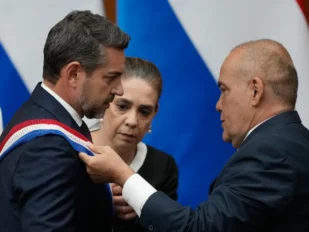
Pedro Aliana took over as president of Paraguay. His predecessor, Santiago Peña, was ordered under house arrest, while the prosecution determines his possible responsibility in the case of the failed digital bank "Ueno".
Hackers are changing the temperature in the cooling systems of European supermarkets, and retailers are throwing away food worth millions of euros. Control panels are often available over the Internet and are insufficiently protected
The four independent members of REM are an example of perseverance and civic responsibility. Rodoljub Šabić even, upon leaving the premises of REM, after the sentencing of the Informer, experienced that the Essenes insulted him, hit him with their hands and feet. But that too will soon be over
Vučić pardoned the batterers and Dijana Hrkalović. The election winners should abolish the sultan's power that allows one man to run afoul of the entire judicial system
Davor Matura's ALTA empire is the transplanted heart of the corrupt regime of Aleksandar Vučić, who was defeated in the October 25 elections. From ALTA Bank, roads lead directly to the top of the progressive government.
The archive of the weekly Vreme includes all our digital editions, since the very beginning of our work. All issues can be downloaded in PDF format, by purchasing the digital edition, or you can read all available texts from the selected issue.