Rudna Glava is a scattered village on the slopes of the Homolje mountains, near Majdanpek, with a few cafes and one restaurant, nothing like the villages that you imagine when you think of Wallachian magic: isolated, far from the roads, in the mountains, villages where only Vlach is spoken, and Vlachs still live with their beliefs - in which you can feel something in the air as soon as you enter them.
In Rudna glava there is even a non-governmental organization that deals with the preservation of Vlach tradition. It is run by women who travel to folklore events. They gather to socialize a bit, but also because they hold on to their heritage. They knit, sing Vlach folk songs and travel. "Recently, entire villages no longer speak Vlach, customs are disappearing, children no longer know anything about their origins," says one of them.
In a dilapidated house next to the Vedra bus station, a lively woman was showing artifacts of the Wallachian tradition, a cherry tree, a plum tree, patient, salty nuggets filled with cheese - the only delicacy that once could be afforded by herders in Eastern Serbia. Grain is a powerful talisman for the Vlachs, it is a way to properly welcome a guest and ensure their well-being and health.
In Rudna glava, waiting for a turn at the witch doctor. The clientele came from Belgrade, Negotin, but also from abroad. A bench under a walnut tree in the yard serves as a "waiting room". A visibly upset woman tells how the villages around Negotin are deserted and that everyone has someone abroad. He claims that there is a "developed crime" of breaking into guest workers' houses. They ransacked their houses twice while they were not there.
She turned out to be a good connoisseur of witch doctors in the whole region, she recommended several. It is difficult to reach them after the crime in Jabukovac in 2007, when the killer of nine people accused Vlach "black magic" for his crime.
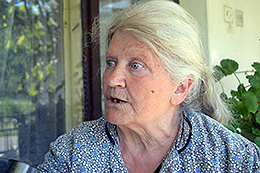
Among her tarot cards and icons, the Sorceress of Rudna Glava looked like many other older Vlains: hunched over, in an age that is difficult to judge due to a hard life, but wiry and lively, with a colorful skirt and shirt, wrapped in a colorful scarf. She was surrounded by her neighbors and they chatted carelessly about the fate of the woman whose great misfortune had caused a line to form in the "waiting room".
The recommendation from the yard led further.
FANTASY, NOT DIVINATION: At Marica's in the village of Laznica, the average wait was six hours. There was no appointment, but she politely told everyone over the phone to come freely.
Marica looks at the water. A nervous, petite woman armed with rosaries and crosses was also waiting her turn. She didn't say what her affliction was, but she was fascinated by this witch doctor. She told how Marica used to come to Belgrade once a week and that people waited for her for hours. She comes to her for the third time. The props required for witchcraft are three T-shirts, a liter of water from the household tap, a liter of drinking water and a jar of honey. A woman came out of Mariča's house, thanked her for a long time and humbly muttered: "How lucky he is."
The big house in the neighboring yard is also Maričina's. Although she earned money from her work, Marica received clients in an unsightly house with peeling plaster and an overgrown garden. She was a professional and knew what kind of environment was more suitable for witchcraft. She received in a small room that looked like a pantry.
Although it was a very warm day, the stove was on, and Marica was wearing a wool vest. She kept silent about the fact that the guests did not have the necessary "equipment" for witchcraft. She was putting stones of incense into a jar of water and muttering something in Vlach, seemingly phlegmatic. She made only a few cautious statements, laconically making mistakes, and the guests later realized that they actually said everything themselves, and she only made a few vague assumptions about their lives, fixing the customers with blue, watery, "evil" eyes. Something was suspicious to her.
In the middle of the session, she answered the phone. She spoke with an acquaintance whose child was sick. The man was upset and shouted, begging her to come to them, saying that he would pay for her trip. Marica said in a kind voice that she could not come, but that she would immediately recommend what they should do: first they should go to the confluence of three streams and then...
Marica is not a prophetess in the classic sense of the word, but when she diagnoses a problem - or when someone comes with a problem - she would speak. She instructed the guests to bring the necessary props next time. When sending them off, she did not want to charge. "Well, I didn't do anything to you." But when you come next time," she said, with obvious doubt that there would be a next time.
CHARMED IN ARABIC: In the village of Ranovac near Petrovac, Jeva lives on top of a hill. A beautiful, spacious yard full of planters with flowers; a small cemetery with a rose garden. He lives in the house with a Romanian woman, which is not unusual because many Romanian women work and get married in Eastern Serbia.
Jeva receives in a spacious room with many rugs, a small altar with icons and walls studded with black and white family photos. She shouted and cursed like many Vlains, and was especially harsh towards women. In the room, the television was blaring loudly, with which she was constantly shouting, and since she had poor hearing, everyone shouted in unison. She kicked the dog that was hanging around the legs of the visitors.
She seated the guest on a small tripod and instructed him to hold a small Bible with a white cover and a large red cross in the middle on his hook with his index finger, along with her. If the "book" turned to the left after the question was asked, the answer would be "no", the right would be "yes". She addressed the Virgin Mary in Vlach and crossed herself over her icon. "Mother of God, I pray to you and your spirits, to tell us about..."
"Is he healthy by God?" Yes. Does he have a curse from his father? No. Does it have an abandoned cemetery? No. Are there relatives who are without money? No," she routinely said.
"Is there a spell on him?" Yes. Since when is there a spell on him? One year. Two years. Three.” The book turned until it stopped at a certain number. "What language are the spells cast in?" In Wallachian, in Romanian, in Gypsy - in Arabic and in Odza. How many women know about those spells? One, two, three. Are they two sisters? No. Two female friends? Yes. And the daughter of one? Yes."
After a dramatic pause, she asked, "Mother of God, I pray to you and your spirits, is he bound?" Yes. And how bound is he? Once. Twice. Three times. Four times. (…) Nine times. Mother of God, I pray to you and your spirits, when was the last time the priest prayed? One young week, two, three, four. In the fifth week of his life, he had the last time."
Having diagnosed the problem, she moved on to the solution. "Is he in danger from a tractor, from an engine, from a chainsaw?" No. Did they put something in his beer, juice, water, or red wine? Yes. Did they give him a brain from a mad dog, from a magpie, from a sheep that doesn't stick to the pack? Yes. Did they tie him up for death? No. Did they tie him down so he doesn't have any relationship with the woman? Yes,” she finished proudly.
Of course, she will be able to free him by incantation, but only if she comes one more time, with the necessary magical equipment: "To bring one kilo of running water from the fountain so that it is good for drinking; one stick of willow; one white thread unmeasured as long as you spread your hands; one kilo of water where two streams meet; a little money and three t-shirts, the t-shirts should be white", she dictated and added after a short thought: "Water under the mill to be poured into nine bottles, woolen cloth as thick or white as your length, and nine knots with the string with which the vineyard or tomato was tied ."
At the end of the session, Jeva's sadness was magically melted away by a thousand dinar bill.
CONVERSATION WITH THE DEAD: The widely famous Mila is one of the last women to fall into a trance - once a year, on All Souls Day. Then he serves as a mediator for anyone who comes to speak with the dead and foretell the future.
Her house is also in the hill, in the village of Crnajka, tucked away in the greenery. A line of cars, waiting and crying people who are oppressed by some heavy pain. There were two tours - first to talk with the living, all present in order, and then with the dead, with a candle. Both times money was left.
There were about thirty people in front of the house. One woman whispered, as if she was afraid of breaking the occult atmosphere, that she was coming a second time. She spoke as she approached Milla, with the fascination common to a witch doctor's regular customers. The curious gathered around the second woman. After leaving Mila, she told her story through sobs. Her son was killed in the forest and his death was declared a suicide. She knew her son, she knew he would never kill himself; he confirmed it to her through the witch doctor.
The scene in the room was reminiscent of village funerals. Mila was lying on a bed strewn with people's gifts and money. With real witch doctors, everyone gives as much as they have or as much as they want. Neighbors who were escorting people were sitting around her; and despite the desire to look solemn and serious, they would sometimes sneak a smile.
Mila turned eighty years old. Completely in black, she had a half-smiling, blissful expression, and her swollen lips were lined with white foam. In a neutral voice, she said great and difficult things, as if she were only a mediator of something coming from outside herself. As soon as she said what she considered final, she would wave her hand to step aside.
They say that women who fall into a trance, when they come back from that state, would be physically completely disabled. Mila started baptizing herself and muttering something in Wallachian. She recovered easily, still smiling.
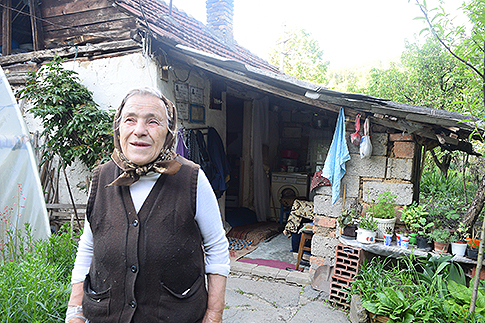
CULT OF THE DEAD: Ljubica buried her granddaughter. She is over seventy, but looks much older. Her husband acts as her shadow. She was ashamed that we found the house in disarray. Obvious poverty eroded everything. He lives in a neglected yard with a withered garden. A "Beware of the dog" sign at the gate and a bunch of cats. Dilapidated one-story brick house, all surrounded by lush greenery. Grass and wild flowers sprout from concrete and walls.

photo: Andrej IvanjiLJUBICA: The woman who "let" her grandson's funeral
Ljubica is a real storyteller. When she started talking, the old beauty was visible on the sleeping old face. She could easily have been a country beauty. Greenish-purple eyes helped the most in storytelling.
She immediately said that she doesn't believe in the old fairy tales and that there are no more real Vlains. She had eight children and nineteen grandchildren. Jovan's granddaughter was killed there, in front of the house. Some guy ran her over with a car. He was never meant to be. She was only four years old.
She was "letting" her grandson's funeral. She described how she had prepared new white children's clothes, which she intended for her to wear in the next world. She prepared her granddaughter's favorite pie with cherries, also intended "so that she will not be hungry in the next world." She filled the table in the yard, where everything he might need in the other world is placed, with toys. She made ceremonial cakes, "covenants", a set of breads that imitate the position of the human body in a coffin on the table.
"Downstairs, we released water on the stream," she explained, pointing to the valley below the house. They made forty knots on the woolen thread, so two women stretched it across the stream, and one girl caught water and poured it over the rope, fifty times, "so that she would not be thirsty in the next world." In the end, each woman pulled from her side and the knots were untied, "so that her soul could be untied from this world."
Since she died without a candle next to the headboard, which according to Vlach means that she died "in the dark", Ljubica, together with specially dressed women, made a heavenly candle for Jovan, the night before the funeral. She put the candle on the "head", a special ritual bread that leads the funeral procession, to show John the way to heaven.
At the funeral, in the chapel, Ljubica saw a wasp. She flew around the candle. It was immediately unusual for her. Then that wasp flew into their car. A year later at a memorial service, given in memory of her deceased granddaughter, she saw the same wasp. "It flew around my son-in-law's ear, but it didn't sting him," said Ljubica significantly. At each subsequent funeral, she saw a butterfly swirling around her granddaughter's crib.
Non-baptized children, children who died before being baptized, cannot be intoxicated by the priest. Their souls reside in a waterless and desolate part of a "meadow in some distant forest", as the Vlachs imagine the afterlife. Ljubica didn't know that, but she sensed it.
The butterfly did not give her peace. Something told her that customs had not calmed her granddaughter's soul, she had the impression that Jovana was telling her something. She dreamed of her one night and after that she went to Tanja in Negotin, who looked after the dead.
Through her, Jovana spoke to her: "Grandma, I was a butterfly, and I was a wasp, and I have everything from you, grandma, I have water, fire, and toys." And tell mom not to wear black anymore, and not to cry at my grave, but to take the video of my birthday off the shelf and watch it again, and smile again," Ljubica recalled her granddaughter's words. She added, while her eyes widened in disbelief: "How could Tanya know that, both for a butterfly and a wasp..."
She couldn't explain why she did what she did for her granddaughter: "That's the way it goes, that's how it's passed down from generation to generation." Ljubica said all this calmly, calmly. Vlachs live with their dead.
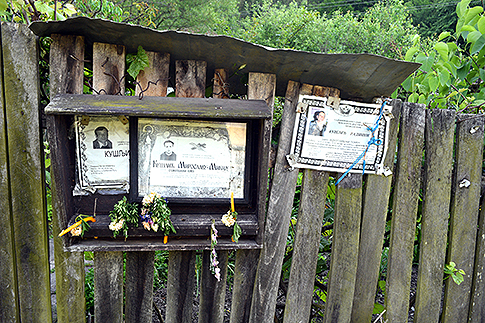
photo: Andrej IvanjiTHE LAST RITE OF THE BLACK WEDDING: Milica Kušljić and her grief
HE WILL COME BACK DEAD: Vlach is spoken in Donji Lug, a hamlet on the way to Majdanpek. Behind the flimsy wooden gate that dragged the death certificates and all the pain on them, hid the miniature house of Milica Kušljić, the woman who was the last to perform the black wedding ceremony.
In a house full of carpets, blankets, many family pictures and memories, one could smell the smell of old people. The stove was pawned. Milica is the embodiment of her house. Small, all huddled together in sadness. On a warm day, she wore a wool vest and trousers. Rumor has it that she is drunk, that she does not receive anyone. Everyone died for her, she was left alone. Nevertheless, the guests were welcomed by a kind, dear old woman who smiled through her tears.
Tears silently followed her story. She stood and spoke the whole time, it was obvious that she had told this story to many people, but that every time she suffered as if it were the first time. Her son was twenty-four years old, engaged, studying. "He was beautiful, tall and strong, everyone loved him." She worked hard to provide everything for him. He was in the army when he was urgently brought to the Clinical Center in Belgrade, he began to suffer. She was desperate. "I did everything I knew how to do." I took him to all the doctors and to all the billiards players. In the end, they sent him to Belgrade," said Milica. She borrowed money so she could follow him, she brought him everything he liked to eat. The day she visited him, he seemed better. She wanted to stay with him, but she had nowhere to go. He died the next day, from galloping leukemia.
When she was bringing him from Belgrade, she attached a red thread to the tractor, so that his soul would not get lost on the way back home. She showered him with gifts, washed him and sang. "He was still as beautiful as a doll," she kept repeating. She watered him at the stream, at dawn before the funeral. His funeral in 2004 was the last recorded black wedding.
So that he would not be alone in the next world, his fiancee in life became his bride in death. "She was a good girl, she apologized to me when she got married later," said Milica. At black weddings, along with singing and wailing, wedding customs were also performed. "We all played a circuit around the coffin for his soul," Milica recalls.
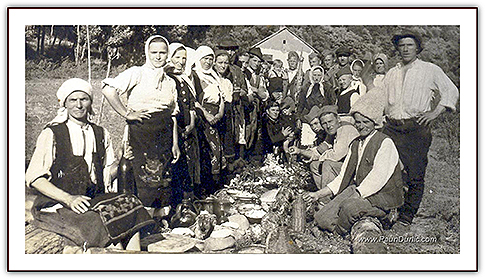
photo: from the archive of peacock es durlićVLAČKA POMANA: Commemoration of ancestors
For the next seven years, there were commemorations, starting from the day of the burial, then through the first Sabbath, forty days and half a year, until the annual commemorations. She also organized a "round for the dead": on Shrove Monday, the whole village came to dance in a round that doesn't stop, around the fire - "privega". The big bonfire should provide light and warmth to the deceased in the other world, the "dark vilayet", the cold, desolate and dark part of that meadow. In that circle, the deceased also comes to live with his relatives again. "He was there, he was there, I knew...", repeated Milica.
She dug him up nine months after his death, so that the sun, as a transmitter of immortality, would return him to the living. "I dug it up at noon." He was still whole. He was still like a doll. The sun can transport it from the other world. The sun can revive him," said Milica with irrepressible faith. "If I had done everything right, he would have come back to life." I must have missed something in those customs. Otherwise he would be with me today."
The Vlachs spend their whole century living with their ancestors and the deceased and taking care of them. However, in addition to the expected concern for the soul of the deceased, they also take into account the physical purity of the deceased, because their understanding of death is animatistic. According to their belief, a person remains whole even after death. Hence the custom of digging up the dead at dawn, when the sun rises, so that the light of day that they miss in the next world will shine on them again. Death is just a transition to the "other" world, which is close to this world and resembles its negative counterpart, the "dark realm". There is always hunger, cold, darkness and desolation. That is why the Vlachs devised a complex of "pomana" ("remembering the ancestors"), with which they provide their dead with everything they need in the "other" world. Thus the deceased passes from the desolate and dark side of the meadow to the green side of abundance.
Memorials are organized seven years after the death of the deceased, and in the first year there are as many as 365 small days. That morning, one goes to the cemetery and with gentle words, the scent of flowers and incense, the deceased "wakes up". The grave is poured with water to wash and refresh the deceased, and then he is led to the table by candlelight. A rich feast consists of the dishes that the deceased loved the most, and large ritual breads have a privileged place. The most common are "vows" with the swastika symbol, decorated with nuts, fruits, sweets, into which large candles are stuck. For the Vlachs, grain is the most powerful talisman, and all customs related to sacrifice or the afterlife have cult bread as an integral element.
Next to the table are things intended for the deceased. They must be new, and everything he may need in the next world is given as a gift. It is not unusual to buy a new house to dedicate it to the deceased, and then give it to a relative. A new suit tailored for the deceased is also bought. Someone present puts on this suit and, in a kind of performance, becomes the deceased. The oldest women wail and, addressing him, sing of his good qualities. They also sing "petrekature" songs, in which they give the deceased with much longing and nostalgia instructions on how to return to the other world.
For special anniversaries, ritual fires are lit for all those who died "in the dark" - anchors. Big moorings are organized on the Feast of the Spirits. In the center of the village, bonfires are lit for all the dead who died "without light". With inevitable distractions, the round is played until the morning.
The Vlachs also care about the social life of their dead in the afterlife. "Circle for the dead" is usually made on Shrove Monday. The round is performed in the center of the village and no one can "interrupt" it. The player carries a picture of the deceased decorated with gifts, flowers and fruits to the ringleader. The picture is the deceased's substitution, because it is considered that in this way he also joins the game. Drinking is done in the circle, the players hold lit candles in their hands, and the hosts serve them to the deacons. According to belief, the deceased is introduced to the local society with a carousel and music.
And the "black wedding" stems from the fear that the unmarried deceased has no one to live with in the afterlife. When an unmarried young man dies, the wedding is organized at the funeral itself. One girl from the village, innocent, "plays" the bride, and the mother has to play the wedding round around her son's coffin.
Rejoicing, music and dance are part of Wallachian posthumous customs. These are traces of pagan posthumous ceremonies, which included dancing and dancing. Vlachs often organize commemorations even during their lifetime, when they sense death, in order to enjoy the celebration in their own name.
According to the interpretation of those who believe in the Celtic origin of the Vlachs, witch doctors are village druids. Priests in Wallachian villages are not very important and always argue with witch doctors who want to perform rituals in their own way. They both heal and curse. Vibrant and mostly cheerful women, bright and talkative, carry something erotic in them that cannot be described in today's vocabulary.
These women have the main say in the house, they pass ritual actions on to each other, from generation to generation. Because of their magic, a silent matriarchy reigns. There are also men who practice witchcraft, but they also learned it from their grandmothers.
The Vlachs were originally herders. They lived at the ends of the southern branch of the Carpathian Mountains, between four large rivers: Velika Morava in the west, Timok in the east, Danube in the north and Crni Timok in the south, on the slopes of Miroč, Deli Jovan, Homolje, Beljanica and Kučaj. Their pride stemmed from centuries of independence, which they clung to even when it meant poverty. They lived their modest lives in those groves, and since this poor part of heaven did not catch anyone's eye, they were left alone. Even today, that area is considered the poorest part of Serbia.
Driving through peaceful villages, you can see small houses by the side of the road, almost log cabins, next to which three-story houses of guest workers flaunt. Both houses are mostly empty, entire villages are abandoned. It is common for half of the family to go abroad even from the most rural areas.
Although they have the status of a national minority, the majority of Vlachs declare themselves as Serbs. Some consider them Romanians from this side of the Danube, especially since Romania used to be called Great Wallachia. They see the origin of the name Vlach in the Germanic word "Welschen", for speakers of the Romance language. Others consider the Vlachs to be Romanized natives of the Balkans. It is speculated that they arose from the integration of Thracian, Celtic and Illyrian tribes, while the Romanians arose from the later mixing of Vlachs and Slavs. They look for the origin of the name in the word "Volcae" for the Celtic people mentioned by Caesar. They call them the oldest autochthonous people in the Balkans.