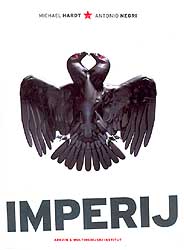
Arkzin & Multimedia Institute, Zagreb 2003.
translation: Dr. Zivan Filippi
Even before it came out of print in 2000, Empire (Empire) by Antonio Negri and Michael Hart was already a theoretical hit. The fame of the author, above all Antonio Negri, the Italian philosopher and long-time prisoner whose popularity grew along with the length of his prison term certainly contributed to this unprecedented popularity. Arrested after the kidnapping and murder of Aldo Mora on suspicion that, as an ideologue, he was connected to the terrorist organization Red Brigade, Negri spent four years behind bars without trial. He was convicted after he was released, but instead of prison he went to France, where he lectured on Spinoza at the Sorbonne until 1997. He then returns to Italy and spends several years under house arrest. Separated from the noise of everyday life by the prison regime, forced to focus on theory instead of plastic explosives, Negri proved to be a very prolific writer in isolation. (Incidentally, his case clearly confirms the communist thesis about prisons as a kind of universities. Probably guided by their own experience, the communists, at least in the area here, abandoned the practice of prisons as prison universities as soon as Mosha Pijade, imprisoned in an unpopular prison, finished translating Marx's Capital, got out of prison and won power, so the communist casemates served less as universities for political dissidents and more for their as effective taming as possible.) Michael Hart, on the other hand, using the never-dying leftist sentiments, skilfully surfed the waves of anti-globalism, published parts from an unfinished book (especially on the Internet, the child of globalization, where you can find the entire book in English for free) and created an atmosphere of great anticipation. In addition, the book was talked about as a manifesto of the anti-globalist movement, which further fueled impatience. The book did appear, however, and the Zagreb publishers Arkzin & Multimedia Institute reacted quickly and published a richly equipped Empire translated by Dr. Živan Filippi. The promotion of the book took place in Belgrade's Rex.
As educated and smart theoreticians, Negri and Hart saw without much difficulty the many weaknesses, dark spots and dangers of the globalization movement, without at the same time falling into vulgar, unreflexive anti-globalism, whose more visible representative in this region could be considered, for example, professor Dr. Mira Marković (from which one should not rush to the conclusion that she would also prove to be an equally prolific writer in prison). Empire that Negri and Hart talk about certainly has elements of continuity with the empire as a historical creation, starting from ancient times up to the United States today, but it is Empire, as a postmodern phenomenon, nevertheless something Completely different.
Empire historically it arises at the moment when the traditionally understood imperial power, derived from the nation state, experiences a deep crisis. If the imperialist order was always understood as a power relationship between two or more empires, each of which had its own center, a more or less rounded territory, clear borders and a defined interest, Empire shows itself as a system of comprehensive, above all legal networks, without a clear center, territory and borders. With the modern transformation of international law, the imperial process of constitution (constitution = constitution) seeks, directly or indirectly, to penetrate the internal law of national states. Constitution Empires it finds its source in the global expansion of the internal constitutional project of the United States. Unlike classical international law, which was a contractual and negotiation process between external parties, i.e. parties that were separated by territory and national laws, today law includes an internal and constitutional institutional process: networks of agreements and associations, channels of mediation and conflict resolution, as and the coordination of various dynamics of states, all of that was institutionalized within the Empire. We are experiencing the first phase of the transformation of the global border into an open space of imperial sovereignty. Because, as Negri and Hart say, the US constitution is imperial, not imperialist. It is imperial because, unlike the project of imperialism, which always protects its power in a straight line in closed spaces and attacks, destroys and subjugates other countries to its sovereignty, the US constitutional project is built on the model of reshaping open space and inventing new relationships in networks on unlimited terrain . Those networks, however, also hide within themselves new forms of domination and subjugation. According to the authors, they should be resisted. However, it remains somewhat unclear - why?
The book will inevitably disappoint those who expected that after it the process of globalization would simply fade away, as well as those who expected a raw attack on globalization. Instead of merciless criticism (which mostly means vulgar criticism) of everything existing, and especially of the United States, the authors, guided by a theoretical rather than an ideological interest, built a coherent story that quite precisely points to the contradictions and dark spots of globalization. America, in this context, proves to be undoubtedly the most powerful driver of the globalization movement, but - and this is what will disappoint the admirers of Noam Chomsky's character and work - not the sovereign controller of the entire process because, according to Negri and Hart, the process is not really can control to the extent that would satisfy the traditionally understood notion of control. For the same reason, the supporters of globalization will also be disappointed, because instead of a bunch of incoherent trumpeting, they were given the task of dealing with learned and well-founded argumentation. Of course, the author's left-wing sentiment emerges from time to time in the form of a division into "honest theoreticians", such as Richard Faulk, for example, and those who are probably not, or a very serious consideration of Lenin's thoughts, which, with due respect to the authors, I can hardly take it as relevant. The leftist sentiment is also reflected in the attempt to understand Brezhnev's Soviet Union not as a totalitarian creation, but as a modernization project in which creativity and freedom flourished, but were well hidden behind Western Cold War propaganda, the ideological machinery of falsification and generally malicious and false information. But despite that, despite the somewhat uneven level of argumentation and despite the striking absence of some important bibliographic references (in the otherwise extensive literature), it is hard to deny that it is a serious, thoughtful, and therefore significant undertaking.