The remains of Viminacium, the capital of the Roman province of Upper Moesia, are located on the territory of the villages of Stari Kostolac and Drmno, 13 km from Kostolac and about 90 km southeast of Belgrade. Viminacium was one of the most important Roman cities and military camps in the period from the XNUMXst to the XNUMXth century. An amphitheater, monumental buildings and traces of a developed infrastructure were discovered inside and around the city. The fact that there is no modern settlement on the site above the Roman remains provides a unique opportunity to get to know all aspects of life in antiquity.
So far, it has not been determined with certainty when the military camp in Viminacium was created, probably already during the arrival of the Romans on the Danube in the first decade of the 1st century. Its exceptional strategic importance was reflected both in the defense system of the northern borders of the Roman Empire and in the complex of communications and trade traffic. No less attractive for the Romans was the hinterland of the Mlava valley, rich in ore and grains. In the Roman era, the city relied on the Danube branch on the north side, while the Mlava river touched the ramparts on the west side. Only in a later period, Viminacium spread to the left bank of the Mlava.
Thanks to its position, land and waterways, Viminacium represented one of those areas where the meeting of the cultures of the East and the West was inevitable. Although these roads had a primary military and strategic function, they had a very lively traffic throughout antiquity and certainly contributed a lot to Viminacium becoming a prosperous and important commercial and economic center.
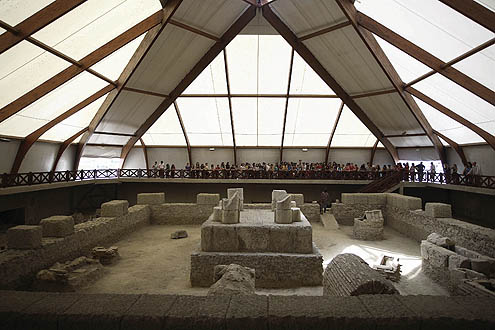
The Roman VII Legion of Claudius was stationed in Viminacium, and a civilian settlement arose near the military camp, which received city status in 117, during the reign of Hadrian. 6000 soldiers were stationed in the camp, and 30 to 40 inhabitants lived in the city. In the first half of the 211rd century, the city was in full bloom, as evidenced by the fact that it then acquired the status of a colony of Roman citizens, as well as the right to mint local money. Here, in 251, Septimius Severus proclaimed his son Caracalla as emperor, and it is assumed that it was in Viminacium, in the Mausoleum and tomb that were excavated, that the Roman emperor Hostilianus died in XNUMX. During the decline of the Roman Empire, Viminacium gained more and more importance, so that as many as eleven Roman emperors stayed there.
Viminacium was destroyed in the middle of the 5th century during the invasion of the Huns, and briefly rebuilt during the reign of Justinian in the 6th century, only as a military fortification. It has lost its former status forever.
Viminacium was the place where the first archaeological excavations in Serbia were carried out. It was in 1882 and they were started by Mihailo Valtrović, an architect by profession and the first professor of archeology at the University of that time, with the help of 12 prisoners because the state did not have enough funds to provide him with a better workforce. His researches were continued by Miloje Vasić, they were renewed in the seventies of the last century, and intensified in the last ten years, namely in the area of the Roman city, the legion camp and the Roman necropolises. Previous research has shown that the camp in Vimincium had a rectangular base, measuring 442 x 385 meters, and that not far from its western ramparts there was a civilian settlement, on an area of approximately 72 hectares. The legion camp at Viminacium is today in a layer of arable land, so the riches of Viminacium are easily accessible to explorers, but unfortunately also to looters.
About 40.000 objects found in Viminacium are preserved in the National Museums in Belgrade and Požarevac, of which over 700 are made of gold and silver. Among them there are many items that represent European and world rarities of inestimable value.
More than 13.500 graves were discovered. Tombstones and sarcophagi are often decorated with relief representations of scenes from mythology or everyday life. Numerous masonry burial structures were also found. The frescoed tombs from the 12.000th century are especially noteworthy. The artistic value of the fresco with the representation of a young woman represents the highest level of late antique painting. Excavations are underway for the amphitheater, which with its XNUMX seats was one of the largest in the Balkans.
Today, Viminacium is located in the area of the "Drmno" surface mine. The projection of the expansion of the mine until 2040 will not endanger the area of the Roman city and the military camp. However, Viminacium covers an area of over 450 hectares, and the city's areas are directly threatened by the progress of the mine. In that area, there are exceptional objects such as an aqueduct with a length of nearly 10 km, late antique basilicas, agricultural estates of Roman soldier-veterans, rustic villas, Roman roads that connected Viminacium with neighboring cities.
The story of the former glory and ruin of the Roman city and military camp of Viminacium drew the attention of not only the national but also the world public, which is eagerly waiting for Viminacium to take its rightful place on the world's cultural and historical scene. Recently, the archaeological park Viminacium was opened in the surroundings of the covered Roman necropolis of the Mausoleum, making this attractive site accessible to numerous tourists and visitors.