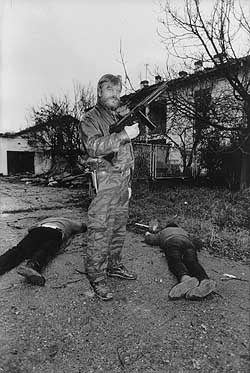
VUKOVAR: Autumn 1991.
The conflicts in Eastern Slavonia turned into an open war in September 1991. Together with local Serbian territorials, but also various paramilitary groups from Serbia, the JNA was in Baranja, on the Drava in front of Osijek, next to Vinkovci...
"The general military attack on Vukovar began on August 24 with air and artillery strikes," the report says. Steering u Croatia i BiH 1991 1995. General Antun Tus, then Chief of Staff of the National Guard Corps, and today Croatia's representative in NATO. "Apart from weapons, ammunition and manpower, the city also needed help in organizing the defense, so on August 31, Lieutenant Colonel Mile Dedaković as commander and Captain Branko Borković as his deputy came there and organized a circular defense - the defense of the city by sectors." There were six sectors and one battalion was in charge of each sector, but they acted as a single unit within the 204th brigade. (...) Our forces in the city failed to find a solution for the JNA Petrova gora barracks, and it is a big mistake that it was not occupied even before the arrival of Vukovar in a complete environment."
It was the release of the Petrova Gora barracks from the encirclement that the top of the JNA cited as the reason for the engagement in Vukovar. However, after its final release on September 20, the fighting only intensified. "Vukovar was a symbol of rebellion for the Croats, and for the JNA a symbol of the establishment of the rebel instant state," says Colonel Ljubodrag Stojadinović, at the time head of the Department for Analysis of Public Information Means and later, until 1994, head of the Information Directorate of the Yugoslav Army. "The order was: Capture Vukovar at any cost."
MOBILIZATION CRISIS: The National Guard Corps in Vukovar had a small number of mortars, anti-tank weapons and a large amount of mines. On the other hand, the JNA had - for the given circumstances - an impressive amount of military equipment. The problem, however, was the people. Mobilization in Serbia, as the last recruiting base of the JNA, experienced a breakdown: the response in the interior was 50, and in Belgrade only 15 percent. Mutinies and desertions became the rule, not the exception.
"The shedding of Serbian reserve units is taking place everywhere," wrote former President of the Presidency Borisav Jović in his book The last one dani SFRY September 28. "One elite unit of the Guards Division experienced disintegration - it was left without an army due to the departure of recruits after completing their military service, and the reservists failed to fill it. Only the Third Brigade from Požarevac was successfully mobilized. She pulled the Vinkovac unit out of the blockade. The second mechanized brigade (Valjevci) completely escaped. They are orthodox Serbian nationalists. Now in Šid stands the complete equipment of the Second Mechanized Brigade without the army. Slavonia needed a lot of troops, they don't have infantry."
On the ground, it is even more noticeable that the JNA cannot survive the state whose armed forces were.
"Many units simply disbanded at the very beginning, unable to go to the front line," continues Stojadinović. "The public was aware of the case of the unfortunate bombing of their own forces near Tovarnik, when some brigades from Kragujevac and Valjevo refused to go further and returned home."
Two cases depict the drama of ordinary people called to a war in which, according to Milosevic, Serbia did not participate. Vladimir Živković from Valjevo brought a transporter from Šid and parked it in front of the SFRY Assembly in Belgrade - here it is, so go to war. Miroslav Milenković from Gornji Milanovac, also as a reservist, happened to be in Šida on September 17, 1991. Two machines were built.
"Milenković was a middle-aged family man," says Nataša Kandić, director of the Fund for Humanitarian Law. "In meeting with people who are ready to go to war, he saw that this is not the world to which he belongs, that there is some ideology that he does not understand, as well as some other interests." In a collision with this, he was constantly in a dilemma: after he would transfer to the platoon going to the front towards Tovarnik, he would always return to the unit where there were people who also had doubts like him. He returned several times and in the end, between those two units - one where there were reservists going to the front and the other, admittedly smaller, of those who had decided not to leave at all costs - Milenkovic took a rifle and killed himself."
The mobilization crisis shook the relations of the military leadership with the political leadership of Serbia. Generals Veljko Kadijević and Blagoje Adžić persistently demanded from Slobodan Milošević and Jović to politically condemn "desertion" and become active in the agitation for the battlefields. On October 27, 1991, the latter wrote to them in his records: "They (the military leadership - op. aut.) have learned for years that they don't have a tutor and that everything is adopted as they say, and now it's a little more difficult."
Already low, the reputation of the military leadership reached rock bottom in the midst of the Vukavar battle. The Yugoslav People's Army is still a pale image of itself: the pentagrams on the helmets have been replaced by the Yugoslav tricolor with JNA written in Cyrillic. Part of the lower Serbian elders saw the solution to the general debacle in the removal of General Kadijević, as well as non-Serb commanders. On the night between September 28 and 29, 1991, a group of officers of the First Guards Brigade led by Major Veselin Šljivančanin broke into the General Staff building. They demanded that General Adžić dismiss General Kadijević. After his decisive refusal, the putschists retreated. They bore no responsibility: after all, Milošević and Jović had been insisting for a long time that the military leadership dismiss around 2000 non-Serb elders. At that moment, the JNA was only nominally Yugoslav: exclusively for international reasons, Milošević did not rename the Army to the Serbian Army.
"The new conception was roughly as follows: we will stay with those peoples who want the JNA as their own," continues Stojadinović. "It turned out that fewer and fewer people wanted that army, and a strategic defensive took place, that is, a successive withdrawal." From that came the killer formula of Vojislav Šešelj - the Virovitica-Karlovac-Karlobag line."
TIME MASTERS RAT: In the late autumn of 1991, the JNA and its elders were needed only for the purpose of using war techniques and some kind of tactical planning of actions. There came a time of various paramilitaries, such as that of Željko Ražnatović Arkan, who, as a supplement to the JNA in the field, did everything that the JNA could not or did not want to do.
"The paramilitary formations were additional units of the JNA," says Kandić. "It was not a combination of circumstances, but a clear plan - the authorities at the time knew that professionalism was a big obstacle for the implementation of a policy that is contrary to the rules of a profession such as the army." According to numerous statements by Serbs and Croats from the Vukovar territory, the officers told them when they met them: 'Run! You have to get out of here. There are Arkanovci, there are many others. We can't help you, we have no control here.' In the beginning, there was more of it, and over time, there is a fusion, identification, loss of professionalism that was characteristic of the JNA."
The paramilitaries treated the JNA elders as suspicious pro-Yugoslav elements who did not understand the goals of the war; conflicts were almost daily.
"When entering and leaving Vukovar, we were stopped by some armed formations that we didn't know who they were or whose they were," recalls Colonel Dr. Zoran Stanković, head of pathology at the Academy of Medical Sciences. "Every 200 meters there were some people with beards or without beards, with uniforms on their shoulders, with this or that mark." They stopped, pointed their weapons and legitimized... Among those paramilitary formations, a conflict occurred one day in which two or three of them were killed. Those bodies were delivered to the brick factory where my team was stationed, and then a man with a beard and a huge beard appeared. He ordered an elder to take one of those bodies, put it in a box and prepare it for transport to Belgrade. This one, confused, started doing it. When I saw all this, I called another one to the roof, which was decorated like a Christmas tree with various weapons. I told him: 'Listen, you're going behind this guy, and I'm going towards him. The moment I tell you to shoot, shoot and kill him.' There was a possibility that such people would completely discredit us in the eyes of the people we worked with. I walked up to this with a shovel and said, 'Pack up and get out of here.' He started to grab the gun, but when he became aware of the machine gun pointed at him, he stopped and we disarmed him. This was humiliating for us, but it happened."
Arkan's Tigers, White Eagles, Chetniks with their voivodes and other paramilitary groups of various names could not appear on the battlefield at will. Although under the name of volunteers they were formally placed under the command of the JNA by one order, their real controllers were elsewhere.
"The Serbian leadership at the time and the MUP of Serbia had power over the paramilitary formations, which resulted in their attitude towards the JNA officers," says Stojadinović. "It is certain that the history of the war between the JNA and the MUP of Serbia will reveal many dark things that happened behind the patriotic phrases - the fight for material interests, looting, immeasurable enrichment... Then, in that war, a symbiotic relationship was created between the then ruling oligarchy and underground where it was not possible to distinguish who was on top and who was underground."
SHEPHERD I RIDER: At the beginning of November 1991, the Vukovar tragedy reached its finale. Tons of shells from cannons, mortars and multiple rocket launchers littered the city - according to some estimates, the JNA fired its two-year supply of artillery ammunition at Vukovar. Bloody battles were fought for every street, and during all that time JNA planes bombed the city.
"The land army could not take the city without major casualties and in the time it had available - given that winter was approaching - without such a large and fierce effect of aviation", says General Živan Mirčetić, then Chief of Staff of the RV and PVO of the JNA. "My opinion is that it was overdone and that city suffered a disaster in large part due to the excessive use of aviation."
Together with various Serbian formations, the JNA occupied the completely besieged Vukovar on November 18, 1991. According to General Života Panić, at that time the commander of the First Army Region, 1503 members of the JNA were killed on the Vukovar battlefield.
"In Vukovar, we lost around 1100 veterans and most of the 2600 missing civilians and veterans," General Tus wrote.
The city, in any case, was dead. After the capture, two columns left Vukovar: refugees to the Croatian lines, prisoners to the prison in Sremska Mitrovica. Vocin, Pakračka poljana, Škabrnja, Gospić - these are some of the places with mass graves of Croatian and Serbian civilians from the year 1991. Prisoners from the Vukovar hospital did not reach any prison camp. On the Ovcara farm, on the night between October 19 and 20, two hundred and sixty-one people were liquidated. The Hague Tribunal accused three JNA officers of that crime: Veselin Šljivančanin, Milan Mrkšić and Miroslav Radić.
"The data shows that the prisoners were taken out of the hospital in Vukovar," says Kandić. "JNA officer Major Veselin Šljivančanin spoke with representatives of the International Committee of the Red Cross in front of the entrance to the hospital and said that they would all be transported." On the other side of the building, through the second exit, they were taken out, taken to Ovčar and shot there. There are survivors who, when the proceedings begin in the Tribunal, will testify. There are also Serbs who have seen it all and are ready to talk about it."
The JNA never admitted involvement and responsibility for the crime in Ovcara.
"Mrkšić was the commander of that sector, Šljivančanin his assistant for security, and I don't even know what he was about that Radić," says General Panić. "The army performed all tasks professionally. We sent the prisoners to certain places, most often to Sremska Mitrovica, where they were kept until the exchange. I heard about Ovčara very late, when people started talking about it. I never received any report about it. I am sure that the JNA did not interfere there. We always acted according to all the criteria and standards that existed during the war."
Even the then judiciary did not react.
"In November and December 1991, we knew that some people were killed there, and only later did we find out exactly what happened by talking to some actors and reading the press," says Colonel Dr. Jovan Buturović, president of the Criminal Chamber of the Supreme Military Court until 1992. I cannot understand why the judicial authorities - both military and civilian - did not pursue any criminal proceedings related to the crime even though it is known that there were some. The judiciary simply collapsed. It was completely under the control of the policy that was implemented at all levels, including in the JNA..."
The investigation was not initiated even after the report of Lieutenant Colonel Milan Eremia about the crime in the village of Lovas.
"For that officer, it was a matter of honor to write what he saw, and it was clear that he had no control, that the only thing he could do was to write a report and, like in a time of peace, forward it to his superiors," he says. Nataša Kandić. "He very precisely, very concretely described what happened there: that he found a paramilitary group that picked up about 60 Croatian civilians, that they tied them with some chains, that they drove them into a minefield." He saw how those people died in the minefield, but he could not do anything: he could not enter the field, he could do nothing, he could only watch the death of those people. When his report was released, there was not even a reaction. It was difficult for the people who read it, but as for the authorities, the generals, the superiors to whom he sent the minutes, there was no reaction. It was a clear sign that the army is moving to some other formation in which the law no longer applies, in which there is no protection for those who must be protected in war, which are civilians of any nationality."
EPILOGUE: Although the National Guard took control of western Slavonia in December 1991, both sides were exhausted. After the acceptance of Cyrus Vance's peace plan, the last truce was concluded in Sarajevo on January 2, 1992, which allowed Milosevic to control a third of Croatia through Krajina. The military leadership then lost its last political significance: General Kadijević resigned on January 6, and on the same day, the MIG of the JNA shot down a helicopter carrying European Union observers by mistake. However, the Blue Helmets did not arrive immediately: Krajina President Milan Babić demanded that Krajina become a UN protectorate and that the peace plan contain a political solution that would provide it with the achieved status. After Babić's dismissal, Unprofor was distributed in four zones in Croatia. On behalf of the JNA, which was retreating for the second time, General Adžić guaranteed the safety of the Krajina Serbs.
"I went to Adžić to tell him that we feel unprotected by the departure of the JNA and without a recognized political solution for Krajina," Milan Babić remembers. "He answered me: 'We will employ ten thousand of your Krajišniks in the JNA in Bosnia and Herzegovina; if Croatia attacks you, we will be there in a few minutes, not in a few hours.' He said this at a time when Bulgaria and Turkey had already recognized BiH as an independent state."
The war in Croatia, at least as far as the JNA was concerned, was over - for the second time, it withdrew from a part of the territory it claimed. In fact, after the Sarajevo Armistice, the JNA was just as dead as the SFRY: it was nothing more than a military organization that Milošević used as an instrument now for the creation of a "shortened Yugoslavia", now for the establishment of the Republika Srpska - depending on what the circumstances would be. and circumstances.
In 1993, Army General Veljko Kadijević wrote in his book Moje seeing shaved wrote that three armies emerged from the JNA: the Army of Yugoslavia, the Army of the Republika Srpska and the Serbian Army of Krajina. He was free to add that the elders of the JNA made up the skeleton of all the armed forces of the independent republics. Faced with the choice of socialism or the state, the Yugoslav People's Army lost both. Instrumentalized by one policy and on the side of only one nation, it disintegrated in wars it was not allowed to fight and could not win.
"The losses of the Air Force were quite high because the operations were carried out continuously - the most of them were in November," says General Živan Mirčetić. "We operated continuously because the front line was not established. They had exceptional weapons at their disposal - they took anti-aircraft guns from the Territorial Defense, and in the meantime they got anti-aircraft missiles. I couldn't say the exact number, but we lost more than twenty aircraft, some helicopters, some airplanes. We lost the most aircraft of smaller combat capabilities - "seagulls" and "hawks", the least MIGs 21. We also had several helicopters shot down.
"The barracks was surrounded, so a decision was made to free it. The action started, but, in my opinion, there was no determination to finish it as soon as possible. The units grew - one battalion was sent from one unit, another was sent from another, and thus the units in the area north, south and west of Vukovar were mixed up. They had strong separatist forces in Vukovar. Their goal was to break the JNA. Why did they hold Vukovar? They held it for one simple reason: Vukovar is on the Danube and if Vukovar is part of Croatia, Croatia will be a Danube country; if Vukovar leaves Croatia, it will not be a Danube country", explains General Života Panić how the Vukovar operation took place.
"WEATHER": Forwards, barracks Petrova mountain u Vukovar Ball je unblocked do 20. September?
PANIC: It was unblocked, but operations against the barracks continued. If we unblocked the barracks, it does not mean that we were completely peaceful. Attacks on the barracks and on members of the JNA were constant, and that's why we had to do that work. Either we throw them out of the area of Vukovar, or they take shelter in some way, so that the army does not suffer any losses.
Why je degree exposed like that destructions?
When they appointed me as the commander of the army, we reorganized the units in that area and set out to finally finish with Vukovar; that neither side should suffer anymore, but that it should end as soon as possible and that there would be as few victims as possible. Why was Vukovar destroyed? The struggle for each inhabited place is a characteristic struggle. This has always been the case in the world and in the history of war so far. Here, see what the Russians and their mighty army have done to Grozny. In order to take Grozny, they had to somehow conquer it, and if they conquered it while every house was being defended, they had to demolish every house. Vukovar had beautiful buildings, but they were mostly old, small, so they collapsed easily, not from such a strong impact, but they mostly collapsed. When you look at it, it looks terrible, but it is better to knock it down and conquer it as soon as possible so that people don't die. Many people who lived in Vukovar died, they were not protected, and they died on both sides.
The Croats defended themselves very well in those areas. They brought fanatics and these fanatics defended themselves from house to house. For example, there is a street with those shafts - if you occupy that space, they appear behind us tomorrow. Then we made the decision to weld all the manholes so that they cannot be used. Vukovar had a very large and wide sewer system, and they turned it into warehouses and could defend themselves there for years because they had large material resources at their disposal. Vukovar was surrounded by corn fields - they used those fields to bring in reinforcements and for supplies. When we hermetically closed Vukovar, that problem was completely solved and in 17 days, when I took office, we finished the problem with Vukovar and that was it.
Why did it stop? The state leadership at the time made a decision to protect only places with a Serbian population. Because, when Vukovar fell, we already entered Osijek, we also entered Vinkovci, we made the decision to extend it in order to preserve Yugoslavia as much as it could be preserved. One group of the army should have taken the Podravina highway, and the other the Posavina highway, and we would have quickly reached Zagreb. All those Croatian separatist units were disorganized, they could not recover quickly, and we would certainly have quickly reached Zagreb and saved Yugoslavia. But there was no such decision by the state leadership and we stopped where we are.
During Vukovar operations destroyed je significant number tanks. Tanks su u colony entered u Vukovar. How to you explain?
Wrong usage. The streets in Vukovar are narrow. The M84 tank is wide. If he enters a lane and is destroyed, the other tanks cannot go any further. If they get away, they are always a target for destruction. There is a special technique of using armored units in populated areas, but it was not applied there. When I took office, we brought the tanks from outside, they provided some support while we with the special units went and occupied the streets and neighborhoods. When tanks could be used, we used them.
Why se sa tanks entered u populated the city?
When there was a crowd in Vukovar, smaller or larger units were gradually brought in. As each unit was brought in, it was introduced into combat operations. Later that changed, so each unit returned to its own composition, and each commander was responsible for his own unit. It all connected, the commanders had everything in their hands, they could easily command and they could easily carry out their tasks.
Code Vukovar su se appeared territorials iz Eastern Slavonia kojima je commanded Badja, Serbian paramilitary formations, Arcana Tigers, Beli eagles e.t.c. How je JNA watched na Serbian voluntary i paramilitary units?
Our state leadership has made a decision to expel all paramilitary units. We partially implemented that. All those units were sent back, and we arrested some of them. However, Arkan's unit - as far as I know, he never had more than 50-100 people - was part of the MUP. He was not a paramilitary unit for the army. The MUP held the northern part, the late Stojčić was the commander and it was outside the army's structures.
Once he came to me to see what he could do, I gave him certain tasks that that MUP should carry out. They did it beautifully. However, when night fell, they retreated. The separatist Croatian units have filled that area again and tomorrow they are going to conquer it again. This could not happen to the JNA units at that time - when a unit comes and occupies a certain area, it holds it until another unit comes to continue operations or they extend operations.
Otherwise, there may have been individual groups that killed or went for some material benefit. Those were the groups that we couldn't even catch. They come, finish the job and leave that territory.
Since testimonials da su te groups obese oficysts JNA...
I don't know that. No one could threaten. To threaten the army? Well, no talk!
How much je members JNA died, a how much je wounded u Vukovar?
1503 soldiers were killed, and I don't have that information on how many were wounded.
"General Mladen Bratić was the commander of the northern part," says General Života Panić. it started from the Bršadin silo and broke out on the Danube, so that the Croatian units would not overflow. Bratić started to implement that decision and in the morning he came to the place where the tanks were crossing a canal. He was there with ten other officers and for the first time he was not wearing a protective vest - why he didn't wear it that day, I don't understand. Basically, I was told at my command post that Bratić was seriously wounded; I then ordered Biorčević to take up his duties and to let me know how Bratić is doing. After an hour, they informed me that he had died. How did that happen? A single 62 mm mortar mine fired by the Croats fell between the officers, exploded and only hit Bratić in the stomach area. Everyone else was unharmed...
It was a great pity for the JNA, but in war, anything happens."
"I was responsible for the forensic medical processing of the corpses." In the beginning, we worked with a team of doctors from Novi Sad, and after that we handled everything with the VMA. The team had the obligation to carry out investigative actions regarding every dead body or mass grave that was found in that area. This meant that the usual investigation should be carried out - that they should come, film each body and perform all investigative actions that could accuse the immediate perpetrators of that criminal act," says Colonel Zoran Stanković.
There were indications that spoke of a war crime. We only had witnesses from Serbs who stayed in Vukovar and who could speak about those victims. For example, there was that kindergarten that was claimed to have 40 children, which was not true. However, we registered that some people were killed there - such as Lukić, Vezmar, Uroš Udovičić, who were killed by the group of Martin Sabljić, Ćibarić, Šipoš and others. In addition, the existence of murdered Serbs at 72 and 74 Nikole Demonje Street was also confirmed, where the entire Ćećevac family was killed - meaning the little one, father and mother. A large number of bodies were found around the hospital and around the harbor master's office - where the whole family was, Aleksandar Matej, his father and mother.
"WEATHER": Da li th had initiation za mass the tomb Shepherd?
STANKOVIĆ: No. If we had known, we would have exhumed the remains, as in the case of some other graves we found in the area of Vukovar. I am primarily referring to the Jewish cemetery where there were 200 or so bodies that we had to exhume because they were buried in two rows of three coffins stacked one above the other. I'm also referring to the mass grave at the "Sloga" playground and some others.
I first heard about Ovčara's tomb at a meeting with the Croatian delegation led by their current UN representative Šimonović, when statements about Ovčara were made by Kunčević and Čakalić. They said that an officer from that area let them go. I didn't even know where Ovcara was then. If we had known, we would have done the exhumation and carried out individual burials so that people could collect the remains afterwards. Only later did I gain some knowledge about that Ovcara, but we didn't know that then.
Kada th came do evidence o wartime crimes, what th s tim findings does it work?
We treated each body in the same way. For each body, a file was created that contained the team number and an ascending number, as the bodies were ordered. Let's say: 3/21, 3/22, ... Each of those bodies had to have a recorded description of the place where it was found, a video of that place, and then it was transferred to Ciglana. We took off our clothes and took personal belongings, documentation, jewelry - these were recorded and placed in special plastic bags, which were then transferred to the Military Court in Belgrade. Such a file was handed over to the investigating judge, who continued the investigation with the prosecutor.
There were also rumors. When there was talk of a crematorium, we went there to verify the stories of people who used to work at the hospital and who claimed that human bodies were burned there. We found that there was no burning of bodies, but body parts amputated as a result of injuries in war conflicts or as a result of gas gangrene.
How set you evaluate ulogu JNA?
I see the war from one side. I saw the victims of war and those forms of violence, I can mostly talk about that. I am not a person who will say, "Someone is responsible for the processing of corpses" for everything that was processed in Vukovar. If something goes wrong, I am responsible and I don't run away from it. If it's good, then we've all done good.
What I noticed then is the fact that there is a great irresponsibility towards the victims of that war. Because, if you took someone's child and brought him into your midst, if you are responsible for his life, and you return him to his parents in a coffin, then it is your duty to say why he died and how he died. I was struck by the inertness of the people in charge of it. Secondly, I was struck by the fact that some political aspects are involved in all of this. People came to me asking me to participate in propaganda. I refused, but I said that if no one wants to, I will talk about everything we do. I talked too, maybe too much. But I spoke for the simple reason that it would be known what we are doing, what kind of victims there are and who those victims are, regardless of nationality.
It's my fault that we didn't go public with that information then. When I insisted on publishing the names of the victims, I was dismissed as pro-Croatian. To me it was notorious nonsense. I do not shy away from speaking openly. They talk about the number of Croats and Serbs killed, but soldiers are not mentioned anywhere. That is a number of about 500 soldiers whose corpses were brought from that area to the VMA and were processed. Could a poorly armed group kill so many people? Why are we keeping quiet about it all this time? Others should talk about that.