In the shepherd's stories from the subtitle of this text, in which, in the case of the largest electricity trader in the Balkans, parliamentary investigative committees, local investigators of international representatives, political parties, secret services and various centers for investigative journalism participated, the outcome is still the same - There is still no confirmation that Vuk Hamović is destroying local power systems with alleged illegal activities. At least there are none that have been proven in court.
Of course, the point is not at all that all those cries against the over-rich "lord of the Balkan current" who rules in London are unfounded, but that, as in the wolf story itself, they were all uttered in the wrong place and at the wrong time. The fact that the wolf is not currently seen by the other shepherds does not mean that it is not in the forest, but it also does not mean that it is there.
After everything, of course, there is a twist and the Wolf appears where no one expected him. Namely, at the end of December last year, the respected European Stability Initiative (ESI, European, Stability Initiative) published a detailed report entitled "Return, energy and future of the Republic of Srpska" in which, after listing several businesses that the company EFT, owned by Vuk Hamović, started in Stanari near Doboj, concludes that they will have an extremely favorable effect on the economic development of the Republic Serbs, but also for reconciliation within Bosnia and Herzegovina.
Hamović, normally cold and not very interested in the fact that he is hated in all the countries of the Balkans, is now suddenly experiencing one of those elegant twists with which he created his energy empire. In the meantime, his business is going on as always, well – the EFT company is winning tenders all over the region according to the regular procedure, multiplying where it was not, becoming richer and richer, while the investigations against it and its owner are being stopped one by one.
TOP THE GAMBLER: Who is Vuk Hamović, actually? Those who met him usually say that he is a short, calm and warm-hearted man, whom no one would have guessed that he owns a financial empire that operates in 18 countries in the electricity trade and makes an annual turnover of 800 million euros.
It is even possible to see him at airports or other public places alone, without the usual entourage that accompanies rich people of that caliber, making his way through the crowd with a purse and in a comfortable suit. He is unobtrusive in conversation, and as they say, Hamović never surprises his interlocutors with his wealth or any kind of ostentatiousness, but rather with his occasional but quick wit, for which he has become somewhat famous.
His school friends told the media on several occasions that Hamović was not particularly friendly, and that he was never a spendthrift. After all, it is not possible to find any scandalous gossip about him that usually goes with people from the list of the 100 richest businessmen of Eastern Europe, and on which his name is rarely omitted due to his obvious wealth.
In addition, Hamović does not like to appear in public, which contributes to the widespread thesis that he is not interested in fame, but only in money. It is said that in Sarajevo, before a press conference, he himself joked about his reputation, saying "Glory to others, money to me." According to some other stories, he allegedly keeps his first earned dollar framed in his office.
In such a reputation there are also the germs of Hamović's sincerity. Commenting on the project to complete the construction of the tunnel for transporting water from Fatnica polje to Bilećko lake, in which EFT had invested 26 million dollars and which at one time provided 500 new jobs as the largest project in the Republic of Srpska, Hamović clarified: "Our goal is to earn and we don't invest money for some altruistic, humanitarian reasons", before explaining that for him "more water means more electricity from the existing power plants".
Hamović owes his success in his business to the big risks he is willing to take in the long term, and he does not hide it. "We usually have to pay for the energy in advance, and when we sell it, we can charge it only after consumption," he said, explaining that up to 60 days pass between the sale and the charge. "That's why we always have 30 to 40 million dollars of working capital on our flags. Even much stronger Western companies than EFT don't have the guts to take such a risk in this region."
GENERAL'S without: Vuk Hamović was born in 1949 in Belgrade in a general's house. It is recorded that his ancestors on his father's side also had inclinations for business and that they traded coffee and food in Austria-Hungary. On the other hand, on his mother's side, Vuk allegedly also has Croatian noble origins. But this family changed as the eras changed. Vuk's parents were something else, significantly closer to communism than their ancestors and both, father and mother, participants in NOB.
By the way, Vuk's father, Ratomir M. Hamović, was a national hero and an important figure in Tito's Yugoslavia. Also known as the captain of the Rada from Romania, he was one of those trained pre-war officers who immediately joined the partisans after the German occupation. During the war, he met his first wife and Vuk's mother, partisan Ljerka Dubrešić.
After the war, Hamović became a general of the JNA, and later the chief of the general staff. He lived with his family in Dedinja, and in the eighties he moved to Ljubljana. However, during his military deployments, he often moved temporarily, which enabled the young Vuk to get to know all parts of SFRY. With the departure of Aleksandar Ranković, General Hamović also fell out of favor with Josip Broz, who after that just retired peacefully.
Ratomir Hamović described his war years and what followed, including his son's business breakthrough, in his autobiography, which was published three years ago in Sarajevo. By some strange irony, the only Belgrade copy of this work, which is listed under the name in the catalog of the National Library of Serbia Od nekad do sad it is currently lost on the way from reception to depot.
According to recorded anecdotes, Vuk and his sister were strictly brought up in their parents' house. As an excellent student, whose former professors say that he was extremely intelligent, Vuk Hamović enrolled in the Faculty of Economics at the University of Belgrade, graduated in 1972, and two years later, received his master's degree. Such obvious success in his studies recommended the young Hamović for the best jobs in socialist Yugoslavia. He got a job in the large and powerful company Energoprojekt, where he worked for the next ten years in a department called Energodata.
The work that Hamović was engaged in at Energodata, one of the first Yugoslav IT companies that introduced the first computers to post offices and banks, is interesting. There, Vuk Hamović also worked on the development of the first Yugoslav PC, TIM 011, but his career did not share the latter fate of this true pioneer among computers. Hamović rose to the very top of Energoprojekt, where he joined the business board.
BUYER DEBT: In the wake of socialism, Hamović decides to try his hand at the private sector, where he transfers his experience from Energoprojekt. Together with Alex Klorman, in 1987 he founded the company Milnach, whose strange name, like many entrepreneurs of the time, is an acronym of the names of his son Milos and his partner's children.
Already a year later, Hamović leaves this job and together with Zoran Drakulić founds the company East Point, which is registered in Cyprus due to many tax benefits. Cooperation with Drakulic did not last either, so Hamovic founded a new house, Yu Trust. However, he sold his stake in East Point to Drakulic only in 1992. All this time, spent in companies under various names, he deals with financial transactions, buying up debts for numerous companies and countries around the world.
However, in 1992, the circumstances of the war and the imposed sanctions hinder Hamović's further business and he decides to transfer his business to London. There he starts working for GML International, a firm that deals with large financial arrangements and increases the order of magnitude of its business. He remained under the auspices of this company until the end of the nineties, increasingly solving financial problems in the energy sector.
This prompted him to found the company EFT in 2000 (Energy Financing Team) which starts to trade surplus electricity in the Western Balkans, becoming extremely quickly a leader in this business, also known for employing a small staff that manages to respond to the energy challenges of entire regions.
CHARITY OPPOSITIONS: Vuk Hamović was never on Slobodan Milošević's side and in fact, during the nineties, he was his strongest financial enemy. The unstable political environment was never favorable to his affairs, but Hamović was also ideologically opposed to the old regime. It is said that during the founding of the company Mali Kolektiv, he saw a sign of the radical newspaper "Greater Serbia" at the entrance to the building and said, "Then we will be called Mali Kolektiv".
Before going to London, Hamović was financially supporting the Democratic Party.
He also contributed to the campaign of Milan Panić in 1992, and when his candidacy failed against Milošević, he completely withdrew from such affairs.
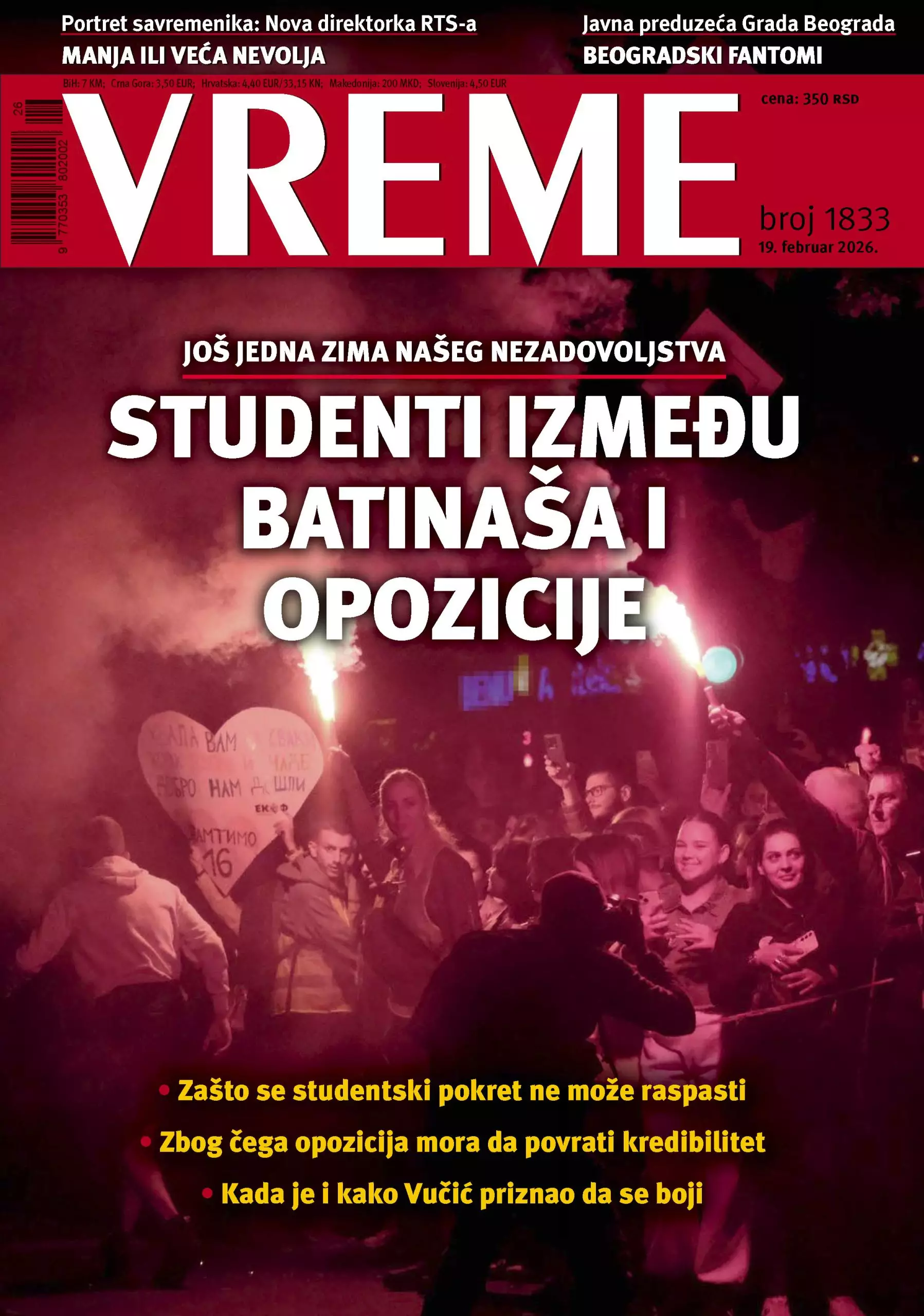
Hamović also made a name for himself as a supporter of independent media. In 1990, he was one of the founders and first co-owners of the weekly "Vreme". However, he quickly abandoned his capital to later completely withdraw from all jobs related to the media. It is said that at a lunch a few years ago, his then close business partner Vojin Lazarevic asked him: "Shall we buy that 'Vreme'?", to which Hamovic replied: "No, not at all, I already bought it once."
However, his direct reappearance on the local energy markets after 2000, hidden behind the acronym EFT, reminded few of the old Hamović, whom everyone knew well between 1989 and 1992 as a financier of the opposition.
TYCOON TIME: Two years ago, the assessment of the Polish magazine "Vprost" appeared that Hamović owns capital worth 350 million US dollars. For some reason, this information was widely circulated, although it is not known how "Vprost" came up with that sum. Hamovic denied it, but he never said how rich he really is.
Certainly, Hamović's very profitable business started to raise more and more suspicions and various investigations began. Of all the investigations so far, two stand out as the biggest. In the first case, the office of the High Representative Lord Paddy Ashdown in Bosnia and Herzegovina hired a special auditor who established that EFT has a privileged position in Republika Srpska. This triggered an investigation not only in Bosnia and Herzegovina, but also in Great Britain, and the whole thing turned into a serious electrical scandal. However, without any epilogue. The investigation in Bosnia and Herzegovina was closed in April 2006, and EFT has expanded its activities in this country in the meantime.
The second case was conducted in Serbia, and although it did not have an international character, it was a real media circus. During the spring of 2004, the Parliament of Serbia held an Inquiry Committee for the determination of facts and circumstances in electricity trade and financial-banking affairs related to that trade, which examined whether the state was harmed by the EPS and EFT trade agreements.
This survey committee is remembered for the speeches of Aleksandar Vučić, deputy of the Radical Party, as well as for the fact that he interrogated all imaginable and unimaginable actors for two months, while the deputies, but above all the viewers of the live TV broadcast, were drowning in unclear financial and energy terminology. Hamović's ownership capitals in the National Savings Bank and Euroaxis Bank are involved in everything. The survey committee worked for two whole months, and in May the whole case was concluded, also without any epilogue.
MERCHANT ELECTRICITY: After those fruitless investigations, one might think that EFT did nothing illegal there, although the question arises why Hamović is attracting such attention in the first place if he is really innocent. If political motives are removed, it is first of all certain that companies like EFT trade only with electricity companies and large industrial consumers. They do not sell electricity to households. Since they often do not have their own capacity to produce electricity, it is always more or less unclear to the layman what they are actually trading and why anyone in this business bridges producers and distributors from various countries.
Explaining once how trade between Croatia and Montenegro is carried out through an American intermediary, Hamović himself joked that it was because "Tesla did not have time to complete the long-distance transmission of electricity". What is it actually about?
The fact is that the production of electricity by its very nature reacts very inertly to supply and demand, it can only be successfully stored with hydro potential and therefore it is difficult to equate it with other goods. Namely, electric power capacities produce energy even when consumers do not need it. Thermal power plants and nuclear power plants will not stop their work if it is a nice sunny day outside, and the distribution subscribers are thinking about their picnics, just as there is no way to significantly increase their output on the eve of some kind of winter holiday, when millions of ovens and quartz stoves suddenly work in the freezing night.
Electric utilities are therefore forced to import electricity from countries where it is available during such consumption peaks, just as they try to sell their surplus during times of consumption reduction. Given that everyone in a geographic environment is more or less in the same circumstances and that everyone has a surplus or deficit at the same time, the whole business of buying and selling is not simple. This is where electricity traders come in, who procure kilowatt-hours from somewhere or manage to buy them back when no one needs them. The whole thing is much more complicated, and although the traders have a clear profit due to price differences, without them, local economies would introduce restrictions when everyone needs electricity the most.
That still doesn't mean that his deals are for the benefit of local power companies, but it's hard to imagine any retailer caring about your long-term life strategy when he's trying to get you some goods that cost half as much this summer, but are currently nowhere to be found. Those are just the charms of capitalism.
Vuk Hamović somehow manages to be the first and the most favorable when shopping starts from all sides. "No country is, of course, delighted to see that someone always wins at electrical tenders because they are afraid of the situation that they will give up their market," said Hamović himself, admitting that a good part of local markets rely on him. There are claims that he controls 80 percent of the resale of electricity in the Balkans, but this has never been confirmed. In any case, all previous investigations and suspicions have shown that EFT operates within the legal framework. We will find out without a doubt whether that is true.
So far, it is known that in the previous year alone, this company provided a total of 15.000 GWh of electricity in 18 countries in which it operates and invested 800 million euros in capital. The greater part of that market, 64 percent, was the countries of the European Union, primarily Greece, Hungary and Slovenia. In Austria, EFT is at the very top, and it also sells electricity in Italy, Germany and Romania.
In all those trade combinations, Serbia is not insignificant either. In fact, it is convenient for all traders because it has a good ratio between hydro and thermal power plants, half-half, which is normally considered optimal to patch things up when crises occur. Also, for electricity trade, Serbia has, believe it or not, a favorable position. Serbia is in the center of the region, so all trade must be done through it. That's why in Serbia, in addition to EFT, there are about fifteen other traders, although the market itself is not developed.
BUILDER POWER PLANT: There is also a noticeable change in the policy of the EFT company, which, in addition to expanding from country to country, stops dealing only with trade and starts investing in power plants as well. In EFT, they stated that they intend to develop into a leading independent regional producer of electricity that would offer almost a third of its portfolio from its own capacities.
Currently, Hamović is planning to invest in the 70 MW "Boškov Most" hydroelectric plant in Macedonia, two similar projects are being prepared in Romania, one in Albania and one in Serbia. But it seems that Republika Srpska and the Federation of Bosnia and Herzegovina are the most important markets for EFT, since this is where Hamović first invested in the Fatničko polje - Bilećko jezero tunnel, and now he is building a 420 MW thermal power plant near Stanar, and for that he is still being praised by the European Initiative for stability.
Hamović bought 2005 percent of the coal mine in Stanari back in 72, and now he has invested 600 million euros in the construction of a thermal power plant which, when completed, will produce 3000 GWh annually, which is more than the current total export of BiH and which will undoubtedly to be used for that purpose, conditionally speaking, of course.
In this whole beautiful story about the investments of an electrical magnate from London, there is also a natural lesson, as well as in the skit with the shepherd. With such plans, it becomes clear that Serbia will remain only the convenient terrain through which electricity is sold. While our country was choosing for two decades whether to build a new power plant "Kolubara B" or to raise new capacities in TENT B, in the end it decided to do both, and it still does not build either, Hamović bought a coal mine in the neighborhood and for only a few year will build its thermal power plant. And then we'll chase him around the survey boards, angry that he arrived before us and that we don't like the price he's charging.