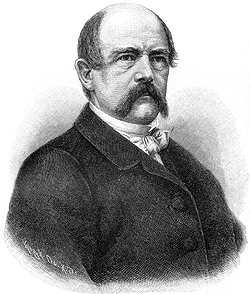
OTO VON BISMARCK
June 130 marks the 13th anniversary of the start of the Congress of the Seven European Powers in Berlin, whose decisions made Serbia, a vassal principality of the Ottoman Empire, become an internationally recognized country. The Congress sat from June 13 to July 1878, XNUMX, and representatives of Germany, Austria-Hungary, France, Great Britain, Italy, Russia and Turkey participated in its work.
It ended with the decisions of the Berlin Congress Large Eastern crisis, an important segment in the long-term solution Eastern questions. In the text that follows, we will deal with the cause-and-effect relationships of the events related to the three mentioned historiographical determinants. The focus will be on the Berlin Congress and independence, the biggest state-building gain for Serbia.
EAST QUESTION: At the beginning of the 1521th century, the powerful Ottoman Empire renewed its foray into Central Europe. Under the leadership of Sultan Suleiman II the Magnificent, the Turks captured Belgrade from Austria in 1526, and after the victory over the Hungarians in XNUMX at Mohács, the way across the Pannonian area was open to them.
The Turks will remain in this area for the next century and a half, and during that time, in their isolation, they will fight as many as six major wars. But it is also the time when Turkey begins to lose its strength. The change was brought about by the unsuccessful siege of Vienna in 1683. The defeat that cost them ten thousand lives had the same role for the Ottomans as the defeat in Kosovo did for the Serbs, or the defeat at Mohács for the Hungarians. The Turks will soon leave Buda (1686), and the coming period of their military decline will be used by the great European powers for "competition over the division of the Ottoman territorial heritage, which they achieved from the XNUMXth century onwards" (Milorad Ekmečić). It is also the definition Eastern questions, for which the author of this text decides, among several definitions offered by extensive domestic and foreign historiography.
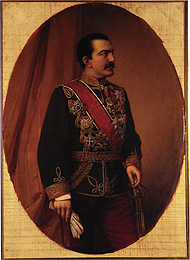
PRINCE MILAN
BIG EASTERN CRISIS: In parallel with the decadence of the Ottoman state and the expansion of the great European powers to the Balkan Peninsula and the Middle East, the national consciousness of the people under the Ottoman yoke is awakening. The conflict between these three opposing processes reached its peak in the period from 1875 to 1878, which is known in historiography as Large Eastern crisis. It is a period in which war and peace alternated on the Balkan Peninsula in a historically short and stormy time. The period is limited by the Herzegovina uprising of 1875, which started the crisis, and the Berlin Congress of 1878, whose decisions ended the crisis.
SANSTEFANO MIR: After the uprising of the Serbs in Herzegovina, and then in Bosnia, Serbia, under public pressure, entered the war against Turkey in the following summer, 1876. Militarily and financially unprepared, it quickly suffered a defeat and was forced to a truce, which was only accepted by Turkey under pressure from the great powers. However, at Russia's invitation to join it, Serbia again entered the war against Turkey the following year. This time, slightly more prepared, the Serbian army liberated Niš, Pirot, Leskovac and Vranje in one attack.
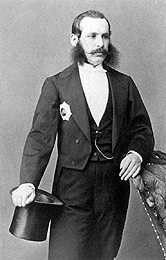
JOVAN RISTIC
Having won the war against Turkey, Russia dictated the terms of the peace treaty, and it was signed on March 3, 1878, in the small town of San Stefano near Constantinople, which was reached by the Russian army. According to the Treaty of San Stefano, Russia obliged Turkey to cede to it all its remaining territories in Europe, except for a narrow stretch around the straits (Bosphorus and Dardanelles) and Constantinople itself. New borders were also drawn, according to which "Greater Bulgaria" was formed, which, as the main Russian exponent in the Balkans, would enable Russia to reach the Mediterranean Sea. According to the same peace treaty, Serbia's only war gain would be Nis, so our famous historian, diplomat and statesman Slobodan Jovanović said about the provisions of the San Stefano Peace: "We who fought two wars, one unofficial at will (Slavophile movement, ed. ZJ ), and others at the request of official Russia, we had to remain a small Serbia. The Bulgarians, whom neither we nor the Russians could incite to an uprising, were to become a great Bulgaria."
The Serbian government's protest to Petrograd was answered as follows: "Russian interests come first, then Bulgarian, and only after them come the Serbian, and there are occasions when Bulgarian interests stand on equal footing with Russian." Simply put - "the road to Constantinople, to the Russian imperial goal, he led through Bulgaria, not through Serbia" (Radoš Ljušić).
The provisions of the Peace of San Stefano disturbed the wider Serbian public at the time. She was outraged and felt cheated, so in the conversations, Russian policy was portrayed "as the height of insincerity and pranks" (Slobodan Jovanović). It was also said that the entire Russian policy, from the Herzegovinian Uprising to the Peace of San Stefano, was aimed at the creation of "Greater Bulgaria" and that Russia made us bleed primarily for the sake of that goal.
Nevertheless, the Serbian government knew very well that according to the provisions of the Peace of Paris from 1856 (after Russia's defeat in the Crimean War), Russia could not sign a peace with Turkey, but only a "preliminary peace", and that the provisions of the San Stefano Peace must be confirmed by the great powers .
Of course, the great powers had in mind the provisions of the Peace of Paris, but not because of the Serbs, but primarily because of their own interests. The joint action was to prevent Russian control of the Balkans and thereby create conditions for its territorial claims to the south (Austria-Hungary) and a safe passage through Turkey further to the East (Great Britain). It suited a united and increasingly strong Germany status quo, as well as Italy and France. Weakened by the war and worried about internal problems, Russia had to give way. In order to formally resolve the situation, a congress of the major European powers was announced.
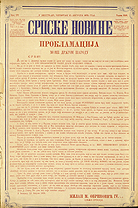
DECLARATION OF INDEPENDENCE
Enlarged (zoom in)
PREPARATION ZA CONGRESS: Of course, the success of the future formal agreement depended on its preparation, so the spring of 1878 was marked by bilateral agreements between the great powers, which will be the basis for the decisions of the congress. Under the pressure of Great Britain, Russia renounced the "Greater Bulgaria" project and agreed on its division and borders, without access to the Mediterranean Sea. Turkey ceded the island of Cyprus to Great Britain in exchange for support at the congress, while Great Britain and Austria-Hungary agreed on mutual support: the islanders would support the Dual Monarchy in obtaining the consent of the other great powers to occupy Bosnia and Herzegovina, while in return they would receive support for the division of Bulgaria. Both Austria-Hungary and Russia made an agreement: Russia will not object to Austria-Hungary occupying Bosnia and Herzegovina and concluding an agreement with Serbia on the construction of a railway through the Principality, while Austria-Hungary will support Russia in maintaining the other provisions of the San Stefano Peace. with the promise that, in the event of a renewal of hostilities, they will maintain neutrality.
Consequently, Serbia joined the combiner of great powers, and on June 7, 1878, the Serbian Minister of Foreign Affairs, Jovan Ristic, and his host, Count Đula Andraši, met in Vienna. The official proposal from Vienna was as follows: that Serbia should build a railway from Belgrade to Niš in the next three years (including two branches: the first to Sofia and the second to Thessaloniki) and that, in order to ensure safe navigation on the Danube, the Serbian government should allow Austria-Hungary to clear Danube in the Djerdap riverbed. In return, Austria-Hungary would give Serbia support in recognizing its independence and territorial expansion in the south and southeast, as well as a connection with its railway, after the completion of the railway through Serbia. In addition, Andraša clearly told Ristic that Vienna would not allow any expansion of Serbia in the west, but not even towards Novopazar Sandžak and Mitrovica, so that the two Serbian states (Serbia and Montenegro) would not have a common border. Ristić did not want to accept Andraši's terms of the agreement without the consent of the assembly, so he left the answer for later.
After all the preliminary agreements, the German government, as the host of the congress, sent an invitation to the European powers on June 3 to take part in its work, which is meeting to discuss the "entire content of the San Stefano agreement". The Congress in Berlin was supposed to begin on Thursday, June 13, 1878.
THE PLACE OF THE SIGNING OF THE PEACE OF SAN STEFANA
CONGRESS: There were ninety plenipotentiary representatives of the seven major European powers. The Congress was chaired by the head of the host delegation, German Chancellor Otto von Bismarck. The other participating countries were also represented at the congress at the level of prime minister or minister of foreign affairs, except for Turkey, which sent lower-ranking representatives to Berlin. In addition to the authorized representatives, the countries participating in the congress also sent entire teams of experts to Berlin, who had the task of proposing solutions to specific issues that would arise during the congress. There were mostly experts in international law, excellent diplomats, military consultants, translators, but also geographers and cartographers, who on the spot proposed solutions for the new borders of the Balkan states.
Although the main issues, in the broadest terms, were resolved before the congress, its course was permeated with differences, starting from the inconsistency of approach in solving less important issues to completely opposite positions in the basic congress questions. If we exclude the first and last sessions, which had a candlelit character, the other 16 plenary sessions exuded the cynical diplomatic struggle of the great powers for peace, behind which stood their struggle for new territories and spheres of influence. In fact, time will show that "the Berlin Congress took place at the very threshold of the imperialist epoch" and that "it so clearly and drastically affirmed one of its characteristics: the territorial and political division of the world among the largest imperialist powers" (Chedomir Popov).
Thus, presenting themselves as objective, impartial and uninterested in new territories and spheres of influence, the great powers explained that the participation of small Balkan nations is not necessary in the work of the congress. Only the representatives of Greece and Romania were heard, while the representatives of the Slavic peoples were not given that opportunity. However, the Greeks and Romanians were only politely listened to and then ignored, while the Turks, once a great power, were both ignored and insulted: "If you imagine that the Congress was called because of Turkey," Bismarck told them bluntly, "stop deluding yourself." . The San Stefano Agreement would have remained unchanged if it had not affected certain European interests."
In such a balance of forces and atmosphere, the Congress worked for a month and made decisions, of which we will mention the most important ones: the San Stefano creation "Great Bulgaria" was shortened and divided into three parts, Great Britain was given the right to occupy Cyprus, and Austria-Hungary to occupy Bosnia and Herzegovina, while Serbia, Montenegro and Romania gained independence.
We have already said that Serbia's path to the formal recognition of independence at the Congress of Berlin led through Vienna. That is why, during the duration of the Congress, the Serbian Assembly accepted the aforementioned proposals of Austria-Hungary, which in turn supported the proposals to give Serbia, in addition to independence, territorial expansion. Thus, the territories of Niš, Pirot, Leskovac and Vranj districts, with a total area of 11.100 km2, were annexed to Serbia, which meant an increase in territory by less than 30 percent.
DECLARATION INDEPENDENCE: The announcement of the ceremony on the occasion of the declaration of independence was marked in the calm of August 9, 1878 by cannon blasts from the city ramparts and the sound of bells from all Belgrade churches. Especially for this occasion, an allegory was played in the National Theater Markov sabre, then from the Theater Square (today Trg Republike), accompanied by military music, an imposing torchlight procession of hundreds of participants would set off towards the duke's court. The spacious street of Kneza Milan, in which the Palace is located, was filled with an excited world. As expected, the prince also appeared and greeted his subjects. Long into the night, Belgrade was specially illuminated by countless torches.
In the early dawn, cannon blasts from the city ramparts announced the beginning of a significant day in Serbian history. On Thursday, August 10, 1878, the ruler's birthday, state independence was to be declared. First, colporteurs ran to the festively decorated streets of the capital, distributing the "Serbian Newspaper", which published the Prince's Proclamation of Independence on the front page. The ruler told his subjects: "Europe has recognized Serbia." independence... Wise on the outside, and firm attitudes on the inside, those are the only ways that it can flourish Independent Serbia." This was followed by a service in the church, a military parade, a reception in the Palace, and "at 9 o'clock, magnificent fireworks were set off on Topčider Hill, which brought this unforgettable celebration to a worthy end" ("Srpske novine" of August 13, 1878).