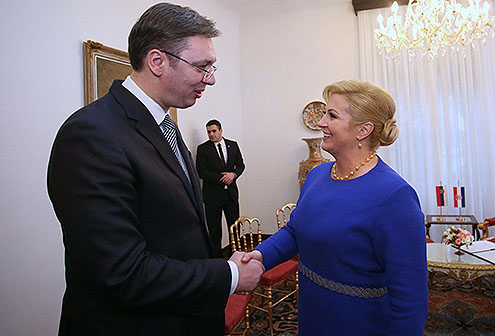
Croatia celebrates the "Storm", not thinking that more than 200.000 of its citizens of Serbian nationality had to leave their homes. At the same time, the government led by Prime Minister Vučić says that there was no genocide in Srebrenica, not even a word about Ovčara, about Prijedor and the cold storage facilities as well. They would only talk about reconciliation, without confrontation
For years, all of us, especially the "workers in culture", and even more so the "owners in the economy", have been assured that Croatian-Serbian relations are on the rise, except for the occasional whining about what Croatian businessmen can do in Serbia, and what Serbs can't do in Croatia. . In contrast to Slovenia, in whose capital Ljubljana the mayor is a Serb: who and what this capable economist is, was not very important.
The year 2015 has changed everything, from March to November everything is full of anniversaries: from last year the First World War, the Second World War, the liberation of Zagreb and Croatia, the liberation of Yugoslavia - its republics - from fascist terror, the anniversary of Blajburg and the liquidation of the Ustasa death camp Jasenovac, anniversaries of anti-restitution... And then new anniversaries: Srebrenica at 20 years old, Ovčara at 24 years old, Dayton Agreement at 20 years old, action "Storm" with just as much…
It seems that the remark that we "in these areas" have too much history... In all those years, however, we have too much hysteria, as evidenced by everything we heard from all sides this hot summer of 2015. Political Serbs and Croats exchanged all available heavy verbal artillery this summer: Croatia celebrated the "Storm", not thinking that more than 200.000 of its citizens of Serbian nationality had to leave their homes (century-old hearths, as it was called in those years), Serbia welcomed those refugees only after 20 years. It sounded terrible to each of those unfortunate refugees when Aleksandar Vučić, today the prime minister and until recently a radical, finally announced his welcome to all of them who have been in misfortune in Serbia for two decades. He was only 20 years late, and even today he has nothing to offer them. On the contrary.
QUARREL OF POLITICAL LOVERS: In these summer months, we listened, all together, Serbs and Croats (and Bosnians all agreed) that it is time for reconciliation. The Serbian Prime Minister takes the lead in this, the others refuse. The rest are not in tune with the times, they want to remain trapped in myths. At the same time, the government led by Prime Minister Vučić says that there was no genocide in Srebrenica, not even a word about Ovčara, about Prijedor and the cold stores as well. They would only talk about reconciliation, without confronting what Serbia - its leaders, including Slobodan Milošević, Vojislav Šešelj and Aleksandar Vučić - are at least politically, if not Hague, guilty of.
Like them, like the Croatian government.
Elections are being prepared there (perhaps here as well, but here the elections depend only on the will of one man, the prime minister) and one should take care of what is said. Everyone is talking: the supposed left, the social democrats of Zoran Milanović are trying to "infiltrate" both their voters and those who would once again swear by the image and work of Franjo Tuđman, and so they want to name Pleso airport after the "first Croatian president". There is no more mockery, not even among them (publicly) because they installed golden doorknobs in Veliki Trgovište back then in his native one-story and miserable house in Zagorje, nor is there any mention of the "200 families" who will become rich in Croatian capitalism, no more - which is probably the most important thing - not even those "Feral" covers with the political lovers Franja and Slobo embracing in the matrimonial bed...
There is, however, a shuffling of bones. This is the story in which Tuđman's regime sued Viktor Ivančić, the editor-in-chief of "Feral" at the time, and columnist Marinko Čulić, who argued against Tuđman's idea - inherited from Franco and Spain - of mixing the bones of the victims of Jasenovac and other camps and their Ustasha executioners. In the 90s, it turned out that even the devastated Croatian judiciary could not cross that "line", so journalists were released from responsibility, despite great pressure from "state-building" factors.
The shuffling of bones, however, is happening to us again. Strong rehabilitation of fascists and collaborators in Serbia, hiding everything for which the rehabilitated "deserved" at the Belgrade Fair, equating the Partisan and Chetnik movements (like, both are anti-fascists).
TWO TOMISLAVAS AND ONE KOLINDA: "Our" anniversaries come on all of them. The President of the State of Serbia, Tomislav Nikolić, a former radical, today's progressive and never renounced Chetnik duke, says that today's Croatia is a continuation of what Ante Pavelić established as a state in 1941. It is quite clear that a large part of the Croatian public is offended, regardless of the pre-election atmosphere in which Tomislav Karamarko and his colleagues are trying - all by referring to Tuđman, who was, in any case, Tito's partisan - to tear apart, schism, divide the Croatian public and society .
The President of the State of Croatia, Kolinda Grabar Kitarović, is also trying to sponsor various events, mainly in the summer, to say that the right is right, she is in Knin where the sleazy Thompson sings "Za dom spremni" and where - like everyone else - she doesn't hear the shout " Kill, kill the Serb", she wants to go to Loro, that war criminal camp, and from there she performs her presidential duties, she - in the end - equating fascism and communism, wants to reconcile the "two" Croatia. The Ustasha and the Partisan, between which - we all know - there is no reconciliation and there can be none.
READY FOR EVERYTHING: Special Forces of the Croatian Army at the parade on the occasion of the anniversary of "Storm"
The harangue against Milorad Pupovac, a Serb and Croatian politician, speaks of this; he only recently met with the Serbian prime minister, but we have not seen any real results. But, for years they were on opposite sides: one on the nationalist and warrior manger, the other on the anti-war and human story, anyone's.
It has been many years since Zvonimir Berković, Croatian playwright and director, born in 1928 in Belgrade, died in Zagreb in 2009, wrote that when a Serb achieves perfection in his work, he becomes so similar to a Croat that you no longer distinguish him.
Then the journalist Boris Rašeta - if I remember correctly, in the late "Arkzin" - wrote an article in which he sarcastically compared various fates and Berkovic the concept of Croatia, which initially referred to Radet Šerbedžija, who reached perfection in his work and became like a Croat. Then Milorad Pupovac found himself there: he also became like a Croat, so nice and polite and educated, a good speaker and brave enough to take some political, other than just declarative, responsibility for his fate and that of his compatriots.
NUMBERS AND LETTERS: All these stories are broken through the Cyrillic and Latin alphabets, especially through the story of Vukovar. At the same time, Vukovar is not only a city of victims of only Croats, it is also a city where, before the siege and liquidation on Ovčara, at the hands of Tomislav Merčep's "team" and others like him, Serbs also died. Today, various people do not want the Cyrillic alphabet in that city, and that is the beginning of the shameful story we are seeing in the center of Zagreb, so the Vukovar city council concluded that Vukovar does not need the Cyrillic alphabet at this time. It turns out that one city, its administration, will decide from year to year how many rights should be given to a people who live in that city, and there was even an argument that Italians in Istria do not have a sufficient percentage of the population, but they still have the right to Italian language, captions and media…
In the end, Berković was right: these governments and rulers of ours are no longer different, they have not reached perfection in their work, but they are in propaganda against each other. They are the same: it doesn't matter if they are Serbs or Croats or others.
You should go to Zagreb's Mirogoj, there they will show everyone who they are. A long time ago, my father, of Russian origin, told me this: "All the history they propagate falls here in the arcades." And there is Cyrillic, and strange names, Croatian and Serbian and Jewish. There are probably other cemeteries in Belgrade, Novi Sad, Pančevo...
If, according to Berković, we reached perfection in our work and became like someone close to us, regardless of the nation, everything would be different in all countries in "our area".
We have not and will not reach; here Cyrillic and Latin, there Serbs, Croats and Bosniaks, then the Vučićs, the Kalakars and the Dodics and their Prireps, and all the other peoples who vote for them, most of whom are disgusted and stay at home and don't vote at all.
If only we could find someone of ours or a neighbor who reached perfection in his work and became like an honest man. It would be a little...
What is happening in the country and the world, what is in the newspapers and how to pass the time?
Every Wednesday at noon In between arrives by email. It's a pretty solid newsletter, so sign up!
Pursuant to the Agreement signed by Partyarch Porfirije and Đuro Matsut on Vidovdan this year, the Government approved 763.100.000 dinars to the SPC. 234.800.000 dinars were immediately paid to the church, and the rest should be paid by the end of November 2026. The document obtained by "Vreme" shows that this money - that is, about 6,5 million euros - is intended for the construction of a new music hall measuring 2315,33 square meters. It is not clear which mosaic it is because the interior decoration was completed in 2020. The public was alarmed by two facts: public money was paid into one of the accounts that SPC has in "Alta Bank", and the second is the suspicion that the money in cash was taken out of Serbia and handed over to certain partners in Moscow. Dejan Nakić is mentioned as the whistleblower, and according to numerous sources of "Vremena" from the Serbian Orthodox Church, he has been mentioned before for various controversies related to the business of the Church.
What can the new government do with people from the security system who have accepted to wage a special, hybrid war against the majority of their citizens on behalf of a regime? What should we do with people who have accepted such rules of the game? We need to get rid of the burden they represent, because they are not capable of doing their job. No, it's not retaliation. From the beginning, the student movement insisted that the state system be regulated, and this implies very radical measures in the security system, where people who have received high salaries for years to follow and harass opponents of the government sit. They have to leave the service. If they're all like that, they all have to go
Students for Time about their experiences with BIA
Invitations to "friendly talks", accusations of espionage, recruitment attempts, threats and surveillance. Doroteja Đenisijević and Lazar Mišić, students of the Faculty of Agriculture, tell "Vreme" what their meeting with the Security and Information Agency was like and what happened when they refused to cooperate
Hidden equipment in a college amphitheater, spyware on a student's phone, surveillance by prosecutors and private conversations on television. After the political change, the question remains as to who manages that system. Judge Milimir Lukić demands the abolition of Bija, an independent investigation and the opening of the file. Predrag Petrović warns that the Service could survive this change too - through new allies
From the documentation that BIRN had access to, it is clear that there were reasons for the National Bank of Serbia (NBS) to enter into a detailed control of the work of Alta Bank much earlier, and some of the risks that the control of the central bank found at the end of October 2026 existed for more than a year. The question is why the NBS did not react earlier
At the moment when the institutions of the Republic are destroyed, when Vučić's octopus is still alive, when people are disgusted by the injustice and the stench left behind by the Essenes regime, we have, as Machiavelli said, only civic virtue as the fuel with which we can return to the beginning
The four independent members of REM are an example of perseverance and civic responsibility. Rodoljub Šabić even, upon leaving the premises of REM, after the sentencing of the Informer, experienced that the Essenes insulted him, hit him with their hands and feet. But that too will soon be over
Vučić pardoned the batterers and Dijana Hrkalović. The election winners should abolish the sultan's power that allows one man to run afoul of the entire judicial system
The archive of the weekly Vreme includes all our digital editions, since the very beginning of our work. All issues can be downloaded in PDF format, by purchasing the digital edition, or you can read all available texts from the selected issue.