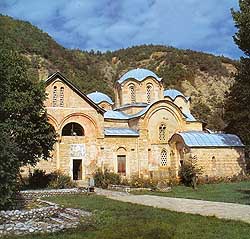
Serbs su u Pecs patriarchy get institution house im je, do certain stepan, replaced independent the state.
(Radovan Samardzic)
The history of the Serbian Orthodox Church is indivisible from the history of the Serbian people. The celebration of the 800 years of the Hilandara Monastery (1998) therefore had a nationwide character. It was an opportunity for the new generations to become better acquainted with the extremely important role that this monastery played in the formation of the religious and national identity of the Serbs.
This year we should celebrate another important jubilee - 450 years since the restoration of the Patriarchate of Peć (1557).
ESTABLISHMENT: The Serbian Orthodox Church received the degree of Patriarchate at the Church-People's Assembly in Skopje on April 9, 1346. On the same day, the archbishop of Pec, Joanikije, received the title of the first Serbian patriarch. It was the result of the spiritual maturity that the Serbian church at the level of archbishopric acquired in the family of Eastern Orthodox autocephalous churches. A week later, on Easter, King Dušan was crowned the first Serbian emperor by the new patriarch. The emperor still addressed the patriarch as "Your Holiness", appeared before him bareheaded, accepted his horse and helped him to dismount.
The seat of the first Serbian patriarchate was in Peja, where from 1253 it was also the seat of the archbishopric. The first seat of the Serbian archbishopric was in the Žiča monastery (from 1219), but due to the danger of increasingly frequent incursions by Tatars and Cumans, it was transferred to Peć, the metoch of the Žiča monastery, at the entrance to the Rugovska gorge, to a safer place.
SHUTDOWN: After Dušan's death (1355), there was no stronger personality in Serbia who would have maintained its integrity. The supremacy was given to regional lords who did not respect the central authority of the minor emperor Uroš, from a folk singer named Unknown. After the tragic Battle of Marička (1371) and especially the Battle of Kosovo (1389), the integrity of the Serbian state, which was consolidated to some extent by the despot Stefan Lazarević, but which, compared to Dušan's empire, was significantly reduced, was rapidly being undermined. In such conditions, even the Patriarchate of Peć could not preserve its integrity, which practically disappeared with the final fall of the Serbian state under the Turks in 1459. It is important to note that with the fall of the Serbian lands under Turkish rule, the Patriarchate of Peć was not formally abolished - there is no written document about that act.
ROBBERY I IMPOSES: After the first attacks in which they carried out large-scale organized robberies of the church and the people, the Turks established a regular levy through high taxes. At a time when "the living envied the dead", the Serbian Church shared the fate of the people. Priests were persecuted, and those who failed to collect taxes from the impoverished people were killed. A large part of the population found salvation in migrations to the north and west, across the Sava and Danube, where they were received by neighboring Austria, but as a human shield as part of the military border with the Ottoman Empire. Together with the people, monks and priests also migrated, carrying with them the greatest national and spiritual values from the old homeland. Thus, north of the Sava and Danube, new spiritual centers for Orthodox Serbs emerged: on the slopes of Fruška Gora, the Grgeteg, Fenek, Hopovo, Krušedol monasteries, Orahovica, Pakrac in Slavonia, Gomirje in Gorski Kotar, and others.
RENEWAL: The Patriarchate of Peć was restored in 1557, and that act itself should be viewed from three aspects: the first in the interest of the Serbs, the second in the interest of the Turkish state and, third, in the interest of the then third-ranking vizier of the Empire, Mehmed Pasha Sokolović.
In their intention to expand the empire across the Sava and Danube all the way to Vienna, the Turks were forced to secure the already conquered territories. This meant the introduction of Christians into the civil service, a loyal local government and the use of local military potential (manpower, logistics). In all of this, the Serbs were mostly thought of, at that time the most present Christian nation in the Empire. In order to win them over, the Turks had to make certain concessions. The greatest concession was the restoration of the Patriarchate of Peć, by which the Serbs "received an institution that, to a certain extent, replaced their independent state" (Radovan Samardžić), but at the same time, in relation to the Empire, "made them even more politically responsible" and obliged them to cooperation.
Bearing in mind that the general interest is the sum of individual interests, in this case the personality of Mehmed Pasha Sokolović, who united the interested parties and found his interest in it, is indispensable. Historical sources say that he is a Turkified Serb from the village of Sokolovići near Višegrad, before that he was a pupil of the Mileševe monastery, who was taken to Turkey as a "blood tribute" as a child. With his abilities, he paved the way in his career, so that as a great magnate, with indisputable war merits, he came close to Sultan Suleiman II the Magnificent and at that time very influential Hurem Sultanate. The restored Patriarchate of Peć was headed by Mehmed Pasha's close relative, most likely a nephew, Makarije, until then most probably the archimandrite of the Hilandara monastery, so that the next three Serbian patriarchs (Antonije, Gerasim and Savatije) would also be from the Sokolović family.
The renewed Patriarchate of Peć, which brought together all the countries where Serbs lived under Turkish rule, would operate for the next 219 years, until 1776, when the Turks abolished it again due to their interests. It was only in 1919 that the unity of the Serbian Church was restored and the throne of the Serbian patriarchs was once again returned to the Patriarchate of Peć.