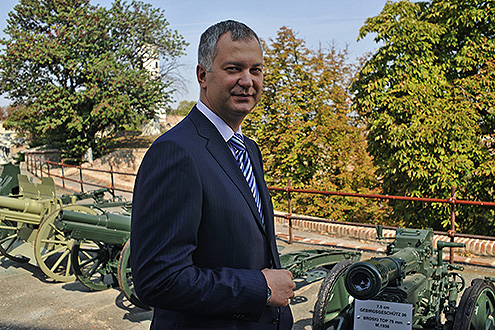
What kind of relationship should we have towards the traditionally friendly countries Greece, Romania, Slovakia, Spain... from whom we expect and have strong support even though they are in NATO. I think that there will be no debate about this for some time, but the moment will come when that important question will also be put before us; it will take enough courage to explain to citizens the benefits of security integration
The drafts of the National Security Strategy and the Defense Strategy of the Republic of Serbia will be presented to the members of the Assembly on October 6. Dragan Šutanovac, Minister of Defense of Serbia, told "Vreme" that this is very significant because these strategies are documents that Serbia has never had before, and together with the strategic review of defense, which the Government of Serbia has already adopted, they represent the three most important strategic documents.
"No matter how strategic those documents are, the parliament can change them, that is not the final value orientation of Serbia," says Šutanovac. "It is an assessment of the situation, challenges, risks and threats, analysis of the future and guidelines for further activities necessary for our country to be stable and secure and to continue to strengthen into a regional leader."
The Minister of Defense believes that there are critics who will say that it should have been done earlier and he agrees with that opinion. However, the fact is that some countries do not have such a strategy even today, and they are very influential around the world. "Bulgaria joined the EU and NATO without having a strategy, Russia only recently adopted a similar document." Those documents are very important and it is good that they are being adopted, even though they are late," Šutanovac believes.
"WEATHER": Amendments to the Law on Defense will also be before the deputies, Law on the Serbian Army (VS), as well as the proposals of the Law on Military, work and material obligation, Civil Service Law, Law on the use of the Armed Forces and other defense forces in multinational operations outside the borders of the Republic of Serbia, of the Law on Military Intelligence and Military Security Agency (VOA and VBA). What are the main novelties brought by this set of laws?
DEAR SHUTANOVAC: The Law on Defense and the Law on the Army were adopted less than two years ago, and in practice it has been shown that some items from those laws are not sufficiently high-quality solutions that are necessary for the modernization of the defense system and complete professionalization. In one part, we are moving the age limit. For example, for certain specialties, for which it is difficult to train a professional soldier, it is illogical that he has to stop working at the age of 40, so the age limit is moved to 50 in some areas.
The law on the use of the Armed Forces and other defense forces in multinational operations outside the borders of the RS is a new, modern law, which should enable Serbia to take an adequate part in peacekeeping operations around the world, thereby raising not only the reputation of the army, but also the reputation of Serbia in the world. According to the bill, the parliament is the only one that can approve going on such operations, and all participants in the peacekeeping mission apply voluntarily.
Practically, all countries of the world that want to achieve international influence take part in peace operations. I believe that this is the future for the Serbian Armed Forces and I wish to protect ourselves from global challenges, risks and threats beyond the borders of our country. That is the modern defense system, the system applied by all the countries of the European Union to which we all aspire. I would like to remind you that back in the 1970s, this activity set Yugoslavia apart from other countries in the region. We had tens of thousands of members of the then JNA who were on peacekeeping missions in crisis areas.
Also, one of the most important systemic laws to be adopted is the law on agencies, which defines the way of work and coordination of those agencies. This is finally put into a normative legal basis, in which there will be no dilemma as to what they can do and in what way. In order for all of this to be controlled and supervised, we are introducing the function of the inspector general, which is a novelty in military agencies.
Inspectors general will not have the ability to lead agencies. They will supervise the work and exercise control, but they will not be able to disable, slow down or in any other way disavow the work. They will inform the highest state authorities if there is a violation of the legal regulations related to the work of the agencies.
What is the actual civilian control over VBA and VOA?
Unfortunately, at the moment that control is not at the level it is in modern democratic societies. With new solutions, we want to raise it to a higher level, and I notice support from the members of those agencies. Although we managed to remove various anathemas that were attached to these services, there is still some echo that certain parts of civil society often use to criticize the defense system and these agencies. I am convinced that with the adoption of this law, with the management control, parliamentary control and public control that always exists, it will be much easier for those agencies to work and they will have better results.
How much knowledge do you, as a minister, really have about what VOA and VBA do and what you see as the biggest problems in their work?
As a minister, I have knowledge of what they are doing, but I don't have complete insight, because for something like that I would have to devote my full time to it. It is practically impossible, and I can say that the quality of the information we receive and the activities carried out by VBA and VOA are satisfactory for me. The fact that in the last two years we have had no scandals in the defense system, and we have also had activities to combat abuse of position, unequivocally indicates that, above all, the VBA does its work in a quality manner.
There are debates about Serbia's military neutrality or joining NATOu. What and how much army we need in one option or another?
Defining the numerical state of the army is not related exclusively to membership in NATO or to our neutrality, of course if we opt for membership then we belong to a system in which we need a smaller army. NATO partners never told us "you can't have more than this many troops". All the armies of the world depend above all on strategic projections as well as financial resources. If you have enough of them, you can organize the army however you want. Of course, modern armies have modern weapons that do not require a large number of men. I think that the current overall structure in the system, with complete professionalization and the number of 36.000 members of the entire Ministry, is a numerical state that can fulfill all tasks.
Unfortunately, in the past twenty years, Serbia has not approached the acquisition of modern equipment and weapons to the extent that it was necessary, and we are waiting for that as part of the reform. However, modernizing the technique is the easiest part of the job if you have the money. What we are doing now is a much more difficult part of the reform.
What is, in your opinion, a better solution for Serbia, military neutrality or joining NATOu?
That dilemma currently exists only in public. Nobody from NATO offered us to join them. Serbia has not yet fully participated in the Partnership for Peace. I think that within that partnership there are a large number of opportunities and quality activities that Serbia has yet to take advantage of.
The fact is that there is a decision of the parliament on neutrality, such as the fact that this decision was not made on the basis of strategic documents and a strategic vision on cooperation in the future, bearing in mind that Serbia will very soon be an island in NATO, because all countries in environment to be in NATO or to have NATO forces on its territory. What kind of relationship should we have towards the traditionally friendly countries Greece, Romania, Slovakia, Spain... from whom we expect and have strong support even though they are in NATO. I think that there will be no debate about this for some time, but the moment will come when that important question will also be put before us; it will take enough courage to explain to citizens the benefits of security integration.
Can we expect members of the Serbian Armed Forces to go on missions that would include combat operations?, like the one in Afghanistan, in addition to previous missions in which members of medical units mostly participated? Is the Serbian Army technically equipped and trained for such operations??
That option is too far away and at the moment we are only discussing the options of participating in peace operations that are less complex and for which we believe that we can provide assistance to international forces in the short term. We are currently present in Chad, Congo, Liberia and Ivory Coast. Our presence in the mission in Chad is attracting worldwide attention. We believe that there are several peacekeeping missions where our presence would be significant.
Afghanistan existed as a topic in 2006. I remind you that the government of Vojislav Koštunica made a decision to participate in that operation with a medical team. I am sorry that that decision was not implemented, just as I am sorry that the decision on the participation of our members in the mission in Afghanistan from 2003, when the then Prime Minister Zoran Živković proposed it, was not implemented. I am convinced that certain problems that arose on the territory of Serbia after that time would certainly have been avoided if we had been partners in the collective security system.
At the moment, we have the necessary equipment for the peace operations in which we participate. For some larger ventures, we would certainly have to talk to partners to find a way to secure certain funds. Those means are not combat in the sense of airplanes, artillery, they are mainly air and land transport means, helicopters or armored vehicles.
What is the situation in the armed forces in the conditions of the financial crisis? What had to be given up??
In the last two years, we have been spending the budget funds very carefully. Although we now have less money than planned for some things related to infrastructure and procurement of modern weapons due to budget rebalancing, the problem on the ground is not felt to the extent expected. This indicates that there is a lot of room for savings and that a large amount of money was "leaking" and that there was no real control. With the new formation, we are introducing even greater financial control, which is an important prerequisite for civil control as well.
Unfortunately, we have not been able to complete all the projects related to infrastructure, some because of money, some because of the rather bad way of tendering the jobs given by the state. It happened, for example, that we could not finish the base in the south of Serbia in 18 months, and we thought it would be finished in less than a year. On the other hand, we worked on the Batajnica airport and showed that in two and a half months that airport can get an absolutely new look, and that there are companies in Serbia that can perform the works in a high-quality manner.
We bought modern weapons both last year and this year, but the state will have to take a more serious approach to these purchases. In some countries, laws are even passed when serious weapons and military equipment are purchased; we will also have to make a step forward and finally refresh our army.
What is the condition of military facilities and what about their sale?
We sell a part of military buildings primarily to the local self-government, that is, we exchange them for certain residential premises. The fact is that this year the crisis primarily affected those who sell real estate, and my wish is not to sell off our real estate for whatever reason, just to get rid of it. On the other hand, we exchanged a certain number of properties this year as well. I think that work is going slowly but surely. The most important thing for me was that there should be no scandal or abuse, and in these two and a half years we have succeeded in that.
What is the material like?technical equipment of the armed forces, what is most necessary for procurement?
All the serious technology we have is quite old. I'm not saying it's not of good quality, but the Serbian Army is crying out for new equipment, both in the air force and air defense as well as in the ground forces. What we managed to do with our resources was to restore military healthcare, with the idea that it would bring in money that would be self-financing in the future. Modern infantry equipment is necessary, and I believe that we will find money to buy certain anti-aircraft defense systems, as well as aircraft, which are a symbol of the strength of every army in the world. It is difficult even for much richer countries, but it is a long-term investment. I remind you that the aircraft we currently have in the sky are older than 20 years. Studies are being done on the needs, and the army approaches it in a serious and planned way. The plan is to procure armored vehicles, the so-called wheels, as well as other purchases...
Two pilots have died in the last two years. What is the pilot's training?, How many flight hours do they have??
They have many times more rush hours than they used to have. Unfortunately, pilots who die in peace are usually the best pilots. A French aviation pilot who is still being searched for had over 5000 flight hours when his plane crashed into the Mediterranean, recently the commander of their acro group who had countless flight hours was killed in Russia. The fact is that our citizens have weaned themselves off such opportunities because they have not flown at all for years. When it's not flying, things like that don't happen. In conversations with pilots, as well as in a recent conversation with General Đukanović, I was told that anyone who thinks that this will never happen should not even fly. It sounds harsh, but pilots are aware of the risks of their profession. They say that flying is their life.
It was very difficult for me when it happened with Kanas and Ranđelović. With all care and understanding, if we want to have a modern state with a democratic arrangement as a country whose standards we strive for, then we should have such an army and air force. And that carries its own risks.
What is the condition of the fleet of VSand means of communication, what are the needs?
In short, we need everything. Last year, after almost two decades, we bought transport and passenger vehicles and moved the age structure minimally, but still the largest part is over 20 years old. People in the army take care of maintenance, so that even what would have long been thrown away in the civilian world, still works here, and quite solidly, but larger funds are necessary for this type of renovation.
We spent several tens of millions of euros to renew the connection assets and it was the biggest investment in recent years. It will be the most modern part of our system, and it was in the biggest trouble because it was both broken and outdated. The signing of the agreement with the MUP, by which we will further develop the TETRA system, will enable us to have an even better network and to cover the entire territory of Serbia, even though the army is not present on the entire territory like the police.
What is the state of the dedicated industry in Serbia and how much does it work for the needs of the Serbian Army?
At the moment, the defense industry is the largest percentage exporter from Serbia. In accordance with our needs, we buy certain equipment. We have introduced a new approach, helping them to market their product on the world market. All the media in the world dealing with the defense industry reported last year that Serbia recovered its production from the ashes, made a contract of 236 million dollars with Iraq and exported arms and military equipment for about 400 million dollars. Even in this crisis year, I expect us to surpass last year's results.
We have developed excellent cooperation with traditional friends from Arab countries, but we did not act only from the position of the defense industry, but from the position of the entire economy. I think that by the end of the year we will have certain contracts that will show that we have managed to hire our construction operative, metal complex and manufacturers of weapons and military equipment. Only in Iraq can our economy have a quality market for many years that now pays for all services, unlike in some earlier times.
After the explosion at the Prvi Partizan factory in Užice, will security measures be increased in the factories of the dedicated industry?
I proposed to conduct surveillance in all factories operating in the defense industry, even though they are not factories owned by the Ministry of Defense. Unfortunately, those factories were demolished in the 1990s, and then they resumed production in an inadequate way. We cannot blame the Ministry of Defense for the situation in those factories, in a situation where the Ministry of Defense does not have the possibility to give them one dinar of subsidies and influence their work in any way.
I understand that there is a question: why do several hundred people work under contract and for a fixed period of time. This year was good and even more people were hired on a fixed-term basis. We hope that the next one will be like that, but we don't know about the year after that. The people who run those factories do not want to employ more people than is needed in the projection, so that at one moment there is a situation where the factories completely collapse due to excess labor, which is currently a problem for us in the announcement at the Zastava Orzej factory, which is burdened too many employees.
We have to increase the security measures around our surplus ordnance that we haven't completely gotten rid of yet! Someone decided to store ordnance from the entire SFRY in Serbia, and now we pay for the destruction, which is a long and rather slow process.
How advanced is the professionalization process? What is the biggest problem along the way??
In one period, even in my mandate, as well as in the mandates of the two ministers before me, it was not done adequately. With the arrival of the new Chief of the General Staff of the Armed Forces, priority was given to that task defined by the President, and I think that it will now be up to us to achieve what we have fallen behind in. If we had fulfilled those obligations in these three years, I could guarantee that we would finish the professionalization process before the deadline. As it is, now we need to receive from 4500 to 5000 professional soldiers, and it is very difficult to train such a number of quality, structure and employ them in one year. Financial resources are also a problem, but I think that we can overcome these difficulties by managing the finances in the Ministry of Defense in a domestic manner and that already in the second half of next year it will be clear to everyone that the end of the professionalization process is finally in sight.
We are also doing a serious reorganization and systematization of jobs within the Ministry of Defense. In the Ministry itself, there will be practically two and a half times less structured training positions for colonels, from the current over a thousand, slightly more than 400 will remain. We are creating a pyramid of officer and non-commissioned officers that will meet the modern criteria of a serious army.
By the end of the year, we expect the final opening of our office in Brussels within the Partnership for Peace, where we will have many more opportunities for advancement and professionalization, because the largest number of countries with professional armies are in that partnership.
What is happening in the country and the world, what is in the newspapers and how to pass the time?
Every Wednesday at noon In between arrives by email. It's a pretty solid newsletter, so sign up!
Pursuant to the Agreement signed by Partyarch Porfirije and Đuro Matsut on Vidovdan this year, the Government approved 763.100.000 dinars to the SPC. 234.800.000 dinars were immediately paid to the church, and the rest should be paid by the end of November 2026. The document obtained by "Vreme" shows that this money - that is, about 6,5 million euros - is intended for the construction of a new music hall measuring 2315,33 square meters. It is not clear which mosaic it is because the interior decoration was completed in 2020. The public was alarmed by two facts: public money was paid into one of the accounts that SPC has in "Alta Bank", and the second is the suspicion that the money in cash was taken out of Serbia and handed over to certain partners in Moscow. Dejan Nakić is mentioned as the whistleblower, and according to numerous sources of "Vremena" from the Serbian Orthodox Church, he has been mentioned before for various controversies related to the business of the Church.
What can the new government do with people from the security system who have accepted to wage a special, hybrid war against the majority of their citizens on behalf of a regime? What should we do with people who have accepted such rules of the game? We need to get rid of the burden they represent, because they are not capable of doing their job. No, it's not retaliation. From the beginning, the student movement insisted that the state system be regulated, and this implies very radical measures in the security system, where people who have received high salaries for years to follow and harass opponents of the government sit. They have to leave the service. If they're all like that, they all have to go
Students for Time about their experiences with BIA
Invitations to "friendly talks", accusations of espionage, recruitment attempts, threats and surveillance. Doroteja Đenisijević and Lazar Mišić, students of the Faculty of Agriculture, tell "Vreme" what their meeting with the Security and Information Agency was like and what happened when they refused to cooperate
Hidden equipment in a college amphitheater, spyware on a student's phone, surveillance by prosecutors and private conversations on television. After the political change, the question remains as to who manages that system. Judge Milimir Lukić demands the abolition of Bija, an independent investigation and the opening of the file. Predrag Petrović warns that the Service could survive this change too - through new allies
From the documentation that BIRN had access to, it is clear that there were reasons for the National Bank of Serbia (NBS) to enter into a detailed control of the work of Alta Bank much earlier, and some of the risks that the control of the central bank found at the end of October 2026 existed for more than a year. The question is why the NBS did not react earlier
At the moment when the institutions of the Republic are destroyed, when Vučić's octopus is still alive, when people are disgusted by the injustice and the stench left behind by the Essenes regime, we have, as Machiavelli said, only civic virtue as the fuel with which we can return to the beginning
The four independent members of REM are an example of perseverance and civic responsibility. Rodoljub Šabić even, upon leaving the premises of REM, after the sentencing of the Informer, experienced that the Essenes insulted him, hit him with their hands and feet. But that too will soon be over
Vučić pardoned the batterers and Dijana Hrkalović. The election winners should abolish the sultan's power that allows one man to run afoul of the entire judicial system
The archive of the weekly Vreme includes all our digital editions, since the very beginning of our work. All issues can be downloaded in PDF format, by purchasing the digital edition, or you can read all available texts from the selected issue.