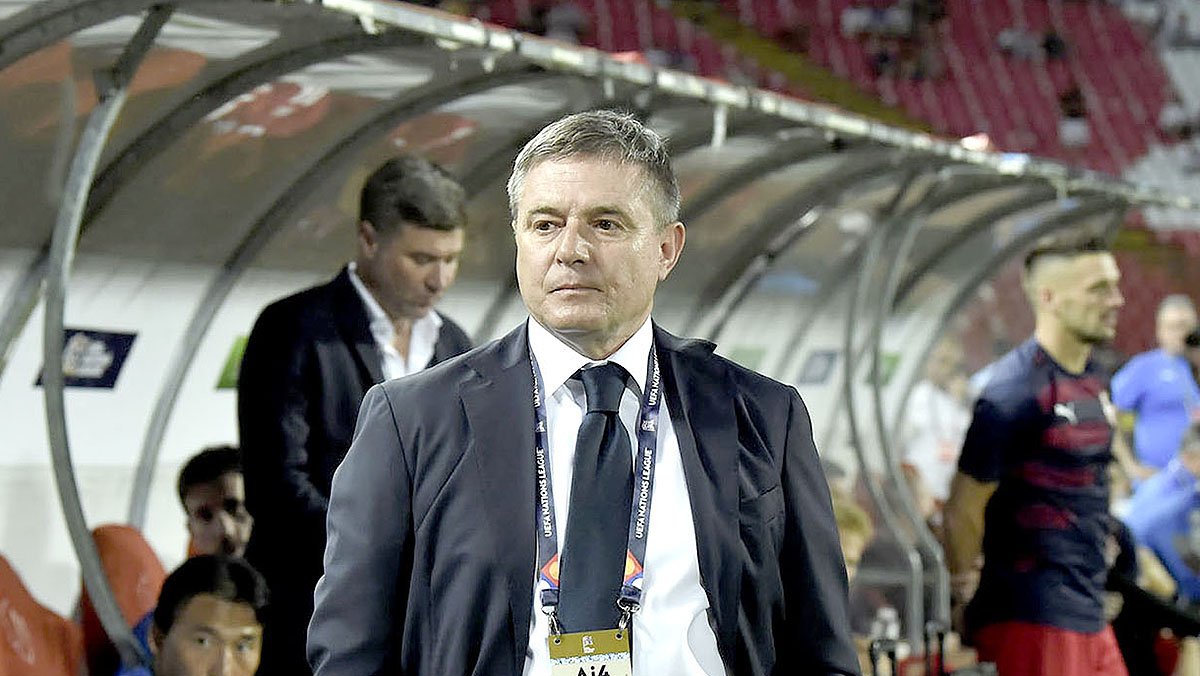
The successful campaign of the Serbian national team through the qualifications for the World Cup in Qatar will be remembered for the goals of Aleksandar Mitrović - "Mitrogol", the assists of Dušan Tadić, the playfulness of Dušan Vlahović and Filip Kostić, new player revelations, attacking play, great combativeness, but all of that would not be there. most football experts, and especially fans, will agree that Dragan Stojković Pixi has not been in the position of selector since March of last year.
With the aura of a great player and, in relation to that, a modest coaching pedigree, in March of last year he took over the position in the ruined Football Association of Serbia and inherited the national team that failed to qualify for the European Championship. Regardless of the fact that he had the support of the public, few thought at the time that this autumn we would play in the biggest football competition and, in addition, enter the first division of the League of Nations.
The biggest optimist was Stojković - he believed that we would be the first in the group with a great team from Portugal and the always tough Irish and he didn't think about a playoff, and he also believed in the game setup that he and his colleagues imposed from the first day. Serbia went through the qualifications without defeat, leaving the Portuguese to sweat in the play-off, and in one of the groups of the B division of the European League of Nations, they also won the first place and secured not only placement in the elite division, but also a better position in the draw for the qualifications for the next European Championship 2024 . year.
He thus repeated the success of Radomir Antic and Slavoljub Muslin, who took the national team to the world championships in 2010 and 2018. But there is an undivided opinion, today our team plays better football, with more goals, similar to some past times when we called ourselves "European Brazilians", and the atmosphere in and around the national team has never been better. Stojković forces attacking football, he likes to compete, just like he did as a player, but he also looks for discipline, responsibility and team play, and what is very important, he managed with his colleagues to restore confidence to the players, he brought positive vibes into team and made them real friends, ready to understand and respect each other.
But, perhaps most importantly, he managed to fight for complete autonomy in his work, both with his authority and attitude, and thanks to the fact that he came after a complete collapse, so he did not have, like his predecessors, tutors, opponents, imposed collaborators and denouncers in Alliance and around him. If the rumors are to be believed, even the one who interferes in everything and decides everything, and who, as it is claimed, amined Stojković's arrival, no longer has the ambition to advise and propose the squad and coaching staff directly or through the mouthpiece. Whether he won't or can't, it doesn't matter, it's important that, as the supreme authority, he makes sure that the state team and FSS don't lack anything. All in all, the painful exit in the group stage at the previous World Cup in Russia 2018 and failure in the qualifiers for the European Championship in 2020 ensured that the current coach can work independently and without pressure from the beginning of the mandate. It was heated up to the nails and many kept quiet in order to allow the man who worked miracles on the field in the national team jersey, to try to work a miracle in the role of the coach as well.
A PEARL FROM NISAV
And the "miracle of players" from Niš was first heard of in the early eighties. Before that, in 1979, Pixie (nicknamed after the hero of the popular cartoon Pixie and Dixie), then fourteen years old (born on March 3, 1965), came to the first training session of the pioneer selection of Radnički, and already at the age of 16 he signed a scholarship contract, just at the time when he played for the first time for the junior representative selections of Yugoslavia (against Bulgaria in Zaječar, October 1980).
He made his debut for Radnički's first team in July 1981 in a friendly match in Negotin with Hajduk-Veljko, and he made his first team debut in April 1982 in Niš against Vardar from Skopje. A week later, he scored his first goal, in a duel with Dinamo Zagreb (1:1). On March 18, 16, when he had just turned 1983, he signed a professional contract with "Real Nišava"; in the next three seasons, he will play 70 league games and score eight goals.
A few days before he became a professional, he made his debut for the senior national team, in a match against France, on March 12, 1983 in Zagreb. In a friendly match in Portugal on June 2, 1984, he scored the first national team goal and won (3:2).
He played 84 games and scored 15 goals for the "A" national teams of SFR and FR Yugoslavia. He played the farewell match for the national team on July 4, 2001 in Japan. It should also be mentioned that he played for the youth national team 26 times, for the youth team four times and for the Olympic team 22 times. With the Olympic team, he took home the only representative medal: bronze at the Games in Los Angeles in 1984.
He just turned 21 years old, but already with the status of the best young player of Yugoslavia, he moved to Crvena zvezda. For more than a year, the competition between Zvezda and Partizan lasted for who would bring a young representative to their ranks: the management of Radnički was ready to come to an agreement with the leaders of the black and white team, but, according to legend, they decided that the Pixies and his father were star players, although it was also said that Dragan Džajić's offer was more generous and that it was the most expensive player transfer in the history of Yugoslav football.
In the red and white jersey, Stojković played 1986 official games from 1990 to 219 and scored 54 goals, many of which are remembered and recounted to this day: directly from a corner against Partizan in the fall of 1987, from a 30-meter volley against Lirija in the summer of 1989. , after he shuffled Milan's defense at San Siro in the fall of 1988, etc. Soon after his arrival, he earned the captain's armband and became the real leader of the team with which he won two national championship titles (1988 and 1990) and one cup (1990). All the star players embraced him and there was no doubt that after Rajko Mitić, Dragoslav Šekularac, Dragan Džajić and Vladimir Petrović Pižon, the club got its new star. And officially, on May 3, 1989, Pixie became the fifth star of Zvezda.
Unfortunately, he did not have success in European competitions in four seasons at "Maracana", and to be honest, neither the draw nor luck were on Red Star's side in those years: in the spring of 1987, they were eliminated by Real Madrid after 4:2 in Belgrade and 0:2 in Madrid; in the fall of 1988 from Milan on penalties, after two 1:1 draws, and in the fall of 1989 from Cologne, as they lost a two-goal home advantage in the second leg.
YEARS OF INJURIES
It was as if that unexpected defeat against Cologne announced that it was time to part with Zvezda: in the summer of 1990, many big European clubs were in the game, but Stojković preferred Olympique de Marseille over Juventus, Milan and Barcelona. After a great start in the new club, a serious knee injury followed, followed by surgery and a longer recovery. Chance wanted Zvezda and Olimpik to meet in the Champions Cup final in May 1991: the recently recovered Stojković played the last eight minutes of the second overtime and at one point mixed up his teammates from yesterday, but luck was with the red and white that evening in Bari; the first and so far the only time the Champions Cup trophy came to Belgrade.
It was not possible for Pixie to justify the nickname "Maradona from the East" in Marseille. The following season, he was loaned to Verona (he scored 19 games and one goal in Calço), and when he returned to the south of France, he hurt his knee again, so he missed winning the Champions League in 1993. In the end, after four years in the Olympic jersey, he scored only 29 games and five goals, but even that was enough for the fans to declare him one of the best players who played at the Marseille Velodrome.
His career was directed in a completely unexpected direction in the summer of 1994 by coach Arsene Wenger, who then led the Japanese club Nagoya. At his persuasion, Stojković went to the Far East and became a legend there.
ENTERING THE LEGEND
But before that, let's go back to his best representative days, when he first became a legend. He somewhat compensated for the failures at the club level with good games and results in the Yugoslav jersey, especially since Ivica Osim became the selector and gave him a leadership role. One remembers the strong passage of the national team through the qualifications for the World Championship in Italy in 1990, then an excellent placement at the championship itself. With his goals against France in Belgrade in the fall of 1988 (a volley after Savićević's cross) and Norway in the summer of the following year (from a free kick), Pixi marked his way to Italy, and then with two grandmaster goals against Spain in the round of 20, he definitely entered the football legend. Even today, it is watched on YouTube and told among football enthusiasts how Pixi breaks Martin Vasquez and the goalkeeper Zubizareta with a fake during the first goal, that is, how the latter scores again from a "free kick" from XNUMX meters.
And just as he was not lucky enough to win European trophies with his clubs, he liked to lead a generation that was kicked out of the European Championship in Sweden in 1992 due to the war in the former Yugoslavia and the sanctions of the Milosevic regime. until 1996. will be excluded from all international competitions. If nothing else, if there were no sanctions, Stojković would certainly be the first to exceed 100 appearances in the national team jersey.
After the permission to perform again, Stojković contributed to our participation in the World Championship in France in 1998 and the European Championship in Holland and Belgium in 2000, and we achieved solid results there.
FOOTBALL EMPEROR OF JAPAN
In Japan, Pixi played for seven seasons and left a deep mark, and he was forever inscribed in the history of the Nagoya Grampus club. His mastery on the field delighted the club's fans, but also all Japanese people interested in football: a square in Nagoya is named after him, one entrance to the Toyota Stadium is called "Pixie Gate", and Toyota made 60.000 copies. special model "pixis". Additionally, Pixie was awarded the Order of the Rising Sun with Golden Rays in 2015, an imperial decoration awarded for outstanding contributions to Japan.
For Grampus, he played 183 games and scored 57 goals, won one Japan Cup, was the best player of the league in 1995 and was selected three times in the ideal team of the championship - 1995, 1996 and 1999.
He played his first farewell match in Nagoya on October 7, 2001, when Nagoya and Crvena zvezda met, while the second one took place in Niš on October 29 of the same year, in a match between his home club Radnički and Vardar from Skopje, the team against which he made his debut in First League of Yugoslavia 19 years earlier.
As a player, Dragan Stojković deserved the status of a grandmaster of the game: he had a great pass, long balls and an overview of the game, which his teammates will best testify to, the same kind of dribbling, which left a mark on the spines of numerous opposing players, defenders and halves in particular, grandmaster crosses and free kicks, nightmares for all goalkeepers who faced him. In addition, and what is necessary to be a great player, Pixi was a leader on the field - a motivator who led and encouraged his teammates with moves and words, fighting and responsible, and when needed, a showman.
NOT A VERY GOOD YEAR
As such, it was logical for him to stay in football and try his hand at other roles after finishing his career. However, the first years after leaving the field were not successful for Stojković. First, in 2001, after democratic changes in the country, he returned from Japan to take over the position of president of the Football Association of Yugoslavia, but in the following four years he did not become famous, especially due to the fact that the national team failed to qualify for the 2002 World Cup in Japan and South Korea, nor to the 2004 European Championship in Portugal.
From that position, he jumped into the presidential chair in Crvena Zvezda and stayed there for two years. If you look at trophies and performances on the European stage, they were very successful - they won two double crowns and in both seasons Zvezda reached the group stage of the UEFA Cup. But, he was practically kicked out in 2006 after he incurred the wrath of the fans because the club, which he took over with debts, took on even more debt in those two seasons, and he was also accused of questionable transfers of certain players.
Since 2007, he has been in Japanese football again, this time as the coach of Nagoya. In the first season, he reached the third place in the championship, and in the third, he brought Nagoya its first national championship title. He stayed on the bench of this club until 2013, and his move in the match with Yokohama in 2009 was also remembered, when he caught the ball that flew out of the field on a volley, while wearing a suit and shoes, and sent it after 40 meters of flight into the net. guest network.
In the summer of 2015, he took over the Guangzhou team from China and stayed there for four and a half seasons. It remains recorded that at one point he was among the highest paid coaches in the world, with an annual salary of seven million euros.
NEW GLORY
Although he had success in Japan and a large salary in China, Stojković's coaching qualities were viewed with suspicion by a good part of the football public. But, after a series of representative failures and troubles that befell the FSS after the mandate of the progressive Slavisa Kokeza, the new selector got the opportunity to work independently, and the entire beheaded Federation practically fell into his lap; many claim that he is the actual acting president, not Nenad Bjeković.
The only ones who called him names in the past year or so were the "stars" - club director Zvezdan Terzić and a group of fans close to him. Terzić accused him of illegally taking over the leadership of the Association and of working against Red Star in the championship, and last summer, when he came to the final of the Serbian Cup at the "Rajko Mitić" Stadium, the fans unfurled a banner with the inscription: "She was never yours, you you were never hers, every star remembers the decade-long flood after you. Sayonara". However, this did not hinder him in his work and he continued to achieve lower results.
From the first day, the new coach radiated optimism and confidently said that we will play in Qatar, and with each match of Serbia in the past year and a half, his attitude gained weight. In the qualifiers for the World Cup, Serbia recorded six wins and two draws and as the first placed secured a trip to Qatar, with a victory in the decisive match in Portugal, despite the home team's lead. Especially that game showed that Pixie's team has knowledge, fighting spirit, responsibility, and character.
Everything was then confirmed in the group stage of the League of Nations, where four wins, one draw and one loss were recorded, the only one for Stojković in official matches (out of 14 matches, he won ten and drew three). And the icing on the cake was the victory in Norway ten days ago, which was a dress rehearsal before the trip to the Arabian Peninsula and a new dose of optimism for all fans.
And Mister, as he is called by the national team members after the example of the Italian clubs, and as he himself wished, continues to spread optimism and points out that he believes that Serbia can reach the end of the World Cup, regardless of the fact that it is in one of the strongest groups. In order to pass the group stage, one must be at least second in a group with five-time world champions Brazil and very good teams from Switzerland and Cameroon, and in order to reach the finals, and among the optimists this means the semi-finals, it is necessary to beat two more strong teams. representation.
Our fans don't need much to aim for medals and glorify our qualities and capabilities, we did that even when we didn't even come close to these results and a quality and well-integrated team, and how is coach Pixi, who promised victories and good football when we were " in the channel" and fulfilled the promise, expectations have risen drastically.
There are not many chances that Serbia will reach the semi-finals of the World Cup, as some are now predicting, but it is realistic that they will enter the top 16, maybe even make a feat and reach the quarter-finals. But what is quite certain is that this time the national team will not calculate and look to save their goal first of all, but will play, as they showed last year and this year, attacking and scoring more goals, just like Pixi did during his playing career - from the Chair, through the Maracana and the Velodrome, to Nagoya and elsewhere around the world.