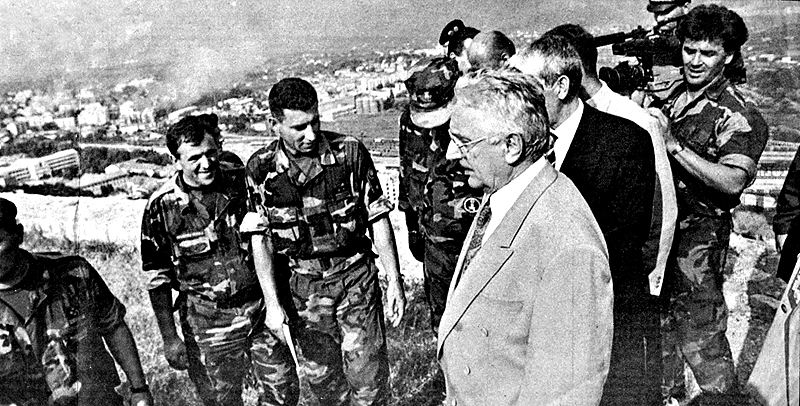
"This is not how barbarians work, this is not how vandals work - those who are paid for the spoils of war, those who wage war for the spoils of war," roared General Ante Gotovina in front of the camera at a meeting with his subordinate officers in Knin on August 5, 1995. He was referring to an orgy of arson and looting followed by the murders of old men left behind in the villages and prisoners of war captured in the chukkas after the Croatian army occupied Krajina. However, neither Gotovina nor HV Police Commander Mladen Markač did anything to prevent these crimes and bring their perpetrators to justice. On the contrary. Gotovina's yelling at his subordinates had a completely different goal: his commander-in-chief and President of Croatia Franjo Tuđman was coming to Knin, and somehow it is not convenient for journalists and some diplomats to pass by houses on fire, corpses of civilians in yards and trucks loaded with looted white goods and other technique... As for the rest, everything was fine: in the area where they lived for more than four hundred years, there were no more Serbs. That idea of the highest command - Tuđman and his associates such as the Minister of Defense Gojko Šušek - has been fully fulfilled.
A BRIEF CHRONICLE OF THE CRUSH: That Krajina cannot survive was already clear in 1991, as soon as the great powers adopted the position of the Badinter Commission that the borders of the former Yugoslav republics are considered to be the borders of future independent states. However, the question remained open as to how Zagreb would establish its power in Knin and under what conditions: namely, few believed that Tuđman's rigid nationalist regime would respect the civil and national rights of Serbs. In addition, Slobodan Milošević was also there. It was his regime - as the forerunner of Tuđman's - that drew the borders of the Krajina by abusing the Yugoslav People's Army and maintained it with all kinds of military and logistical support. Even more important was the fact that Milosevic appointed and firmly controlled all Krajina leaders.
At the beginning of 1992, both Belgrade and Zagreb accepted the peace plan of former US Secretary of State Cyrus Vance. Divided into four zones under the control of United Nations peacekeeping troops, Krajina had to reach its final status through negotiations. However, no matter how silly Milošević and his Trabants pretended to be in Belgrade and Knin, it was understood that any solution reached would be within the borders of Croatia. At the same time, Tuđman also faced the fact that he would have to agree to Serbian autonomy - the only question is how much.
However, in accordance with the law of connected vessels, since 1992 the status of Krajina has been linked to the bloodshed in Bosnia and Herzegovina. Looking for a way to divide it, Milošević and Tuđman gained a wide field for mutual trading, trickery and blackmail. The fate of Krajina, in that context, was nothing more than a coin to change. Held from time to time, the negotiations between Zagreb and Knin were therefore nothing more than conversations of the deaf. However, the relationship between Milošević and Tuđman was quite different: the two of them intensively talked and agreed at various peace conferences and negotiations (forty-eight times in total), and Hrvoje Šarinić, as Tuđman's special envoy, secretly met seventeen times with Milošević in Belgrade from 1993 to 1995.
Nevertheless, how the then government in Zagreb intended to establish its power in the Krajina was seen in 1993. If the aim of the surprise attack of the Croatian army in Ravni Kotari was to establish a land connection between central and southern Dalmatia with the rest of the country via Maslenica, the raid in the Medac pocket had only one result: eighty-eight Serbs killed, including thirty-six civilians - twenty people were over sixty years old. In return, by order of the Krajina leaders, civilian targets in Croatian cities were shelled... From then until August 1995, periods of fragile truces and conflicts on certain parts of the front would alternate.
The hope that it would be possible to resolve the status of Krajina peacefully appeared in mid-1994, when the United States of America, Russia and the European Union proposed the Z-4 Peace Plan, according to which the Serbs would receive broad autonomy in Croatia. Although Tuđman was never ready for such a solution, he at least took the plan "on notice" in the hope that one way or another he would find a reason to reject it in the future. He didn't even have to try. As Plan Z-4 spoiled Milosevic's combinations in Bosnia and offered a similar precedent for Kosovo, the Krajina leaders, on his orders, also refused to receive this document of fifty-eight pages of A4. After that, not only was there no hope for the autonomy of Krajina, but the survival of the Serbs in the territories where the majority lived for four centuries came into question.
LAST DAYS WITHOUT DEFENSE: The Krajiska border was more than a thousand long, and the depth of the territory was between thirty and fifty kilometers. A member of the Serbian Army of Krajina was forty-seven years old on average, and there were companies with an average age of fifty-six and brigades with an average age of fifty-three. And one more thing: the SVK brigades actually represented weak battalions, battalions - weak companies, and companies - weak platoons... In short, without significant military technical support and, especially, manpower from Serbia and Republika Srpska, before the comprehensive offensive of the Croatian Army, Krajina units could only offer extremely short-term and symbolic resistance. And to make things even worse for the Serbs in Krajina, the negotiation strategy of Richard Holbrooke, the special envoy of US President Bill Clinton, was based on exploiting this balance of power.
It all started when the Croatian government engaged the company in silence Military Professional Resource Inc. (MPRI), whose personnel consisted of retired American generals, diplomats and, in general, people before whom all doors in the Pentagon open wide. The essence of hiring this company is not in the training of troops or in the development of plans for war operations, or even in circumventing prohibitions related to the acquisition of weapons... When generals from the MPRI accept the job, it is the best sign that the one who hired them received the blessing and support Washington to achieve its military goals. And what Croatia's goal was in the summer of 1995 is well known.
American General Charles Boyd later said that Zagreb would never have launched "Storm" without support from Washington. There should be no doubt in his words, nor in the fact that Holbrook very plastically explained to Milosevic the real importance of the general from the MPRI. The last chance - if it still existed at that moment - to resolve the status of Krajina through negotiations and with major concessions to Zagreb, was sacrificed by the then President of Serbia by making deals with the American "bulldozer diplomat" related to the territories and position of Republika Srpska within BiH. And as Tuđman had to give up his beloved son, the parastatal Herceg-Bosnia, in that area, he received a free hand in Krajina as compensation. How they will use it - and that is well known.
BRION PLENUM: The Croatian army occupied western Slavonia with its center in Okučani in operation "Bljesak" on May 1, 1995. The fall of that part of the Krajina was briefly recorded by the then state TV Dnevnik in Belgrade in the seventeenth minute. No help came from Republika Srpska Radovan Karadžić and Ratko Mladić, with whom the leaders of Krajina were so united.
The fate of Krajina, left to itself, was sealed. The last attempt to avoid the "Storm" took place on August 3, 1995 in Geneva. Realizing what time it was, the Krajina delegation signed the Peace Plan Z-4 at the negotiations under the auspices of the co-president of the Conference for the former Yugoslavia, Torvald Stoltenberg. However, it was too late. Croatian negotiators demanded only one thing - immediate capitulation. That they had reason to be confident is also evidenced by the fact that the Krajina delegation unsuccessfully tried to get instructions from Milošević in Belgrade before their trip to Geneva. According to Vladislav Jovanović, then Minister of Foreign Affairs of the Federal Republic of Yugoslavia, he was on vacation and did not intend to interrupt it, while the Croatian army was occupying its starting positions...
Thus, Tuđman was able to get rid of the Serbs once and for all. For him, they primarily represented a "disturbing factor" in Croatia, and by no means the citizens of the country he was at the head of. This was precisely the meaning of Tuđman's speech at the consultation immediately before the "Storm" in Brioni; this is exactly what he meant when he said "that the Serbs must be dealt a blow from which they will never recover", "that the Serbs should be given a chance, all while supposedly guaranteeing their human rights" and the like. Ante Gotovina, Mladen Markač and others present understood him very well. They knew what to do - questions and sub-questions were not needed.
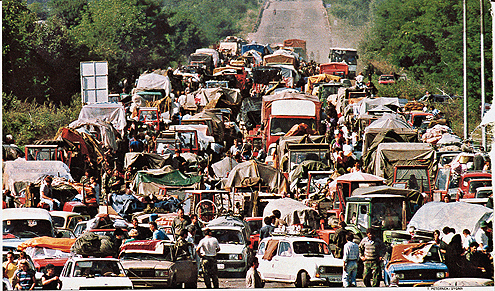
EPILOGUE: Krajina was on its knees on August 4, 1995. The collapse of the Serbian forces there is therefore neither a large, nor an ingenious military operation. The shelling of small towns in Krajina, the attack of MIGs on the refugee column near Bosanski Petrovac, propaganda aimed at causing panic in order to leave their homes and - above all - giving a free hand to anyone who wanted to rob, burn and kill in the Croatian army, there was nothing else. until the implementation of Tuđman's grant "Serbs of the Road". Gotovina and Markač, as the executors of that plan, didn't even have to order anything in particular - it was enough for them to wink, turn their heads, triumphantly pounding into the chests of the general and the national. If that is not a joint criminal enterprise - then what is?
During the "Storm", more than 220.000 Serbs fled, and around 2000 people died or went missing. The return of some of these people was painful and difficult: years and years will pass while the Croats brought in as part of Tuđman's ethnic engineering move out of their houses. It will take even more to rebuild their burned homes, and today there are very few Serbs in the state administration of Croatia...
Seventeen years have passed since the fall of Krajina. After the verdict of the Appeals Chamber of the Hague Tribunal acquitting Gotovina and Markač of joint criminal enterprise, Croatia is in national ecstasy, and Serbia is outraged by the injustice. Nationalists and chauvinists on both sides ride like they haven't for a long time. It is also possible that the president of Croatia, Ivo Josipović, a man otherwise personally responsible for the process of improving Serbian-Croatian relations, looks like a promising cadre from Tuđman's headquarters while receiving the freed generals; it is also possible that Tomislav Nikolić, Ivica Dačić, Aleksandar Vučić - not to mention others such as Uroš Šuvaković or Milovan Drecun - who during the nineties supported and implemented the most disastrous policies of Milošević, including the one in Krajina, become champions of international justice. Indulging in the cheapest political populism has always been profitable.
However, this in no way changes the fact that the Appeals Chamber of the Hague Tribunal made a wrong and deeply unfair decision. War crimes - of course - cannot and must not be divided into "ours" and "theirs". Nevertheless, members of the military and political leadership of Serbia, Krajina and Republika Srpska were punished before the Hague Tribunal for crimes committed from 1991 to 1995. No one was convicted of ethnic cleansing and other crimes committed against Serbs in Krajina before the same court. It is not and cannot be good. Not because of the past - it is the way it is, but because of the future that everyone, including Gotovina, is talking about so much.