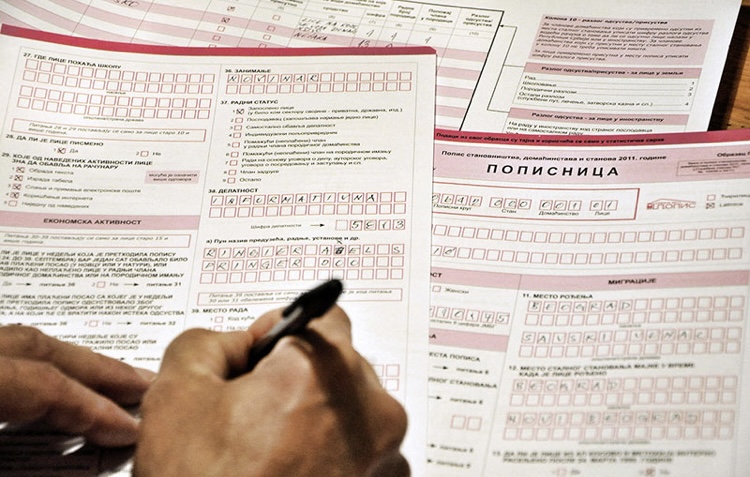
One of the methodologists Population census Dejana Đorđević of the Republic's Statistical Office (RZS) stated that in the Belgrade region the number of inhabitants increased by 1,6 percent, while the decrease in the number of inhabitants was recorded in all other regions by about 10 percent.
The largest population lives in the region of Šumadija and Western Serbia - 1.834.791. There are 1.749.356 inhabitants in the Vojvodina region, 1.685.563 in the Belgrade region, and 1.421.177 in the Southern and Eastern Serbia region.
The municipalities with the largest population decline are Crna Trava, Gadžin Han, Rekovac and Babušnica, and the municipalities with the largest population increase are the Belgrade municipalities of Zvezdara and Voždovac, as well as Novi Sad and Novi Pazar.
Đorđević said that a total of 2.520.854 households were enumerated, and that the number of households increased by 1,3 percent. A slight decrease in the number of households was recorded in the region of Vojvodina and Šumadija, and a slight increase in the number of households in the region of Southern and Eastern Serbia, while in the Belgrade region the number of households increased by 7,7 percent.
The total number of listed apartments is 3.628.175, which is 2011 percent higher than in 12,3. The increase in the number of apartments was recorded in all regions, and the highest in the Belgrade region, by 18,6 percent. The municipalities with the largest increase in the number of apartments are Čajetina and Sokobanja, the Belgrade municipality of Zvezdara and Novi Pazar, while Nova Crnja, Sečanj, Bač and Alibunar are the municipalities with the largest decrease in the number of apartments.
RZS Director Miladin Kovačević mentioned the orderly census in the south of Serbia, in Bujanovac, Preševo and Medveđa, as one of the successes of this year's Census. "Albanian population was properly enumerated. That part of the population boycotted the 2011 census. "Now we had completely smooth and normal cooperation, complete trust in the Republic Institute of Statistics," Kovačević said.
When asked how many Albanians were enumerated in those three municipalities, Kovačević replied that "the total number of enumerators that entered the database is about a hundred thousand, and that the contingent of the usual present population is somewhere around 61.000 - 62.000".
MN/FoNet
Read daily news, analysis, commentary and interviews at www.vreme.com