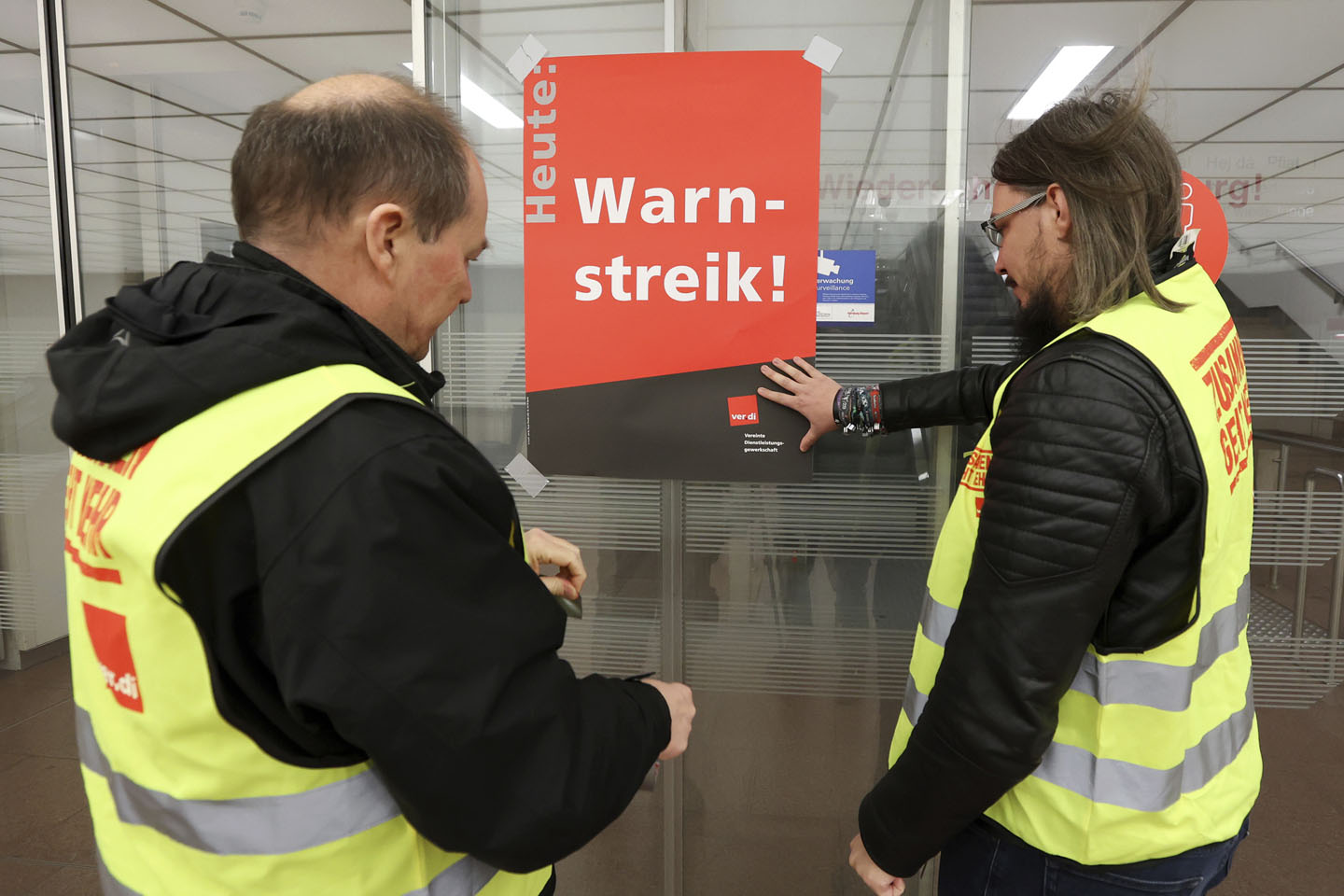
A two-day strike by flight attendants and Lufthansa staff began in Germany. Millions of travelers across the country were affected. In the railway transport sector, only every fifth train runs, it says "Deutsche says" (DW).
This is already the fifth strike organized by GDL, the union that represents the interests of train drivers, as part of negotiations on a new collective agreement. The strike in the travel sector started on Thursday morning at 2:8 am and is scheduled to last until 13:XNUMX pm on Friday, March XNUMX. Railway traffic has largely been suspended. Millions of travelers across the country were affected. German railways have re-introduced an extraordinary timetable, and according to some reports, approximately one in five lines is operating. There is also a strike in freight traffic, and train drivers in that sector stopped work already on Wednesday evening. German Railways announced that it expects normalization of traffic only on Saturday.
In parallel with the strike of the train drivers, in the next two days the Lufthansa staff will also stop work at several airports in Germany. These are people who work, for example, on security controls. On Thursday morning, several airports formed long lines of passengers waiting for controls. Numerous flights have been canceled due to the strike, and there are also major delays. The airport strike is also expected to end on Friday. According to the Airport Association (ADV), about 250.000 passengers in Germany were affected by this action.
The union does not agree to compromise
After heavy criticism for the new strike, the GDL union announced that it was not satisfied with the compromise proposal of the mediators who tried to "reconcile" the train drivers with the management of German Railways in recent weeks. GDL demanded a reduction in the number of weekly working hours from 38 to 35 with the same salary. External mediators proposed a gradual reduction of working hours (until 2028) to 36 hours a week, with the same salary - which the Railways accepted, but GDL refused, as confirmed by the head of the Union of Train Drivers, Klaus Veselski. He also announced that in the future GDL will not announce strikes in advance (and it was about a deadline of at least 48 hours), as it has done so far. A spokeswoman for German Railways said that in that case the company would not even be able to offer passengers an extraordinary timetable, which means that railway traffic could completely collapse.
The conflict between GDL and German Railways is causing increasing concern (and frustration) in economic and political circles. Federal Minister of Economy Robert Habek (Greens) signaled that he no longer understands the GDL strike.
"It should be possible to find a solution, that is, not to fight for one's own interests so radically at the expense of others." "I don't think it's right anymore," said Habek.
And when asked what he thinks about the moves of the head of GDL, whom many accuse of stubbornness and unwillingness to reach a compromise, the minister added that the moment has come when an urgent solution must be found: "I really don't understand it anymore," he said.
Unannounced strike
As for the situation at the airports, those in Frankfurt am Main and Hamburg are the hardest hit so far. Dusseldorf Airport confirmed on Thursday morning that there is also an unannounced strike at passenger control.
"Due to the unannounced strike, the airport and its partners could not prepare for that work stoppage," it was announced.
Due to the unannounced strike at that airport, during the morning hours, there were huge crowds in front of the security checkpoints, that is, the entrance to the terminals.
Ifo-Institute President Clemens Fuest called the current mega-strike, as it is called in part of the German media, i.e. the simultaneous suspension of work in the railway and air traffic sectors, an additional blow to the already weak conjuncture in the country.
A blow to the German economy?
Fuest agreed with the opinion of some other economic experts who claim that the recession, which Germany is currently sliding into, reduces the level of willingness to compromise in negotiations over collective agreements.
"The shared pie is getting smaller and the conflict is getting more intense. It is much easier to make concessions in conditions of economic growth, than when one's back is against the wall anyway," he pointed out.
Fuest also added: "These are systematically important areas, the entire population is affected by this strike." And that's why you should think about whether all that is still appropriate. At least something could change in the rules of the game. For example, to say that there are no strikes as long as negotiations on collective agreements continue".