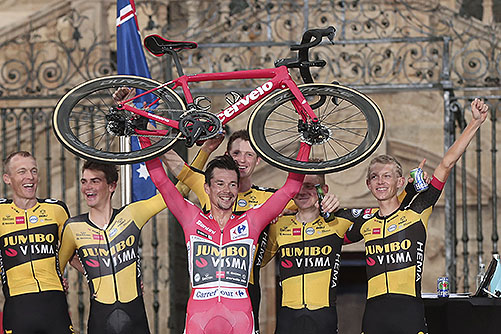
The Slovenian Primož Roglič earned several nicknames, the Beast, the Predator, the Machine, the Terminator, and all those nicknames are valid at the same time: the man, simply, rips. If he gets the chance to win a stage, nothing will stop him from doing so, not even some better cycling customs, such as the first place winner not having to take the stage win away from a lower placed cyclist who rode bravely. The man, however, just likes to win. In the last stage of this year's Vuelta, which was raced against a time trial – the cyclist, namely, tries to cover a stage several tens of kilometers long as fast as he can, fighting against time – in the last 100 meters he arrived and overtook the second-placed Spaniard Enrique Massa. Just to remind you: in the time trial cyclists start every two minutes, so Mas started two minutes before Roglic, and in the end Zver overtook him in the last 100 meters and thus sealed his third Vuelta in a row.
The Vuelta d'Espanya (Circle of Spain), along with the Tour de France and the Giro d'Italia, is the biggest cycling race in the world. It is something like the Grand Slam in tennis, it is driven for 21 days, it is about 3500 kilometers long and it is terribly tiring. With three victories in a row, Primož Roglič ranked among the greatest cyclists that this sport has, and in recent cycling history, only the Englishman Chris Froome managed to win one big race three times in a row (Tour de France). Today, Primož Roglič, together with another Slovenian, Tadej Pogačar, is undoubtedly the best cyclist in the world. Roglic completely dominated in Spain and, in the end, won by four and a half minutes ahead of the runner-up, which is a huge difference.
Roglič came to last year's Vuelta after the Tour de France, the most difficult race in the world, which takes place only a month before and where he lost to his compatriot Tadej Pogačar in the last, epic stage. Three big races are run in just two months and it is impossible to participate in all three, and it is barely possible to participate in two. Therefore, Roglič came to the Vuelta still unrecovered after the Tour, fought like a lion and in a sort of gigantomachy won with a 14-second advantage over the Venezuelan Ricardo Carapaz.
This year Roglic participated in the Tour de France as well, but already in the third stage he fell so hard that he was left, roughly, without half the skin on his body, so he soon had to give up, and he won the Tour, for the second time in a row, of course , Tadej Pogačar (see "Vreme" no. 1594). That fall, however, allowed Roglic to prepare well for Spain. Meanwhile, at the Olympics, he overwhelmingly won the time trial and, rested and eager to win, wiped out his opponents, among whom, along with Enrique Massa, were the Australian Jack Haig, then the winner of this year's Giro and the Tour de France in 2019, the Colombian Egan Bernal (who , truth be told, he has not fully recovered from covid), the second Colombian Miguel Angel Lopez, the Englishman Adam Yates, the outstanding Dane Magnus Kort Nielsen, the French Guillaume Marten. So, the cream of world cycling with its great teams, as well as the great Spaniard, 41-year-old Alessandro Valverde, or the legendary Italian Fabio Aru, who just said goodbye to cycling at the Vuelta.
Despite Roglic's dominance, this Vuelta was, in many ways, uniquely exciting.

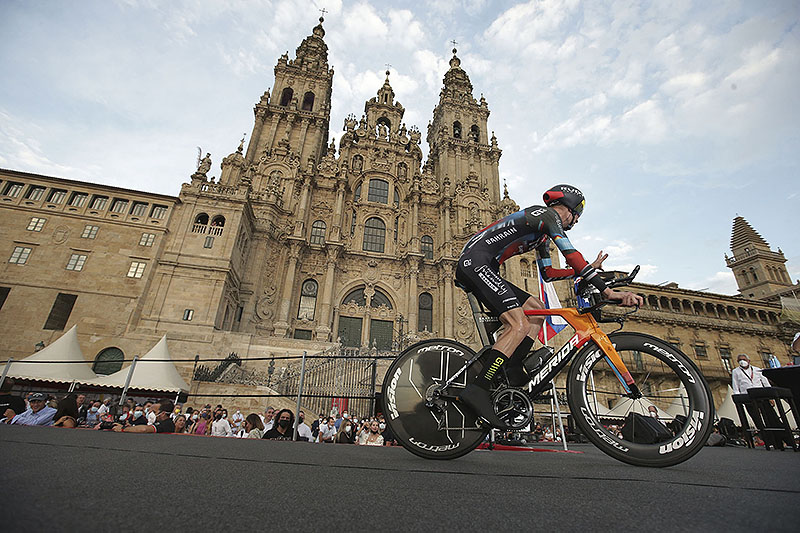
photo: ap photo / luis vieiraSANTIAGO, SPAIN: Australian Jack Hague on the road
THE FALL OF VALVERDE
Already in the first stage in the time trial, Roglič takes a red shirt - for those who do not follow cycling closely: in the Tour de France, the leader in the general classification wears a yellow shirt, in the Giro d'Italia, that shirt is pink, while in Spain it is red - but in the following days, in straight stages, he loses that shirt. Stages without significant climbs are used by teams with strong sprinters: the team leads the sprinter to the last few hundred meters, and then the best sprinters compete among themselves. This year, the German Fabio Jakobsen was dominant, who competed with the Belgian Jasper Philipsen in the first few stages, but Philipsen soon gave up and Jakobsen finished the Vuelta in the green shirt as the best sprinter.
In the fourth stage, the Frenchman Roman Barde and the Spanish Mikel Nieve, who are among the favorites, experience a heavy fall 11 kilometers before the finish line, they continue to drive, but lose their chance for the overall ranking. In the sixth stage, in which Magnus Kort Nielsen runs ahead of everyone, on the climb of Alto de la Montaña de Cujera, Roglič demonstrates his strength for the first time after the first stage: on a terrible slope (more than 20 degrees), he "jumps" and leaves his biggest competitors behind ( compared to Roglič, the others look as if they have hit the wall), Nilsen arrives and enters the finish line as the runner-up, but again breaks out into the first place in the general standings.
The seventh stage goes to the young Australian Michael Storer, who will assert himself in the following stages with his courage and fighting spirit: every now and then he breaks out to the front of the race and drives alone. (Again for those who follow cycling less closely: the one who tries to "escape" the main group faces air resistance that exhausts cyclists incomparably more than when they ride in a group, i.e. in the lee. When a cyclist rides in the lee behind someone else, he spends 30 percent less power than the one that "breaks through" the air.) The seventh stage, however, was marked by a heavy fall of the great Alejandro Valverde: he is on the descent, 43 kilometers before the finish line, flew over the protective fence and ended up at the bottom of the ruins, with fractures. Although he managed to climb to the road on his own, the first medical examination revealed a fractured right shoulder.
The ninth stage is exciting, the great Italian Damiano Caruso escapes in front of the main group, only for Roglic and Mas to chase after him on a strong climb. It was fascinating to watch how, one by one, the great cyclists Yates, Lopez, Bernal, Haig (not to mention the others) fall away, and in the last few tens of meters, Roglic leaves Masa behind and the second one reaches the finish line. The tenth stage is again won by Michael Storer, and then the 11th stage and a fierce battle between Roglic, Massa and Lopez. The fantastic Magnus Kort Nielsen was already seen as the stage winner, but he wasted a lot of energy driving alone in front of the group. At 1800 meters before the Valdepeñas de Jaen finish, cyclists hit the wall at an angle of as much as 26 degrees. Roglič, Mas and Lopez stand out from the group and start chasing Nielsen, they reach him in the last 300 meters and pass him as if he is standing still (while they are "running" at 15 kilometers per hour). Then Roglič and Mass increase, Lopez cannot follow it, so that the two leaders, while sprinting outside the seat (they are not sitting on the seat but pedaling while their buttocks are in the air), collide in the last fifty meters. Nevertheless, they stay on their bikes, Roglič crosses the finish line ahead of Mas with a two-second lead, and immediately afterwards they apologize to each other for the accidental collision.
THE FALL OF ROGLIC
The twelfth stage is finally won by the strong Kort Nielsen, who sprints equally well, goes uphill and downhill, but the stage was marked by Roglic's fall on the downhill. Very early on, on a sharp climb some 14 kilometers before the finish line, Roglič unexpectedly attacks alone and in his destructive style makes a big difference to his followers for a while, reaches the top of the climb with a fine advantage and rides bravely on the descent. But, in one corner, which he obviously enters too quickly, his rear wheel slips, Roglič falls on his side and slides about ten meters on the asphalt, to stop right in front of the guardrail. It all seems very unpleasant, but immediately afterwards, by the way he gets up, prepares his bike and moves on, it can be seen that the fall had no serious consequences. At the finish line, Roglič will say that it was nothing, that it was all fun ("wasn't it?") and that there is no glory without risk. Exactly. However, taking into account the number of times Roglic has crashed here this year - and he crashed both in the Tour de France and the Paris-Nice Classic - word began to spread that Roglic can only be stopped by himself: crashes.
In the 14th stage, which was won by Roman Barde with a fantastic drive, the Australian Jay Wine experienced a terrible fall when, at high speed, while the coaches were giving him water or food from the team car, he lost his balance and fell. The first reaction was whether Vine would continue the race at all, and he not only got back on the bike but, in the end, managed to "win the podium", that is, to be in third place. In the 16th stage, the second-placed Enrique Mass and one of the favorites, Guillaume Martin, experience a nasty fall, both of them return to the race, and Mass even manages to stay in the lead.
ATTACK ROGLIC
And then the fantastic 17th stage, which ends on the legendary climb near Lake Covadonga. Forty kilometers before the finish Roglic and Bernal attack on a sharp climb and build a very decent lead over the pack, and continue to ride alone at the front, thus repeating the famous battle between Alberto Contador and Alejandro Valverde from 2014. However, if the duo can make an advantage on the climb and if they can maintain the difference from the main group on the descent, on a flat road it is almost impossible, even if the cyclists are called Roglic and Bernal. Unless, of course, if, as they say, they don't work together, which means they take turns, first one breaks through the air and the other gathers strength in the lee, and after a while they change places. In addition, both are fantastic time trialists (Roglic is also an Olympic champion), which helps in these situations.
You should have seen how the two angry enemies cooperated, how Roglič was literally drooling from the effort (but there was no time to wipe himself), so that they reached the last terrible climb exhausted. The group is getting closer to them, Bernal's face is contorted in pain, and Roglich finds his pace and, without getting up from the saddle, pedals hard and walks away from Bernal. The main group eventually arrives and overtakes Bernal, but not Roglic. The great American Sep Kus finishes in second place and Lopez in third.
The eighteenth stage, with the goal at the Gamoniteiro Peak (Alto del Gamoniteiro), is one of the two most difficult. Cycling is a team sport and an individual, even if his name is Primož Roglič, has no chance without a team, and especially without a good team. Therefore, when a man is attacked, let's say the one with the best time in the general classification, his whole team is attacked. In the 18th stage, the "royal", the Movi Star team decides to attack Roglic by attacking the entire Jumbo Visma team. And how is it done, how is it attacked? An entire team or a few people go to the front of the race and impose such a strong pace that the group breaks up, and individuals and teams that cannot keep up with the pace begin to fall away. The problem, however, is that Roglic's Jumbo Wisma team is as strong as the country with, say, Sep Kus and Dutchman Steven Kriswik (and the other five are not much weaker either), and they all ride for Roglic.
Movi Star, therefore, managed to break the group with a strong pace, but not Roglic, who finishes second behind the great Lopez, but increases his advantage in the general classification. The nineteenth stage with the finish at Montforte de Lemos is even worse than the eighteenth, and it is won again by the outstanding Magnus Nielsen. In the twentieth, flat stage, something happens for which there is still no explanation: until then, the third-placed in the general standings, Miguel Ángel López, gives up, and in an incredibly interesting chase at the end of the stage, when the caravan entered a rolling hilly area, the Frenchman Clément Champoussen unexpectedly wins in front Roglich and Adam Yates. In the last, 21st stage, Roglic convincingly wins the time trial and takes first place, four and a half minutes ahead of Enrique Mas and seven and a half minutes ahead of Jack Haig.
What to say. Roglic tears.