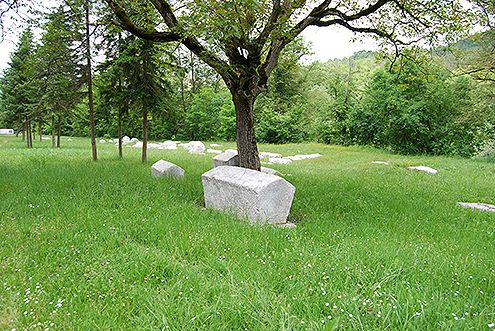
Stećci represent an authentic form of grave marker from the second half of the 12th to the end of the 15th century. In the area of the Western Balkans, more than 72.000 stećaks are known in 3.300 localities, and most of them are in the territory of Bosnia and Herzegovina. In 2016, UNESCO inscribed 28 of them from Bosnia and Herzegovina, Croatia, Montenegro and Serbia on the World Heritage List under the name "Stećci - medieval tombstones" (see "Vreme", August 3, 2016).
In Serbia, the Marble Cave in Perućac, the Marble Cave in the village of Rastište on the territory of the municipality of Bajina Bašta, and the Greek cemetery in the village of Hrta, in the municipality of Prijepolje, are under the protection of UNESCO. However, there is no sign on them that they are part of the revenge treasure, even though it is the state's obligation to mark the world heritage sites with the UNESCO symbol.
At the Mramorje necropolis in Perućac, on the high bank of the Drina river, there are 88 stećaks.
It is the largest stećak necropolis in this part of Serbia and one of the few that has been partly archaeologically explored. It is dated to the 14th and 15th centuries. The tombstones are placed in regular rows, in the west-east direction with minor deviations. According to their form, there are slabs, gables with and without a plinth, chests with and without a plinth, and amorphous monuments. They are undecorated, only one has a decoration in a circle motif. Adult men, women and one child were buried in the tombs. Two silver coins from the 15th century were found in the graves: a fragment of a half dinar coin of the Serbian despot Đurđ Branković and a dinar of the Bosnian king Stefan Tomas. The stone used to make them comes from the village of Simići. The remains of the settlement were not found, which is often the case in the territories where the stećak spread.
Although the site is extremely accessible and visible, its presentation is modest: there is only a basic landmark without an information board. The Republic Institute for the Protection of Cultural Monuments (RZZSK) told "Vreme" that it existed before: "JP Tara National Park installed an information board, the text of which was written by the RZZSK.
Unfortunately, the information board has been removed, we don't know why and when, and the board with the name of the site is in a dilapidated state". They plan to, and "considering that it is the state's obligation to mark the world heritage sites with the UNESCO symbol, new boards will be made this year, both informative and with the name of the site, as well as to install several boards with road direction signs, all with the UNESCO logo and a personalized logo for the good Stećci medieval tombstonesThe procedure, obtaining approval from the UNESCO World Heritage Center, is ongoing, they say, followed by public procurement for construction, and only then installation.
The necropolis of Mramorje in Rastište is seven kilometers west of the necropolis in Perućac. There are two necropolises on that site, half a kilometer apart, on the stretch of Uroševina, i.e. Gajevi. They are also from the 14th and 15th centuries. Near them is Maidan Vagan, where tombstones were carved in the Middle Ages.
There are 38 stećaks on the stretch of Uroševin. The first half of the stećak is oriented in the direction west-east, and the second half north-south, which is unexpected. The most common form of graves is a gable or a chest on a plinth. On the four ridges there are decorative motifs of a bulging cross, relief representations of bows and arrows and two identical swords with fenders and an apple at the end. The carved weapons on the monuments are often associated with the warriors beneath them.
There are thirty-five stećaks on the Gajevi route. They are oriented in the west-east direction. They are in the form of a plate or a low box without a stand. Three monuments on the west side are decorated with a crescent moon. One of them has a Latin cross - three arms end in circles.
In contrast to Mramorje near Perućac, the site of Mramorje in Rastište is better marked. The Institute says that "from 2011 to 2015, major works were carried out on clearing and opening space for quality access to the stećci and on the stretch of Uroševina and Gajevi. All monuments were washed, but no conservation was carried out, considering that in the meantime the Interstate Committee for Steći made a decision not to undertake any actions until a strategy for a joint approach to conservation is adopted". They state that the installation of new signs with the UNESCO symbol is planned for Mramorje in Rastište.
as well as road signs.
The village of Hrta with the Grčko groblje site is located 16 km southwest of Prijepolje, and ten kilometers east of the Kamena gora mountain plateau. It is marked with boards, but not those that would indicate that the site is part of the UNESCO list. It was formed on two hills at a distance of 100 meters. The Greek cemetery site has the most decorated monuments in Serbia.
Although the mentioned stećci are part of the UNESCO world heritage, their actual status depends above all on continuous care on the ground and on the way of presentation to the public. And Serbia constantly declares itself as a country for which cultural heritage is an important item on the state agenda.
Real journalism costs money, and we will not be bought by tycoons and corporations. Support us with a one-time or monthly donation. The time for it is now!