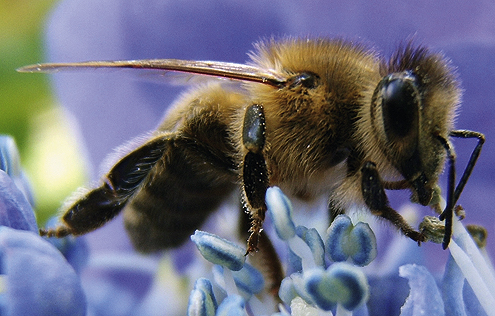
Despite these individual differences, the bee society remains a perfectly organized community.
On average, about 50.000 honey bees live in one hive. During their life as a bee, they are assigned to several tasks - for example, for gathering food, fetching water, cooling down by flapping their wings, but also as guardians who defend the hive from enemies, writes Deutsche Welle.
During a sting - a smell that is an alarm signal
If someone gets too close to the hive and is stung by the guard bee, it then releases an alarm pheromone. This scent signal warns other guard bees of danger. The smell attracts additional bees, which then also sting. In this way, even more alarm scent is released.
One might think that this process continues indefinitely, until all the bees are alert and ready to sting.
"But that's not the case - they have their own brake. As soon as a sufficient number of bees sting, the others stop stinging. This makes sense from the point of view of the bees, because every bee that stings dies. This means: too many bees that sting the hive would cost too many individuals," says Giovanni Galizia, professor of neurobiology at the University of Constanta and co-author of a new study. This shows that the bee colony can only regulate itself.
Bees exhibit individual behavior – even within a swarm
However, precisely through the behavior of stinging in a situation where they believe that the bee colony is threatened, it can be seen that each bee has its own identity.
"Some are then more inclined to sting harder, while others sting less. This means that each individual has its own individuality in the way it behaves when the hive is attacked."
Scientists Morgana Nuvian and Kavita Kanan targeted guard bees from hives at the University of Konstanz. Through various experiments, Nuvian was able to show that some bees are more aggressive and others are more friendly.
"So they have individual characters, which obviously influence their defensive behavior. The personality of an individual bee plays a big role in its stinging behavior."
At the start of the study, the researchers assumed that each bee was essentially operating under swarm control. So let the swarm decide: now we have to defend ourselves - and then all the guard bees are ready to sting.
However, experiments have shown that it doesn't work that way. Each bee has its own personality, which is expressed in different behavior when stinging - and yet the swarm functions successfully through collective intelligence and defense.
Why do sheep graze on the roof?
The individual personality of the bee, therefore, has a greater influence than the need to adapt to the behavior within the swarm.
This is confirmed by another experiment, in which an aggressive bee was inserted into a group of defensive bees - to see if it would change its behavior when stinging. However, the presence of "good" bees had no effect either: the bees retained their individual stinging habits - regardless of the group they were placed in.
Morgana Nuvian investigated the extent to which honey bees change their individual stinging behavior in different situations and whether they are affected by the behavior of the rest of the group.
The team repeatedly exposed aggressive and defensive bees to a supposed threat to the hive - so some kind of aggression. However, the bees stuck to their basic stance.
"The good bees didn't sting, no matter how many times we tested them."
Neurobiologists actually expected bees to exhibit some kind of average behavior. Instead, they discovered bees that almost always sting and others that do so very rarely or never.
The researchers' conclusion: the average level of stinging in a bee population depends solely on the composition of that population and the differences between individual bees.
Does glyphosate kill bees?
Useful for organizing work and regulating autonomous driving?
So how does a swarm of 50.000 bees function, despite the highly individual characteristics of each individual - especially when it comes to defensive behavior?
It is precisely this question that makes bees an extremely interesting object of research, and the results may be useful in other areas as well. For example, when it comes to how to distribute work in society or how to organize traffic with autonomous vehicles. The questions arise here: How much must a vehicle know about other vehicles in its environment, and how much individuality can it be allowed?