Are there aliens among your Facebook friends? Do you visit them, wish them happy birthdays on the wall and wonder how much they really look like their photos and how much they look like astral projections of popular Martians? And is it time to really meet them? According to a completely new hypothesis by Michael Lampton from the University of Berkeley in the USA, the first communication with an extraterrestrial civilization could look more like an acquaintance on social networks than a meeting that implies real, physical contact. In a paper published two months ago in the International Journal of Astrobiology, Lampton presents the thesis that if extraterrestrial civilizations have already reached sufficient technological progress to establish contact with us, they will be much more oriented towards information, its collection and networking, than towards physical space exploration and direct contact with long civilizations.
This thesis is one of dozens of scientific papers about extraterrestrials that are published almost daily in the world and just another in a series of attempts to answer the sixty-year-old central question of the search for small green beings - the Fermi paradox. Examining the illogicality that in a galaxy with 400 billion stars we have not yet observed a single living and at least somewhat intelligent alien, the paradox was first posed by the American nuclear physicist and Nobel laureate Enrico Fermi (1901-1954) as the question "Where are they all?", which is crucial fueled half a century of persistent and so far unsuccessful searches for extraterrestrial life.
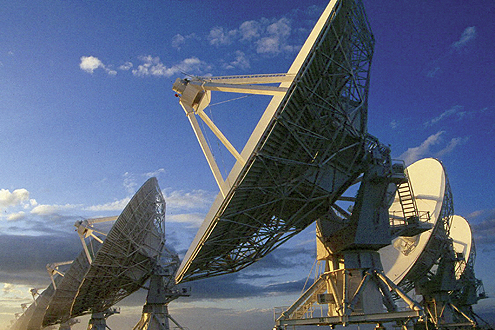
What is the forecast today, that is, the situation with aliens? This summer, the defunct Kepler space telescope is no longer hunting for habitable planets in deep space, but thanks to the vast number of recently discovered planets (some of which are almost entirely Earth-sized), our knowledge of the habitable corners of the galaxy is much better than before. only ten years. Despite funding problems and alongside numerous UFO conspiracies, the purely scientific search for extraterrestrial intelligence (SETI, Search for Extra-Terrestrial Intelligence) gather millions of volunteers. Observatories such as the giant Arecibo radio telescope in Puerto Rico and the Grand Array in New Mexico scan the sky piece by piece, and tons of information are continuously analyzed by computers around the world, looking for what might be an intelligent signal.
Some space probes, such as Voyager, sent from Earth in the 1875s, have long since reached the edge of the solar system and, with radio signals sent into space, tell anyone who might hear that we are here. And let's wait. In addition, a deeper understanding of the structure of matter, genes and biological systems, as well as human society, has returned the search for extraterrestrials to scientific circles, from which it was to some extent banished with the spread of the "myth of the modern age", as the idea of extraterrestrials was called by the Swiss psychiatrist Karl Gustav Jung (1961–XNUMX). But they are still not there. Should this great search therefore be stopped?
THE MYTH OF THE MODERN AGE: The strongest argument against stopping the search for extraterrestrial life is the age of the Universe, which, based on cosmic background radiation, has existed for at least thirteen billion years. If that hard-to-imagine time period were to be presented as just one year of 365 days, then it could be said that during that year people exist only in the last ten minutes of New Year's Eve, on December 31. In the same comparison, the search for extraterrestrial life lasts only one-seventh of a second, just before midnight. Maybe the aliens should be given a little more than a split second to advertise after all.
It is commonly believed that modern UFO history began in 1947, when, on the eve of the first space expeditions, the media's interest in extraterrestrial civilizations increased sharply. In June of that year, the term "flying saucers" was coined as a synonym for UFOs, after businessman and pilot Kenneth Arnold (1915–1984) gained worldwide fame after publishing a controversial photograph of nine strange objects flying in formation over Mount Rainier in the western US. It was in July of that year that the cult "Roswell" case took place, probably the most famous UFO incident of all time, which was completely forgotten until the 51s, when the myth spread about a secret project in Area XNUMX, where the US government supposedly hides the bodies of aliens who fire at Roswell.
Meanwhile, the number of reports of unusual objects in the sky increased around the planet, so in 1948 the US Air Force launched the "Blue Book" project and began to record cases of unusual celestial phenomena. Over the next twenty years, more than 12.000 different sightings were recorded, of which at least 90 percent were explained by natural causes. At that time, several public and secret scientific studies were conducted on the origin of UFOs. Probably the most influential scientific research of this kind was published in 1969 under the leadership of the famous American physicist Edward W. Condon (1902–1974), when more than thirty scientists analyzed in detail 59 different UFO cases and concluded in each of them that it was not a question of alien visitation.
Despite the fact that behind the UFO euphoria was nothing more than a mixture of hoaxes by fame-hungry individuals, mass hysteria and easily explained optical illusions, the idea of extraterrestrials continued to live on as a myth. Since the network of UFO enthusiasts is the most widespread in the USA, the vast majority of Americans today believe in this myth, but that number is not negligible in the rest of the world either. But the aliens didn't stop digging for scientists either.
It all started in May 1950, while Enrico Fermi, already well known as one of the fathers of the "American bomb" and one of the most respected physicists of his time, was staying at Los Alamos, the famous base where the atomic project was carried out during World War II "Manhattan". Fermi went to lunch in one of the pavilions with physicists Edward Teller, Herbert York and Emil Konopinsky. Like everyone in those days, they discussed the newspaper reports of flying saucers, only to dismiss the idea of such a UFO sighting as obvious nonsense.
When the conversation at this lunch took a different turn, Fermi suddenly got choked up and exclaimed, "Where's everybody?!" This question, in various variations, will remain known as the Fermi Paradox. Namely, it was then that Fermi noticed that, if there are billions of stars in the galaxy, and the Sun is nothing special among them, then a civilization that is millions of years older than humans must have developed around one of them and that in such a long time, it is inevitable had to develop interstellar travel, thus conquering and conquering the entire Galaxy in less than a million years. How then is it possible that such a civilization has not yet reached Earth?
Later, this question will be discussed at the famous conference in Green Bank on the existence of life outside the Earth. In 1960, astronomer Frank Drake will propose a slightly more precise estimate of the number of possible civilizations in the Galaxy, which will become known as the Drake formula, sometimes also as the Green Bank formula. From it, the number of developed civilizations in our Galaxy can be calculated based on parameters such as estimates of the number of stars, the number of planets and various probabilities about life and the appearance of technical intelligence. Depending on the value of those parameters, estimates range from none, over ten as Drake himself got, to several thousand possible civilizations. And none of them have "officially" visited Earth so far. Why?
LEMMING GALAXY: In the book Where are the aliens? author Steven Webb, which was published in the Serbian language and translated by Dejan Smiljanić by the Helix company, as many as fifty answers to that question are considered. Controversial immediately after publication, primarily due to the choice of solution to the Fermi paradox, Webb classified potential answers into three categories - those that explain that aliens are already here or were on Earth in the distant past (a paleo-astronomical thesis associated with the problematic Erich von Däniken and which these days is analyzed widely and at length on cable television), then those who claim that extraterrestrials exist, but have not yet come forward for technical and other reasons (which is closest to the opinion of most scientists), as well as the last, rather creepy one - that they do not exist and that man is completely alone in space.
Paradoxically, although from the fact that aliens have not been seen yet, and we are researching them so much, it follows that they do not exist at all, the explanations that support this are extremely anthropocentric and at times almost immersed in religious dogmas. Some of these ideas are based on the scenarios that the universe was made just for us, that we are the first of the intelligent civilizations, that the universe is still too young for life to develop in various places, that the Earth is too ideal a place for life, that the Moon is unique phenomenon in space, that intelligence is rare, that some steps in evolution on Earth could only happen once, as well as that language and science are peculiar only to man, and not to any other civilization in space.
Although none of the solutions to the Fermi paradox can be said with certainty whether they are correct or not, certain ideas from this set are not naive at all. Namely, it is also possible that civilizations last too short, that they are prone to self-destruction and that both the galaxy and any planetary system are too dangerous places for any species to live long enough so that their stay in the Galaxy coincides with our few minutes of duration. Maybe we are alone in space and because we live in a computer simulation that aliens made for us. This idea, known as the "planetarium hypothesis" has many adherents among modern scientists and thinkers.
The ancient idea of panspermia is among the hypotheses that imply that "They are already here" - that we ourselves are aliens, descended from extraterrestrial seeds that arrived on Earth from space. The idea proposed by John Ball in 1973, which is known as the "zoo hypothesis", rests on similar foundations. According to Bol, aliens are ubiquitous, but they are so much more advanced than us that they maintain the entire Earth, including the Solar System, like a zoo where they research and observe how species develop. This scenario, in various variants, was a powerful engine for numerous SF plots, including conspiracy theories about UFO abductions and laboratory studies of humans.
Among those ideas that claim "They're out there" but we haven't heard them yet, below is a list of technological obstacles facing any quest in space - the universe is too big to just see them, we don't hear them because we're listening to the wrong ones frequencies, we didn't listen to them long enough, they use different mathematics and we can't understand them even though they call us, and the idea that they visited us and didn't even want to make contact with us is not without foundation. The very idea of the need to establish contact is deeply anthropocentric, and it is a good question whether an extraterrestrial civilization would even want to communicate with us in any way. If they are based on a different chemistry or are much less material, why would aliens even want to communicate with a "piece of flesh", as a human might appear to them.
In discussions from the 1980s, Robert Freitas presented the "lemming hypothesis" in an attempt to point out the potential absurdity of the Fermi paradox. Namely, lemmings are a species that reproduces extremely quickly, three births with eight cubs per year, and if Fermi's logic were to be followed, they would have to reproduce so quickly that they would completely populate the entire planet in no time. However, who has ever seen a lemming outside of a zoo? Only a few research biologists. Similarly, Freitas argues that aliens could very well be out there, in the asteroid belt or who knows where, without us ever noticing them. In this connection, the Columbus paradox is a favorite of UFO enthusiasts, according to which the inhabitants of the American continent did not even notice the Spanish ships on the open sea, because due to lack of experience they could not understand what it could be.
In the story "Twilight" by Isaac Asimov, somewhere in the depths of space there is a planet that is in a system with six stars instead of one. In that world, because of so many suns, even though the planet rotates, daylight never disappears. The inhabitants of this world have never seen the night sky, the depths of the galaxy, and they don't even know that a single moon is moving near them. And then there is a phenomenon that has never been seen before in this world - the eclipse of all the stars at the same time. And the sky opens. If you've ever sat in the dark of a backyard with an amateur telescope and waited for the clouds to clear so you could look far up, you understand the feeling. It's a faint hint of what might happen once the "clouds" are removed, which makes us unable to see if anyone is still up there today, just like in Fermi's time.