The one hundred and fiftieth birthday of the largest Serbian court south of the Sava and Danube, the Obrenović court in Arandjelovac, was celebrated by the light of flames. It wasn't the flame on the candles of the birthday cake or the one from the fireworks.
Half a year ago, in a sea of other news, the public's attention was briefly occupied by this one: "Part of the roof of the Old Building in Arandjelovac burned in a fire, the cause of which has not yet been determined, but which, fortunately, was extinguished!"

Old Building2…The Old Palace…
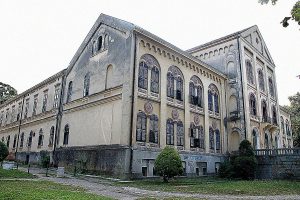
The old building, as the palace was called, was a state building from the time it was completed in 1872 until two years ago. The state leased it, at auctions, for a period of three years, and after the end of the Second World War, the building was used by the public catering company "Bukovička banja" as a hotel. Bukovičke Banja Park was declared an immovable cultural asset - a spatial cultural and historical entity, by the decision of the Aranđelovac Municipality Assembly in January 1998. In 2011, the Government of Serbia protected the Bukovičke Banja Park as a nature monument of great importance. This decree also protects all buildings in the park as part of the cultural and historical heritage: the hotel "Staro Zdanje", the Pavilion of Prince Miloš, the hotel "Šumadija", the institute with open and closed bathrooms, the building e
exploitations – the first modern mineral water bottling plant and a valuable outdoor sculpture collection, at that time 63 sculptures.
The courtyard, in which everyone sees only the "Staro Zdanje" hotel today, was built on the initiative of Prince Mihailo Obrenović according to the project of the young architect of the Ministry of Construction, Kosta Šreplović.
Today's sad fate of the Obrenović Palace seems to have been forged at its beginnings: neither Prince Mihailo nor the architect Šreplović saw the end of the work on this building. The prince was killed in Košutnjak during the beginning of works on the palace, while Šreplović died in a fall from the scaffolding while supervising the final works.
With the construction of the Old Building, the Bukovička spa rivaled the largest European spas and became one of the most visited in the country, and the state invested much more in it than in other Serbian spas. The middle and upper classes of Serbian society lived here. Simultaneously with the development of the spa, the town was also developing, whose inhabitants tried to keep up with the cultural level of their guests as hosts. After 1971, when the last restoration of the hotel was completed, until its closure in 2005, many people from Aranđelov got married in the Prince's Hall in the Old Building, and the graduates remember the hotel precisely because of the unforgettable prom night.
The old building was also the home of Princess Natalija Obrenović, the wife of Prince Milan Obrenović, for whom it was renovated for the first time in 1887. Her son, King Aleksandar Obrenović, stayed in Aranđelovac on June 28, 1889, and during his trip around the country in 1893, he spent three days in Bukovička banja.
In the last decades of the 19th century and later, dances with folk music were held in front of the Old Building, while balls were held in the Prince's Hall. At one of those balls, Živojin Mišić met his future wife, Lujza Krikner, the daughter of the entrepreneur Fridrich Krikner, who built the old steam bath in the Bukovičke banja park.
This is where we get to the latest news about Bukovički Park. At the end of September, it was reported that "in the Bukovičke banja park in Arandjelovac, the demolition of the Steam bath, which belongs to the historical heritage complex of this city, has begun. First, the pool near the main building of this steam bath was demolished."
The investor, the company Bukovička banja Stublina doo Arandjelovac, plans to build a seven-story hotel here, similar to the hundreds of buildings we can see in tourist destinations from Zlatibor to Antalya.
The investor received all the necessary permits from the municipality and other competent authorities for the demolition of the Steam Bath, and then a construction permit for the construction of a multi-story hotel. So, everything is according to the law. The municipality issued a statement about everything on its Facebook account, and on that occasion mentioned "devastated buildings" without listing them by name, as well as "years of neglect".
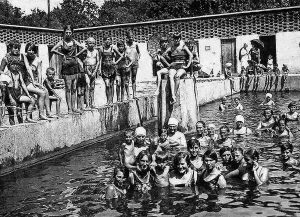
On Saturday, October 1, the former outdoor swimming pool with a facility with changing rooms and showers was demolished, due to total reconstruction. "Kupatilo", as the people of Arandjelov called it, was one of the symbols of the city and the former tourism of Arandjelov.
According to the announcement of the Institute for the Protection of Cultural Monuments in Kragujevac, a new swimming pool and spa center will be built on this site in a new hotel facility, due to the conservator's assessment that these facilities are too devastated and without greater architectural and artistic value compared to other valorized facilities in the area of the park. .
Architect Slađana Milovanović, who, together with academic painter Ana Đorđević, has been pointing out the destruction of cultural assets in the city for years, told the portal "Vremena" (https://www.vreme.com/vesti/opstina-arandjelovac-ko-kaze-da-je- bilo-sta-sruseno/) that neither the bathroom nor the pool were devastated as claimed. "It is enough to remove the dust with your hand and the white marble will appear. It's just that the bathroom and the pool have the fate of innumerably valuable and unrepeatable objects that have been neglected and left at the mercy of time, lest they collapse and be demolished by themselves."
Steam Bath2…and the pool
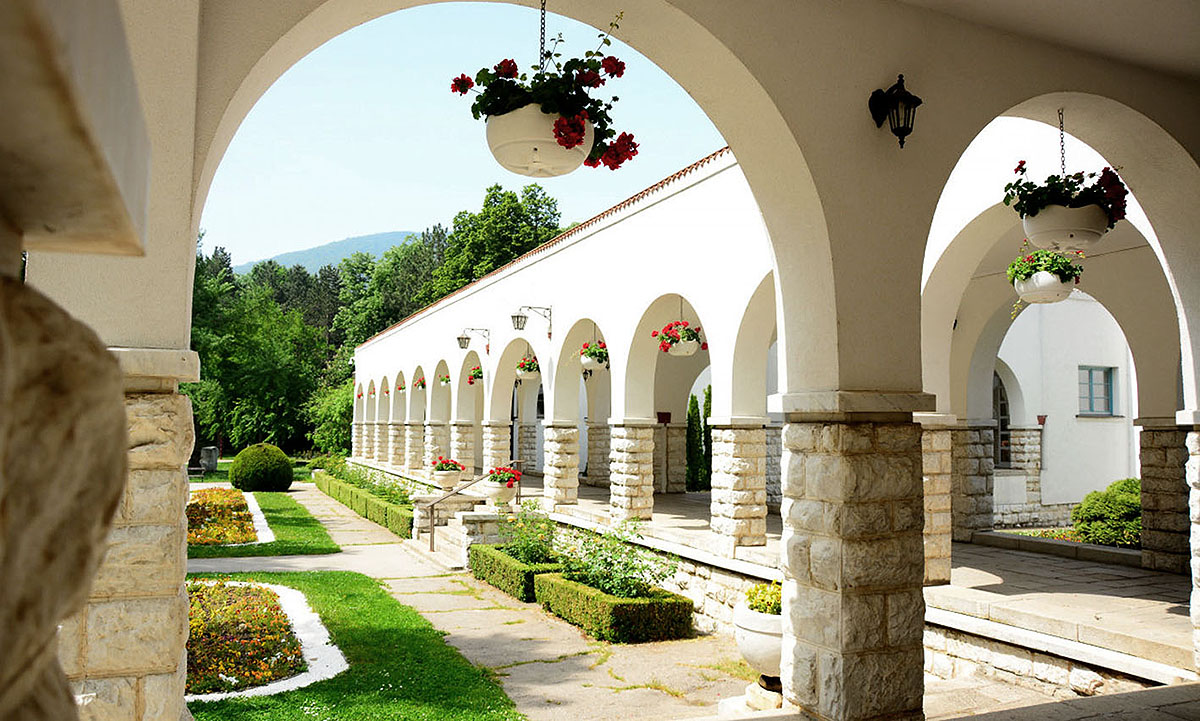
The steam bath, also known as "Arkade", is a project of the well-known Serbian architect Gojko Todić, who was also called the "court architect of the Kingdom of Yugoslavia" because of his numerous engagements for the state. The building he designed in the style of late art deco was built in the period 1938-1939. and the works were carried out by the construction company of engineer Stanojlo Bader. The open bath "Arkade" with a swimming pool only worked during the spa (summer) season, and only mineral water from the thermal spring was used for bathing. The pool was paved with blue tiles, and inside the building there were hairdressing, cosmetic, manicure and other salons and shops related to spa tourism.
Next to the swimming pool there was a facility with a hundred changing cabins, a restaurant, shower cabins... The entrance was decorated with arcades made of white wedding marble. The "beach", as the visitors called the area around the pool, was covered with wooden slats, and there were also twenty wooden beds and twenty lounge chairs, parasols with metal bases, wicker armchairs and tables, nickel-plated ashtrays...
I was interested to see who is the owner of "Stubline", which is mentioned as the investor of the new, modern hotel that should spring up instead of the Steam Bath. With a little search on APR, I come to the information that it is Radovan Milojević, a businessman who received the "Entrepreneur of the Year" award in 2018, awarded by the prestigious consulting firm "Ernst & Young".
Economic journalist Miša Brkić wrote about Milojević in the article "How Radovan returned the iconic hotel to the people" in the daily "Danas" on September 17, 9: "He is one of the best and most respected domestic businessmen. A businessman with an impeccable reputation. His company is one of the most successful medium-sized companies. There are few such companies in Serbia, capable of competing on the global market. Radovan Milojević is a self-made businessman with an incredible business gift. His name has never been associated with controversial privatizations or murky business operations. The kind of businessman Serbia can only wish for (...) Milojević lived such a relatively orderly and idyllic business life until a few days ago. And then dark days came for Radovan and completely ruined his life!"
After this "dramatic twist", Brkić explains how Milojević decided to expand his company's portfolio with the help of local politicians in Arandjelovac who, chasing a winning combination for the local elections, convinced Radovan to buy a bankrupt company, which he owns next to the once iconic hotel. Staro zdanje" and the hotel "Šumadija", the outdoor swimming pool in the Bukovičke banje park and the restaurant "Lovački dom" in Bukulja.
After the failed first attempt at privatization in 2012, this failed enterprise was offered to prominent local businessmen, but they refused to embark on a dubious investment adventure with political support. Radovan accepted the offer of local politicians and for 1,75 million euros bought the failed company with the hotels "Staro Zdanje" and "Šumadija" and a restaurant in Bukulja. The very next day, in the manner of a true benefactor, Radovan presented the "Staro Zdanje" to Arandjelovac, with the explanation that "he wants to return that iconic hotel to the people". But, after only two days, it turned out that the Municipality of Aranđelovac bought the "Old Building" from Milojević for 526.000 euros. Apparently, Milojević assessed that the massive Obrenović mansion was still "too big a bite" and that it required huge investments that would be difficult to pay off.
The steam bath, like the Old Building from the beginning of the story, was under the protection of the state during the rule of Obrenović, Karađorđević, Tito, and even the German occupiers in both world wars. However, a similar thing happened in Arandjelovac as with numerous castles, summer houses and villas in Vojvodina, and even the most representative buildings such as the White Palace in Belgrade: since in the 21st century we have been left alone, independent and without the "supervision" of any Austro-Hungarian or of Yugoslavia and still not the European Union - we simply do not know how to adequately take care of our own heritage. The lucrative interests and problematic tastes of private investors and the officials who allow them to do so always win.