Election 2026.
Purgatory in the elections: Dacic, Đilas, Jovanović go down in history
Apart from the Student List, which convincingly won, and the United Serbia, no other list even came close to the parliament, except for the minority
 photo: a. Angel
How on March 12, 2003, the most powerful mafia cartel attacked Serbia and what was the self-defense of the state and society
2003, year fourteen
The assassination of Zoran Djindjic
"Vojislav Šešelj, the president of the Serbian Radical Party, has decided to leave politics and all Serbian countries in history," writes "Vreme" in issue 633 about the radical leader's voluntary surrender to the Hague Tribunal at the end of February 2003.
However, this does not apply to his former comrades: on the stage of Šešelj's "farewell" rally stands the entire political elite of Serbia today: President of the Republic Tomislav Nikolić, Prime Minister Aleksandar Vučić, Speaker of the National Assembly Maja Gojković, Governor of the National Bank Jorgovanka Tabaković... Previously, the leader radicals announces bloody confrontations in the country in the spring.
Seselj, it seems, knows what he is talking about. In order to thwart their own arrest due to a large number of murders and drug smuggling, the criminal cartel of Milorad Ulemek Legija and Dusan Spasojević - part of the Special Operations Unit and the Zemun Clan - organized the assassination of Prime Minister Zoran Đinđić on January 22, 2003. On that day, Dejan Milenković Bagzi tried to cut off and stop the column with the prime minister with a pickup truck. Number 634:
"If the idea was for the truck to get in front of the convoy and stop it, and then someone from another vehicle opened fire, the story begins to take on a more ominous meaning." The fact that the prime minister's car is armored would possibly protect him from the first burst, but concentrated fire from automatic weapons easily penetrates the reinforced windshield."

This is exactly what Legija and Spasojević planned - along with the use of hand throwers. Their plan did not succeed primarily because of the composure of Djindjic's driver. What followed was an incomprehensibly superficial and lukewarm reaction from the police and judicial authorities. The criminal cartel thus gets an opportunity for a new attack on the prime minister, for whom their arrest has been the number one priority for months. A new assassination will follow on March 12, 2003: through the window of the Photogrammetry Institute building in Gepratova Street, Djindjic is shot by lieutenant colonel of the MUP of Serbia and a member of the JSO Zvezdan Jovanovic from a sniper rifle:
"On Wednesday, March 12, 2003, at 12:35 PM, the Prime Minister of the Government of Serbia, Dr. Zoran Djindjic, got out of his armored BMW 7 series to the courtyard of the Government building, which is entered from Nemanjina Street. He was sitting behind the driver, on the left side of the vehicle. At the moment when he stood up to take the crutches he was using for his injured leg, two shots were heard in a very short space of time. Zoran Đinđić was shot from the front straight in the heart; Milan Veruović, the bodyguard who was standing next to him, was hit in the abdomen by a second shot. Security first turns one BMW in the yard, and immediately another, places the victims and heads for the Emergency Center, about a kilometer away from the scene. Zoran Đinđić arrived on the operating table clinically dead; resuscitation attempts failed," writes "Vreme" in issue 637.

The murder of the prime minister caused enormous sadness and a revolt of the citizens: during the funeral, hundreds of thousands of people took to the streets of Belgrade. Zoran Đinđić is sincerely saddened like few others. "Forgive for the words of criticism. You were better than the time and space you lived in", is one of the characteristic entries from the book of mourning of the Government of Serbia.

"Even when he decided to engage in politics, Đinđić, it seems to me, was determined, first: to fight for some large, strategic goals, and not to simply exercise power, and second: to act in all conditions, without waiting for circumstances to change and for something to be put in order first. So, he was ambitious and brave, and those qualities already made him a candidate for a tragic end, because, of course, there is no tragedy without greatness. And in Đinđić's neighborhood, everyone easily recognized the breath of tragedy and many subsequently understood that in his fate, in everything that led him to such an end, there was greatness that was often masked by the prosaic aspects of daily politics," writes "Vreme" in issue 637 .
After the assassination of the prime minister, a state of emergency was declared in Serbia and the police operation "Saber" began, and in the following months the Zemun clan was broken up and the JSO was disbanded. While the search for Legion, the Special Anti-Terrorist Unit of the MUP-
on March 27, 2003, killed Spasojević and Milo Luković Kum during their arrest in Meljak. Number 639:

"Questions remain open: could the house have been attacked in such a way that the two - in a combination of stun bombs and tear gas - were still captured alive; whether there were any miscalculations for that operation; how could they break out of the building that was surrounded and get from the door (or window) to the yard... In any case, the death of Spasojević lost an important witness in the future process of the criminal-terrorist-parapolice mafia under the protection of the State Security."
By the way, during the "Sablja" state of emergency, the media is under some kind of censorship, and the head of the Government Communications Bureau, Vladimir Beba Popović, holds briefings for journalists and editors every day. "Vreme" does not pay attention to censorship, nor does it go to briefings - there is too much defamation and persecution of political dissenters.
Zoran Živković becomes the new prime minister. However, without Đinđić, the DOS coalition government is unable to function: affairs and scandals keep changing like on a conveyor belt. Finding from number 646:

"Struggle for power, verbal conflicts, confrontations in the shadows, intrigues and accusations. And the questions are difficult. A bubbling debate erupts in the ruling party, not so much because of the proverbial sanguineness of our politicians, but because of very difficult issues that have come up: the need to review the economic strategy, to separate money from politics and, of course, the issue of power. The question arises as to whether this ruling party can make strategic decisions without a new electoral ID."
It turns out that he cannot, so extraordinary parliamentary elections are called for November 28, 2003. Both before and after, the G17 plus Miroljub Labus and Mlađan Dinkić conduct a systematic attack on the government through the tabloids, the climax of which is the very end of the election: the public then learns that Dinkić was removed from the position of governor of the National Bank by voting with the card of Neda Arnerić, member of the Democratic Party, who was not in the Parliament, but on summer vacation in Bodrum.
Like Šešelj, at the end of the year, DOS will also go down in history. After the election, the Democratic Party of Serbia of Vojislav Koštunica and the G17 get the opportunity to form a new government.
In 2002, after a long and serious illness, our colleague Uroš Komlenović, one of the greatest Serbian journalists, died. He will be especially remembered for his reports and texts in which he advocated, regardless of the cost and consequences, for social justice.
In 2003, "Vreme" chose Ljiljana Raičević, the executive director of the Safe Women's House in Podgorica, as the person of the year, for initiating an action to combat sex-trafficking.
To be continued
Apart from the Student List, which convincingly won, and the United Serbia, no other list even came close to the parliament, except for the minority

Why is there nothing else between the overcome regime and the changes? What does the regime mean when it says it is defending Serbia? Why is the Student Movement indomitable? Who has the knowledge and real experience, and who leads without a day of work experience outside of politics? And why students win

After almost two years of protests, hundreds of kilometers walked, arrests, persecution and unprecedented social mobilization, Serbia is holding elections that could mark the end of a political era. Sociologist Marija Babović tells "Vreme" that the hope for change has not been so great since October 5, 2000, but she also warns of the danger that, if changes are not made, the country will face an even tougher authoritarian regime.

Their only weapon now is the media they control: like, we don't have an agenda, which is not true; as, we will betray the national interest, which is not true. One of their arguments is that we are afraid to go to the debate with Vučić. They do not understand that it is their punishment. This is a punishment for Aleksandar Vučić, who for 14 years conducted exclusively a monologue. For fourteen years he did not allow anyone any kind of dialogue, and now he would like to be rewarded or pardoned with the opportunity to talk to us. Well, he won't be able to. What he sowed is now reaping

These elections are not elections about Serbia's membership in the European Union, Kosovo and Metohija, gay marriage, tax policy or any other single political issue. Although parties on the fringes of political power try to impose these themes, at the heart of the upcoming political election is a much simpler dilemma: change or preserve the existing order. For more than a year now, surveys have shown that this is the primary dilemma on the ballot

Why do we suddenly have no place to find out what Vučić thinks and who the "blockaders-Ustasha" are planning to kill? Why these pathetic attempts to fly over?

The citizens of Serbia have pronounced a political verdict. Violence, persecution, abuses, embezzled money must be decided by freed institutions based on the law
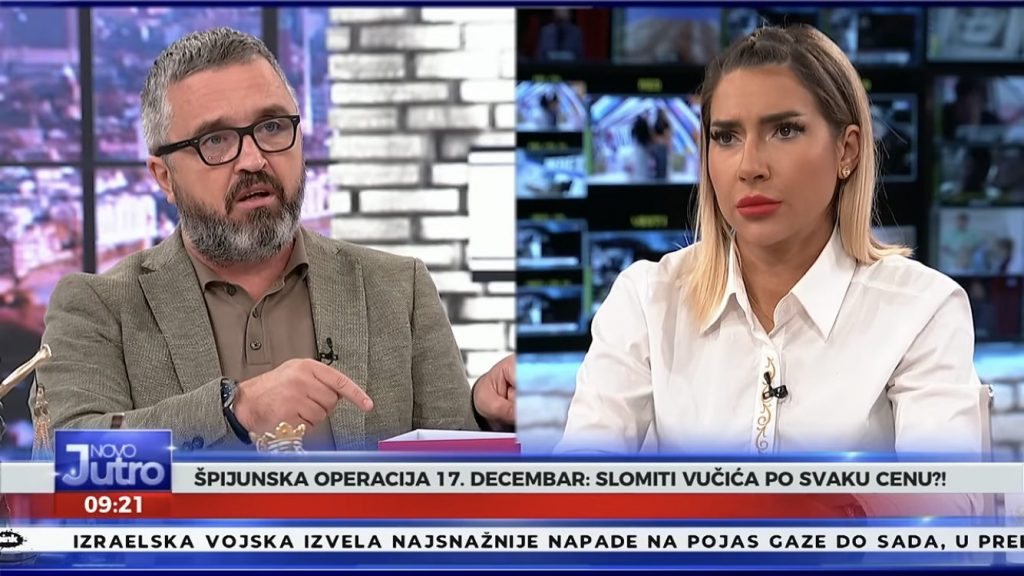
Requiem for evil does not have to be solemn. Sometimes it sounds like a shaky voice on a morning program and like a story about winter tires.

The archive of the weekly Vreme includes all our digital editions, since the very beginning of our work. All issues can be downloaded in PDF format, by purchasing the digital edition, or you can read all available texts from the selected issue.
See all