Why do all the candidates in the presidential elections in Montenegro think more about April 2 than March 19? The answer is clear, each individual is almost certain that they do not have enough votes to win in the first round. Hence the complete absence of conflict between candidates who belong to different sides of the electorate whose demarcation line is Milo Đukanović. However, these are also the first presidential elections in which the leaders of most of the most dominant political entities are at stake. Their parties, for example, at local sources in Podgorica, in October of last year, collectively won 88 percent of the votes, with a turnout of slightly less than 70 percent. In that sense, these are indeed historic elections for Montenegro, but also a fight for a result that will define the starting positions in the upcoming parliamentary elections. In this race, for many, the percentages of support are far more important than the victory itself. This is precisely why the risks in this fight have increased.
GAMES WITH PARLIAMENT
If Milo Đukanović were to dissolve the Montenegrin Assembly from the position of the current president today, would the citizens of Montenegro vote by majority on Sunday for him to complete his tenth term in his prime-presidential chair? This is certainly a question that bothers his associates after they put this topic on the agenda of Đukanović's campaign - raising tensions, showing dominance and certainly underscoring the main thesis that in the previous two years, after the DPS lost its majority in parliament, there was a collapse of almost all state institutions. And the parliament. Experts relied on by the current president find that such a procedure would be fully in line with the solutions provided for by the Constitution of Montenegro. The dissolution of parliament is controversial for at least one reason. The mandate to Miodrag Lekić was given by the Assembly, not the President, based on the recently adopted Law on the President. That law is awaiting a verdict before the Constitutional Court and, according to voices from this institution, which only recently, with the election of three judges, became functional again, the disputed law will certainly not be on the agenda in the next month.
The dissolution of the parliament is the opening of a pandora's box of political, and not only political, conflicts, it means that the current president of Montenegro has decided to get the most out of the possible chaos at the polls. It would not be anything unusual, although the risk is too great for Đukanović, primarily due to the fact that in the previous two years support for his political option has been in constant decline. Such a development will lead to a further shift of the DPS towards a hard national option and a new shedding of support in the group which still sees them as carriers of civic ideas.
DEBT FROM PAST LISTS
The biggest change in political narratives occurred in the election campaign of Andrija Mandić, the leader of the New Serbian Democracy. He made a strong departure from the hard-line Serbian platform, and from being a fierce critic of the Đukanović regime, overnight he became a conciliator and the main proponent of the idea of a reconciled Montenegro. The leap into the environment of democracy and cooperation was preceded by an apology for former political actions and a general recognition of one's own mistakes, without a detailed elaboration of the omissions. However, this change is so obvious and inconsistent with the political activities and image of the Democratic Front, of which he is one of the leaders, that it confuses his own electorate more than it will get closer to traditional abstainers or politically undecided voters.
It is interesting, however, that Vladimir Joković's Socialist People's Party publicly supported Andrija Mandić. Of course, it is the payment of the debts from the joint electoral list in the parliamentary elections, after which the SNP woke up almost from clinical death and with good maneuvers managed to be one of the key factors in the minority government of Dritan Abazović today and holds the position of President of the Assembly. This support certainly provides guidelines for the interpretation of further events in the political shift, including coalition action in the eventual extraordinary parliamentary elections.
GOVERNMENT ON TWO CHAIRS
The second part of the government in the technical mandate - Dritan Abazović's URA - supported the leader of the Democrats Aleksa Bečić. This is perhaps the biggest surprise in the campaign for the election of the president. The sharp conflict between the Democrats and the Civic Movement URA has been going on for a long time and has largely contributed to the complex political situation and the weakening of relations within the parliamentary majority. Apart from the fact that Abazović's party will support Aleksa Bečić for president, these parties also announced a joint list for the parliamentary elections, on which they would like to see the Europe Now Movement. Their idea is to unify the "political center".
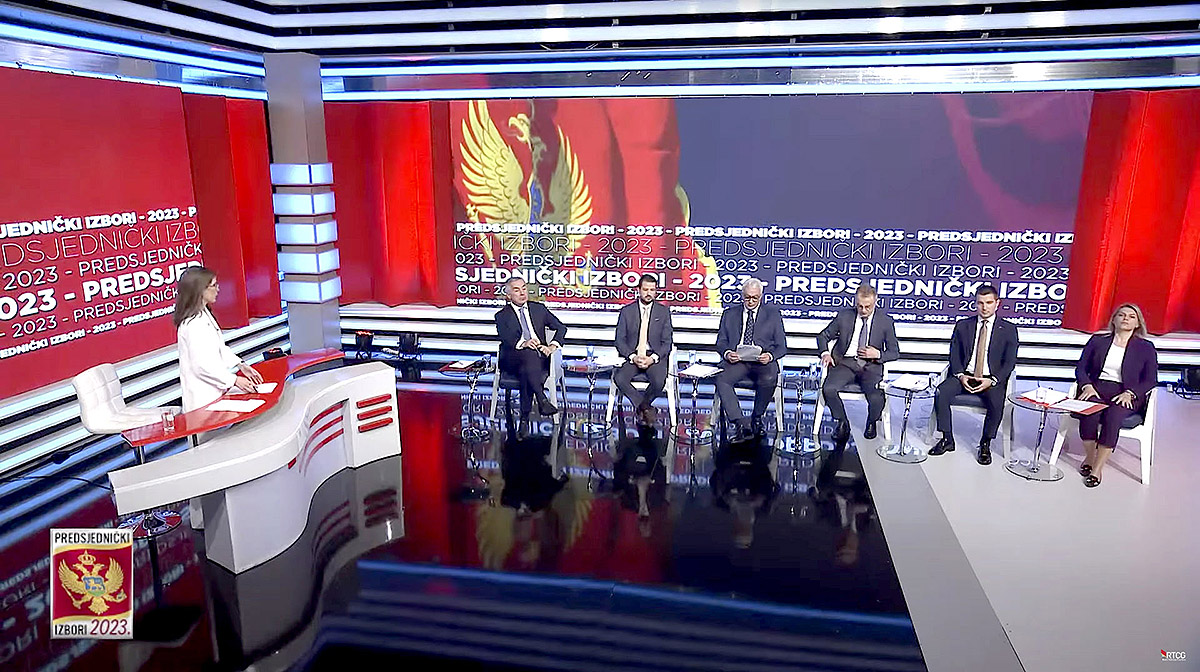
And while Đukanović under the election slogan "Nego ko" says that he has decided to finish the work he started in Montenegro, thinking of European integration, while Mandić thinks about the future and talks about tradition, Aleksa Bečić under the slogan "Honor me" in to a significant extent, he stepped out of the visual space of his own party and is working very focused on a profile that represents him not only as a fighter, but also as a good candidate for a statesman. Even though he was among the last to highlight his candidacy for the position of president and thereby put an end to the disunity in the performance of the ruling majority, even though the Democrats are also following the decline in popularity, the impression is that Bečić was the most dominant in the joint presentation of presidential candidates on the Montenegrin public service. He didn't get into polemics, he didn't repeat old topics and he said what he intended. He kept every conflict under control and did not go beyond the framework of the central message that was planned in detail, and not only in terms of time.
Jakov Milatović is the unsuspecting candidate of the Europe Now Movement in these elections, after the State Election Commission did not accept the candidacy of his party colleague Milojko Spajić due to his disputed dual citizenship. Milatović entered this game from the bench with a ballast of lies that Spajić held on to for an inappropriately long time. Simply, Europe now did not want to release the wave of discontent on which that movement surfaced as a dominant surprise in the recent local elections in most Montenegrin municipalities. The impression he leaves is completely in line with his election message - "We will succeed". The physical attack he experienced in Cetinje, coming to the promotion, reinforced that message and further singled him out as a candidate that Đukanović himself is wary of.
ELECTIONS FOR ELECTIONS
Although many analysts estimate that Goran Danilović, the leader of the United Montenegro, influencer Jovan Radulović Jodžir, and SDP candidate Draginja Vuksanović Stanković do not have a great chance of entering the second round, we should not forget that Draginja Vuksanović Stanković is in the 2018 presidential elections, which Đukanović won in the first round, won 8,2 percent of the vote. Even though it was a period of SDP's distance from DPS, and the competition was not like this either, we should not ignore the fact that the only female candidate can pull perhaps the most important votes for the dominance of any of the candidates.
So this is not just a presidential election. These are elections whose percentages will dominantly decide on the distribution of influence in the upcoming parliamentary elections, certainly on the further development of events related to the technical government of Dritan Abazović, on the consequences of the failure of the parliamentary majority in the case of the failure of the mandate of Miodrag Lekić. They will be the key to solving the mutual relations between the political groups that stand against the Democratic Party of Socialists. Again, everything depends on Milo.