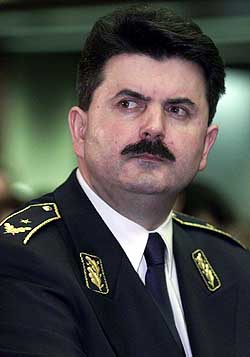
VICTIM OF THE MURDERER: MUP General Boško Buha
Police general and assistant head of the Department of Public Security, Boško Buha, was killed by a well-grouped burst from a Kalashnikov automatic rifle, from a distance of five to ten meters, in the parking lot on the Danube side of the "Yugoslavia" hotel, at 2.40:10 a.m. on June XNUMX. Apparently, gen. Buha came to the parking lot from one of the rafts where he was sitting with his friends; he was killed at the most convenient moment, while putting the key in the car lock, as in several previous cases. The place is also convenient: open space, bushes for cover, multiple escape routes. A traffic police patrol that happened to be nearby, hearing the shooting, first wisely threw itself on the ground; when they got up and peeked, it was too late: the attackers had already disappeared and fled in a car. General Buha was shot in the chest and gave signs of life until the ambulance took him to the hospital, where he expired. The usual police actions - tours of the surroundings, increased controls around the city and other things - did not yield results.
"WRONG GROWTH": Political Belgrade was horrified. Something like this has not happened since the murder of General Stojičić in April 1997. After Baõa Stojičić, two police colonels, Vlahović and Simić, were killed in unexplained assassinations in March and July 1999; in August of last year, Momir Gavrilović, a former important man in the State Security, was killed in a manner similar to this latest one. But killing an active police general and assistant head of the Department like this is not the same. After a period of adjustment, the government made appropriate noises: Dušan Mihajlović, the Minister of the Interior, promised - as in other cases - that he would "overturn heaven and earth" (unfortunate metaphor: like Milošević back then because of Štrbac) and that this overturning would be "permanent operation", that "all known criminals will be brought to information interviews" etc.; Zoran Đinđić promised that he would inquire with Mihajlović every other day; Vladan Batić assessed, somewhat hastily (probably scared), that it was "not a political murder"; Goran Svilanović, on the other hand, did not rule out that possibility either, adding that this case is another proof that "crime is the biggest danger for this country" and its future.
Of all those politically correct sounds, however, it is not easier for anyone. It is wiser for Serbia to trust more in the fear of our politicians, and less in their words and promises. Anyway, they got on our heads with stories about the "fight" against "organized crime", "the remnants of the old regime", "the fusion of police and crime", etc. In the meantime, there were kidnappings for millions of dollars in blackmail: Mišković, Delta: seven million marks handed over late at night under the bridge near Beška, with complex security procedures; Babović, Verano Motors, fifteen million marks allegedly paid in Italy; son of Boba Živojinović and beautiful Brena; all three cases unexplained. Momir Gavrilović was also killed, which only led to a weak-minded attempt to politically instrumentalize the case, instead of noticing the true nature of the danger: the fact that certain criminal-police-intelligence structures managed to regroup and survive even under the new government, capturing connections when and with whom it was necessary and making slanderous offers and favors to the future government and its later factions ("merging", as warned by Dušan Mihajlović and others). The case of the armed rebellion of the Special Operations Unit of the RDB in November last year was a supplementary warning, but it seems that it was not understood that way... You should not plant pumpkins with the devil, and you should not borrow money from moneylenders, because in the first case, you will get pumpkins on your head. pound, and in the second the interest rates become unbearable. Since the devil is impatient and the moneylenders are greedy, the pounding of gourds and the recalculation of interest is fast approaching.
In such a general "political-security" context, Police Major General Boško Buha, Assistant Gen. Sreten Lukić, head of the Department of Public Security of the Ministry of Internal Affairs of the Republic of Serbia. The method of execution and the motive would point to the perpetrators, organizers and orderers of the criminal act.
The method of execution was standard Belgrade: another in a series of murders with the same operational-tactical "handwriting". This kind of assassination, say experienced criminals, requires at least two direct perpetrators, at least one driver, at least two "sterile" vehicles, at least one safe apartment; in addition, intelligence preparation, telecommunications, logistics and a lot of money. All hired people must be cold-blooded and reliable professionals, otherwise the matter ends up like in the case of the murder of Željko Ražnatović Arkan.
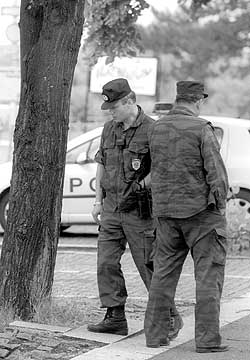
PLACE OF LIQUIDATION: Police officers investigating...
TACTICS, TECHNIQUE I PERSONALITY: First of all, the question arises - how did the perpetrators know where to find Boško Buha? People who knew him say that he did not keep himself and that he had constant habits; it was known that even before October 5, he went on those two rafts, actually a converted barge on the Danube ("Zabar" and another one, marked on the outside only with a number), places reserved only for people from the State Security, policemen and certain politicians. During the 1999 bombing, those barges sheltered a whole host of interesting people, strong, short-haired and awkward; they were brought and taken away in all-terrain vehicles with dark windows. So the place was expected. It was known where Boško Buha lived and where he worked; an inconspicuous escort requires six to seven people and at least three motor vehicles. As far as telecommunications are concerned, mobile phones, especially with SIM cards for short-term use bought anonymously on the street, are quite sufficient: there are at least half a million mobile phones in Belgrade. There are more than enough weapons in this city; fast cars that can be stolen the same evening – too. With some money there are also apartments. And as far as people are concerned, based on the number of professionally and coldly executed murders so far, it can be safely concluded that there are enough candidates for such jobs, hardened in ten years of war, who are as easy to kill as to sneeze at. The only thing missing is a customer with a motive good enough to be worth that money. And past experience shows that the business of murders and kidnappings for blackmail has become quite legitimate in this country... You just need to have a sufficiently strong (financial or politically justified) motive.
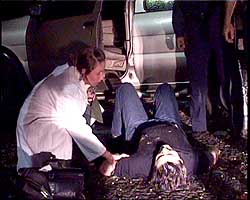
...and ambulance intervention
As far as the motive is concerned, it is always related to the personality of the murdered person. It was precisely on this plan that there was an astonishment: Boško Buha was the last man whom fellow policemen would have thought was threatened by such a thing. Born in 1959 in Virovitica, he graduated from the Faculty of National Defense in Zagreb and was employed as an internal affairs worker in Virovitica. Soon, in 1991, as a smart man, he understood the situation and moved to Serbia. Again, soon he became the head of the Department of Internal Affairs in Sopot, below Kosmaj. Sometime in 1998, he became the commander of the Belgrade SUP Police Brigade, which is an important position in the capital. In that capacity, he also served in Kosovo in 1999, where he was wounded during the bombing. The key moment in the career of police colonel Boško Buha came before October 5 and on that day: as a smart man, he realized that the matter with Milosevic had no future; it is not known whether he made any agreements with the DOS before October 5, although he was often seen with people who were often seen (to this day) with some high-ranking officials of the DOS in the Surčin locality, near Belgrade; but it is known that on October 5, as commander of the Police Brigade, he did not do a whole series of things that Milosevic expected of him. With the assumption of office of the new government, Colonel. Buha becomes (February 6, 2001) the head of the Belgrade SUP, the second most important position in the Department of Public Security of the MUP of Serbia; On June 1, 2001, he was promoted to the rank of major general of the police. In mid-December 2001, he was appointed to the position of adviser (later assistant) to the head of the Department of Public Security. To remarks that it was "removal", Minister Mihajlović replied that Gen. Buha was actually promoted to a position that suits him better because his entire career was tied to the uniformed police, and the city's SUP is looking for a criminalist.
In an interview at the end of 2001 ("Weekly Telegraph") Gen. Buha warned that "the mafia is trying to drag some police officers into the underground", but also that it is "trying to curry favor with some politicians from the DOS, offering them various services, money, and even files to compromise political opponents... Mafiosi who worked well in Milosevic's regime, they try to run into the camp of DOS, in order not to get patronage for jobs... If the politicians and policemen refuse the offer, the mafia puts pressure on the MUP, stages a scandal after which the dismissal of the Minister of Police of Serbia is publicly requested." These words of the late Boško Buha are thought-provoking. By the black irony of fate, his death became another one of those "scandals".
SPECULATIONS: Why would someone kill Boško Buha? There are different theories about it; neither prevails at this point, as there is simply no evidence to support it yet. Some believe that Boško Buha was removed as a potentially damaging witness at the Hague Tribunal. Gen. Buha did say: "I am ready to say what we did there and to answer for everything"; but he stated this in a context that clearly indicates that he does not think of the role of an "insider", that is, a witness harmful to the cause for which he and his men fought. He clearly stated that he would not allow "any policeman to be held accountable for what I ordered." I am responsible for everything that the police officers from my unit did while we were in Kosovo and Metohija...where we fought against terrorism." . The theory that Boško Buha was killed because of Hague does not hold for another, perhaps stronger, reason: there are many more dangerous witnesses - as will be seen - who are alive and well.
The second theory - that he was involved in various dubious affairs - seems extremely implausible: as a man from the uniformed police, engaged to the greatest extent in public order and peace, Boško Buha could hardly have had a share in serious affairs; it did not belong to him in formation, that was done by others, from other branches, and uniformed policemen could only be "integrated" at the lowest level of jobs, not to mention on the street. Those who connect Boško Buha with the "surčin clan" do not take into account that any serious competition to the "surčin" - if he wants to deprive them of protection - should kill some other, more important people before Boško Buha. Some policemen who served under Buch, shocked by his murder, link the crime to the latest successes of the police and customs in preventing cigarette smuggling. They think that this murder is "a warning to the authorities to give up on preventing smuggling". Some others think that the killing of Bosko Buha could be revenge for his role in the events of October 5; only that theory seems far-fetched, for obvious reasons.
The investigation will, of course, deal in detail with the possible motives of the murder, as well as the immediate indications from the crime scene. As was seen from the course of the investigation into the murder of Pavel Bulatović two years ago, the police and the State Security will take, for example, computer printouts of all mobile phone communications from the territory of the base station that covers the area around the "Yugoslavia" hotel. This is not about transcripts of conversations (they are not recorded for all phones, but only for those of "security interest"), but only about data about which mobile phones were active in that area at a given time. They will also question all possible witnesses at the scene and around it. The personality of the murdered person will be thoroughly analyzed, as well as all his contacts and previous career and private life; it is a common methodology. Criminalistics, however, is not all-powerful, as we here well know.
Politically speaking, the murder of police general Boško Buha could become a key test for the new government, its biggest in a series of problems that began in August last year with the murder of Momir Gavrilović. The problem escalated with the rebellion of the JSO in November and its "canning" without consequences, so that - along with the Momčilo Perišić affair, which opened, among other things, the issue of relations between various services - it culminated in this latest assassination. The name of that problem is the lack of political will and courage to get rid once and for all of the legacy of Milosevic's kleptocratic government, with the criminal-police-Udba underground that has thoroughly embedded itself in finance, trade in the most current goods and services (cigarettes, oil, drugs, weapons and military -police equipment, rackets, protection, prostitution, intelligence). Small but significant segments of the DOS (from both current factions) have only too readily welcomed – in their squeamishness – discreet hard-to-refuse offers from those circles. Where an offer did not help, blackmail did, because it was understood in time that information is money, and that Slobina will not burn until dawn. After all, the late Boško Buha also warned about all this... Four months of that silly triumvirate in Serbia was more than enough for artists to regroup, consolidate, save what could be saved and launch a counter-offensive that continues and - moreover - escalates. This whole criminal circus is, of course, "scandalized" by the old (SPS, SRS, JUL), but also the new (DSS) opposition, because this is the most effective way to destroy the reputation, credibility and future of the DOS government. That government now - now! - she has to do something on that front, otherwise she doesn't write well. In order for this government to be able to solve this problem - once and for all - it should first deal harshly and without sentimentality with all the elements in the parties that make up the ruling coalition, who are unable to provide real answers to questions such as: whose Do you drive? who are your security guards, why are there so many of them and who pays them? what do you do in certain places and in the company of certain persons previously known to the prosecution authorities, who are known to live on the lack of evidence? what's the point of talking to so-and-so without immediately informing the Directorate for Combating Organized Crime? how come your friend got a fat government contract? And so on; there are many such questions.
Until this is done, it makes no sense to expect the police, prosecutors and courts to excel in their service and risk their heads for that money. They are not at all stupid, so that they do what the top of the political power obviously won't do; they know very well how such procedures end - in the best case, in the statute of limitations. If the political top of Serbia does not understand that it is about his head, the police officers, prosecutors and judges do. And whoever will not fight for his own survival in power, others will not fight for him either. In other words, this behavior of parts of the ruling parties is tantamount to political suicide.
DRAGAN RADIŠIĆ - inspector of the Department for Blood and Sexual Offenses of the SUP Belgrade. Killed on February 1, 1996 in the entrance of his house. Ambush, one perpetrator, a "scorpion" with a silencer.
MIROSLAV BIZIC BIŽA - private detective and former policeman, involved in the Lakonić case (Nana, 1990), but also in a number of other cases, was killed on May 21, 1996, in front of Mercator in New Belgrade. Ambush, one perpetrator, a "scorpion" with a silencer.
JOYFUL STOJICIĆ BADGE - Acting Minister of Internal Affairs of Serbia, Head of the Department of Public Security of the MUP, was killed on April 10, 1997 in the Belgrade restaurant Mamma Mia. Break-in, one perpetrator, "ingram" with silencer.
DRAGAN SIMIĆ - a young and ambitious police colonel, head of the Department of Internal Affairs of the municipality of Savski venac, the most important municipality in the city, was killed on July 8, 1999 in Sava Kovačevića Street in Belgrade. An ambush.
MILORAD VLAHOVIC - police colonel, assistant to the head of the criminal service (UZSK) of the SUP Belgrade, was killed on March 11, 1999 in front of the Sports Center "Košutnjak". Ambush, sniper rifle.
MOMIR GAVRILOVIC - former high-ranking official (occasionally appeared as a "colonel" on the battlefields) of the Department of State Security. Killed on August 3, 2001 in front of his house in New Belgrade. Ambush, gun.
BOSKO FLEA - Major General of the Police, assistant to the head of the Department of Public Security of the Ministry of Internal Affairs of Serbia. Killed on June 10, 2002 in the parking lot of the "Yugoslavia" hotel. Ambush, automatic rifle.
A matrix can be observed in the enumerated cases of murder. That matrix, i.e. the method of execution, the "handwriting", the profile of the victims and - the most important of all - the fact that the perpetrators were not discovered, indicates that the internal affairs bodies of the MUP of Serbia were either not capable (which appears incredible), or were not willing (which is hard to believe), or they had instructions not to act on those cases. The possibility of the involvement of organs and services of the Ministry of Internal Affairs of Serbia in those murders cannot be ruled out either. Interpretations according to which Serbia and Belgrade are being raided by "foreign services" and mysterious "terrorist organizations" that kill whoever they want appear as difficult to accept; such interpretations are frivolous, considering the number, expertise, powers and resources of the internal affairs authorities. By all accounts, the Ministry of Internal Affairs of Serbia and its Department of State Security will have to be searched and cleaned from the inside, by their own forces, especially since the data indicate the "merger" (minister Dušan Mihajlović) of the police and organized crime on many levels: from providing protection to to "typing" and intelligence work for the benefit of criminals. There is also a well-founded suspicion that there has been an even greater convergence between the State Security and certain political parties, in order to facilitate the execution of criminal acts: from attempts to change the constitutional order, through abuse of official positions, armed rebellion, robbery, corruption and illegal appropriation of other people's property. ; not to mention other criminal acts. There is also a well-founded suspicion that hard work is being done to ensure the continuity of certain political-police-financial structures and connections from the old to the new government; no wonder - we are talking about monopolies, "incorporations" (corruption) and acquired positions; all of this is a source of high income for the persons involved and all of this is impossible without the protection and cooperation of the internal affairs authorities, the judiciary and other state authorities. That's how it's been done so far and it was very successful for the actors of those machinations.
If the cleaning and the introduction of order in the MUP of Serbia, its bodies and services/departments are not achieved by their own efforts and the efforts of honest and uncompromising policemen in cooperation with the new government, the minister and the new heads of services, the new government will have no choice but to decide on radical measures - if he wants to survive and preserve the trust of voters.