The goal bar under the north stand of the Municipal stadium has already become so hated in this area, so the poor person shares the blame for the unsuccessful episode of the FR Yugoslavia football team at the World Cup in France in 1998: that the masters from "Little Wembley" in Toulouse installed the structure by a centimeter more (rugby is also played there, so, realistically, they could have missed a bit), Predrag Mijatović's powerful shot from the penalty spot would have ended up off the crossbar in the net and our the team would lead against the Netherlands 2:1 and be one step away from the quarterfinals. This way, thanks to the media reminders written by the younger generation or football laymen, and the internet spreads and multiplies, that crossbar in the south of France is still shaking and evokes sad memories of being relegated from the World Cup, and we could, as we already know, do much more.
When looking at the statistics of the World Cup from 24 years ago, FR Yugoslavia recorded two wins, one draw and one loss each, and in the final standings they took 10th place in the competition of 32 teams. That score, from today's point of view, comparing it with the three subsequent World Cup performances of our national team, can be considered successful.
However, many think that that team led by today's coach Dragan Stojković Pixi and other playing stars - Predrag Mijatović, Vladimir Jugović, Dejan Savićević, Siniša Mihajlović - could have gone beyond the round of 16. Especially due to the fact that the other team that inherited the success and reputation of the national team of SFR Yugoslavia before the breakup of the joint state - the national team of Croatia - came in third place and a bronze medal.
RETURN AFTER SANCTIONS
The qualification for the World Cup in France marked the return of our national team to the big stage, after years of sanctions that prevented playing in the qualifications and potential participation in the World Cup in the USA in 1994 and the European Championship in England in 1996.
After the easing of sports sanctions at the end of 1994, the national team of the truncated Yugoslavia (Serbia and Montenegro) got the right to play friendly matches, so the Football Association quickly arranged a meeting with Brazil, the current world champion, on December 23 and in Porto Alegre, Stojković, Savićević and others got the opportunity after almost three years to perform for the national team.
And the opportunity to lead the national team was given to Slobodan Santrač (1946–2016), the best scorer in the history of Yugoslav football and winner of the Bronze Boot of the French newspaper "France Football" in 1972 as the third top scorer in European leagues, but without real coaching experience. "Before the national team, he trained only the pioneers of Galenika from Zemun", said the scathingly famous Velibor Vasović at the time, and the bazaar reported how the then president of FSJ Miljan Miljanić (1930-2012) satisfied the ruling parties, especially the newly founded JUL, and appointed the popular Sani as selector. But rather, it will be that Čiča Miljan satisfied himself and other gray eminences of football and politics at the time, in order to more easily control the invitations to players to the national team and the composition of the first team, and Santrac, it seems, too harshly received the epithet of a complete party appointee, as if he had never been in football before, nor had he hoped for so many goals. In essence, the germ of later failure in France was found in the then Football Association and clubs, which reflected the state of society and the state: crime, corruption, violence, insecurity reigned... It is enough to remind that just before the departure of the national team to the World Cup in 1998 the championship was won by Belgrade's Obilić under the management of Željko Ražnatović Arkan (1952–2000) and under, so to speak, still unclear circumstances. Every other "fierce guy from the Belgrade asphalt", ie. a person with a thick criminal record, in those years he was simultaneously the owner, sorry, the president of a football association of citizens, which could be seen in the newspaper obituaries where most of them ended up.
FOOTBALL STARS TOGETHER
Santrac then had a selection of players like few other selectors on the planet and it was expected that we would use the first opportunity after the sanctions to qualify for a major competition, regardless of his coaching inexperience and despite the strong qualification group in which the draw placed us. Stojković and his team faced the always strong Spain and current European vice-champion Czech Republic, as well as unpleasant Slovakia, and there were also two weak national teams in the group - Malta and the Faroe Islands. The first place led directly to the World Cup, and the second place to the playoffs.
Yugoslavia played its first competitive match after a four and a half year break (the last one was against Austria in Vienna in the qualifiers for the European Championship in Sweden) on April 24, 1996 in Belgrade against the Faroe Islands and routinely won 3:1. This was followed by "goals" in duels with Malta (6:0) at home and away in the Faroe Islands (8:1), and a minimal but great victory (1:0) in Belgrade over the Czech team of stars - Nedved. Berger, Poborski, Babel, Schmitzer...
As soon as we took off and saw each other in France, the Spaniards brought us down to earth: at the Mestalla in Valencia at the end of December in 1996, they routinely won with 2:0, with goals from Guardiola and Raul already in the first part of the match. Yugoslavia showed its other face: timid, timid, focused on defense and without real actions on the opponent's goal, which is quite unworthy of a team with world-class strikers. It was also recorded that the leader of the attack of the "blues" Mijatović (desperate in that game like most of the players) was booed and insulted every time he made contact with the ball, since shortly before that he moved from Valencia to Real Madrid.
The Spanish lesson had a somewhat sobering effect, which was shown in the decisive match for the second place with the Czech Republic on April 2, 1997 in Prague. The home team played from the beginning, carried by the full stands of Sparta's stadium, but they missed chances or the cheerful goalkeeper Ivica Kralj took the ball away from them. However, the first half was marked by a masterful goal from a free kick by Predrag Mijatović for the leadership of Yugoslavia. And in the second part, ours mostly defended and rarely threatened from counterattacks. The Czechs kept missing until midway through the half when Radek Babel equalized. Even after that, we played for our goal, and then in the last minute, a counter-attack started and brought us joy. The joker from the bench, Savo Milošević, used a great pass from the wing of the fast-footed Ljubinko Drulović, also a reserve player, and with three points from the Czech capital, the barrage was practically secured.
There is still a chance to win first place if we beat Spain at home. That meeting in Belgrade, in front of the full stands of Zvezda Stadium, at the end of April 1997, was one of several excellent performances by the national team at that time. Luck and head referee Rune Pedersen from Norway saved the "red fury" from defeat. In the end it was 1:1 - the Spaniards took the lead from a penalty at the beginning of the game, the scorer was Fernando Jero, and Mijatović scored for the Blues from the penalty spot, five minutes before the end. In addition to those two, referee Pedersen failed to award at least two more penalty kicks from 11 meters for Yugoslavia, so the "soccer nation" went crazy because of the injustice, and it went so far that a famous commentator declared: "Mr. Pedersen, you really deserve such a surname. "
BURST FIRE IN THE BARAGE
As the second in the group, we entered the play-off among eight teams, and now the draw was in our favor between Italy, Russia, Ireland or Croatia, and on the way to France, we had the weakest competitor - Hungary. After learning the name of the rival in the live broadcast, Santrač and the team at FSJ jumped for joy and congratulated each other. Out of place, of course, but based on facts: the Hungarian national team barely reached the second place in the weakest qualification group, behind the dominant Norwegians and ahead of the Finns, and our team was the absolute favorite in everything.
The first match was played at the end of October 1997 in Budapest, at the Ferencvaros stadium, with more of our fans than Hungarian fans and in the end with drastically more goals from us compared to the Hungarians. Already in the 10th minute, it was 3:0, and by the end of the first half, the "blues" put the ball into the home team's net two more times. In the end, the anthological result was achieved - 7:1, just like once upon a time the "Hungarian light cavalry" led by Puskas and Kocsis overheard the opponents. Mijatović scored a hat-trick, and in the rematch in Belgrade, he scored four more of Yugoslavia's five goals for another convincing victory (5:0) and a confirmed ticket to France.
Euphoria gripped the "suffering nation", eager for at least sporting success, and excessive optimism spoke from the majority of fans, commentators, experts - let's go at least to the semi-finals! They didn't care much that we were winning on the improvisation of good players, and less on meaningful tactics, that in the duels with strong teams, the coach's calculation and the players' impotence were shown, and that, after all, the overall atmosphere in the state and domestic football was rotten and polluted.
TROUBLE IN THE GROUP PHASE
The team that Santrač took to France was full of names for every respect: Mijatović was the star of Real, shortly before the World Cup he scored the only goal in the final of the Champions League and brought Madrid their first title after 32 years; Vladimir Jugović won the Italian Cup with Lazio, and the Champions League two years earlier with Juventus; Siniša Mihajlović shone in Kalč in the jersey of Sampdoria, Pixi Stojković played in Japan, but a master is a master, Miroslav Đukić was among the best players of Valencia, Darko Kovačević of Real Sociedad, Branko Brnović of Espanyol, Savo Milošević of Aston Villa, Ljubinko Drulović of Porta, Slaviša Jokanović of Tenerife, Goran Đorović of Celta Vigo, Zoran Mirković of Atalanta, Dejan Govedarica of Leće, goalkeeper Ivica Kralj Partizan... And only two younger players - Dejan Stanković and Perica Ognjenović from Crvena zvezda. Of course, Dejan Savićević was also on the list, but he was injured and out of the Milan team for a long time, so his performance was questionable.
Quite an experienced team, and for most of them, the World Cup in France was the last chance to achieve greater success in the national team. That is why it was expected that the coaching staff would improve the game shown in the match against Spain in Belgrade and in both meetings with Hungary in the play-off: to play without calculations and more attacking, and to try to the end to use the technical skills and goal-scoring abilities of many players.
In addition, the draw went to Yugoslavia again - it was drawn in a group with Germany, Iran and the United States of America and it was expected to pass the first round.
In the preparatory games, unfortunately, there was no glimpse of the real game. The "blues" were not convincing in the duels with Japan and Switzerland, and they partially resembled the team against Nigeria, but later it turned out that the Nigerians drastically oscillate in form and motivation and that the 3:0 victory was not a true reflection of the quality of the Yugoslav national team.
All those bad forebodings were confirmed at the first game in France. In Saint-Etienne on June 14, 1998, we barely managed to win a minimal victory over Iran (1:0), thanks to Mihajlovic's art of playing the "liberal". In the first half, we did not direct a single shot at the Iranian goal, and only after the team was refreshed by the reserves Stanković, Ognjenović and Kovačević, did we begin to threaten the opponent's goal. The troubles were solved 18 minutes before the end with a shot from about twenty meters from the "first left" of the national team.
Football fans consoled themselves that the first games are the most difficult and already in that style, and that we will see the true value of the "blues" in the duel with the three-time world champions, the German national team. The current champions of Europe routinely defeated the USA 2:0 in the first round, but it was clear that it was no longer the team that won the trophy in England two years earlier.
And that match with Germany is one of those that are retold, one of the sad episodes of our football, when we lost the matches we won, especially with the Panthers. This time we were not defeated, we drew (2:2) at the stadium in Lens, but by the 73rd minute we were 2:0 and practically secured first place in the group.
We took an unexpected lead in the 13th minute. After Mijatović sent a cross, Stanković missed the ball in front of the goalkeeper Andreas Kepke, and it then rolled to the post and bounced off the embarrassed Jens Jeremis behind the goal line. In the ninth minute of the second half, the German defense rewarded us with a goal again: Kovačević made a strong cross from the edge of the penalty area, and the ball squirmed under Kepke and reached captain Stojković, who knocked it into the net from two meters away.
Then the German team goes on the offensive, and the Yugoslav team unnecessarily crawls into its own penalty area and defends frantically. The Blues paid the price for such a game in the 73rd minute, when Mihael Tarnat hit a free kick from close to 30 meters, and Mihajlović deflected the ball into the goal. It wasn't a signal to try to fight back either, but it continued with the "bunker", so the Germans equalized in the 80th minute after a corner and a great header by Oliver Bierhoff. Until the end, we frantically defended the point and defended, thus leaving the hope that we could reach the first position thanks to the goal difference.
However, on June 25 in Nantes against the USA, we struggled like we did against the Iranians and again managed only a minimal victory. Now the goal fell at the opening of the game, already in the fourth minute, but again after a "bomb" by Mihajlović, with goalkeeper Friedel managing to deflect the ball, which Komljenović then sent into the net with his head. In the last round, Germany was better than Iran with 2:0 and thanks to the goal difference took the leading position.
A COWARD'S END IN TOULOUSE
As the second-placed in the group, the Yugoslavs in the round of 5 were defeated by the Netherlands, which at that moment had a better rating, but did not shine in the group stage: they drew with Belgium and Mexico, and their only performance was against South Korea (0:XNUMX ), but it was the team that took the last place in the group.
After many years, the football team reached the elimination stage of a major competition, and regardless of the fact that we made it through the group, the already excessive optimism grew even more before the duel with the "Tulips" scheduled for June 29 in Toulouse. The Municipal Stadium was filled, and the stands were dominated by orange jerseys, and the Netherlands line-up justifiably instilled fear: Van der Sar, Reisinger, Stam, Frank de Boer, Numan, Koko, Davids, Bergkamp, Seedorf and Overmans were in the first line-up. , and on the bench Kluivert, Winter, Ronald de Boer, Zenden... The backbone was made up of Ajax players from Amsterdam, who won the Champions League three years earlier.

24-Pages from 402vreme...
And obviously, the fear entered into Santrac and the prompters, and transferred it to the players, so that from the beginning to the end of the first half we were completely inferior - we looked to save the goal and did not seriously threaten in the attack. Bergkamp gave the Netherlands the lead in the 38th minute, and only luck, the clumsiness of "lala" and the dexterity of the Kralja goalkeeper saved us from a bigger deficit.
And then in the first ten minutes of the second half, the national team of Yugoslavia played as expected and those minutes, along with a few dozen minutes from the game with Germany, were the only thing worthy of praise at the World Cup.
In the 48th minute, Mijatović was brought down near the penalty area of the Netherlands, and then Stojković showed his football mastery: a filigree cross to the second post, too strong for goalkeeper Van der Sar to react, and just enough for Komljenović to head the ball into the net. The score was tied and it was shown in a few minutes that the Dutch could attack and disrupt. Just a few minutes later, Jugović entered the penalty area with the ball, and the staunch Stam was pulling him by the shirt, which was missed by most of the spectators, but not by the Spanish referee García-Aranda, and a penalty was awarded.
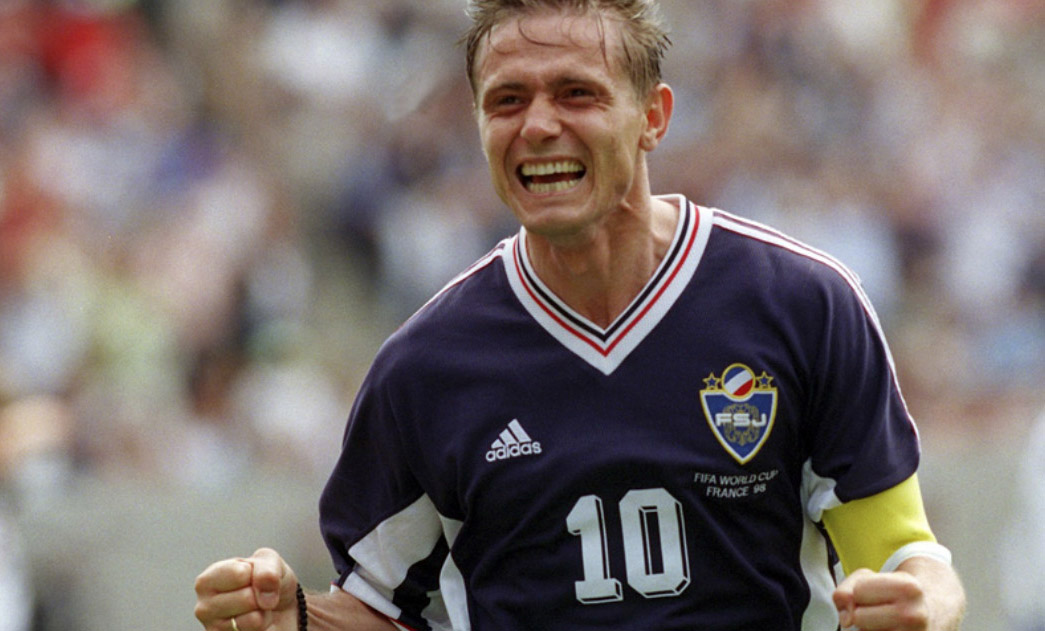
And we come to that famous crossbar. As Santrač himself later testified, Stojković was designated as the penalty taker, followed by Jugović, and Mijatović as the third. However, the ball was taken by the player who, a month and a half earlier, with a field goal, at the stadium in Amsterdam, brought Real the title of club champion of Europe and experienced stellar moments of his career.
Mijatović confidently placed the ball on the penalty spot, but his look did not inspire confidence, or at least that's how his tired facial expression was subsequently interpreted, and after a long run, he fired his full foot at the ball with all his strength, and it then hit the middle of the crossbar, bounced off was a meter away from the goal and then in a big arc flew outside sixteen meters.
Shock and disbelief gripped the fans of Yugoslavia, but again, there were still almost 40 minutes left until the end of the game and hope was awakened that they could reach the quarter-finals. However, from that moment we inexplicably return to the game from the first half and retreat to our half. Until the end, the "Orange" completely dominated and created chances, and luck and the good defense of Kralj saved us until the last minute, when Edgar Davids' left shot flew and the ball flew into the left corner of the goal between a forest of legs on the ground. Justice has won, and our national team has to pack up and go home.
And not only was she defeated, but she left a faint impression, regardless of the fact that in the end she was officially ranked tenth in the world. It is enough to remind that one of the best football players of all time, the Dutchman Johan Cruyff, harshly judged that the Yugoslavs played cowardly, or as the late colleague Uroš Komlenović described it then on the pages of this weekly: "The selector was obviously guided by the proverb 'Better a live donkey dead lion', and in the end we all got a dead donkey.”
IT'S NOT THE BAR'S FAULT
The national team which, by the will of Milosevic's regime, bore the name of a country that fell apart, whose anthem was whistled by its fans, which was imposed by a coach without experience and authority, behind which stood the criminalized Football Association, and which represented a broken society and state, realistically could not more.
Even if Mijatović had aimed a few centimeters lower or if by some miracle the builders at the stadium in Toulouse raised the crossbar a little, and the ball ended up in the net, it seems that the Dutch would have turned the game around again and then the result in their favor. We had a team full of stars, but we didn't have a team in the true sense of the word.
The players were comforted by the congratulation of Slobodan Milošević, the then president of the FR Yugoslavia, who recognized them "for the great sacrifice, game and attitude with which they worthily represented our country", just as one year later he declared the victory of the FR Yugoslavia in the war with NATO, as well as the satisfaction of FSJ president Miljan Miljanić with the achieved result, with the laconic conclusion that "it is not easy to lose in the last moments of the match".
Namely, what we already experienced with the national team of the great Yugoslavia at the world championships in SR Germany in 1974 and Spain in 1982 was repeated, and it showed what will happen to us in the next big competitions, starting with the European Championship in 2000, when we are in in the first elimination game they were crushed by the Netherlands with 6:1.
The championship in France was the last World Cup for all players except Stanković, and among them for current coach Dragan Stojković. After 24 years, he is back at the World Cup and that is the only coincidence for now, because unlike the national team that he led as a captain, today's team under his coaching leadership does not calculate and plays for the goal more, so we hope that we will not be there sometime in December to mourn some unfortunate bar or post, but that even if we are eliminated again in the round of XNUMX or earlier, we will do it honorably and bravely.