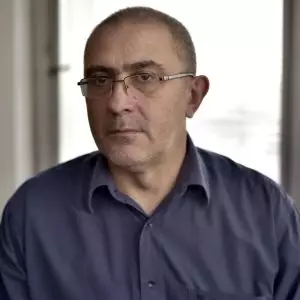
Radovan Lazić is one of the few prosecutors who are not afraid to publicly express their decent views on the state and current events in the judiciary. He is a former member of the State Council of Prosecutors (predecessor High Prosecutorial Council), which enabled him to see the prosecution system from different angles. Today, he is a public prosecutor in the Appellate Public Prosecutor's Office in Novi Sad and the president of the Management Board of the Center for Judicial Research (CEPRIS).
In an interview with "Vreme", Lazić assesses that the subject murders in Senjak followed by numerous unusual and difficult to explain moves by the Higher Public Prosecutor's Office in Belgrade, which is why, as he says, one can justifiably suspect that this is an attempt to relativize the responsibility of a high-ranking police official Veselin Milić, that is, that someone from a very high position is trying to protect him. He believes that there are already reasons to involve the Supreme Public Prosecutor's Office in the case, inspect the file and determine what is really happening in it.
However, he adds that it seems to him that the case is already so contaminated that it is difficult that this procedure will end so that we can say that justice has been finally served.
"WEATHER" From what you have seen and learned so far, officially or through the media, what key procedural and legal problems do you recognize in the case of the murder of Aleksandar Nešović in a restaurant "27" in the Belgrade neighborhood of Senjak? What are the illogicalities and contradictions in the actions of the Higher Public Prosecutor's Office in Belgrade, and which in the police's actions?
RADOVAN LAZIĆ: From the very beginning, VJT in Belgrade has been taking rather strange and illogical actions in this procedure. The first thing we were able to notice is that the legal qualifications of the crime charged to Belgrade Police Chief Veselin Milić do not correspond to the factual description of the event. I had no insight into the order on the investigation, but if it is true that it states that he "lured" the victim to the restaurant "27", then it cannot be about the criminal act of assisting the perpetrator after the commission of the crime or the act of not reporting the crime, but complicity. If you accuse someone of having "lured" the victim whose life was later taken, then he is charged with the crime of aggravated murder in an insidious manner. It is very unusual in prosecutorial practice for the prosecutor to apply a lighter legal qualification at the beginning of the proceedings than the one that results from the described facts. The investigation is usually entered with a more serious qualification, so later, if the investigation shows that it is about something else or a lighter one, when the indictment is filed, it can be reclassified as a lighter crime.
In addition, the way in which VJT communicates with the public in Belgrade is very unusual. It practically inundates us with announcements: they are announced every few days, and sometimes more often. It is completely out of the usual practice of public prosecutor's offices, and even more strange is that some announcements contradict what was stated in the previous ones.
In the end, the surprise was the latest announcement of the Higher Public Prosecutor's Office in Belgrade, which states that the criminal complaint was dismissed in relation to one criminal offense, while the prosecution continued for the other criminal offense. In the case of Chief Milić, the only remaining offense was failure to report a criminal offense. This is completely outside prosecutorial practice, and the question is whether it is legal for a public prosecutor to reject only one legal qualification of a criminal offense. This is about one event. For that event, the prosecution assessed that two criminal acts were committed in the actions of the reported Veselin Milić. When a criminal complaint is dismissed, it is dismissed in relation to the entire reported event and all criminal acts that could arise from it. To dismiss the criminal complaint in relation to one legal qualification, and to continue the criminal prosecution for the other qualification, is something that has not been known in the current prosecutorial practice.
In which case the prosecution could drop one, and continued prosecution under another criminal qualification? And when the criminal charges can be dismissed in this part of the investigation?
The law prescribes several reasons for rejecting a criminal complaint, and in this particular case it is about the fact that there are no grounds for suspecting that a criminal offense has been committed, for which it is being prosecuted ex officio. Therefore, it is clear from the legal wording itself that, when it comes to the same event, the criminal complaint is dismissed for each of the criminal acts for which it is prosecuted ex officio. The situation would be different if the criminal complaint included several completely separate events. For example, if you have one event from May 5th, another from June 10th and a third from July 20th, and those events are not related to each other, then it is possible to partially dismiss the criminal charges in relation to one of those events. However, if it is about one event and one action of the suspect, you cannot dismiss one part of the report and continue criminal prosecution for the other.
It is extremely unusual that the announcement states that the criminal charges were dismissed at a time when the investigation into Nešović's murder was being conducted. If the order to conduct the investigation includes Milić, then the criminal complaint against Milić can no longer be dismissed, because it has already been resolved by issuing the order to conduct the investigation. The moment when the order to conduct the investigation is passed, the criminal complaint, in the procedural and legal sense, no longer exists as a pending complaint. These are not just unusual procedural situations. These are things that I, during my practice as a prosecutor, have not come across so far. And VJT in Belgrade, despite all the announcements it publishes, did not explain these illogicalities and unusualness to us.
There is great public doubt about this process, it seems to many that he is contradictory precisely because of the existence of political pressure to cover up some things. Do you think that the illogicalities you point to are enough to involve the Supreme Public Prosecutor's Office in the case??
I think there are already reasons for the Supreme Public Prosecutor's Office to get involved in the process, to inspect the case, to see what is actually happening in it and to issue a mandatory instruction if necessary.

photo: marija janković...
How are things with "omissions" police? For two days, the prosecution did not know that this crime had even happened.
One of the suspects is a high-ranking police official. If he was involved in the event and if what was charged against him in the criminal report is true, we can only assume what kind of obstructions there were within the police. All actions were taken with great delay, which, of course, made the procedure even more difficult. We cannot blame the prosecutor's office or the police operatives who directly act in this case. On the contrary, we can understand the circumstances in which they work, because their actions are extremely difficult if the investigation is obstructed from the very top of the police.
Can it be said that the entire confusion we are talking about is precisely the result of various obstructions? Maybe combined with the incompetence of some prosecutors?
It is difficult to assess the reasons for this development. The first public information was published so that the impression was made that the role of Veselin Milić in this case was extremely important. We are talking about a man who, logically, due to the function he held and the position he held until recently, was the most interesting to the public. The very information that one of the highest officials was suspected in such a difficult case was a big shock. Viewed through the police hierarchy, this is a functionary who was directly below the police director, practically on the second level of the police pyramid, viewed from the top down.
The first information indicated not only that he was involved, but that he practically managed the destruction of traces and the cover-up of an event in which one person lost his life. According to the description that has reached the public - although we do not know if it is completely accurate - it was even stated that he "lured" the deceased injured party, as I said, to come to the scene. It's a scenario that seems almost unbelievable. If you offered an editor a manuscript of a novel with such a plot, he would probably tell you that the story is unrealistic. This is exactly why all of this was a terrible shock for the entire public, and its need to be informed about this procedure is quite understandable.
However, from the statement of the prosecution, one gets the impression that Milić's role in the whole event is continuously reduced. It is difficult to determine whether this is really the result of the evidentiary actions carried out so far and new knowledge gathered during the investigation, or whether it is a matter of relativizing his role for some other reason. Nevertheless, bearing in mind all the strange and unusual moves of the VJT in Belgrade that I talked about, it is quite justified to suspect that it is about relativizing responsibility and that someone from a very high position is trying to protect Milić.
It has long since become customary for the President of Serbia to go public with very sensitive details from investigative and pre-investigative proceedings in the case of serious crimes.. Who would have to institutionally react to this phenomenon, given that it is a blatant violation of the law?
It is certainly a violation of the law. But even if it wasn't, such a course of action would, at the very least, be a contamination of the investigation. It is inadmissible for an official, or any other person who does not have any competence in the conduct of criminal proceedings, to present information about the actions taken, knowledge and evidence collected until then in the investigative and pre-investigative proceedings. When such statements come from the highest political level, that is, from the president, the problem is even more serious. The president is not only a high-ranking political functionary but, according to his political authority, he is undoubtedly the most powerful and influential political figure in the country, regardless of formal powers. Such behavior represents an impermissible influence on the work of the public prosecutor's office and the police.
The acting public prosecutor should certainly inform his immediate superior, i.e. the chief public prosecutor, about illegal interference, and this High Council of Prosecutions, which should then react to such phenomena. Issues of illegal political influence, including the statements of the President of the Republic, have been raised before the Supreme Court of Justice. However, as far as I know, this body has so far not reacted when the pressure came from the highest political level. It reacted mainly in cases where criticism or pressure came from the media, while the statements of the highest state officials remained without an appropriate institutional reaction. In this case, the address of the VJT in Belgrade to the High Council of the Prosecution was also missing. At the same time, there was no independent reaction of the VST, and it did not require any formal address, since the matter is played out in public.
On the other hand, The Belgrade-based VJT reacted strongly to the text that appeared in "Radar", in which it is stated that the announcement of this prosecution contains falsehoods. Namely, VJT claimed that all the suspects except Milić are defending themselves by remaining silent, a "Radar" has offered clear evidence that this is not true. The Prosecutor's Office found that this media is jeopardizing the process. How do you see this??
"Radar" informed the public that VJT in Belgrade was reporting falsehoods. He published the minutes from the questioning of the suspects, from which it is clear that some of them presented a defense, that is, that they did not defend themselves by remaining silent, as VJT announced. In this case, there was no basis for the reaction of the prosecution. It is completely unacceptable, I would say impermissible, for the public prosecution to mislead the public by publishing a press release that contains incorrect information.
The investigation is a phase of the criminal procedure in which the public is limited. The so-called party public is allowed, which means that the public prosecutor, the suspect and his defense attorney, and to a certain extent the injured party, can be informed about the details of the investigation. These are the persons to whom the information from the investigation is available in accordance with the law. Here, however, it is about the fact that "Radar" obtained the information from the suspects themselves, that is, from their defense attorneys. Therefore, it is not an illegal leak of information from the prosecution, the police or any other state body. The secrecy of the investigation was established, among other things, in the interest of the suspect. The suspect has the right to be familiar with the contents of the records that refer to him, and he does not have the obligation to keep data from the investigation, as is the case with the public prosecutor, the police and other state authorities.
It is understandable that the public prosecutor's office cannot go public with all the information it has and that it must keep certain data in order to protect the interests of the investigation. However, the prosecution must not publish false information. When the public prosecutor goes public with information that is not correct, the suspects have every right to deny such a statement, even by publishing the minutes that are legally available to them and to which they are entitled.
This case is just one of many that show that the prosecution has major problems in communicating with the public, which is for some cases quite understandable very interested.
It is true that we do not have a tradition of good communication between the public prosecutor's office, the media and citizens. On the contrary, public prosecutions have long nurtured the practice of silence and avoidance of the public. When they announced themselves, they mostly did so in an outdated way - announcements. In cases for which there is great and justified public interest, it would be natural for the prosecution to organize a press conference and allow journalists to ask questions. Of course, he cannot and should not answer all questions, especially if it would endanger the investigation, but he would have to provide enough verified and clear information.
Poor communication is one of the causes of great distrust of citizens in judicial authorities. If the prosecution communicated in a timely, clear and responsible manner, the level of mistrust would be significantly lower. Avoiding communication leaves room for various speculations, conspiracy theories and scenarios that often have no basis in reality. Due to the lack of information, the prosecution in the eyes of the public sometimes looks even more closed and problematic than it really is.
However, what VJT did in Belgrade is not the result of bad communication, it is a matter of presenting untruths.
Let's get back to the case.. Some lawyers claimed in public that this case should actually be handled by the Public Prosecutor's Office for Organized Crime, because in it, as they say, there are elements of organized crime. How do you rate it??
I don't have enough information to give a clear assessment. Could there be elements of organized crime in this case? It is possible. If it is determined that they exist, the case should then be taken over by TOK. However, the legal qualifications of the criminal acts that have been mentioned so far are not sufficient to establish the actual competence of this prosecution. If it turns out that there was an organized criminal group, then TOK could establish its jurisdiction. However, without an insight into the case and the evidence, we cannot responsibly present a final conclusion. In any case, I believe that TOK should monitor this case in a certain way. As I said, the Supreme Public Prosecutor's Office should also do that.
Procedurally, the Supreme Public Prosecutor's Office could assign the case to the Prosecutor's Office for Organized Crime, as happened in the process for the fall of the Novi Sad canopy?
If, during the procedure, the VJT in Belgrade determines that the TOK is responsible for the case, it should submit the case to it for further processing. However, taking into account the relations between the VJT in Belgrade and the TOK, as well as the relations between the VJT and the Supreme Public Prosecutor's Office, such a scenario seems rather unrealistic. That is why I think that a change in jurisdiction could only come about through the intervention of the Supreme Public Prosecutor's Office, similar to what, as you said, we saw in the process for the fall of the canopy in Novi Sad.
You mentioned the bad relations between VJT in Belgrade and TOK and the Supreme Public Prosecutor's Office. There was a lot of talk in the public about the fact that VJT in Belgrade is under the firm control of the executive power. Do you share that opinion??
It seems so. I can't claim that this is really the case, but everything that can be seen in public leaves that impression. I wrote about the behavior of the chief public prosecutor of the VJT in Belgrade in an article specifically for "Radar". My impression is that the President of Serbia does not even have to tell him directly what he expects from him. Prosecutor Stefanović, it seems, recognizes very well what is expected of him in a certain situation and then implements it quite zealously. I believe that the Prosecutor's Office in Belgrade is the prosecutor's office that is exposed to the greatest influence of the executive and legislative, that is, political authorities. I would even say that it is not just about influence, but that it seems to be almost completely under the control of the executive branch. I wish that impression were wrong. However, everything we have witnessed over the last few years suggests that this is the case. The public attitudes that Stefanović and his closest associates publicly represent also contribute to this. Based on them, it is clear that their vision of the prosecution is as follows: it should be a sword in the hands of the executive!
photo: marija janković...
Do you, based on everything that has happened so far, in general, we can talk about the possibility of a court procedure that will satisfy law and justice or the subject "27" already now, based on available information, irreversibly contaminated?
It seems to me that this procedure is already contaminated to such an extent that it will be very difficult to subsequently remove all the consequences of previous failures. Objectively speaking, the subject was extremely difficult from the very beginning. When you find out about such a serious crime only two days after it was committed, you are in serious trouble. In two days, the face of the place can be changed in many ways. Traces can be removed, the area washed and disinfected, and objects moved or destroyed. It is difficult to expect that during the investigation, conducted only after such a long time, you will find everything that could be significant for the proceedings. The same applies to marks on suspects. After using a firearm, so-called GSR particles may remain on the hands, clothing and body, that is, traces that may indicate that someone has fired or was in the immediate vicinity of a shooting. However, after two days they can be removed, the wardrobe washed, and the people bathed. Therefore, the prosecution had a very difficult position from the beginning, because it joined the proceedings with great delay.
Everything that happened later builds on that. Unfortunately, it has become almost usual for the President of the Republic to speak at press conferences about specific criminal cases and present details from the pre-investigation and investigation procedure. However, this is not normal. In which orderly state does the head of state, be it a president or a monarch, publicly disclose details of a specific criminal act? This should not be done even by the prime minister, who is operationally managing state policy. There are competent authorities for conducting criminal proceedings. A particular problem is that the president discloses a large amount of information that should not be available to him by law. The question arises as to how the data from the pre-investigation procedure or the investigation reached him in the first place. They could have reached him only by passing them on to him by the people acting in the case, although there is no legal basis for this.
Everything indicates that the case is seriously contaminated and that it will be very difficult to ensure a process that the public can recognize as fair and independent. It is difficult to expect that this process will end so that we can say that justice has really been served in the end.
Real journalism costs money, and we will not be bought by tycoons and corporations. Support us with a one-time or monthly donation. The time for it is now!