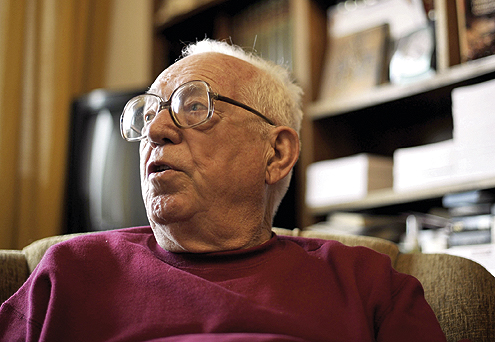
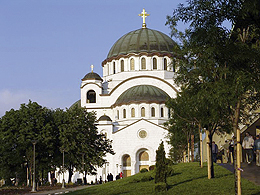
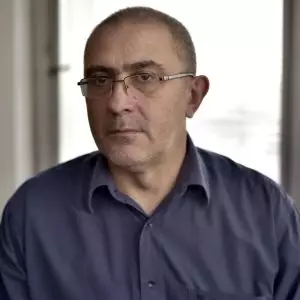
Dusan Čkrebić's study. A library, a computer and a framed photograph of engineer Čkrebić with a medal. One armchair and a sofa. Čkrebić's wife Anka follows my gaze and explains: "That was when he received the order for the Saint Sava Temple." I nod, I remembered. The photo is from 2007, when one of the highest state and party officials of the former SR Serbia and SFRY was presented with the Order of "St. Sava" 1985st degree by Metropolitan Amfilohije of Montenegro and the Littoral (at that time in front of the Holy Synod of Bishops of the Serbian Orthodox Church, during the illness of Patriarch Pavle). Newspaper headlines: Order of "Saint Sava" for former communist. Namely, Dušan Čkrebić, as the president of the Presidency of the SR of Serbia, in 23 lifted the state ban on the continuation of the construction of the Saint Sava Temple, so the SPC decided to thank him with its highest award, XNUMX years later. Čkrebić is uncomfortable. His demeanor and speech reveal a virtuous, unobtrusive and restrained, but thoughtful and witty man, so he begs his wife with a gentle look not to praise him while patiently, in his armchair, posing for the photojournalist "Vremena". Mrs. Anka leaves us, smiling.
On the table, next to the computer, the book Life and Politics 1967–1978 by Dragoslav Draža Marković. Čkrebić has been flipping through the second volume in recent days. While he was writing his book Koca Popovic a deep human secret (Official Gazette, 2011) did not want to read Draža's diaries, so that he would not be "distracted", he says, from what was his assessment of the time in which he was a participant in the event. On the Internet, he searches for texts about the Brijuni Plenum and the role of General Ivan Mišković. "I would have a hard time without the Internet, many things would not be available to me." In my time there were no computers. "I had to learn in the old days," he laughs. And he's doing well. While the book is about Konstantin Koča Popović, philosopher, military leader, statesman, as stated in the subtitle of Čkrebić's work.
"WEATHER": You wrote a book about Koca, as you said, not wanting to be his biographer. Yet, based primarily on Koca's notes that you read, you tried to solve the enigma that followed him all his life. From Koča's surrealism and communism, fighting in the Spanish Civil War, through Koča vojskovodje in NOB u, to Koca, Chief of the General Staff, and the head of Yugoslav diplomacy, broke up with Tito in 1972, and the final disintegration of Yugoslavia, about which he had his own opinion, because he dies in 1992. What would you do?, as someone who has dealt with his life for a long time, rated as Kochi's largest "secret"?
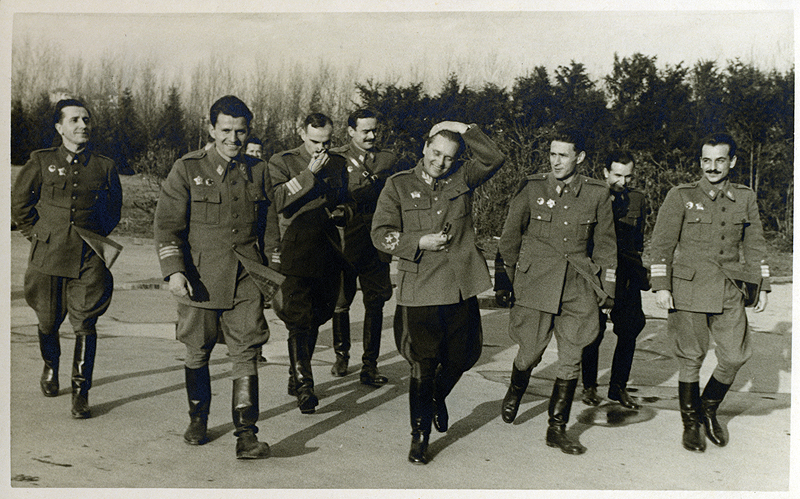
DUŠAN ČKREBIĆ: I read Koča's notes in manuscript, which today are kept in the Legate of "Koča Popović and Lepa Perović", but, unfortunately, not all of them, there are between 17.000 and 19.000 pages in A4 format, someone younger should read it. That's why I wrote that this book is just an incentive, a start for those who should deal with the personality Koča Popović was, the kind that appear like Halley's comet, in a row in the sky in 76 years. I knew him, I can't brag too much, but I knew him. He was, in terms of age, two decades ahead of me. He was a historical figure when I was still in high school. He - a military leader, I at the age of 17 with the lowest officer rank, in the same war and in the same brigade of which he was the first commander, the First Proletarian Brigade. Although he had moved on, his spirit lived on in that brigade as if he were there. In several cases, I participated in the consideration of political issues, mostly during the time when the Central Committee of the Union of Communists of Serbia was headed by Marko Nikezić. Nikezić invited Koča to all the more important non-forum consultations. Koča Popović also left the political scene with Nikezić, supporting the policy led by the then narrow party leadership of Serbia, the then liberals, Marko Nikezić and Latinka Perović. Contacts with Koča and people who knew him well encouraged me to start studying his life, so it has now become a book.
I borrowed the half-title "deep human secret" from Mirko Tepavac. Tepavac and Koca knew each other well, after the war they cooperated, Tepavac was his assistant, and later he held the position of State Secretary for Foreign Affairs. They hung out even when Koca left public and political life. Tepavac is one of the best connoisseurs of Koca, I spent five hours talking with him, on two occasions, in order to check some details from Koca's life.
At the beginning of 2010, I was in the hospital for a month and a half. For the third time, I slowly read Koca's book Notes on warfare. One patient, when I put the book down, saw what I was reading, and asked me: "Will the secret about Koča Popović ever be known?" I was surprised by the question, because we hadn't exchanged a word about it before. Surprised by the question, somewhat taken aback, I answered: "No!" Taken aback, because at that moment I was reading page 291 of the book, where Koča writes: "It will never be possible to express the conversation I had with Vjera (Bakotić, Koča prva žena, prim . aut.) on the second day, more Borinac. In one moment, I cried..." I too had the impression for years that there was a secret surrounding Koča's personality...
Is that it?, maybe, or his behavior before the Belgrade police in 1940. years in prison, for which he was expelled from the party and which even his first wife Vjera Bakotić considers as a key moment in his life, but also fatefully important in their life together?
He was arrested several times before the war, sometimes alone, sometimes with Vjera. Once, back in 1933, he was in prison on Ada Ciganlija when he first met Lepa Perović, who would become his second wife after the war.
That arrest that you mention in 1940 is an important event and has three versions, the first is Milovan Đilas, the second Kočina and the third - Vjerina. Koca and Vjera were also arrested, who, while the police were banging on the door, burned all the compromising material in the stove in the bathroom. In Glavnjača, they beat Koča, slapped Vjera: "What did you burn in that oven?" Koča was transferred to the prison on Ada Ciganlija, where he spent six months, and Vjera was released from prison by his father. Djilas is in his own Memoirs (1973) published how Koča "gave away Ranković's name after a short beating". Because of this, he was expelled from the party, and the decision was communicated to him personally by Djilas in Aleksandar Vuč's apartment. It seems to me that Djilas's version is the most doubtful. Koča was expelled from the KPJ at the end of February 1941, and in his notes he writes that "the qualification of his alleged weak attitude was betrayal": "Đilas was less able to hold on in prison. He dishonestly slandered me even though he knew that I did not reveal the author of the draft of the proclamation (Đilas wrote the proclamation) and no one was arrested because of me." As for Ranković, he admitted, he says, that he only knew his mother, he said that he saw him at the time when she was carrying packages to prisoners in Sremska Mitrovica. It is true that no one was arrested because of him. I would say that Vjera Bakotić's version is the most accurate, because it is simple, general and hits the essence. Faith said this after many years: "That arrest later ruined our lives." It seems that under the beating of Koca, he told the police something that he thought was allowed, and the Party - that it was not allowed. From then on, they had him in their hands and he had to do everything they ordered him to do. And to divorce me. They barely accepted him into the partisans." Perhaps here lies the key to many secrets of Koča's later life and behavior, as well as the attitude of others towards him.
In a footnote, but you note that regardless of what he thought about his imprisonment and expulsion from the party, Koca still had to obey the decisions of the KPJ?
That's right. After the war, as early as 1946/1949, the file on KPJ members was organized by filling in questionnaires with about 75 questions to which each member of the party had to answer in writing on a special form in the municipal committees and with a note in the questionnaire that "untruthful giving of information entails expulsion from the Party". That questionnaire was also filled out by Koča on May 7, 1949. To some questions, Koča Popović had to answer as the highest authority of the KPJ evaluated and decided, and not as he thought. Thus, to the question of whether there are party punishments, why, when and who punished him, he answers: Expelled from the Party in February or March 1941. due to unworthy behavior in front of the class enemy, by decision of the Central Committee of KPJ, re-admitted to the Party in August or September 1941. When asked what kind of attitude he had in front of the class enemy, he answers: 1940. weak, unworthy. Therefore, he had to obey the decisions and evaluations of the KPJ. His party punishment was lifted after the war, and his party seniority was recognized continuously since 1933. In a way, the party implicitly corrected its mistake, but following the Bolshevik doctrine, it never forgot its mistakes. It became much clearer what Blagoje Nešković (Secretary of the KPJ Provincial Committee for Serbia, then) was talking about in a narrow circle - that in 1941, Koča was not allowed to be in the NOB in political and party positions, but only in military and command positions.
Blagoje Nešković is, on behalf of the party, announced to Koča Popović that Vjera Bakotić "it is no longer moral politically eligible to be his wife"?
Blagoje Nešković was, above all, his friend since before the war. He was not only the secretary of the Provincial Committee, he was his friend. Nebojša Nešković, Blagojev's son, told me that, they knew each other from the Spanish Civil War. When he joined the partisans, Koča did not know what kind of reception he would encounter, because he was excluded from the party. That is why Koca did not lead Vjera to the partisans. When Tito invited him to Užice, admittedly too late, to organize some kind of defense of Užice, he asked him why he didn't take his wife with him? Koča writes that then he wanted to perish in the ground from shame. His conscience was gnawing at him, he didn't know how cruel the war would be, he left Vera in occupied Belgrade, he told her if she had problems with the special police, because they knew she was his wife, to say that she had filed for divorce. She stuck to it during the war. Nevertheless, the party was suspicious of the fact that it remained alive in occupied Belgrade. Despite their great love, they broke up. Probably fate wanted it that way - the man who decisively influenced Koča to break up with Vjera Bakotić - Blagoje Nešković, became Koča pašenog, because he married Brana Perović, the sister of Koča's second wife, Lepa Perović.
Once again, Koča Popović almost earned the epithet of a traitor. When he broke through the German encirclement near Balinovac with the First Proletarian Division he commanded, on Sutjeska, 12. June 1943. years. Some of the connoisseurs of war conditions, and you mention it in the book, claim that after Sutjeska, Koča Popović was saved from the epithet of a traitor by fighters and Peko Dapčević, who both then and later claimed that Koca's decision to break through was the only possible one? It turned out to be Cochin "headstrong" the decision was the salvation of the Supreme Staff and J. B. Tita? What if he hadn't done that?
That is in the realm of conjecture. Probably the main body of the army would suffer and its top. The national liberation movement would suffer great damage, but it would not fail. The outcome would be different, it could be. Peko Dapčević told Tito that they must go after Koča, because if they don't go immediately, they will make their way through the same path under more difficult conditions. From a military point of view, Peko covered the decision that Koca made alone. In fact, Koča's decision was implemented by Danilo Lekić, commander of the First Proletarian Brigade, Koča's successor. Koča proposed that the First Proletarian Party and Danilo Lekić should be praised, but the Supreme Headquarters did not do it, it was harder for him than the "ice" with which Tito greeted him. It was rumored that Koča was replaced very shortly and his genius move was interpreted as cowardice. When they arrived in eastern Bosnia, near Zvornik in Plahovići, Koča was ordered that he and Filip Kljajić should come and that Koča should hand over his duties to Vasa Jovanović. Then he thought he was fired.
Trawling, however, he did not write down the conversation with Tito in Plahovići anywhere?
There is no record of that conversation. So neither Miloš Vuksanović, who compiled a book from three Koča notebooks Notes on warfare, did not publish that note. She is obviously not there. Koca only wrote in one place: "I am a different person after that conversation."
Broz was not aware that Koca had saved his life?
Koca understood Tito's behavior. Many years later, at the end of the eighties, after the split with Tito and everything, Koca said that during the NOB he never had any reservations about Tito, the strategist and leader, as his operational commander. He knew that the greatest weight was on the commander-in-chief because he is the one who decides, there were many wounded, he was at the back of the military schedule. He understood that every decision has consequences, he also understood the hesitation that existed in Tito. In the Supreme Staff, they were angry with Koč as if he had done something to save himself and his division. And he paved the way in a way that only a surrealist can do. He passed under the noses of the Germans. The German commander could not even dream that he would pass by him so rudely. Koca took advantage of the improbability of the situation; he sent a message to Tito to go immediately and he sent couriers, some were killed and some went astray, he left one battalion as a reception for the Second Division led by Dapčević and the Seventh led by Pavle Jakšić. If only he had thought of breaking through, he would not have left ties behind, and he suffered great losses just so that they could get away. Maybe Tito's vanity worked there, but still reason prevailed.
Why was Koca the last to become a national hero, teak 1953? Because of Sutjeska, expulsion from the party?
In 1945, the Russians awarded Tito the Order of Victory, Koča and Arsa Jovanović (chief of the Supreme Staff of NOPOJ, during the NOB) received the Order of "Suvorova" of the first order, and Peko Dapčević the Order of "Kutuzova". The Order of Suvorov is higher in rank than the Order of "Kutuz", then Milovan Đilas and Aleksandar Ranković estimated that the Russians make a difference between them because of some of their misunderstandings between Pek and the Soviet commanders. In order to amortize it, Tita Đilas and Ranković suggested that Peko be declared a national hero. Đilas took it upon himself to make his proclamation as a national hero more prominent in "Borba" than these Soviet decorations. This is the reason that Peko first became a national hero.
Sometime in 1950, on December 21, when the First Proletarian Strike Brigade was founded, fighters gathered again in Rudo. Then Tito came as commander-in-chief. The fighters did not stop chanting "hero Koca". My friend from Kragujevac, Tika Janjić, told me what it looked like. Kochi was uncomfortable. The fighters stood up, chanting. Mijalko Todorović Plavi stood up, deputy commissar of the brigade, later commissar of the division, Moša Pijade stood up, and others. Then Tito also stood up and threatened a bit, because the Politburo in our country decides on that and so that they don't get impatient. The fact that he is not yet a national hero does not mean that he will not become one. A somewhat unpleasant situation. They didn't want Koca to get it under pressure.
The reason must have been that the Supreme Headquarters and Central Committee considered that he had nevertheless broken through the enemy's encirclement near Balinovac and had done so on his own initiative, and that in this way he had put them in danger, because they had to move much faster than they had intended. Perhaps the reason was that, even though he was returned to the party in 1941, even though they recognized his party service since 1933, maybe they thought that it was all fresh, the party does not forget mistakes and is always right. They wanted time to take its course, the memory of Koca being kicked out of the party had not faded yet, it was still present. In 1945, he was elected a member of the Central Committee of Serbia. But at the end of the war, he became the Chief of the General Staff. It continues through its military waters.
Kochi's already legendary arrival has been documented many times in great detail "with a sleeper" from Brion to mark the anniversary of the Battle of Sutjeska. He came uninvited, and left the next morning. What does that say about Kochi?, and what about the state leadership of Yugoslavia and Serbia in 1973. and attitude towards him?
Unfortunately, I also went to Tjentište then, but I didn't know that. The Serbian delegation went, as every republic had a delegation. The exact number was known, because there was a problem with accommodation. The Serbian delegation included Draža Marković, Tihomir Vlaškalić, Pera Stambolić and myself. At that time, I was the president of the Republican Conference of the Socialist Union of Working People (RK SSRN). Pera Stambolić invited Rodoljub Čolaković to go with us. We got two rooms, Draža, Vlaškalić and I were in one, and Stambolić and Čolaković were in the other. We did not know that Koča was not invited, but a year earlier Koča had resigned from all positions and had no contact with the Serbian leadership. Invitations were sent by federal and military protocol. We didn't know where Koča was, whether it was in Briony, or in Belgrade, or in Šibenik, where Lepa bought a log cabin. He was on Briony. He got into a sleeper and came to Tjentište. He reported to the protocol. There were military tents there, and they put him in the military tents. He was not very healthy then, he started to improve.
A small digression, I remember that after that, when I was already the president of the Executive Council of Serbia (1974-1978), Koča was supposed to go to Paris for treatment. We offered him to stay at our ambassador's residence after the surgery, because he has good accommodation there. He thanked and accepted the offer, with a cynical comment: "Oh, so I don't feel bad for your excessive concern and kindness?"
Let's go back to Tjentište. Are you saying that he was not invited because he broke up with Tito a year ago??
So, Koča went half-sick to Tjentište. They put him in a tent, and some policeman who didn't recognize him got on him... He had to get up all night, because of his prostate. In the morning he immediately sat down in the "spaček" and returned back to Brione.
All of this was preceded by the split between JB Tito and Koča Popović, which is illustrated by an episode from April 1972. In the military show "Front", they wanted to have, on the occasion of Tito's 80th birthday, interviews with a large number of eminent personalities. Everyone agreed, and the conversations were published under the title Tales of a generation. The editor-in-chief of "Front" Šime Kronja came to Koča Popović with stenographer Dušan Mandić. Lepa made them coffee, Kronja the Dalmatian explained what they had in mind, and waved his hands, Koča looked at the list of people who were going to talk about Tito, and said: Serious business, will you succeed? Shime answers: We would like you to participate as well… He waves his hands. Kocha will not. He says that he can't be on the political scene enough, he can't write. Shime: You don't have to write, tell us... Koča also says: You took 20 minutes from my tennis. Well, you know I'm a surrealist, I can't do that. Cronja, however, had the task, if he did not get a promise that Koca would tell or write something, to at least create a situation from which an incident could result. And he succeeded. They commented on that conversation with Koca in such a way that it was a big deal, and this is already related to Tito's relations with the liberal Serbian leadership. Dolanc immediately called Latinka Perović: Did you see what he did?... The Latina asked: Should we also censor Koča?? The intrigue was created, it was an unfair attitude towards Kochi. On Brioni, after that, Koča with Lepa, and Tito with Jovanka, and Jovanka asks him why you don't call Koča, he says, Koča knows where I am, let him come. It's 1973, let's say.
That episode from 1968 is interesting, The Prague Spring and the discussion of how Yugoslavia should position itself towards the USSR and Czechoslovakia, when the Warsaw Pact occupied Czechoslovakia, so Koca insists on a discussion, and Tito says that it is a discussion luxury.
Tito understood Koča's and Nikezić's appearance as an advocacy that at that moment we should open up the issue of our general relations with the Russians, that is, cool our relations with the Russians, and turn to the West. That's why he behaved like a true autocrat.
On the other hand, Koča Popović made the armature of Tito's foreign policy. And he constantly aroused the suspicion that he was a man of the West?
They doubted him.
Let's trivialize, whose man he was?
He was his own man. His displeasure with the fact that we were in constant retreat after 1955, that we won a decisive battle against the USSR, that we came out of the arms of the USSR in 1948, endured pressures, blockades, human sacrifices, prepared for defense in the event of an attack...
He played a significant role in the American arming of Yugoslavia. He went to Washington., Pentagon, talked to American generals, the head of the CIA...
Everything to strengthen the position of Yugoslavia. In one way, he tied us to the Atlantic Pact, the Balkan Pact with the Greeks and Turks. That they should think a little so that they don't make some imprudence, that they don't enter Yugoslavia, like they did in Czechoslovakia and Hungary. He did a lot to equip Yugoslavia militarily for its own defense. Although the West did not trust Yugoslavia much at the time, it was not easy to gain the West's trust at that time. We received a variety of weapons for about 15 billion dollars, which according to today's values is about 60. That indirect connection through the Balkan Pact with NATO contributed to making anyone who would attack Yugoslavia think deeply. Stalin dies, in 1955 Khrushchev comes here, in 1956 our delegation goes to Moscow. Tito makes concessions to the Soviets. That disturbed Koča and his concept of foreign policy, our departure from the Soviet Union with all the sacrifices is being lavishly spent. It happens that Soviet ambassadors go to the Central Committee for talks rather than to the State Secretariat for Foreign Affairs. Because this is more difficult: DSIP looks at the state, and they should solve everything through party relations. This is where the mistrust that the DSIP is pro-Western oriented, the whole DSIP as a thinking organization that works on Yugoslavia's foreign policy, comes to the fore.
You describe Koca's withdrawal from all state functions in detail. Given what you know today, with whom did Koča Popović stand in solidarity with the liberals or the liberals with Koča? Who influenced whom here?
Koca has long believed that steps should be taken in terms of democracy, he hoped for that after 1948. He did not have a Bolshevik upbringing like those of us who were born in that environment. He studied in France, where the Communist Party was a parliamentary party, he moved in the circles of French advanced intellectuals, French social democracy, that finger of Bolshevism did not touch him. He did not say decisively, but it can be concluded that he had no one to talk to in Serbia. He said that with Djilas, with whom he was friends, he could only talk about Soviet literature. Perhaps in Croatia, if he had been there, he would have had better interlocutors, Otokar Keršovani, Srđan Prica... Everything else was the product of a party that was founded on social democratic foundations, but did not adopt the heritage of Serbian social democracy, but took over Bolshevism. It was tight for him in such an environment. This is not the anxiety from the time of the fight against fascism and later, Stalinism. But he quickly saw that resistance to Stalinism did not help Yugoslavia develop the democracy he wanted. Koca expected greater democratization after 1948. But everything was more difficult for him. He believed that all chances to direct the system in the direction of real democracy were missed. He supported Latinka and Nikezić to try to change those Bolshevik habits within the elasticity of the system on the one hand, to reduce the autocratic bureaucracy, so that personal power is not the measure of everything. Koca did not like to go to gatherings, he did not like to speak. But they felt that he was behind them, that their background was safe. They called him for consultation. At that time I was the president of the Republic Chamber of Commerce, I was not a member of that Central Committee. But I attended every meeting because they called me.
Latinka Perović and Marko Nikezić were a perfect tandem. They did not want to change the system, nor could they, but within the system there is an elasticity - will you publish in the newspaper some opinions that do not exactly match the official one, will you value another opinion, will you agree with someone who is critical of the system, have a conversation or you will declare him an oppositionist, an enemy, which was quite easy at that time.
A year earlier, the Croatian leadership fell, and then the Serbian liberals. However, these were two different contexts. In Croatia, there was Maspok, emphasized nationalism, and here it is exactly the opposite. Tito wanted to cut both at the same time. Draža Marković told him not to do that because no one will understand him, they will think that he wants to create a balance, a balance between Croats and Serbs. Which he wanted and he didn't give up, except for the time. He thought that Latinka and Nikezić were against him.
Later, Petar Stambolić admitted that our mistake was that we did not talk to people of a different opinion. The party's position was not to argue with the opposition. We had a very difficult situation, for example, Dobrica Ćosić writes us letters, and we have a party position that we do not respond to him. Dobrivoje Baja Vidić (diplomat, one of the high state and party officials) wanted so much to answer him, but he could not because he was not allowed to violate the party position. Years pass and Dobrica Ćosić puts all those letters in a book, but there is no answer. Because the attitude was not to argue with the opposition. It wasn't a wise decision, but it was what it was. We found ourselves in a stupid position, now that people are reading those books...
Koča dies in 1992, but he managed to call the nationalists "to the brabonniks who are returning Serbia to opanak and šajkača". Except for the testimony you mention in your book that Koča refused to meet with Tuđman in Dubrovnik during the beginning of the JNA siege, how many details are there about what he thought about Milosevic?
Nothing good. He spoke of him as a Chetnik in the new wafer, although he was neither a Chetnik nor a Bolshevik. In his diary, Koča Popović evaluates defenders of Serbia and "Serbs by profession". He says: "Bashibozluk, Bagra and Brabonjci rose to restore Dušan's empire." Serbs are only against anyone who wants to make them even a little wiser, and they enthusiastically shout at anyone who makes them even more stupid, backwards and unhappy. It is unfortunate that the Serbs, in terms of civilization and culture, have remained at the level they were at a hundred years ago. They are not in conflict with the world, but with themselves, returning to the shack and sleaze from which they barely emerged. I was and remain a Serb, but I am not sick of slander and Srbenda. They betrayed and shamed the Serbian people and mocked its glorious history." He said of Tuđman that he was just one small "conspirator" from Gošnjak's cabinet (Ivan Gošnjak, Federal Secretary for National Defense of the SFRY 1953-1967).
He did not spare Croatian nationalism, nor did he have the same attitude towards Maspok as Serbian liberals. The liberals were lenient towards Croatian Maspok, and Koča did not agree with them. The liberals believed that this should be resolved in Croatia, and not at the Central Committee presidency in Karađorđev. Koca believed that the presidency of the Central Committee is the place where the pretensions of a republic to secede are discussed. Last year there were right-wing demonstrations in Zagreb, and they asked why it happened that the Serbian divisions occupy Zagreb? They don't think they are partisans released from Germans and Ustasha Zagreb? It was finally seen that the future gave him his due, Koča is one of the few people who, without personal vanity, became the restless conscience of our age.
Dušan Čkrebić (born in 1927) is an electrical engineer by profession, he held numerous economic, political and state positions during the former Yugoslavia: director of the Lukavac Soda Factory, president of the Serbian Chamber of Commerce, president of the Republican Conference of the Socialist Alliance of Working People (RK SSRN), president Executive Council of Serbia (1974-1978), President of the Assembly of Serbia (1978-1982). In the period 1982–1984. he was elected president of the CC of Serbia and president of the Presidency of Serbia in 1984-1986. Member of the Presidency of the Central Committee of the Republic of Yugoslavia from 1982 to 1984 and from 1986 to June 1990. Due to the politics that Slobodan Milošević began to lead, he broke up with him in the mid-1990s, when the latter was at the zenith of his political popularity, according to Dušan's biography Čkrebić, and since then he has not actively participated in political or party life. He is engaged in journalism.
In the book, you ask how it is possible that Koča Popović did not know about Goli otok when he was the Chief of the General Staff at that time? How did you figure it out??
It's hard to explain. In conversations with Saša Nenadović between 1986 and 1988, Koča said that he thought that other high officials did not know about Goli otok either. He thought that Ranković must have known much more. When Tempo once said that he did not know about Goli otok, almost no one believed him. Koča says that the military intelligence service was tied to the Political Administration and Gošnjak and that it did not cooperate with him much. At that time, Tempo was the head of the Political Administration. At that time, senior officers, brigade and division commanders, some generals, several colonels were arrested. It is impossible for neither the Chief of the General Staff nor the Chief of the Political Administration to wonder what happened to these people, where they are, what their fate is. Just amazing.
At the Eighth Session of the Central Committee of the SK of Serbia in 1987, on which, as he likes to say today, broke the future of Serbia, you said your famous line: "Serbia is tired of leaders and does not need others. " Paradoxically, this sentence contributed to the political saddle of the horse for Milosevic?
That sentence was later interpreted maliciously, and I, of course, stand behind it even today. Milosevic didn't like her either, he laughed bitterly at that time. First, we were already fed up with the leaders and self-proclaimed leaders in the one-party system. At that time, we did not have a multi-party system in which the parties could nominate their champions, our "leaders" were the product of party personnel commissions, and often the result of subjective selection in narrower groups of leading people. Ivan Stambolić, for example, became the president of the Executive Council of Serbia by simply telling Tihomir Vlaškalić, then president of the Central Committee of Serbia, that he wanted to do so in 1978 as the secretary of the Executive Committee of the Presidency of the Central Committee. At that time, Vlaškalić came to me in the Executive Council, depressed by that conversation with Ivan. Not because he thought that Stambolić was not a good solution, on the contrary, but he was struck by Ivan's imposition and disregard for the established procedure that should have been valid for everyone, including him. Due to his later impatience for Milosevic to enter the top party leadership, he resented many. He assumed that he would be able to influence him. But that was unrealistic. Ivan was not naive, he was extremely politically educated, but he believed too much in his own power. Ultimately, both were obsessed with power, each in their own way. The tragedy that happened to Ivan Stambolić pushed that into the background. At that time, none of us could have guessed that after everything that happened to us in the one-party system, a man with such, let's say, leadership and other needs, as Milošević was, would be born.
You broke up with Slobodan Milosevic in 1990. years. What moment did you decide to retire??
I spoke with him in April. At parting, already when I was leaving, I told him that hoping for changes in the party, I got sick when Djilas fell in 1954. He didn't seem to understand me. I thought that was the time when the party could democratize. Such things are not said at partings when a man cannot explain what he meant. The key was that I proposed to him to create a social democratic party cleansed of Bolshevism, with a broader platform that was acceptable to much wider layers of both workers and peasants, to the intelligentsia, at that time social democratic parties were in power in developed countries. He was giving me credit, but he was lying to me. I saw that there was nothing to it. After that we neither saw nor heard from each other.

In making the decision to approve the continuation of the construction of the Church of St. Sava in Vračar to the Serbian Orthodox Church, which was started half a century earlier, you played a crucial role. At that time, you were the president of the Presidency of the SR of Serbia. How were the negotiations with Patriarch German?
I remember Mr. German from Vrnjačka Banja, where he was a parish priest, we Vrn residents affectionately called him "Pop Hrana". I went to the same grade of primary school with his son Vlasta. Pop Hrana sang beautifully, he had a beautiful voice and we loved listening to him, like the opera we listened to when he served God in the church.
By chance, we met again, after many years, me as the President of the Executive Council of Serbia, and Mr. Hranislav Đorić as the Serbian Patriarch German. We talked in the Executive Council for three hours, then, because we had to tell who was where and what happened to whom in Vrnjačka Banja.
It was a practice for the patriarch to come to the Prime Minister for a conversation. Every time the Holy Council of Bishops meets, they come to me to tell me what the problems are. There were many problems, questions, demands, arbitrariness of local authorities, individual mayors, abuse of power in relation to the church, but they always emphasized the prohibition of building the Church of St. Sava in the first place. They demanded the state to lift the ban 88 times, they counted. Through the Religious Commission, there was an idea to build a Museum of Frescoes instead of a temple, then the House of Saint Sava, to be the Library of the Serbian Orthodox Church... Patriarch German always said that: "If you need it, build it, but as far as we are concerned, we are started to build a temple, and we want to continue building it." I knew very well that the prohibition to continue the construction of the temple passed after the war was in fact a political decision of an ideological nature, that it was passed in the political leadership of Serbia, and not in the Assembly. And that it has no legitimacy. It was transmitted for years by the force of political attitude, without ever being adopted or confirmed by any competent state body of the Republic. It was not printed in the "Official Gazette" as an official decision.
When I was elected as the President of the Presidency of Serbia in May 1984, I estimated that I could significantly influence the change of the long-held political position.
Whether it was just up to you at the time?
I was not some kind of autocrat, I consulted, for example, with Slobodan Gligorijević, the president of the Serbian Parliament, he thought that we should do that. I also informed Ivan Stambolić, he was the secretary of the Central Committee at the time, he had nothing against it. Slobodan Milošević was in the city committee then, he was not interested in that, he just said: "Do what you think you should do." There was no organized resistance. Only the Association of Fighters' Unions of the Municipality of Vračar was against it. I achieved everyone's agreement in the Republic.
In June 1985, in Botićeva Street in Dedinje, in the villa of the Executive Council of Serbia, I told Patriarch German and the members of the Synod of the Serbian Orthodox Church that they could continue the construction of the Church of St. Sava. Without hiding their joy, they remained dignified and calm. I am proud without false modesty, it was done at a time when in our society there was a lot of resistance to the Serbian Orthodox Church, countless prejudices and obstacles to the democratic transformation of Serbia.
However, I do not want it to be understood that I made that decision because I knew Patriarch German. If any were the patriarch, I would do it. That was my civilizing obligation. Because it didn't make any sense for one party in power to ban the construction of a place of worship for which a decision was made to build in 1896. And the construction started in 1935. I wanted to remove the shame from our generation. It is not civilized to prohibit the construction of places of worship, whether they are Orthodox or any other.