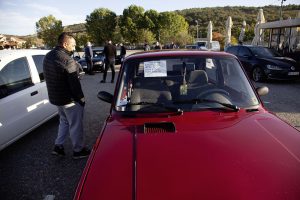
Mostly old, dirty and cheap cars from the European Union are imported into Serbia, while the EU itself is making plans to switch to electric vehicles. A large survey by "Vremen" shows that this will leave even more used cars for poor Balkan or African countries.
Za "Time" from Essen, Brussels and Belgrade
Said Jašarević (51) points to one and then the other side of the spacious lot. Once upon a time, there was a famous car market here in Essen, people crowded around as if the goods were for nothing.
Now there are barely two hundred cars on offer, some of them cost around one thousand euros and are older than some potential customers. Above them is the smell of hamburgers and kebabs from a couple of bars.
"It used to be, look there, all the way down; and there is another lot below. Everything was full, four thousand cars each. And by God, there were also buyers", remembers Jašarević.
The talkative man with a thin mustache is a native of Surdulica, he has lived in Germany since childhood. He has been trading cars for 25 years. He buys cheaper, sells a little more expensive, that's the whole joke.
The market in Essen, in the heart of the Ruhr region, the largest urban area in Europe, is held in the area where a drive-in cinema is. You buy popcorn and a drink, you get headphones, you watch a movie from the car on a giant screen.
Jašarević says the same thing as every used car seller - people want a cheap and good car, even if it was a little newer... It doesn't happen that way, he says, you usually get what you pay for.
But nowhere is it cheaper than here. The markets that have survived in the west of Europe are still roamed by resellers whom Jašarević diplomatically calls "exporters". People who make a living by transporting used cars somewhere where the "market" is crying out for them, say to Serbia.
The dealer is showing the Volkswagen jetta for sale, dark metallic, built in 2011, 1.2 engine, heated seats. Asking 5600 euros, although there would be some bargaining.
"For this jet, all with registration and customs, it would cost you about 1500 euros to import into Serbia. Again, it pays off because this car would cost eight or nine thousand euros in Serbia", Jašarević explains the logic of business.
"ALL THE GARBAGE OF EUROPE GOES THERE"
This Saturday at the beginning of November, with wind, rain and few customers on the lot, Jašarević was lucky: "I fixed nine cars, I sold three this morning. Some Dutchmen came, put them on a truck and drove away. They are resellers looking for cheap cars.”
The Dutch are less talkative, but they reveal that one of the cars they bought is going to Serbia.
"If only you could see what car crap they import there, all the garbage of Europe goes there", says the elderly dealer, while smoking a cigarette that he rolled himself. "Crap cars go to such countries."
34-14JUST LET IT TURN: Car market in Essen, Germany...
Serbia is an oasis for European old-timers, according to data provided to "Vremen" by the UN Environment Program (UNEP). Last year, almost 150.000 used cars from the EU were imported into Serbia, which puts the country in second place. Only Ukraine imports more.
The number has been steadily increasing, except for a drop during the pandemic. So, for example, in 2015, Serbia was the second largest importer of European used cars, but then with 70.000 cars per year. The first was then the African country of Benin.
The top twenty importers also include the neighboring countries, Bosnia and Herzegovina, North Macedonia, Montenegro and Albania. But everything is far behind Serbia, where it is still allowed to import ancient cars with Euro 3 or Euro 4 standards, those that pollute a lot.
While the cars that are almost ready for scrap are destroyed by sending them to poor countries like Serbia, the European Union itself will ban the registration of new vehicles with classic engines from 2035. Of the new cars, practically only those that run on batteries will be on the roads.
The so-called Green Agenda (see box) will leave millions of "dirty" used cars flooding markets like the Serbian one. As "Vreme" found out in Brussels, the European Union has no intention of banning the export of antiques - they say, let Serbia make its own laws.
In the research that led reporters across half of Europe, to car dealers, experts and officials, many stated that Serbia is already a "graveyard" of European cars whose exhausts are involuntarily poisoning the air. And that is paid for by the shorter life expectancy of people.
BETTER STANDARDMORE CARS?
Two figures in Serbia have been growing in parallel for years - the number of imported and registered cars, and of course the amount of pollution in the air. On the tables of the world's cities with the worst air, Belgrade and Niš are increasingly appearing at the top, where cities in China, Pakistan and India are usually. For the authorities of the Serbian Progressive Party, this is a sign of progress. "That (air pollution) became our biggest concern when, apparently, we solved much bigger problems. What, did we have better air two years ago? And before four? And ten years ago?" said Serbian President Aleksandar Vučić three years ago.
The air, he added, "is as bad as our standard is higher, so today we all drive as individuals in a car." The president told reporters that he counted personally, coming to work. He saw more than one person in only a couple of cars.
Back then, Vučić announced a ban on the import of cars below the Euro 5 standard. It was never done.
Petar Živković, an experienced automotive journalist, knows these stories well. "The state has been announcing for years, but vehicles with Euro 3 and Euro 4 standards can still be imported here. Although these are ancient vehicles, some made in the last century, they also have the status of waste in Europe."
Živković says that the authorities have tightened the technical inspection. Banal things are also looked at, for example whether there is windshield washer fluid. Inspections comb services, inspections are recorded, and they cost a lot. And yet, the karsts persist.
"The car will pass the technical inspection," says Živković, "but it can also pass the Yugo 45, which does not have headrests or seat belts at the back - that was not the standard back then. But that vehicle is not safe at all, it is a rabbit trap, because it breaks its neck in a crash."
WHO STILL HAS MONEY FOR NEW??
34-09…and in Bubanj Potok
The Serbian fleet has 2,2 million registered vehicles - one million more than ten years ago. The average age of a car has almost reached adulthood – it is now 17,5 years old.
At least two-thirds of imported used cars, says Živković, are actually of low environmental standard Euro 3 and Euro 4. Three-quarters of the Serbian car fleet is still made up of diesels.
"Everyone would like to drive new cars, but people don't have money. Look at salaries, then the prices of food and other things - who should buy a new car? The cheapest offer in Serbia is 17.000 euros, which is a dream for many", says the experienced journalist.
Out of about 150.000 used cars sold annually, only about 25.000 new cars come. This includes expensive fleets that are purchased by public companies, companies or vehicle rental agencies. "It's a ridiculous figure - Slovenia has three times more new cars sold with four times less population," adds Živković.
According to the data of the website "Polovni automobili", in their classified ads, the average price of a used car came close to nine thousand euros. Imported old ones are cheaper. Traders estimate that the average goes from three to six thousand euros.
This would mean that the market for the import of used cars in Serbia is worth between half a billion and one billion euros per year. The game involves big importers, people who don't want to talk to newspapers, and they bring cars from Germany, Italy or the Netherlands with tow trucks. And in the game there are little ones, who here and there turn around for a car.
"I assume that importers have a strong lobby. Nine out of ten imported used cars pass through their hands", says Živković and adds: "The market has not dried up because many places in Western Europe are held by people who have good connections with our importers. It is more profitable for them to sell the karst to us than to force it to waste."
ON THE ROADS OF NORWAY
Jan Hoytema is certainly not an environmental fanatic. He grew up on the family farm in Friesland, in the north of the Netherlands, where every piece of plain is subordinated to the keeping of dairy cows, without much regard for the destruction of the land. But Hoytema, an MEP from the People's Party for Freedom and Democracy, which ruled the Netherlands for a long time, was the main negotiator of the European Parliament when it came to the ban on vehicles with classic engines.
"Traffic accounts for 15 to 20 percent of carbon dioxide emissions in the EU. That rate is growing, while it is falling in other sectors. So, we had to do something about the traffic," says Hoytema for "Vreme".
As a result, in March of this year, a regulation came out that echoed like a bomb in the European press - the end of gasoline and diesel engines has come. From 2035, there will be no newly registered fossil fuel vehicles in the European Union. Only electric ones will be allowed. At the insistence of the German Liberals - close to the patrons of the automobile industry - a loophole was left in the law. It will also be allowed to fill the tank with so-called e-fuels, if these are produced ecologically. Most experts think that it is science fiction and that such a synthetic fuel is too expensive.
However, Hoytema is satisfied with the compromise. "A high barrier for consumers now is the price of new electric vehicles. With this regulation, we wanted to let everyone know that this is the future."
There are still many skeptics. They say, electric cars will never be as durable and affordable as the "old" ones. They ask, where will so many people who don't have garages charge them? Where does the electricity come from, unless it is made in nuclear power plants, from coal and gas? And if coal is burned to power the car, what is "green" about it anyway?
In the best case, the European Union will, from Portugal to Bulgaria, resemble today's Norway. In that Scandinavian country, nine out of ten new cars go electric, powerful chargers are at every turn. If so - and giants of the automotive industry such as Volkswagen are already moving in that direction - where will the second-hand cars go? In a press on some waste? Or, rather, it will be in countries like Serbia, Ukraine, Libya, Mexico, Tajikistan?
The European Commission tells us that the rules deal only with the registration of new vehicles in the EU - they do not deal with production or export. "Manufacturers can legally continue to make cars with internal combustion engines and export them outside the EU if they so choose," the response states.
BETTER EUROPEAN THAN CHINESE
Another regulation has been in the Brussels drawers since July - the one about "vehicles that are at the end of their life". Which vehicles are considered true waste and will no longer be allowed to be exported? Neither the European Parliament nor the member states have yet taken a position on this, which is the most important thing. The spokesperson of the European Commission could not be heard specifically about this. "As for the used vehicle market - the faster the penetration of zero-emission vehicles into the EU market, the sooner such vehicles will reach a second or third user in the EU or outside the EU, so they will also benefit." In other words, the Balkan and African poor are condemned to drive what Europeans will no longer drive. If that's the case, in a couple of decades, second-hand electric vehicles will be waiting.
Dutch politician Jan Hoytema opposes export bans. "What environmental benefit would it be if we sent a used car to the scrapyard? It can be said that it is better to use the old than to destroy it and build a new one."
After all, he says, it is up to Serbia to adopt laws and ban the import of these or those vehicles. If there is no such law, Hojtema thinks like this: since Serbs are already importing diesel and gasoline engines, it is better to import European ones.
Moreover, this liberal-conservative politician expects that for a long time - probably outside the territory of the EU - cars with the famous "sight" of Mercedes, circles of Audi or the blue and white propeller of BMW will roll off the factory lines.
"Fossil fuel cars will continue to be bought for a long time, so why wouldn't they come from European manufacturers? Why shouldn't we compete in that market?", thinks Hoytema.
AND WHO WILL SAVE THE PLANET??
When the microphones are turned off, many politicians and activists - even those who were involved in the legislative process - speak with disappointment about the European rules.
They talk about "rotten compromises" and colorful lies. Because if the goal is to save the world's climate, then it makes no difference whether a diesel-powered old car drives through the streets of Brussels, Berlin, Vienna or Belgrade, Bogota and Budžumbra. There are 1,2 to 1,3 billion cars in the world, by 2050 there could be almost twice as many.
"Almost all of that growth will go to developing countries," Rob de Jong, the Dutch head of the Transport Department at UNEP, tells us. That United Nations program is based in Nairobi, the capital of Kenya. De Jong knows that in such countries a car - any kind - is a symbol of a better life.
"But what kind of cars will they be? If these are today's, then the harmful emissions will double by 2050, the air will be even worse. This means that we will never reach the goals of the Paris climate agreement," says De Jong for "Vreme".
The Paris Agreement (2015) states that humanity will do everything possible to limit global warming caused by the emission of harmful gases. The idea is that by the next century, the planet will be at most 1,5 degrees Celsius warmer than before industrialization.
"We have a global climate and air problem, so we need a global solution," says De Jong. However, the development with electric cars does not inspire him with confidence: "The Global North will have more electric vehicles, so a possible scenario is that gasoline and diesel vehicles go to the Global South. he will drive there for another twenty years. Then it is clear to you that global emissions will not decrease.”
Similarly, Ana Krajinska from the Brussels-based non-governmental organization Transport and the Environment says: "From the perspective of environmental protection, it does not make sense that we are phasing out classic engines in Europe, and not elsewhere in the world."
She calculates that by 2035 - that is, before the ban - around one hundred million new petrol and diesel cars will be sold in the European Union. "We see that new cars are bought first in Western Europe, then they go to the east of the EU, and then outside the EU. Those cars will pollute thirty years after the ban."
IN SERBIASTEP BY STEP
Minister Goran Vesić welcomes him in his office at Nemanjina 11, where he makes coffee from the machine himself. He quickly approaches the map to show new roads, then railways, which, he says, will change Serbia.
The story of "green oases" that will spring up along the highway, each with many chargers for electric cars. About the regulation that will oblige gas stations to have at least one fast charger for electricity at every four gas stations.
But Vesić also knows that today's Serbian fleet is ancient. He says that the realistic goal is to reduce the average age of vehicles to 2030 years by 14. It is not his right that Europeans export everything and anything here. "They will not ban exports, because that way they provide additional income to the citizens. It makes no sense to export your problems to others in Europe, but that's how it always goes."
But the better question is, why doesn't Serbia ban the import of even the oldest cars? It is being worked on, says the Minister of Transport and Infrastructure.
photo: n. rujević"NOT EVERYONE HAS THE MONEY TO REPLACE THE CAR IMMEDIATELY": Minister Vesić in the cabinet
"We are not a rich enough country to be able to change the regulation overnight and have everyone drive Euro 6 cars from tomorrow," says Vesić. "People need time to get used to it, not everyone has the money to change their car right away."
This spring, domestic media reported that the import of Euro 3 and Euro 4 standard vehicles will be banned from next year. But they wrote the same last year and the year before last. Allegedly, the measure was discussed several times in the Government, but it was abandoned for fear of angering the poorer electorate. Starting next year, the state will subsidize the disposal of old diesels - and the purchase of newer vehicles. Over one hundred million euros will be set aside for such a deal with citizens: diesel (Euro 1, 2 or 3) goes for recycling, and the owner receives 2100 Euros to buy a car that has the Euro 6 standard.
"We calculate that with 102 million euros in subsidies, we will not solve the entire problem, but we want a part of it. The plan is to eventually remove 140.000 old vehicles from the streets and discourage their use," says Vesić.
With the allocated 102 million euros, a maximum of fifty thousand diesel truck drivers can be stimulated. Then, they say, that budget will be supplemented. A bottleneck could arise when it comes to vehicle recycling. But the first question is how much interest there will be.
"We need to add four or five thousand euros in order to buy a Euro 6 car with the subsidy," says journalist Petar Živković. "But I think an enviable number of people will change the car."
THE MOST EXPENSIVE PRICE IS DEATH
In the corridors of the Faculty of Political Sciences in Belgrade, the main one is the cleaner. Docent Marko Vujić first has to ask her to unlock a room where we would talk, and she picks through the keys with gusto and cracks jokes. Vujić deals with ecology and spares no criticism of the authorities and Brussels. As he talks, he turns his car keys in his hands - he knows how knowledgeable citizens are about their own four wheels.
"Albania has lower wages, lower environmental standards, lags behind in everything - but cars with a minimum Euro 5 standard can be imported into Albania," he says. "And our government always says - next year, and so every year. Maybe the car dealer lobby is strong, maybe they have the power to bribe politicians. "Constant announcements that something is supposed to change from next year suit resellers - because people rush to buy an old car, thinking that it will really be banned next year," he adds.
Vujić is aware that no government should ban the use of old cars that are already in the country. He says it would only affect the poorest. But, like this, he says, "we are a car graveyard that no one else wants".
From the point of view of the planetary climate, it may not matter whether thermal power plants, obsolete factories, mines or diesel generators pollute Brussels, Berlin, Vienna or Belgrade, Bogotá and Budjumbura. But for the residents there, it is by no means indifferent.
"Every story about the environment is like that - there are developed countries and others, for example Serbia, Albania or Chad", says Vujić. "The West wants to be clean and sustainable, responsible for itself, but not for others - it exports dirty technology to pollute until the end of its life. China does the same - it does not even respect the minimum standards here."
The price, he believes, is too high. In Serbia, it is estimated that ten thousand people die prematurely every year due to the consequences of air pollution - that's one in ten deaths.
"The average life expectancy in Serbia is 73 years. Our neighbors, the Croats, are six years older, and the French ten. The most important reason for premature deaths in Serbia is air pollution," says Vujić. "It is devastating for health, especially in Belgrade and other cities where there are many cars."
His colleague from the faculty and Member of Parliament, Biljana Đorđević, says that traffic is neither the first nor the second problem when it comes to bad air - it's thermal power plants and individual furnaces. But traffic also has its share. "Our entire traffic policy is focused on the car - they build roads, highways, railways, not really. It does not work on public transport. This is how people are forced to use a car", says the co-president of the Green-Left Front. "And if they don't have enough money, then they are forced to buy a used car that pollutes a lot."
Vujić believes that politics does not deal with these issues because it is not among the priorities of the voters. "We are more enthusiastic about the national stadium, which will cost more than Real Madrid's stadium, but few people are interested in investing money in clean air," he says.
THE MARKET HAS GONE ONLINE
Dragan Radulović (63) points to one side and then the other side of the spacious lot. Once upon a time, there was a famous car market here, on Bubanj Potok, people crowded around as if the goods were for nothing.
Now there are barely fifty cars on offer, some of them cost around a thousand euros and are older than some potential customers. Above them is the smell of burgers and sausages from a couple of restaurants.
"I have been here for 35 years. It used to be the biggest problem to get in. My best man and I bring two cars from Borča - and people are already waiting from one in the morning. Let's leave it, then come at five with the other two cars. I sold four cars a day, the market was full", says the experienced trader, who has Njegoš tattooed on his arm.
The flea market on Bubanj Potok, in the suburbs of Belgrade, is full on Saturdays, but the car market barely survives on Sundays. And Radulović says that people are looking for cars on the Internet, young people want fast cars, old people "who are no longer sick of running around" are looking for reliable, warm ones. Older people still go because everyone likes cheap. "They buy a twenty-year-old car for a thousand and a half euros, so they think they bought a plane. Give twenty thousand euros for a new one, and you have a guarantee! That's the kind of people we are - we look for cheap. And we don't know what's inside."
He used to sit in a car with four others, go to markets in Munich or Utrecht, work a lot and sleep little. Everyone is shopping for a car and they are imported to Serbia in a caravan.
"It is easy in Germany when it is an honest country. Let's say, there are two identical BMWs on the lot, same year, but one is twice as expensive. Because he traveled three times less. And with us, they return the mileage to everyone", says Radulović.
But it no longer goes abroad. He says that big importers don't go either, but look for online auctions, buy a couple of cars, pay around five hundred euros apiece for a tow truck to fix them up.
NO WINTER FOR POLOVNIK
There are all kinds of goods around Radulović. Mostly older and cheap. There is also the latest stojadin (year 2008), perfectly red, for 1550 euros. But, in Bubanj Potok, business has not been going as it used to for a long time.
"Now we're here out of habit - we come to socialize, drink coffee, exchange stories of how it used to be nice," says Dragan Radulović. "I will come as long as I live, for the sake of nostalgia. See that entrance to the lot? That's where I should bend down and kiss the ground every time. I made a nice amount of honest money here, my whole family lived off it, I made a house rent and I'm happy."
Journalist Petar Živković thinks that there won't be winter for traders for a long time. Clean air or reliable cars - it matters less when it comes to money. "If imports fell, the state would give up a lot of money. You would lose VAT, income from excise duties... those cars use much more fuel than new ones. The state fills the budget with drivers and cars, it's a field full of levies", adds our interlocutor.
At the market in Essen, while he is looking to sell some more cars and pack, Said Jašarević looks at this whole brave new world with skepticism. "It will be difficult for electric cars to break through. There is not enough electricity. And secondly, they are too expensive, people don't have the money", says Jašarević. He doesn't care about the second-hand business or himself. "I will definitely be able to do this until I retire. And my son is also there, he also works, I think he will also be able to retire."
What is the Green Agenda?
GREEN ON BILLBOARDS, OLD AND USED ON ADVERTISEMENTS: EU and the "Green Agenda"
The big idea of the European Union is that from 2050 it will no longer be a net producer of harmful gases. This means that across the EU, no more carbon dioxide would be emitted than greenery can absorb.
Admittedly, with some exceptions that critics call a big hole. Let's say, it will be possible to "trade" CO emissions2 - whoever exceeds the rates, pays. Also, European companies will be able to pollute to their heart's content elsewhere in the world.
The entire "European Green Deal" should be financed with around a billion euros, mostly public money from the Brussels coffers.
Part of the plan relates to traffic. It was decided that from 2035, no new vehicle will be able to be registered if it emits harmful gases. There are also lawsuits against this with the argument that it is not fair to measure only the emissions on the exhaust, but that one should look at how harmful the production of the vehicle is overall. This is where electric cars - due to the production of huge batteries, mining and processing of lithium - do not fare so well.
For some, it is a miracle that even such a rule was passed against the powerful - especially German - lobby of the automobile industry.
"Many manufacturers have supported the abandonment of fossil fuels from 2035, for example Ford or Volvo. There are also those who are not, like BMW. But it was more difficult for conservative players from the industry to oppose as a lobby because the changes were supported by key players like Volkswagen", Anna Krajinska from the Brussels-based NGO Transport and Environment tells us.
"If all manufacturers were united, 2035 would probably not have been specified as the year of abandoning classic engines," she adds.
In particular, German manufacturers are afraid that the Chinese and the Americans will permanently retain primacy in the field of electric cars, which would dwarf the most important German export branch. That is why many in Germany are switching to the production of electric vehicles exclusively.
But Daimler has announced that it will continue to make classic cars in China. BMW will do this in plants from Mexico to South Africa.
It is expected that by 2035 there will be pressure to water down the fossil fuel divestment rule. The key argument: not enough lithium. That market is held by the Chinese and, if Europe wants independence, then it cannot escape from classic engines. And they, they add, could one day work on green hydrogen anyway.
The market for gasoline and diesel engines, new and used, will remain huge even after 2035. Apart from the European Union, their ban was announced by Norway (as early as 2025), Israel (2030), Canada and the American states of California and Massachusetts (2035), Singapore (2040), Costa Rica (2050)...
This research was supported by the Dutch Fund for Special Journalistic Projects and the European Fund for Journalism
What is happening in the country and the world, what is in the newspapers and how to pass the time?
Every Wednesday at noon In between arrives by email. It's a pretty solid newsletter, so sign up!
Why is there nothing else between the overcome regime and the changes? What does the regime mean when it says it is defending Serbia? Why is the Student Movement indomitable? Who has the knowledge and real experience, and who leads without a day of work experience outside of politics? And why students win
Elections 2026: From student revolt to decision at the polls
After almost two years of protests, hundreds of kilometers walked, arrests, persecution and unprecedented social mobilization, Serbia is holding elections that could mark the end of a political era. Sociologist Marija Babović tells "Vreme" that the hope for change has not been so great since October 5, 2000, but she also warns of the danger that, if changes are not made, the country will face an even tougher authoritarian regime.
Interview: Tihomir Stanić, actor on the Student list
Their only weapon now is the media they control: like, we don't have an agenda, which is not true; as, we will betray the national interest, which is not true. One of their arguments is that we are afraid to go to the debate with Vučić. They do not understand that it is their punishment. This is a punishment for Aleksandar Vučić, who for 14 years conducted exclusively a monologue. For fourteen years he did not allow anyone any kind of dialogue, and now he would like to be rewarded or pardoned with the opportunity to talk to us. Well, he won't be able to. What he sowed is now reaping
These elections are not elections about Serbia's membership in the European Union, Kosovo and Metohija, gay marriage, tax policy or any other single political issue. Although parties on the fringes of political power try to impose these themes, at the heart of the upcoming political election is a much simpler dilemma: change or preserve the existing order. For more than a year now, surveys have shown that this is the primary dilemma on the ballot
In the RS, 19.800 people registered for the elections in Serbia, who will be able to vote at 28 polling stations. It remains unknown how many of them will cross the Drina on October 25 and vote in Serbia. In any case, I do not believe that the voters from Republika Srpska are the ones who will decide the winner of the elections in Serbia. Realistically, the voters from Republika Srpska can influence a little, but it seems that they are symbolically very important to both Vučić and the opposition.
There is, literally, no difference between the one who claims it is day in the middle of the night, or the one who claims to be a giraffe, from the claims we read on billboards: that Vučić is working to unify Serbs and that Serbia is doing better and better day by day.
The pre-election arrests due to the alleged "overthrow of the state" testify to the regime's panic. The bad news for them is - they can't arrest the whole people who decided to defend themselves from progressive beatings and election theft
The ring that tightens around Ćaciland Student list is getting narrower. Because there are more and more spoiled people who see the false prophet for what he is: a street obscener who is fighting Serbia
The archive of the weekly Vreme includes all our digital editions, since the very beginning of our work. All issues can be downloaded in PDF format, by purchasing the digital edition, or you can read all available texts from the selected issue.