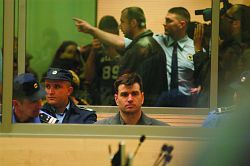
The Supreme Court of Serbia, in a panel of five judges, only had objections regarding the punishments determined by the panel of the Special Department of the District Court for the fight against organized crime, so it changed the amount of the first-instance "awarded" single punishment for some of them. Milorad Ulemek Legija and JSO member Branko Berček were thus given the maximum sentence of 40 years in prison, while Leonid Milivojević's first-instance sentence of 15 was changed by the Supreme Court to 30 years in prison. Dušan Maričić, initially sentenced to a maximum of 40 years, had his sentence reduced to 30, Nenad Bujošević from 40 to 35, while Nenad Ilić was sentenced to 15 years in prison.
Radomir Marković was sentenced to 15 years in prison for helping the perpetrators of the crime, while Milorad Bracanović, the former deputy head of the Security and Information Agency (BIA), who was a JSO security officer at the time of the crime, had his four-year first-degree sentence changed to two years. prison.
In addition, the Supreme Court confirmed the first-instance verdict in the part in which the convicted members of the JSO are ordered to return the illegal property benefit that they received as a reward for the crimes committed from the first-convicted Ulemek, so Berček and Milivojević must return the dinar equivalent of 30.000 German marks , and Maričić and Bujošević 20.000 marks, and Ilić ten thousand marks, all converted into appropriate in the amount of euros, and in the dinar equivalent at the official exchange rate of the NBS on the day of payment, for the benefit of the budget of the Republic of Serbia.
After the verdict of the Supreme Court was announced, fans of the image and deeds of the condemned immediately came forward, with the remark that the verdict is not yet final; even DSS spokesman Andreja Mladenović said this, blaming the President of Serbia for daring to comment on the "illegal verdict". The matter, however, is different: the verdict of the Supreme Court is final for all except for those sentenced to 40 years in prison, i.e. Ulemek and Berček, who have the right to a three-stage trial (another appeal to the new five-member panel of the Supreme Court of Serbia), given that the maximum prison sentence of 40 years replaced the severest penalty - death.
CUSTOMER MILOSEVIC: Others - fans of the character and deeds of the late Slobodan Milošević - from the fact that the proceedings against Slobodan Milošević (as well as General Nebojša Pavković) were separated for the obvious reason, their "excused absence" due to the indictments for war crimes in the Hague Tribunal, which has priority over by the domestic judiciary, concluded that Milošević died as an innocent baby in the case of Stambolić and Drašković. And that, just like Ante Pavelić above us, he is playing with an innocent little girl... Nothing is a less wrong conclusion than that, politically and legally: "The complaints of the defense attorneys of the accused Ulemek, Berček, Marković and Bujošević challenge the established factual situation in relation to the political motive the commission of criminal acts to the detriment of the injured parties Ivan Stambolić and Vuk Drašković, claiming that they were not political opponents of Slobodan Milošević, and that the court, by refusing to conduct an expert through experts and political analysts failed to correctly establish the factual situation in regard to that fact", says the Supreme Court of Serbia in its judgment and states that "contrary to the appeal allegations, the first instance court correctly established on page 165 of the explanation (note, the first instance judgment has 176 pages ) gave reasons accepted by the Supreme Court, that Slobodan Milošević issued an order to kill the victims as political opponents."
Judge Albijanić, on the aforementioned page 165 of the first-instance verdict, explains that from the defense of the accused in the pre-trial and preliminary proceedings before the investigating judge, as well as from the testimony of witnesses, "it is clear that the accused were aware that the criminal acts to the detriment of the injured Stambolic and Drašković were being committed because of that the political opponents of the indicted Slobodan Milošević were harmed" (Milošević was still in Scheveningen at the time and was treated as an accused for those two crimes while still alive). Collaborative witness Nenad Šare confirmed that he spoke with the other members of the JSO, convicted today, about Stambolić being a presidential candidate and that his liquidation should be carried out "by a certain date, which they connected with the holding of the presidential elections in September 2000." year", as well as that "the liquidation of Stambolić was presented to them as a job of importance for the state". And Radomir Marković spoke about it in his defense, so he pointed out that "he remembers that his accuser Milošević Slobodan, when he talked to him privately, repeatedly said that the opposition in Serbia is an ordinary gang that should be liquidated, that all members of the opposition present at a rally should be blown up with explosives, that during one of those conversations he told him that ošt. Ivan Stambolić should be 'removed' considering that he is a direct danger to our country and asked him if he has someone for that". Milošević, blessed Marković, also asked that "if Ulemek turns to him" for help, to give it to him, after which he actually came after a few days "and 'dead cold' said that he had received an assignment from the accused. Milošević to liquidate ošt. Stambolić, that it is a state task of great importance for the country, because serious consequences can occur in case of further toleration of engagement and actions of the injured party". Similar conversations were held regarding the preparations for the assassination of Drašković in Budva on June 15, 2000, when Milošević told Marković "that he will deal with the defendant." Ulemek Miloradom to do in Budva what he messed up before"; The "mess", if anyone is unaware, happened on the Ibar highway on October 3, 1999.

FINAL JUDGMENT OF 40 YEARS IN PRISON: Milorad Ulemek Legija
"
CONTROVERSIAL STATEMENTS": The extensive explanation of that "crime with low motives" from the first-instance verdict is confirmed in one more place by the Supreme Court, which refutes the appeal claims of Radomir Marković that without his "controversial statements" from the pre-trial proceedings, the court would not have a single piece of evidence against Slobodan Milošević. "The role of Slobodan Milošević as the person who commissioned the execution of the criminal acts in question, in addition to the testimony of the suspect Marković, also emerges from the defense of the suspect Ilic, who claims that the accused Milorad Ulemek told him that President Slobo would treat them with a helicopter, the testimony of the witness associate Sara Nenad that the accused Ulemek told him said that they were rushing to commit the crime to the detriment of the victim Ivan Stambolic, because he was being pressured by those from the top, on the basis of which he concluded that it could only be Slobodan Milošević and Radomir Marković, suspect Bracanović's testimony that Ulemek told him that he received an order from the "boss" to liquidate the victim Ivan Stambolic, and his bosses, as the accused Marković himself claims, were Slobodan Milošević and himself, when he states that Ulemek had direct contact with Slobodan Milošević, because JSO was then providing security for Slobodan Milošević, which is why he was able to receive an assignment directly from Slobodan Milošević, the defense of suspects and defendants Duško Maričić and Leonid Milivojević, to "The State Security is responsible for the execution of these tasks," he says The Supreme Court of Serbia, ordering further evidence for the assassination of Drašković in Budva, the testimony of the witness Milan Zec that "General Pavković really asked him for logistics for the execution of the 'task' by members of the State Security of the Republic of Serbia on the territory of Montenegro", and other witnesses " which statements, when brought into relation with each other, confirm the allegations of the suspect Marković that Slobodan Milošević was the one who ordered the execution of these criminal acts, and as the first-instance court correctly found.
MILOSEVIC'S VICTIMS: Ivan Stambolić, as established by the verdict of the court of first instance and the Supreme Court of Serbia, was abducted on August 25, 2000, near his house in Košutnjak, by order of Slobodan Milošević, taken to Fruška Gora in a white van, where he was shot with two bullets in the occipital part of the head was killed by the convicted Berček, with a "Pietro Beretta" pistol, caliber 22 LR (5,6 mm), and he was buried there, covered the corpse with quicklime. It was only found during the time of the Saber, on March 27, 2003.
The remains were found thanks to cooperating witness Nenad Šare, who showed the place where Stambolić was killed. The first-instance court heard the permanent court expert, Dr. Branko Mandić, on the circumstances of the fear that Stambolic suffered during the kidnapping and murder: "The court undoubtedly determined that the injured party experienced a sudden increase in emotional tension at the critical moment, i.e. at the moment when he was abducted, which the basic psychological content is the affect of fear of high intensity, because the injured party found himself in a situation where he was unable to undertake any adequate motor actions to protect his bodily integrity and vital existence. This fear lasts from the moment of the abduction to the moment when he was deprived of his life, where the fear was real and of high intensity, and it culminated in the moment when the victim, now deceased. Ivan Stambolić was ordered to kneel," the first-instance verdict states, and concludes that "fear is a normal reaction that occurs in every person when their vital existence is threatened, and in Stambolić's case it was a real fear, which, given the course of events, he had its growth in intensity, and it culminated just before the loss of life."
Stambolić was abducted in the morning in front of his house, forced into a van at gunpoint, under the pretext of going to an information interview. In the van, his hands were handcuffed, his legs were wrapped with wide duct tape, as well as his mouth and eyes with newspapers which were then wrapped with duct tape. In the van, when they arrived at the chosen place of execution, he waited so bound and powerless for the perpetrators to dig up the crab - only after that he was pulled out and brought to it, he was forced to kneel and listen to the preparations for his own execution. At the same time, he could not say anything: "he was just mumbling something", one of the accused stated before the court years later.
CONVICTS NA MORU: The first accused Ulemek defended himself that he could not participate in the liquidation of Stambolic, because he was not even in the country - he went on a summer vacation with his family, and took his newborn daughter to the sea for the first time. According to the verdict, while he was playing with his newborn on a beach, the logistics he left behind functioned flawlessly: his subordinates had already been following the victim's movements for weeks, Radomir Marković secured - and Ulemek delivered to the perpetrators of the crime - a paper with Stambolic's picture and data, a fleet of vehicles was ready. That paper with Stambolic's data, by Legij's express order, had to be returned to Radomir Marković - "to return it to the archive, or I don't know", says the associate witness, or - which does not change things - to be destroyed as compromising evidence of involvement in crime, as stated in the judgment of the Supreme Court of Serbia. Careful planners missed a circumstance that made Ulemek very angry - according to the statements heard in the courtroom - and upset Radomir Marković so much that a glass almost fell out of his hand in Villa "Jelena" in Belgrade: on the white van at the time of the abduction, there were still real, not stolen or forged plates.
That's the only thing that upset the perpetrators and facilitators of the crime in the whole Stambolic thing. After Ulemek's return from his summer vacation and enjoying his offspring's first view of the blue sea, the perpetrators of the crime in the envelopes received a reward (those previously mentioned German marks), although - as they claimed - they did not expect money, because the interest was "state", and they were obliged to remain silent about such and such their "tasks". Ulemek ordered them to remain silent: "They must remain silent about the execution of the 'assignment', because otherwise they will be liquidated themselves." The Supreme Court concludes, analyzing numerous evidences about Ulemek and Marković's connections with the perpetrators of the crime, that "the obligation to unquestioning execution of the assignment and keeping its secrecy was not based on the mutual trust of the participants of the 'task', but on the hierarchy and fear of each other, and that information was transmitted hierarchically and each of them had information in accordance with his position in JSO as part of the state security department".
This hierarchy can also be seen in the assassination of Vuk Drašković in Budva: Radomir Marković secured fake identity cards for Ulemek's men, who had to go on an important mission: at first they thought they were going to arrest the high official of the JUL, Nenad Đorđević, they claimed. The removal of Drašković turned out to be a state task. After the failed "assignment", the perpetrators returned in a military helicopter, which - claiming that it was a "secret mission" of members of the State Security of Serbia, transported the trio of immediate perpetrators, Berček, Milivojević and Ilic - was secured by Nebojša Pavković. By the way, in the whole matter surrounding the assassination of Drašković in Budva, other well-known characters appear, such as Mile Luković Kum and Miloš Simović (accused of the murder of Prime Minister Đinđić, still on the run), while the trio of unsuccessful perpetrators are waiting for the inevitable Ulemek at Lađevci airport near Kraljevo. but also Dušan Spasojević, the murdered head of the Zemun clan.
FINAL THE TRUTH: With the verdict of the Supreme Court of Serbia, we have the definitive truth that Slobodan Milošević ordered the murder of Ivan Stambolic, no matter how many tried to prove in the 50 days of the main trial that the human remains found in the lime pit on Fruška Gora were not the remains of the brutally murdered Ivan Stambolic. They even claimed this in spite of science, the fact that the probability that it is him is two hundred and twenty one thousand billion times greater than the possibility that the remains belong to someone other than Ivan Stambolić. The definitive truth is that the same "team" of members of the state authorities, on the orders of Slobodan Milošević, tried to correct "what they messed up" on the Ibar highway and kill Vuk Drašković in Budva.
There remains only the possibility of a third-instance review of the verdict for Ulemek and Berček, when the Supreme Court will go through two thousand pages of trial transcripts, more than 200 pages of first- and second-instance verdicts, and the appeals of the two convicts and their lawyers.
First-instance judge Dragoljub Albijanić, after the third-instance panel of the Supreme Court makes a decision, has one more thing to do, apart from the judicial pride of his own and the members of his panel because he has established the truth and that his verdict has been confirmed, to make a decision on court costs. Namely, by the verdict that has already been pronounced, the defendants are obliged to pay the costs of the criminal proceedings, the amount of which will be determined by the court within 15 days of the finality of the verdict - under threat of execution. There will be another opportunity for the whining of various "lovers", given that convicted perpetrators of crimes generally claim that they have no property, just like the organizer of the criminal association Milorad Ulemek Legija, who stated in his personal data that he "does not own real estate". and to "live on savings"!
With this verdict, however, it is certain that serious criminals such as these, who before the changes in the law would certainly have received the death penalty, can be sentenced to the most severe punishment today - 40 years in prison. "At the time the crime was committed, the death penalty was prescribed. The Criminal Code abolished the death penalty in March 2002, but immediately replaced the death penalty with a 40-year prison sentence. The foreseen sentence of 40 years is lighter than the death penalty", explained Judge Albijanić while pronouncing the first-instance verdict, and the Supreme Court of Serbia has now definitively confirmed this possibility and explained its position in detail in the verdict.
However, in July of last year, none other than special prosecutor Mioljub Vitorović offered a kind of consolation to the convicts in their well-deserved long years in prison, in his closing speech: "The death penalty has been abolished." But even a sentence of 40 years gives the defendants the right to life. That right was taken away from Ivan Stambolic."
Let's start with statistics, because in the judiciary, the statistics of successfully conducted cases is a very important measure of the quality of work: how many criminal reports become indictments; how many indictments lead to a first-instance verdict; how many first-instance judgments become final; how many appeals are successful. For example: during 2004, the First Municipal Public Prosecutor's Office in Belgrade submitted 300 appeals against various verdicts, and 40 were accepted. In the same period, the Third Prosecutor's Office submitted 60 appeals, and 40 were accepted. Which prosecution is more successful? The one that files complaints mechanically, out of principle, to have a mere figure as performance? Or the one that files complaints based on a thoughtful professional assessment that it has a chance of success? Let's turn things around: The first OJT had 260 rejected appeals that year, and the third only 20. And who is more successful now? By the way: in the "Instructive review of municipal public prosecutor's offices" (comparative analysis of work and practice, for the sake of learning and future work; managed by Zorica Popović, now deputy public prosecutor and reporter in the case of Gordana Čolić, the recently suspended public prosecutor of the Third Municipal Court) from December 2004 , the third prosecution was in second place in terms of success.
The above example will teach us something completely different - however important the statistics of successful subjects might otherwise be. It teaches us a simple truth (which does not only apply to the prosecutor's organization): only the obedient are successful, and the disobedient will suffer - one way or another... Thus, in the police and in the BIA, the devil took everyone who was successful in the fight against organized crime; regardless of success, measured in any reasonable way. And who advanced? People kicked out for indolence and worse; Legion's best friends; best friends of a current minister; people who filed false criminal charges against their successful colleagues because no one else would; people who were sniffing around with the Zemun clan and declaring the JSO's armed rebellion a "patriotic" achievement.
In the prosecution organization (but also in the judiciary) the principle is similar. First, we appointed people nearing retirement for the republican and then for the Belgrade district prosecutor (by this point, they should have retired a long time ago - by force of law!); the public prosecutor of the District Court in Belgrade, Milovan Božović, does not have much of a biography: suspensions and criminal charges follow him, and his son has an interesting past. It is interesting that the High Council of the Judiciary has not yet managed to get hold of their personal files, and the Ministry of Justice and the Government of the Republic of Serbia are acting silly, because - obviously - they are not interested in that. But that's why they all - and especially Justice Minister Zoran Stojković - were very interested in what and how (former) special prosecutor Jovan Prijić, deputy Mioljub Vitorović and others are doing, and especially what Gordana Čolić, public prosecutor of the Third Municipal Court, is doing. That is, what she doesn't do, even though she was nicely told to do it. Gordana Čolić, who was appointed to that (very important in Belgrade) position in February 2001, is known from before as a person of integrity, brave and incorruptible. That sober and smart woman refused to act illegally on at least two occasions, following verbal orders from the top: the first time in a case that we will leave for later, because the legal actions related to it are still ongoing; the second time in the case of the illegal arrest of the former Minister of Justice, Vladan Batić, whom she duly released and refused to prosecute, as the accusations were meaningless, although eloquently suggested by the top of the executive power.
Well, that's where we come to the beginning: that's exactly why - illegally and pointlessly - Gordana Čolić, the public prosecutor of the Third Municipal Court, was suspended and dismissed last week - because she didn't listen when she was nicely told to do this and not to do that. The explanation was found precisely in the gap that the republican and district prosecutors persistently refuse to fill for two years, because they do not adopt criteria and regulations for the prosecutor's organization. April 1 of this year was the deadline to determine the success criteria of prosecutors in Serbia; it should have been done by a working group whose members were appointed by the prosecutor's organization in time; the public prosecutor never appointed his two representatives in the working group. According to the Law on Public Prosecutions, the prosecutor can neither be dismissed nor suspended without applying those (yet non-existent) criteria. That's how it happened that Gordana Čolić was suspended and fired illegally; that a person who does not have a deposited signature and cannot replace her was appointed instead of the deputy whom she appointed by law. A sequel is expected.
Miloš Vasic
No less (especially) the professional public was surprised than the deputy special prosecutor for organized crime, Mioljub Vitorović, by the decision not to extend his mandate from July 1, despite the fact that only three days earlier, on June 28, the Supreme Court of Serbia announced that confirmed the verdict for the murder of Ivan Stambolić and the attempted assassination of Vuk Drašković, a case in which prosecutor Vitorović represented the indictment.
"It's my decision," special prosecutor Slobodan Radovanović told Vreme on Monday, adding that "he has the right to decide on personnel in the Special Prosecutor's Office", resolutely rejecting criticism that he has political influence in not extending Vitorović's mandate, as well as the claims of some of the public that the Socialist Party of Serbia requested Vitorović's departure in order to cast their parliamentary votes for the election of Ivana Dulić-Marković as Deputy Prime Minister.
"This shows the importance of the independence of the judiciary." If I have to account to the public now, what can I say, where is the independence of the judiciary?", is the comment of the special prosecutor Radovanović, who builds on the statements already made on his behalf by his spokesman Tomo Zorić, that Vitorović has closed a major case for which he (Stambolić) was brought, that there are no more such difficult cases in the Special Prosecutor's Office, that Vitorović returns to the District Prosecutor's Office. "Let him rest for a month," says Radovanović.
The story about the non-extension of prosecutor Vitorović's mandate was known in judicial circles long before July 1: even before the Supreme Court's decision on the verdict against Milorad Ulemek Legija and his co-accused, there was mention of the possibility that his mandate would not be extended, but it was believed that this idea would fall through. into the water if the Supreme Court confirms the first-instance verdict of the Special Court. The confirming verdict was announced on Wednesday, June 28, and already on Friday, June 30, the decision that Vitorović would not remain in the Special Prosecutor's Office after all spread through the corridors. The spokesman of that institution, Tomo Zorić, however, still on Saturday, when asked directly by a journalist from "Vremen", said that he was surprised that the journalists were more knowledgeable than him and that - so surprised by the question - he did not know anything about it. When the news was published in Vijesti B92, announcements followed, which have evolved over the past few days: firstly, that Vitorović has finished the work for which he came to the Special Prosecutor's Office, then that there are no more such difficult cases to work on, so that this is good for his own safety. It was only in some fifth statement that it was established that there is a rule: you come to the Special Prosecutor's Office, do the job-case for which you came and - that's it, the only problem is that this "rule" was only established in the case of Mioljub Vitorović these days.
It is a lie that prosecutor Vitorović no longer has a job at the Special Prosecutor's Office: on Monday, July 3, he was emptying drawers in his office and arranging as many as four cases that he is leaving to his successors: three cases of human trafficking and one investigation with 19 defendants. At the same time, it should be noted that in one human trafficking case, in which Vitorović represented the indictment, a final verdict has already been passed, as well as that Vitorović has gained an international reputation in that area of criminal law, so the news about the "shot card" from He came across the Special Prosecutor's Office at the moment when, as a lecturer, he was returning from a seminar held on the subject in Zlatibor during the weekend.
Formally informed about the non-extension of the mandate on Monday, Vitorović said that he only received "insulting explanations" about it from the special prosecutor. His spokesman again supplemented the explanation, the principle according to which no one should stay in the Special Prosecutor's Office for a long time, that is, "that as many quality personnel as possible should pass through that special body". The public's justified suspicion that Vitorović was punished because, in his closing statement in the Stambolić-Budva case, he clearly identified Slobodan Milošević and his regime as the organizer of the crime, which "established several structural levels: the so-called court intellectuals, the economic mafia, the secret and other police, the army, the ruling party, all with Slobodan Milošević and his wife Mirjana Marković as the center of the network and the personification of that system". Special Prosecutor Radovanović tells Vreme: "I stand behind that closing statement, it was more than a crime. I stand behind everything and no one can doubt that. Condemning crimes and individuals who committed crimes has no alternative, and I would also say that", but his spokesman Zorić disputes Vitorović's role and says that "tying the prosecutor to certain cases creates the impression that these are cases of individuals; that is not true, because most cases are the result of a series of individuals".
The public should be reminded that Vitorović is a prosecutor of a very special type, who cannot fit into any "line of individuals". It will be recorded that the head of the Zemun clan, Dušan Spasojević, threatened him in 2001 if he did not release his companions from prison: Vitorović did not agree, and Spasojević later spread the word about him as "the only fool you can neither buy nor intimidate".
By the way, the departing Vitorović has already received an adequate replacement: a certain Jovica Jovanović, a former assistant to Milošević's Minister of Justice Dragoljub Janković, who from 2001 to 2006 gained experience in the Subotica post office. Nota bene, the information about his arrival at the Special Prosecutor's Office, which had been in circulation for months, was published by "Vreme" in mid-February, just as it was published in the following issue denying the request of Tomo Zorić.
TT