Evaluating these questions as "very interesting", a senior MUP official told "Vreme" that "regardless of the situation, he does not currently see any interest in answering them". Lower instances "don't know anything" about it, and those that do "are not authorized". During and after the Special Operations Unit rebellion, these questions are probably the only ones that none of the conflicting parties asked. Even those who harshly attacked the Red Berets in the past two weeks, and who (thanks to the position they occupy) should have been informed about the way JSO was financed, did not go into the 'details': dealing with highly political theses probably excluded stating the price of everything of what is located in the JSO headquarters on the farm Stolz near Kula and which, if necessary, exits from that farm to the streets, roads or battlefields.
We can probably thank these high-level political theses for the fact that, one year after the MUP (like other state bodies) promised transparency in its work, we know as much about the way of financing and the cost of maintaining the JSO as we did before. Officially: nothing.
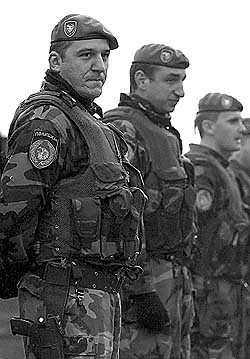
However, no matter how secretive they are, the members of this unit have already shown some of the equipment and weapons at their disposal to the widest audience: on the fifth of October last year, at the "Shield 2001" exercise, at the recent protest... that it all costs a lot. Arsenal looks something like this:
HAMMER: High Mobility Multi-purpose Wheeled Vehicle (HMMWV), whose model AM998 is better known to our public as the Hummer, is a military all-terrain vehicle of American production; it has four-wheel drive and successfully overcomes climbs, water obstacles, inaccessible terrains. Military models are used for the transfer of weapons and command systems, weapons and personnel, and can be armored and adapted to different tasks. The lowest price for a civilian model is $45.000, while specially equipped and enhanced models sell for more than $150.000. According to the insiders, the hammers at JSO's disposal have been upgraded, but in a "homemade" manner.
VILLAIN-3: The armored combat vehicle, i.e. the 20/3 mm self-propelled anti-aircraft gun, is intended for action against targets in the air space, and it can also be used for action against unarmored and lightly armored targets on the ground. During the wars in the territory of the former SFRY and in Kosovo, the BOV-3 proved to be the most effective tool for destroying snipers and fire points in urban areas. Price: $250.000-$300.000.
M80A: Infantry fighting vehicle of domestic production - it has an M55 caliber 20 mm automatic cannon, an M86 machine gun and two launchers for anti-armor guided missiles. Newer models are enriched with smoke box launchers and a day-night aiming device. Price: around $100.000.
GRIZZLY: Canadian-made armored personnel carrier equipped with a 12,7 mm machine gun and a 7,62 mm machine gun; in addition to moving on an asphalt surface, it also enables overcoming water obstacles by sailing (for which two propellers are used, and the maximum speed is 7 km/h). Estimated price: $200.000-$300.000.
M53/59: The self-propelled anti-aircraft gun 30/2mm of Czech production, better known as "praga", was created by mounting a double-barreled gun on the armored chassis of the V3S truck, and was introduced into the armament of the JNA as early as 1968. During the wars in the territory of the former Yugoslavia, that model was enriched by installing different types of cannons and machine guns, but it is still considered obsolete; most often used for demolishing houses. The production price would be around 200.000 dollars, but due to the obsolescence of the "threshold" it is estimated that it could not reach a price higher than 50.000 dollars on the market.
Mi-24: The Russian-made armored attack helicopter is better known under the NATO name Hind; originally conceived as a transport helicopter, over time it proved to be very successful in the fight against manpower, armored fighting vehicles and other targets on land and water. The Mi-24V model received a new Sturm-V anti-tank guided missile system and an automatic aiming system. To equip police units, the Mi-24PS model was made, which does not have built-in weapons, and instead of a launcher, it carries additional fuel tanks, searchlights and a loudspeaker. It is interesting that the JSO does not use that, but the military model, which was shown at the "Shield 2001" exercise in October of this year. Price: Base $1,35 million, but can go several times higher. JSO owns two such helicopters. It is not known whether these helicopters are the property of the JNA or, as some sources claim, were smuggled from Ukraine.
B212: An American-made helicopter that is successfully used for both civilian and military purposes. It is produced by Americans and Italians, and its price is around 1.250.000 dollars. JSO has at least one such helicopter.
GAZELA: A domestically produced helicopter that costs about one million dollars. JSO own at least one.
M-70: Domestically produced automatic rifle based on the Russian AK-97 (Kalashnikov). Caliber: 5,56 or 7,62 mm. Price: $200-$250.
MACHINE GUN M84: This 7 mm machine gun was developed in Yugoslavia based on the Russian PKM machine gun. Like the Kalashnikov, it is produced by Zastava from Kragujevac.
AGS - 17: A 30 mm automatic grenade launcher of Russian production, but also produced in Yugoslavia as the M93 ABG-30. It is used for operations against live force, unarmored and lightly armored techniques in open space, in trenches, shelters and trenches. Price: about $300.
FOLLOWING EQUIPMENT: Each member of the JSO has three sets of uniforms - winter and summer work and one dress uniform, boots, shoes, belt, bulletproof vest, helmet, beret. According to free estimates and available data, the approximate price of a set of uniforms is around 2000 dollars (where, according to insiders, the most expensive boots are), extremely high-quality bulletproof vests cost around 200 dollars, and the price of a helmet ranges between 300 and 3500 dollars. Total: about $XNUMX.
JSO members carry CZ99 automatic pistols, which cost about $200.
The communication system used by the Red Berets cannot even be guessed at, but it is known that (depending on the range) Motorolas cost over a thousand dollars each, and that car radios can be purchased for around $200.
CURRENT COSTS: On the question of how much the renovation of the Štolc farmhouse cost, there is no information for now (based on the words of Đorđe Antelj, director of the company Gemax, which was the contractor, it is only known that members of the JSO have photocells in the toilets). It is not even known how much the bills for gasoline, electricity, water and telephones used by the Red Berets are. Of course, it is not known whether these bills are paid at all.
As an illustration of what could be called "current costs", we should mention the fact that a member of the MUP's special units must shoot at least 200-300 rounds a week to stay in shape. If it is known that a bullet of domestic production costs 30 dinars, a simple calculation shows that one specialist in Štolac costs taxpayers a minimum of 6000-9000 dinars per week. Each "red beret", provided that he does not receive money for his services, does not eat, drink, drive, phone and sleep in the cold, spends more than four average pensions or salaries!
Such a calculation is, of course, highly speculative - the true costs may be much higher or much lower than what we only assume based on what we have seen. The real calculation should still exist. As a precaution.