Od permanent correspondent "political" iz Ljubljana

"SLOVENIAN WAR": Pictures that we (all) have somewhat forgotten
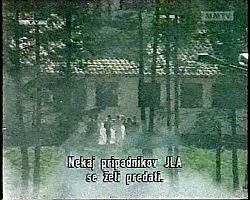
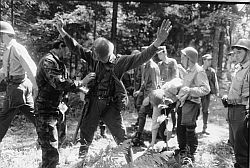
A group of soldiers raising their hands, above them a white sheet, a volley, smoke, soldiers fall and disappear in the dust. A journalist from the Austrian National Television (ORF TV) comments: a group of JNA members at the Holmec border crossing is trying to surrender. But, "in vain". It was June 28, 1991. It was the beginning of the "Holmec affair", which is known in Slovenia as the "Vič-Holmec affair", and which, 15 years late, has recently reached the hands of the Serbian prosecution for war crimes.
Does the video show a crime? What happened to the recruits in the video? Are these those whose names have been published in the press these days, and who died on Holmetz? If someone had given a clear answer to these questions in these fifteen years, there would be no doubts today. The Slovenian authorities failed to do so. Moreover, in Slovenia, the question "what really happened" was already at the beginning of the affair replaced by the question: "Who delivered that dirty story to the journalists?" Dealing in gossip, the unusual sloppiness of the proverbially precise state authorities, who never clearly answered the most important questions - they turned this affair into a "skeleton from the closet".
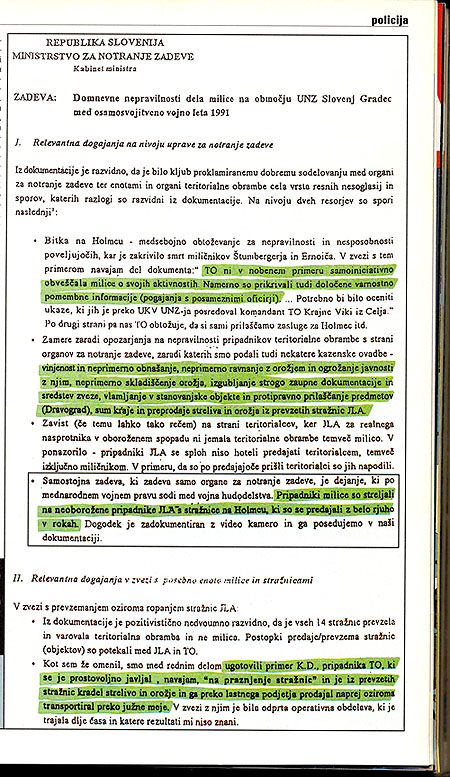
And it started naively, with a question from the journalist of the tabloid "Slovenske novice" Bojan Buđa if he could go to Gotenica in Kočevska Reka, where the police keep confidential materials in bunkers. The Minister of Police at the time, Mirko Bandelj, was inclined to the idea of allowing Buđa to enter the archive, but the head of the archive, Anton Bukovnik (advisor to the minister by function), refused. In a special report, Bukovnik informed the minister that there are a number of records in the archive on the topic of how brave Slovenian territorial guards at the border crossings "liberated" items that did not belong to them from duty-free shops and houses, as well as reselling stolen weapons and ammunition, and the like. Among other things, he wrote:Special an event, u which su involved samo organs internal jobs, presents action house se prema international the right one includes u war crimes (Slovak: war crimes). Members militia shot su na unarmed members JNA iz watchtowers na Holmetz, u moment Kada su se taught s white with a sheet u hands. An event je documented video with a camera i we have ga u ours documentation. "
Said document, the so-called Bukovnik's report was liked by the journalist "Slovenskih novic" Buđa, who published the story at the end of December 1998 in an article entitled "Slovenes killed prisoners of war?".
Buđi read the details of the report over the phone from its source - Director General of Police Borut Likar. Likar later claimed that he did not read the report to the journalist, nor did he tell him anything that was confidential, and that he wanted to dissuade him from writing. The journalist claimed the opposite. He soon succumbed to the pressure, forgot one of the first journalistic principles about protecting the source of information and "beat" Likar, so the former police director flew out of office and was sentenced to a suspended prison sentence, for revealing an official secret.
That's how the affair was born. As if no one was interested in what happened to the recruits from the video - the whole story revolved exclusively around the question of who "placed" whom in the police and authorities. The investigation itself into the event from the video was completed within the police, with the report of police officer Bojan Gričar, which was immediately labeled "confidential". Six copies of that report went to parliament, where the case was taken over by a special commission - which never completed the work. This was followed by the "second Gričar report", which again dealt with the issue of leaking secrets and who is most guilty of tarnishing the image and actions of brave territorial soldiers and policemen. Next comes the third, "Anžič's report", which was written by Andrej Anžič, a lecturer at the Higher Police School in Ljubljana. Anžić assessed "Gričar's second report" as "illegal", because the hearings of the witnesses were conducted contrary to the provisions of the law on criminal procedure. Again, parts of the report were leaked to the public; again, the center of attention was "who wants to denigrate whom more" on the internal political level. Along the way, some diagrams and maps proved that there was no crime in Holmec, the positions of Slovenian special forces, police officers who allegedly did not see the soldiers who surrendered from their position were marked. Finally, there was the epilogue of four controversial reports - in the style that individuals from the top of the police wanted to defame Marko Pogorevac, a rising police officer, who was offered the position of Minister of Defense, with accusations "about theft from duty-free shops." Pogorevac was one of the commanders at Holmec. Likar managed to take him with him - Pogorevac never became a minister, now he works as a security guard in the Slovenian mobile operator Mobitel.
Minister Bandelj also flew away, who was not doing well when the case culminated in 1999. The whole thing was completed by an intelligence report, in which it is written that there is a well-founded suspicion that "foreign factors" were involved in the launch of the Holmec case.
PATRIOTIC DEFENSE: Even the parliament did not remain deaf under the pressure. Hours and hours of discussions gave birth to a special commission, which was supposed to investigate the involvement of "public office holders" in the Holmec affair. Incidentally, a criminal investigation was conducted into the whole case. The parliament came up with how the scandal surrounding Holmec "cast a big stain on the war for the independence of Slovenia and on all members of our army, police and others who participated in it". Slovenian policemen and territorial officers got a new holiday, June 27, which is regularly celebrated at the watchtower on Holmec. Since 1999, all those who fought on Holmec have traditionally gathered to celebrate and deal with those who fuel the "dirty affair, which desecrates the heroic demeanor of Slovenian policemen and territorial officers".
The editor-in-chief of "Slovenskih novic" warned in vain at the beginning of the affair that the police did not allow journalists to see the documentation related to the conflict near Holmec, claiming that it was "working material" prepared for a book Police u Queen. As for the recording of the event itself - which the families of the fallen soldiers did not have the opportunity to see until a few days ago - it is a miracle that a usable copy survived, because it was leaked that after less than seven years it suddenly became "unusable" in the archives of the Slovenian National Television ". In fact, there is every chance that there were two recordings. Longer. And abbreviated. The one where there are no ambulances, wounded, paramedics or stretchers. Until Neva Miklavčič-Predan, president of the Helsinki Monitor of Slovenia, handed over a copy of the recording of the event (actually a recording of ORF TV) to the SCG embassy in Ljubljana, which delivered the material to the Serbian judicial authorities. Neva Miklavčič-Predan has already paid a high price due to publicly expressed doubts that a crime took place at the Holmec watchtower. The State Prosecutor's Office, as well as members of Slovenian "veteran" organizations, brought as many as three lawsuits against her for making false claims and insulting her.
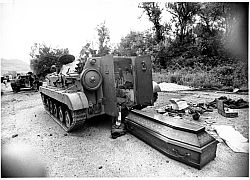
The case ended for the Slovenian authorities with the finding that there was no crime. The same is claimed by the Slovenian criminalist Drago Kos, who conducted an on-site investigation on June 28, 1991, and this is partly confirmed by the testimonies of some of the participants in that conflict. Even so, there is no doubt that the "Holmet case" will not be solved without what was not done in the beginning. Now it is necessary to patch the "holes" in the procedure that was ended by the Slovenian authorities without any conclusion, plus ensure the full cooperation of the investigative authorities of the two successor states of the former SFRY, in which the participants of these tragic events live today. That it will be a tough nut to crack, is proven by the office of the state prosecutor general Barbara Brezigar in Ljubljana, who rejected even the suspicion that a crime had been committed. Which masks another, bigger problem. Because, if it is determined that there were no crimes at Holmec during the 1991 conflict, "there are many more hidden skeletons in the closet" - several dozen cases of more serious violations of the law of war. There is a long list of victims who have been waiting for justice for a decade and a half, and in whom the Hague Tribunal has never been interested. Because these are "minor violations". Minor or major sins, it was a model that the helpless and humiliated victims, soldiers and officers of the JNA - later practiced during the conflicts on the soil of Croatia and Bosnia. It is never too late for justice, especially when it comes to war crimes. If only the investigators would stop weighing the crime against the merits of those who committed it. If it is known that some of the "heroes of the war for independence" are also there, then it is clear what the stakes are.
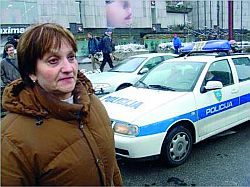
Against Neva Miklavčič-Predan, the president of the Helsinki Monitor of Slovenia (HMS), the Slovenian State Prosecutor's Office initiated court proceedings regarding her statement given at the press conference of the Helsinki Monitor of Slovenia in 2003. The president of HMS then, before the testimony of (then former president) Milan Kučan at the trial of Slobodan Miosevic in The Hague, reminded the public that the Slovenian prosecuting authorities did not investigate the background of the death of three JNA recruits at the Holmec border crossing on June 28, 1991. In an interview with "Vreme", Neva Miklavčič-Predan confirms the introduction of verbal delict through the back door in the Slovenian judiciary.
"The prosecution claims that 'I had to know the truth about Holmetz from the media.' However, I saw the video of ORF TV in the media, nobody can turn a blind eye. I have analyzed all the articles published since 1999, as well as the effects of the parliamentary Gričar commission that investigated the Holmec case - there is nothing credible. I proposed to engage not only domestic but also foreign experts who would determine the authenticity of the ORF TV video, and also - what exactly is seen on the video. Experts from the area of the former Yugoslavia could also take part there, anyway it concerns all of us. The prosecution did not approve the expert testimony. They rejected everything.
Ima li testimonies soldiers JNA, what se vidi na recording ORF TV a?
Of course, people contact us all the time. At first we did not want to go public, we studied the documentation - after all, I am the daughter of my father who was a judge, I am aware that we cannot flatly accuse anyone; that is not our task, but that of the prosecuting authorities, who should have investigated any suspicion regarding Holmes. Attorney General Barbara Brezigar, however, is doing everything she can to close the case, even though it has yet to be opened. And they neither imprisoned him legitimately, nor legally, since there was no conclusion about Holmetz. They would have to reopen the investigation every time new facts appear. And they didn't. Citizens should be concerned about the kind of country we live in - instead of investigating whether a crime has been committed, the country is persecuting an organization for the protection of human rights!? The fact is that in 1991 we were not at Holmec, we did not shoot... We said back in 1999 that our intention was not to remove skeletons from the closet, we filed a criminal complaint against an unidentified person, and they put it in the bottom of a drawer, they do not admit nor that there is any doubt that a crime took place on Holmec. We need to establish a balance, abolish this perverse situation, it is high time to put Holmec on a healthy foundation. Fortunately, the war did not last here, so in those ten days there was no opportunity for more people to die due to disobeying the law of war. And then Janez Janša makes a statement that what we are doing is worthy of condemnation!?
S. V. M.
DOCUMENTS AND/OR EVIDENCE: One of the reports of the Slovenian Minister of Police and ORF personnel from Holmec