For a long time now, every winter the governor of the central bank has become the main actor on the economic scene of Serbia, because everyone has the impression that it is he who directs the large redistribution of profits and debts that is carried out on the foreign exchange market - where the exchange rate of the dinar is supposedly established. Because, somewhere from November 2011, when the state budget deficit for the next year is being prepared and the missed balances of the previous one are being reduced, until the end of March of each new year - through currency fluctuations, the results of operations and current losses are redistributed and, what is even more important, establishes a platform for state and business borrowing in the new cycle.
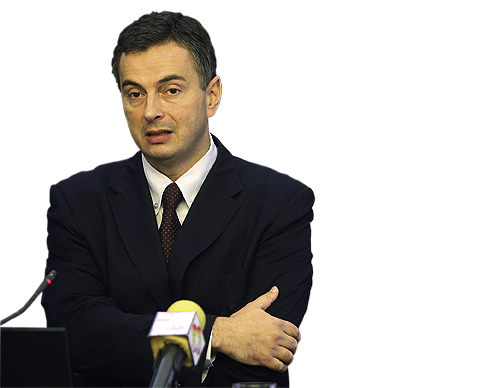
In this drama of fear, greed and impotence this winter, he played the main (ungrateful) role, to be understood as an independent monetary conductor, on whose moves depend not only the earnings of speculators and the profits of entrepreneurs, but also the purchasing power of our wages and the dinar weight of our debts and loans. , had the young governor Dejan Šoškić.
Without showing too much trepidation, he played his role so far "according to the textbooks", without stuttering or mercy, with the stubbornness of a well-prepared gentleman, strictly adhering to the "legal powers" which he interpreted "from his head" in front of the widest public, without a single mistake, even and in free television panels, where you can't peek under the bench to remind yourself of something.
Ergo, Šoškić's conclusion is that the drop in the value of the dinar against the euro in two and a half months by about seven percent should not be seen as a disaster, that is, that he cannot conduct foreign exchange policy according to the interests (that is, according to the losses) of individuals who have huge foreign exchange obligations. but in the interest of the people, which is why his bank is called "people's" (even when 20 percent of the purchasing power is taken away from the people); that thanks to the policy of the NBS, interannual inflation is on the decline (to five-six percent) and that there is a perspective that the "target inflation" for this year of around five percent will be hit this time (which is not usual), because despite the significant increase in foreign exchange the costs of an import-dependent economy, due to severe stagnation, will not be able to pass that cost on to anyone; that the model of determining the "controlled fluctuating exchange rate" has allegedly proven to be better than the fixed exchange rate model, because it better preserves foreign exchange reserves and does not require the reduction of nominal salaries in the public sector, that is, it preserves the credit rating and capacity of the state to borrow abroad; that the dinar cannot be strong in a weak economy (which is doubtful from the point of view of textbooks written by monetarists, which claim that the local currency can be strong and stable in Somalia as well, if there is no more than the supply of foreign exchange), etc.
All these statements by Šoškić, and not even the new seasonal, dangerous fluctuation of the value of the dinar, probably would not have caused such a strong reaction from the authorities in Serbia, as it appeared this time, if the mentioned "foreign exchange storm" had not happened just before the parliamentary and presidential elections. Namely, at one point it seemed to the leading politicians in power that Governor Šoškić "forgot" that currency nervousness is the least thing the ruling coalition needs right now, which needs to overcome re-election, and which is telling the people the truth in the midst of a very serious economic crisis (which , by the way, it has practically been going on in Serbia for almost 35 years - with only occasional surrenders).
From the harsh and casual and public remarks directed at the governor over the past few weeks, one gets the impression that the government and the leading politicians in power were most annoyed by the "official interview" of Dejan Šoškić, which was broadcast via "Blic" and "Večernje novosti" on the 25th. February. In that speech, Governor Šoškić said: "If I were prime minister, I would raise VAT." The second move would be to reduce payroll taxes, the third would be better social protection, and the fourth would be the rationalization of the public sector and the reduction of the gray economy. The state and all of us with it must stretch only as far as we can. The most important thing is to rein in additional borrowing and provide an incentive for development that creates jobs."
After that interview and the daily "historic declines of the dinar" against foreign currencies, the President of the Republic Boris Tadić expressed his belief that the governor will quickly stabilize the exchange rate - a message that is so clear that it could not be clearer. A little later, the mayor of Belgrade, Dragan Đilas, was much harsher (whose city has large foreign currency liabilities for loans, and whose income is mainly in dinars), who said that everyone should do their job (so the governor should not interfere with the prime minister's). and that he is annoyed by those who have entered the waters of high politics without having previously achieved anything in real life - and that the governor should not lead a policy that will be a reference for him among his faculty colleagues, but he must keep in mind the life consequences (therefore the political consequences) that his every move causes.
At the Kopaonik Business Forum last week, Prime Minister Mirko Cvetković confirmed that he and President Tadić recently had a meeting with the (independent) governor - and he characterized that meeting as "normal and usual" (if my memory serves me right). Of course, it is clear to everyone that at that meeting it was not possible to talk only about some kind of usual February moaning of big cats, but also about the consequences of the currency disturbance on the pre-election "atmosphere", and maybe something else threatening.
However, even after that meeting, Šoškić, in his speech at the aforementioned Kopaonić consultation of economists and businessmen and other liquid investors, nominally maintained his basic positions and showed "stubborn firmness". In this regard, he pointed out at Kopaonik: "Countries with an insufficiently competitive and import-oriented economy, which for years spend more than they produce, which postpone structural reforms, do not attract enough foreign direct investments and do not show reform efforts, such as an active arrangement with the IMF, in the medium and long term, they cannot have a relatively stable exchange rate."
Soškić's firmness left him only for one moment, when "unprovoked" he said that he was not afraid of a change. The truth is that he formulated that seductively dramatic sentence somewhat dryly, basically bureaucratically: "The replacement of state representatives and public officials is normal in a democratic system, but there needs to be a procedure and argumentation for that..."
No matter what procedure and argument in Serbia, when the government is on the hook, someone would notice. However, the impression is that this conflict will only be seasonal and that those better versed in "Balkan rules" will already find ways to bring the game to a "tie" again. This can already be seen from the fact that the more "anointed" politicians are already declaring that they have no idea about any kind of campaign against an independent governor. And, just in case, police information has already appeared in the newspapers that Governor Šoškić was a co-owner of a small company that sold some software to commercial banks, which was omitted from his official biography when he was appointed to the position.
On Kopaonik, Šoškić received the most inconvenient praise for his nominal firmness from Jorgovanka Tabaković, who is one of the few from the main opposition party (SNS) who dares to speak about monetary and foreign exchange issues, without fear of uttering some big nonsense. Namely, she declared: "The next government will have a difficult task, just like Šoškić has." The golden rain that led to the pampering of commercial banking, which does not lend to the economy, but trades nicely and safely with the NBS and the state, buying their debt securities, no longer exists", and that "the false dilemma is either an increase in VAT or borrowing "and that the governor "honestly, with facts and without courting those who elected him, advocated for the measures he applies" ("Today" from March 9). Tabakovicka, of course, did not explain why that "golden rain" pulled Serbia out of the abyss for a while, and now it is drying up, and she did not go into the question of whether the country would quickly experience a financial collapse if it were not for those "spoiled" bankers and speculators who are ready to they are playing with the troubles of a poor country, in order to make good money, with the risk that the country will suddenly collapse, and they will be left stranded.
On this occasion, attention should be drawn to the fact that even this latest drama, in which the head of monetary policy plays such a large role on the broadest public stage in a country that is largely illiterate in terms of the market, and in which, even through the daily newspapers, discussions that are mostly absolutely incomprehensible to the people, actually gets tangled up in the question of what can monetary policy be done in a country that is in economic stagnation? The question is old and, no matter how pathetic, there is no simple answer to it. On one side are those who believe that the priority is to help the economic conjuncture and keep employees and citizens alive, at the cost of all risks, including inflationary risks, and on the other are those who believe that there is no more time and space for maneuvering and that a firm monetary through politics and realistic devaluation, the people should face the stark poverty we have reached after decades of national deception and delay.
Businessmen who complain that every drop of the dinar against the euro brings an increase in their liabilities to the banks by about 14-15 billion dinars, because their loans are tied to the euro (which would mean that they "received" from the NBS in the first two months a burden of close to 100 billion dinars), of course, they do not take into account how the state will cover the budget deficits and the deficit in the state's balance of payments, and how much the interest costs will cost us. They are allegedly not looking for a fixed exchange rate, but a "predictable exchange rate", except for those who advocate full "eurization" of domestic payments. However, in our case, it is not really the key problem in the model of formation of the exchange rate, but the key problem is that the disproportions between the potential of the economy and public expenses are indeed so great that someone has to pay the difference, today or tomorrow (I am for tomorrow, if that still possible).
Without, therefore, entering into the professional problem of the dispute about models of monetary and foreign exchange policy, and in that dispute, Governor Dejan Šoškić, by the nature of his job, is on the side of Serbia's creditors, primarily the International Monetary Fund (because his company organizes the servicing of foreign debts and takes care of the credit capacity of the state, although it obviously does not cooperate smoothly with the Ministry of Finance) - it should be noted that our monetary authority is trying to maintain the credibility it gained ten years ago.
In this respect, it is not a bad thing that Governor Dejan Šoškić mostly kept his temper and retreated into the "language of legal authority", although sometimes it is felt that he was carried away by the public scene and that he loves the journalistic spotlight. In truth, he resists the prejudices of that public quite well, who see the central bank as a kind of money factory that could save Serbia with his miraculous moves and angelic grace - with the fact that sometimes one can get the impression that he is prone to the stereotype that every governor of the central bank he should be strict with the uninitiated and the unenlightened. Politicians, of course, should be kept away from decisions about money (as Galbraith said), but monetary policy is not particularly magic either - because almost all of it can be read in interest rates. In this sense, it should be noted that the Monetary Board of the NBS announced the other day that it has kept the reference interest rate at the level of 9,5 percent - we will see if there will be enough buyers for the government bonds that are sold on the basis of that money price. for dinars?
The latest announcement of the NBS, by the way, states that foreign exchange reserves in February were reduced by around 400 million euros and amount to 11,2 billion euros (6,3 billion euros are net state reserves). The largest foreign exchange inflow in the first two months came from the state, 52 million euros, which is starting to sell for dinars what it borrowed from the world in the fall. And on the foreign exchange outflow side, the main thing is the state - which bought 204,2 million euros from the NBS to pay for the matured government securities denominated in euros. The National Bank had to set aside 188,5 million euros from reserves to "calm down" exchange rate fluctuations.
3,5 billion euros were traded on the interbank market in the first two months. Someone from Greece would say - the Serbian foreign exchange storm is a storm in a glass of water. Indeed, the question arises as to whether our foreign exchange market is too shallow for one big governor and to accurately measure the spontaneous relations of supply and demand for foreign exchange.