At the moment when this issue of "Vremena" is in the hands of readers, the first-instance verdict against the conspirators who killed Prime Minister Zoran Djindjic will be pronounced. The first on the indictment is a man with many names, Milorad Ulemek, also known as Luković, Vlado Vukomanović, Legija, Cema and Šareni - among others (see New Testament, Luke 8; 30). He has already been sentenced to 40 years in the Budva and Stambolić cases, and a similar outcome awaits him in the Ibarska magistrala and Zemunski clan cases. Three days before the sentencing, the person in question - as written in large letters on the front page of a certain printed matter - stated that he had already booked an arrangement in the Dominican Republic and that he would run away as soon as he satisfied the curiosity that led him to surrender and spend three years in the "Hyatt" of the Central Prison, entertaining the guards, the court, lawyers, politicians, ministers, newspapers and the general public with his stories. So, while there is still time, until Cema moves from this "Hyatt" to another one of the same chain in the Dominican, let's consider his precious personality and "too creepy life", as Stanislav Winaver would call it.
LEGIONARY: First of all, it is very difficult to break through the diligently (but haphazardly) woven web of lies of our hero, who - by the nature of his craft - is prone to lying, and skilled. During these three years that the main trial lasted, some things got more or less untangled, to Ulemek's detriment, of course. Some remained under suspicion, because the court did not deal with them; the court judges according to the indictment and does not go beyond it. Deputy Special Prosecutor Jovan Prijić, the man who started this process and is finishing it, made a convincing point during his closing speech three weeks ago; it is worth mentioning:
"The accused Ulemek told falsehoods about himself already at the moment of giving personal information; that's how he said that he finished secondary music school and the IV degree of auto mechanic school. On April 9, 1996, he personally filled out the questionnaire (of State Security), which was necessary when establishing an employment relationship, about his personal data. There he wrote in his own hand that he had the III degree of high school from 1985 in Belgrade, etc. It is true, however, that Ulemek only obtained a diploma in his life from the National University of New Belgrade, Metal Education Center, for the profession of auto mechanic (August 26, 1985). It is a course, not a school; certainly not musical.
In the school of life, however, Ulemek went a little further, but not as much as he is trying to convince us. He started out as a Mangupčić-diesel driver (to this day, he speaks like that, in the diesel language of the time, with many soft "ž", "č" and "đ"). He says that he broke into an Elan sports equipment store with his team when he was young, because "their parents didn't have money to buy them sneakers." It turned out, however, that they took much more than sneakers from there: bags full of various sports equipment that they later wanted to sell, and that's how they ended up.
Finding himself in an extremely unhygienic situation, young Ulemek decides to move away. Like any young criminal with ideas, he joins the French Foreign Legion. He must have served in the engineer regiment, although some of the pictures also have parachute wings, which is not unusual: the Foreign Legion encourages cross-specialization. Well, now: you don't join the Foreign Legion because of unrequited love or out of sheer adventure, like in bad movies; it is a haven for criminals on the run from the law. The French are aware of this, no worries: they maintain iron discipline and beat the legionnaires like oxen in cabbage. So, in the Foreign Legion it is learned first, as we see from Ulemek's later career. The most that can be learned there is to make a man an efficient non-commissioned officer: a foreigner cannot advance beyond the rank adjutant, something that would be a standard bearer for us. Our Ulemek reached the rank of corporal, as can be seen from an identification card confiscated from him by the BiH militia in Zvornik, and the French authorities officially treat him as a deserter from the Foreign Legion. He is not the only one: a lot of former legionnaires passed through our recent wars, especially in Croatia, where almost all of them became generals from sergeants - six or seven of them, headed by the famous Anto Gotovina. Ulemek only made it to "colonel", which is not a consolation. In the Special Operations Unit of the State Security Service of the MUP of Serbia, ranks were divided anyway without any formal criteria, so Zvezdan Jovanović went from "senior sergeant" to "major" in 14 days, and then to "lieutenant colonel" (from school he has course for a toolmaker in Peja).
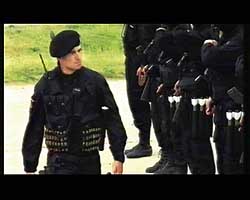
The court did not go into the reasons for Ulemek's desertion from the Foreign Legion; according to some information, he (like Ante Gotovina, after all) got involved in some kind of crime, so he had to hide... In any case, in early 1992, Ulemek appeared in his homeland as the bodyguard of one of the then more than controversial businessman from the area of cigarette smuggling who was later killed. Very soon, Ulemek joined the Serbian Volunteer Guard of the late internal affairs worker Željko Ražnatović Arkan. That team of criminals, collected from penitentiaries and on the hot Belgrade asphalt, had to be kept in some order, so Ulemek came forward as a natural solution, based on his legionary experience. In the blink of an eye, he distinguished himself and became a high-ranking officer with Arkan. He slowly began to introduce legionary discipline, as well as customs, etiquette, etc. Soon everyone began to resemble legionnaires in terms of training, saluting, wearing the beret crooked on the wrong (French) side, which Ulemek brought to perfection in the last phase of the infamous JSO - a. On a video of one of their meetings, Ulemek can be seen limping on one leg: this is the result of a serious traffic accident that he hid in southern Serbia by careless driving. For that accident, there is a final and enforceable judgment of the District Court in Nis, which was never executed, because Milorad Ulemek was - unavailable to the court...
He was not available because he was engaged in serious business in Cazinska Krajina, for the account of Jovica Stanišić, Franko Simatović and Arkan. In short: they got rich by organizing and protecting smuggling operations on a huge scale, robbing everything in turn in the Bihac region and cooperating with everyone. They did so well that they barely made it out alive when Operation Storm began in August 1995; they withdrew the money before that.
In the post-Dayton period, Ulemek realized where the future lies: in State Security. Jovica and Frankie realized this much earlier, so the Red Berets decided to "legalize" it; outside the law, against the law, but what does it matter? June 1996. The unit is "legalized" from mercenaries to "contractors" of the State Security. Ulemek is engaged in instruction, he goes to Macedonia to train those Lions there who later performed a miracle and penance, but he also begins to make connections in the Belgrade underground. The rest is history, as they say... What is important here is that a new "patriotic" warrior nobility was created from paramilitary artists and villains who have now acquired the status of members of the MUP and official identification and badges.

FOREIGN LEGION-LIKE UNIT: From the time of the Arcane Tigers
IMPRESSIONIST: In order to fully understand the character and work of Milorad Ulemek, it is necessary to look back at his basic vocation in life, from which he also made a profitable trade. Ulemek is basically a swindler by profession; more precisely, swindler and swindler, manipulator and schemer; profile desired in the Service. Rising above the law and the rules, he began to spin a web of his political, criminal and security-intelligence business contacts. To politicians, he was a "patriot"; he was the protector and partner of criminals; He was an efficient executor of the service and its top (Milosevic). Politicians were fascinated by his Mangup charm of a "fierce guy"; to criminals it was theirs; the security guards are used to that anyway. The diligently built image of the "experienced soldier" and the "most capable Unit" completed the costume design: "doctors for terrorism", in a word. But Milošević's affairs should have continued, so we have the involvement of the Unit in Kosovo in 1998-1999; so we have Ibarska magistrala, then Budva, then Stambolić... And we also have increasingly close ties with gangsters and drug dealers.
Listening smarter than himself (a virtue he later lost, like many vain people), Ulemek realized in September 2000 that the devil had played a joke and joined a large crew of flyovers, some would say - deserters. During the October XNUMX coup, Ulemek played his role of life, his own coup de theater. First, he impressed them, all of them, led by Djindjic, scaring them and offering them protection; then he performed that circus on October 5 in the afternoon. Within a few days, he started to implement his personnel policy, to weave intrigues and sow discord in the Army, among politicians, in the police and State Security. Everyone looked at him like Pinky looked at Tito; if someone had reserves, he kept them to himself; some even wanted to tattoo that famous rose on their necks, but their friends stopped them in time. He realized Legion – somewhat prematurely, admittedly – that he was dealing with sheep za haircut, as they say among diesels (with a soft "sh"). Playing between these and those, frightening one and consoling the other, winking at one and frowning at the other, Ulemek strengthened his position as a hero, a knight, a protector of Vaskoliki Serbia and a guarantor of Serbia's survival. In this capacity, he begins to flirt with General Aco Tomić, establishing a beautiful friendship. Few of them were not accepted, Beba Popović least of all; he despised him from the beginning and made it clear to him. Djindjic was untrustworthy, but he had more important things to do than some Legion clown.
The problems started in 2001, when the new head of the Service made the subject of the Ibarska highway, and then Budva. The kidnapping of Milorad Mišković and its elucidation bring Ulemek into an unpleasant relationship with the criminal organization from Surčin and Zemun, just as his role in the Ibarska magistrala case is looming. The moment is coming to show the combined strength of the Legion, Zemun, the Unit and their logistical support in political parties and court media. The armed rebellion of the JSO in November 2001 was successful, as Legija later explained to the disgruntled Duća Spasojević: they killed two birds with one stone - they put their people in charge of the State Security, and they reduced the danger to themselves because of the crimes they committed . The legion was on horseback again, all fine, out of retirement with armored vehicles and a pack of bodyguards, all at state expense.
There, around that pension, you can already see the cracks in Legia's personality: the illusion of omnipotence, fueled by psychoactive substances and lack of resistance, leads a man to, how shall we say...excesses, especially if he is not emotionally mature, educated and rational. In short, Ulemek went too far in the spring of 2001, nervous and tense about Mišković, the Ibarska highway and the heroin trade as a full-time job. This is how the discotheque in Kula was set on fire, and later riots in "Bojan Stupica". Once retired, Legion with his horde of official bodyguards embarks on punitive expeditions around Njegoševa and other places that impress him. We'll spare you the details; we will only say that he would have had a very bad time if he had not been surrounded by armed officials; it says something about "heroism". That combination of protected leisure, frustration, vulnerability and ambition leads him further: he cooperates more and more closely with the people of Zemun, embeds himself in their criminal enterprises, provides them with intelligence and counter-intelligence support through his people in the Service. He still intrigues: about Boško Buha and Maka, about Ibarska; throws spoonfuls of discord between DSS and DS; plays "patriotic" sounds in his newspaper.
THE WRITER: The summer of 2002 was fatal: we missed Ljubiša Buha Čumet twice, whom the Legion can't stand (calls him "peasant girl"), and neither does this one (he read it), Čume started to sing to the authorities, running around. A manhunt on a European (and wider) scale ensues, in which all the organized criminals of the former Yugoslavia are fraternally involved at the Legion's signal. Chume manages to avoid them, keep his head alive and tell Jovan Prijić everything (or almost everything) that he needed to at the end of 2002. The noose is tightening and Ulemek can see that from the information provided by his associates from the police, judiciary and State Security. Duća Spasojević, in fear and nervousness, kills more and more in Belgrade and with less and less reason: a well-founded or unfounded suspicion is enough for him; he doesn't care why he kills anyway. Legion Ulemek, on the other hand, is launching a political and media offensive. It starts with a fake JSO recruitment campaign, ads, TV spots and billboards; the goal is to scare the public and impose JSO as an option. He gives boring and pretentious interviews to his and Duca's journalists. He writes letters to politicians and diplomats, in an equally boring, confused and pretentious style, running for the "factor of peace and stability" in Serbia, clumsily alluding to this and that and practically offering his valuable services.
The climax occurred on January 28, 2003, when Legija Ulemek published its "open letter" to the public of Serbia. Somehow before that, the BIA got a new leadership, which immediately starts a purge and active cooperation with the police, precisely along the lines of the "Witness" action, that is, work on the criminal organization of Duce Spasojević and Legia Ulemek. The noose tightens again, this time much more seriously, and the team is in a panic: State security has eluded them, the flow of data has been cut off, they are in the dark. Ulemek's "open letter" was the pinnacle of his wit and literacy: again pretentious, haughty, half-literate and boring, boring, boring. The Ulemek complains about how, what a shame!, "the commanders are not respected" and so on, how they complain about the state that trusts Chumet more than the "Commander" and in that direction, all "patriotic" indignant and sighing. It did not help, and the preparations for the murder of Zoran Đinđić continued on the sidelines, another by line activities.
THE PRISONER: That's how we get to March 12, 2003, when Ulemek aggressively hung around his terrace while fellow soldiers were killing the prime minister. Then he retreated to the stable to wait for what would happen next. What he expected can only be concluded from the testimony of witnesses who speak about "plans A, B, C; 1, 2 and 3", "going to the forest with a transistor" and waiting "for the Unit to hit the streets, so we can join". The unit did not come out; a state of emergency was declared and a warrant issued. Legija told his comrades, in a statesmanlike manner, that they had "made a mess", broke off relations and moved away in the direction of Western Herzegovina, and later to the whole of Europe, provided with false identities that opened certain bank accounts for him in which he deposited money for rainy days. . Salt on the tail…
After 14 months, at the beginning of May 2004, Ulemek, bearded and overgrown, surrendered to the gendarmes guarding his house. They say he didn't look very presentable; they say that he had an argument with his wife before surrendering. It was nine in the evening. While hand to hand, he ended up in the building of the MUP of Serbia, in the office of the head of Public Security, Gen. Miroslav Milošević, who otherwise has tender feelings towards him. Where did Ulemek come from there, and not in the Central Prison? Why was judge Marko Kljajević, the president of the court panel that tried Ulemek in absentia, not informed until the next day? What was happening there in the cabinet? Well, that's what the participants of the event of that particularly interesting May night will tell us: the Minister of the Interior Dragan Jočić, the Minister of Justice Zoran Stojković (who for years persistently claimed that he was not there, until they proved to him that he was; so what?), the director BIA Rade Bulatović and Chief of Public Security Miroslav Milošević; and maybe Ulemek also decides to tell his version... There were also those of Legija groupies: Saša Tijanić, general director of RTS, Aleksandar Nikitović, head of Kostunica's cabinet, etc., but they remained at the door, as they say, unless...
What was said there that night in the intimate circle, no one will yet say; that the law was broken is of no importance to our legalists, as usual. However, based on Legia's defense before the court, his examination of witnesses and his confrontation with them, one somewhat general conclusion can be drawn. Namely, Ulemek tried with all his might to impose on the court an interpretation of the murder of Prime Minister Djindjic that would correspond to the ideology (not to say the dogma) of the Democratic Party of Serbia and "patriotic" forces in general and their election campaign, which was extremely dirty in 2004. To their and Ulemek's regret, the prosecution and witnesses blew up his fantastic stories and wiped the floor under him. During the entire process, Legija aimed at those whom he, his defense and the "patriotic" bloc judged to be the most convenient due to the campaign of industrious satanization that lasted for years: Čedomir Jovanović and Vladimir Popović. It didn't work, on the contrary: one of the dramatic highlights of this process was the confrontation between Legija and Bebe Popović, on which occasion Popović proved that the "hero of Legija" lies when he lies. Thus, the granite building of Ulemek's defense was slowly crumbling, along with the promises he and others made.
In the meantime, he served 40 years for Budva and Stambolić, legally binding, currently at the third instance of deciding on the amount of the sentence in the Supreme Court. It is unlikely that he will get away with it, because it is a matter of evidence that cannot be more solid; he is threatened by the Ibarska magistrala (for the third time in the District Court), but also the case of the Zemun clan, before the first-instance verdict; no one mentions the one from Niš anymore. Citizen Ulemek is in great trouble, and his friends are nowhere to be found. Tabloid eulogies and tales of escape are scant consolation, as are people wearing JSO T-shirts. Those who promised that "Serbia will see again when the Legion speaks" somehow no longer remember him.
Like any prisoner with ambitions, Ulemek dabbled in writing; that is no small consolation. He has published three books so far. Iron rov, Legionary i Very. The first one is the most depressing war prose; the second is a mixture of autobiography and prose; the third one is again prose (this author didn't have the strength for that third one either...). As it happens with half-literate and ambitious authors, those books are boring as hell, as well as his letters, speeches and "open letters". The fact that someone is sitting in prison and writing does not guarantee the quality of that writing. That many great writers wrote great books while sitting in prisons is not enough; it takes more effort, literacy and - excuse me - talent. Our writer, therefore, now has two ways out: to start reading a lot and constantly during the next 40 years, and then to start writing, when he has read and thought about it all; or that writing is done in the Dominican Republic. Well, take, for example, Hemingway and Graham Greene: both of them liked the West Indies and the Caribbean very much; even Joseph Conrad did not fail to hang around and write in his cabin of the captain of sailing ships and long-sea steamers. In either case, our writer has a chance; but he should try much harder than before.