Although officially Serbia, that is, Yugoslavia, was not even close to becoming a member of NATO during the previous decades, it had intense relations with the Northern Alliance throughout most of the history of this pact. They had ups and downs until the end of the eighties of the last century, but they were never questioned. In the opinion of Dragan Simić, professor of international relations and global and national security at the Faculty of Political Sciences, the relations between NATO and Yugoslavia were much less emotionally burdened for most of their history than today: "A few years after the formation of the Atlantic Alliance, in 1953, we had the opportunity to get closer to NATO through the Balkan Alliance, and for it to be a kind of membership of the former Yugoslavia in NATO. In fact, the help that came in the form of food, money and, above all, military aid from the United States of America, and NATO, in the most critical moments of the conflict between Tito and Stalin, saved the independence of Yugoslavia," says Simić in an interview with "Vreme" and adds that Tito was very grateful for that. "But, as there is no permanent gratitude in politics, very soon after that the relations between the USSR and Yugoslavia were normalized." Tito then slowly began to turn his attention to balancing relations with the Soviet Union and opened the so-called third way, that is, he began activities on the formation of the Non-Aligned Movement, which for him was a kind of third way between these two big blocs. The world had two major military-political alliances that had no alternative for a long period of time. Tito and the leaders of the Afro-Asian countries simply realized that an alternative was needed and that it was necessary in some way to mitigate the severity of the conflict between the existing two alliances, because that conflict could have serious consequences for all of humanity."
"WEATHER": How NATO views the Yugoslav involvement in the Non-Aligned Movement?
DRAGAN SIMIC: The relations between Tito and NATO in the time after the emergence of the Non-Aligned Movement were correct, but complex, considering the pre-history. In essence, Yugoslavia was always a kind of guarantor that would prevent the eventual penetration of Soviet infantry that would follow from Hungary through Slovenia to northern Italy. There you can see the extremely important geostrategic and geopolitical position that Tito's Yugoslavia had and which the then leadership was able to use very well and useful for our position. They managed to achieve advantages in the relationship on both sides: both with Moscow and with Washington. Tito's leadership made extraordinary breakthroughs and these are anthological examples of correct assessments of their own geopolitical and geostrategic position and ideological position. Tito's relationship with NATO was not a relationship of neutrality and could not be characterized as just correct. I am inclined to believe that it was a relationship of substantial cooperation. In fact, Yugoslavia achieved a balance by representing for both sides a buffer that prevented mutual conflict, where neither side wanted to allow the other to have excessive influence on Yugoslavia.
However, after the normalization of relations with the USSR and the opening of the third path of non-alignment, the enormous material and military aid from the USA and NATO almost completely stopped.
Between the cancellation of American military aid in 1957. and the beginning of the procurement of Russian weapons there is a gap of several years. Is there, however, between those two events causally-consequential links?
Tito was a very pragmatic politician and in that balancing act between East and West, he always leaned towards the side that could offer him more at a given moment. His foreign policy is a true example of how this job should be done the right way. He adhered to the fact that there are no eternal friends and eternal alliances in foreign policy, only the interests of your country are eternal. Of course there is a cause and effect relationship. Tito simply behaved according to the context in which he was acting at that moment.
You said that Tito always counted on the importance of the geostrategic and geopolitical position of Yugoslavia. In some NATO-these military estimates from the fifties, It is Yugoslavia, in the event of a possible conflict with the USSR, characterized as a country that would rather support the Western Bloc, because it itself is threatened by the USSR-a. What were those assessments later, after the reconciliation between Tito and Khrushchev?
The fear of an attack by the USSR always existed, and NATO always expected that in the area under the control of the so-called Ninth Army Area, i.e. Slovenia, the Yugoslav People's Army would close the penetration of the Soviet infantry, which would eventually rush towards the lowlands of northern Italy. At the same time, there was always a fear that Soviet policy could become aggressive, despite the conciliatory tones that prevailed in the 1968s. But in 1956, the Prague Spring took place. Before that, in XNUMX, when relations between the USSR and Yugoslavia were normalized, we had tragic events in Hungary.
In our strategic calculations, there was always the possibility of an attack by the USSR, and NATO also very seriously calculated that in such a conflict, especially if a conventional war were to occur, Yugoslavia would side with the West. This is something that was always left unsaid, but always hovered in the international relations of the time. In that delicate balance of relations, the Yugoslav leadership at the time, in terms of statements, behavior and certain moves, such as the deployment of military personnel on the territory, managed to excel and did not give the upper hand to any side. But, ultimately, I am inclined to believe that, in the event of a conflict between NATO and the USSR, Yugoslavia would still side with NATO.
During the Cold War, Yugoslavia's relationship with NATO was much less emotionally charged than it is today. We came out of the Second World War as allies of the USA, regardless of our greater ideological closeness to the USSR. In the military sense, the Soviet Union has always represented a greater threat to Yugoslavia than NATO.
Regardless of the relationship with Yugoslavia, What was NATO's position?-and according to the events in Czechoslovakia in 1968?
Brezhnev's doctrine of limited sovereignty predicted that in the then relations within military-political alliances, each leading country in that alliance is "the master in its own backyard" and has the right to intervene if the unity of the alliance is threatened. When we compare these two alliances, Eastern and Western, it is very difficult and, in my opinion, unfounded to make complete symmetries. Despite that doctrine, it was far from anyone's expectations that the US would react with a military intervention in one of the countries of Western Europe, if there was a regime change. They would have used some other measures, but the brutal military intervention that the Soviets resorted to in Czechoslovakia in the West was unthinkable. However, it was different in the East. The great powers simply allowed each other such interventions precisely for the sake of higher interests. The balance between the two blocs meant that everything was done to avoid a direct confrontation between the two most powerful countries. To this end, the great powers allowed each other to wage so-called special wars. The Vietnam War was one such war. And all this was done in order to prevent a conflict between the USSR and the USA, which would be fatal for all of humanity.
At the same time, it was allowed that within its alliance each of the great powers could appease any unwilling members, if they questioned the cohesion of the alliance. That is why both alliances were often able to turn a blind eye to the moves of the other.
Why do, despite that tacit greater favor to NATO-u, In the 1960s, Tito opted for Russian technology and weapons?
It is a tradition of relations with the East. We can assume, but not know what it was about, because Tito never openly declared about it. I don't know of any research in our language that dealt with why he didn't opt for NATO weapons standards. Simply, the proximity of the Eastern Bloc could have been crucial. On the other hand, we also had a lot of Western weapons, ammunition, transport planes, but when that cooperation with the United States stopped at the end of the fifties, he turned to weapons and training according to Soviet standards. However, the training in the JNA was specific: it was not strictly according to the Soviet model, but also used many traditional skills and knowledge from the rich history of the Serbian army. Over time, it degenerated into an ideological army and, as we know, it failed to save the country even from an internal conflict, and if external aggression occurred, the question is how it could react.
Relations between Yugoslavia and NATO-and during the sixties and seventies they were complex. What are the main phases of those relationships and what events influenced the alternating thaws and coolings?
We have relatively stable relations during the time of Richard Nixon, and with Gerald Ford, and especially with Jimmy Carter. As is well known, after Tito's death, Jimmy Carter made an extraordinary gesture of respect by sending his mother to the funeral. With Americans, it is a big gesture. It is difficult to separate the phases. These were mostly upward relations. In that period, Yugoslavia led a complex policy that clashed with the policy of the USA on some issues. First of all, it supported the Palestinians in the conflict with Israel, supported the Arab world, following its policy of non-alignment. To a certain extent, the USA had understanding for such a policy of Yugoslavia and for Tito's personal connections with certain Afro-Asian leaders. At the same time, Yugoslav propaganda openly condemned American involvement in Vietnam at that time. The years before the end of the Vietnam War were the most critical for American-Yugoslav relations. However, at that time, America had bigger concerns: after the end of the Vietnam War, the popularity of their military was at the lowest level in its history, which they have managed to fully correct and restore the reputation of the military to this day. But in 1973, the citizens of New York pelted young West Point cadets parading through the city with eggs and bags of urine from their windows. From today's perspective, it is unthinkable. Shortly after the end of the Vietnam War, the Watergate affair followed, so America was preoccupied with its domestic problems.
At the same time, the move towards the final document of the Helsinki Conference from 1975 begins, which is a truly great achievement in which Yugoslav diplomacy played a major role. At that time, the Americans did agree with such Yugoslav foreign policy involvement and they supported it. It seemed to the USSR that it gained a lot from the conclusions of the final document of the Helsinki Conference, but they forgot that that document, in addition to the first two "baskets", which concerned the military-political and economic dimensions, also contained the famous third basket, which concerned free movement of people, ideas and capital. It was this third basket that, in the long term, "sub-localized" the Eastern bloc and showed its weak points.
How those relations change immediately after Tito's death?
Until Tito's death, they were peaceful, without any major crises, but with minor oscillations. After Tito's death, scenarios of what will happen next with Yugoslavia begin to play out. It is difficult for the NATO planners to say what they expected at that moment, but the American leadership certainly believed that such a Yugoslavia could not survive. With the arrival of Mikhail Gorbachev at the head of the USSR, it became clear that something was shaking in the East and that Yugoslavia, with the departure of Tito, who had exceptional statesmanship, lost the importance it had before. Foreign support for the survival of such a state began to weaken. In addition, Yugoslavia at that time was faced with two internal processes - the process of dismantling by the nationalist republican leadership and the economic crises that followed each other.
So, there are internal causes of the disintegration, but there is also a slight "winking" primarily from the West to certain republics, so that they might be able to come forward more openly with some of their demands. It was not open, because the great powers were preoccupied with the situation in the Soviet Union, they were closely watching what "glasnost" and "perestroika" would produce. At that time, no one mentioned the dissolution of the SFRY. Proposals went in the direction of a loose confederation or some other form of reconstruction of the state, but there was no talk of complete dissolution.
When NATO starts seriously counting on the breakup of Yugoslavia?
For a very long time, the possibility of Yugoslavia surviving was counted on. There were expectations that a certain transformation would occur, but that the country would survive. The United States of America in 1990 and 1991 sent clear signals in this sense. I had the opportunity to attend the press conference of US Secretary of State James Baker on June 21, 1991 at the US Embassy. At that time, the USA was sincerely trying to save what could be saved from Yugoslavia. But, at that conference, he expressed impressions that were very devastating and frustrating for the American leadership: that such a country cannot be preserved and that none of the leaders of the six republics at that time is sincerely ready to preserve the country. It was a turning point for them. But America was already the world's biggest power back then. At first, they left the care of Yugoslavia to Europe, so that it could have a little fun and see what can be done there. At that time, Europe was moving towards a stronger unification and sent its famous threes here, but at that time they were leading a contradictory and biased policy that inflamed passions more than it calmed them down. With the outbreak of the war in Bosnia, the Americans immediately reacted and that was the key turning point for them. At that moment, they recognize all the breakaway republics of the former Yugoslavia. Since then, the continuity of American involvement in these areas begins.
The then American ambassador, Warren Zimmerman, warned our leadership that Yugoslavia could survive and that America would support survival if it was the result of agreement and finding a peaceful solution, but that it would not support any action in which force would be used. They were especially warned then that any violent solution when it comes to Kosovo would provoke an American reaction. That was the first time the wording was used that Kosovo is of vital interest to American security. That might have been surprising then, but only at first glance. It was clear to American planners and analysts in the Pentagon and the CIA that Kosovo could be the neuralgic core of the conflict, which proved to be true, albeit with a delayed effect. However, their intelligence services started dealing with Kosovo since the 1981 riots, which the JNA suppressed by force. At the same time, already at that time, the Albanian lobby began, at first shyly, and then more openly, to invest money in advocating the position of the Albanian people in the circles of American high politics.
Today, the domestic public is divided over the issue of Serbia joining NATO. At the same time, Serbia becomes surrounded by members of the Alliance. Does the dilemma even make sense? "for or against"?

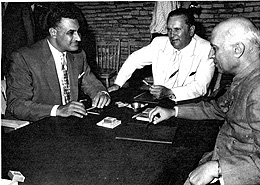
THE CREATORS OF INDIVIDUALITY: Tito, Nasser
and Nehru
From what can be concluded from the statements of NATO officials, the doors of this political-military organization, the most powerful in the world, are open for Serbia today. If we had a commitment to NATO, I think that the membership process could go faster than it is the case with other countries in the region. Our relations with NATO are good, Serbia cooperates wherever possible and wherever our interests require it. Cooperation is particularly good when it comes to Kosovo and Metohija, despite the fact that 28 NATO member countries have recognized Kosovo's independence. Military cooperation is very important for the stability of the region, and Kosovo is home to the large US military base Bondsteel. I think there is no place for the question "for or against NATO". At this moment, taking into account the attitude of public opinion and the political elite towards NATO, that question is logically wrong to ask. We are surrounded by NATO members. We missed many opportunities to join them, in the period five or six years ago when we were much more interesting to them than today. If, back in the mid-XNUMXs, we had referred to the cooperation we had in the XNUMXs, things would be very different for Serbia today.
Today, NATO is facing a major self-examination and a change in its strategic concept. That change is as important for NATO as the one that happened in 1991, when it reoriented itself from territorial defense and transformed into a political-military organization dealing with humanitarian interventions, peace operations and crisis management. At that moment, when it seemed that NATO was a relic of the Cold War and that it had lost its historical role and reason for existence. However, that alliance well recognized the changed security reality and, above all, NATO planners then recognized the changed nature of the security threat. Conflicts today are asymmetric, internal, there are no more interstate conflicts. NATO has adapted to new challenges and threats and as an organization has proven that it is still needed by Europe and the world.
These very days and months, NATO is at a similar turning point. My impression is that NATO, retaining at its core the role of collective defense and security, has become the central institution of the new global security network that is being created. This means that NATO no longer deals with the issue of territorial defense, because no member is threatened by someone attacking its territory. Today, the security of NATO member countries is defended thousands of kilometers away from their territory. The nature of the global threat has changed. They no longer come from individual countries, but rather terrorism, extremist organizations that can get hold of nuclear weapons, technological and cyber terrorism. All of these threats require an adequate response today, and at the same time there is an internal change in the concept of NATO. That is why today NATO wants to cooperate with everyone. The security context is completely new. In the 1990s, we only talked about global threats, but today they are a reality and you can no longer solve anything separately, but only in cooperation with everyone.