

Election 2026.
Purgatory in the elections: Dacic, Đilas, Jovanović go down in history
Apart from the Student List, which convincingly won, and the United Serbia, no other list even came close to the parliament, except for the minority
 photo: tanjug / ap photo / darko vojinović
What is the goal of the current fight against crime? How did the hired team go from being on a short chain of Partizan fans to being the number one national enemy? What role did politics, the police and ratings play? Why did the southern tribune of the JNA stadium find itself in the heart of the darkness of organized crime? Has an entire structure that coordinated, calculated and traded with Belivukov and teams similar to his for years, lost Vučić's trust? More precisely, how they mixed up their priorities in this state job
Since February 4, there has been only one piece of news - the arrest of Veljko Belivuk aka Velja Nevolja and, according to the latest reports, at least twenty-one members of his criminal group. Why? Because - as the government claims - like on the eve of the assassination of Prime Minister Zoran Djindjic in 2003, they tightened the noose around the President of Serbia, Aleksandar Vucic.
In this name, the tabloids are running a dead race finding similarities with the Zemun clan. Ferocious liquidations of competitors, "steaks", protected communication and other forms of activity and organization really match. But do other mafia groups like the Skaljarski or Kavački clan behave differently? This classic criminal pattern did not prevent the hunters of analogies with the "Zemunci" from proclaiming the not at all impressive Belivuk's house under construction on Zvezdara to be the new Šilerova (luxury building of Dušan Spasojević), and the seized sniper rifle is solid evidence that an assassination attempt was being prepared aimed at the very top of the state. . All together, in an inspired statement, the Minister of the Interior, Aleksandar Vulin, summed it up:
"Could they liquidate me?" They could. Would that solve their problems? It wouldn't. The only man whose liquidation would stop the organized fight against the mafia, whose murder would paralyze the entire country and bring it into severe political instability, would be Aleksandar Vučić."
The public found out from his mouth what kind of danger the President of Serbia escaped from:
"We had a problem during the opening of the Monument to Stefan Nemanja that someone could be killed by a sniper." It was an awkward position, a lot of tall buildings, so we had to engage all the snipers. We knew about their snipers even before and who their target was..."
Later, it was announced that the unveiling ceremony was secured by 850 special forces, and the arrest of Belivuk and his team was turned into a progressive version of the "Saber" police operation. However, unlike the one made after the assassination of Prime Minister Đinđić, this second government is presented as timely - despite all the risks, Vučić was successfully protected, crime was dealt a devastating blow, and the mafia's rotten apples in the state apparatus will soon be removed. Among the various paradoxes, the one that stands out here is that this version is mostly propagated by the same people who at one time relativized the assassination of Djindjic and challenged the "Sabre" from 2003.
They have and for what reason. Officials have been advertising the fight against crime for months, and in the finale of the campaign - right before Belivuk's arrest - the tabloids, directly connected with the progressive propaganda machinery, began to report everything that the public had humiliatingly whispered about in connection with Belivuk and his clan. Now, when this team has been removed from the street, who can still mention Jovanjica, Krusik, the phantoms from Savamala, the "aunt from Canada", photos of Danilo Vučić with the faces of the bold files and other affairs? No one, except, as the regime will portray them, mafia friends, enemies of the state and vile rascals who attack the president of Serbia and his family... In this direction, it is quite possible that a campaign of demonization through the "political background" and analysis of the reporting of the few past independent and professional media.
To make sure there are no misunderstandings, the arrest of Belivuk and his team is indeed a great police success. They are suspected of several kidnappings and liquidations, cocaine and heroin smuggling, violence, racketeering and a whole series of other crimes.
There were such dangerous criminal clans before, and there are also now. Velja Nevolja does not stand out in any way. Removing the bodies of slain rivals is nothing new; for example, back in July 2000, near Golupac, three concrete boulders were taken out of the Danube, that is, a man's corpse filled with cement, the identity of which has not been determined. Similarly, the sniper rifle has long been part of the "tool" of criminals, which can be easily determined by a cursory search on Google. There is no need to waste words about criminal clans under the guise of fan groups...
The only question is why exactly Veljko Belivuk became a "puppet on the front page" and the number one enemy of the state. It is not a short or simple story.

VACUUM IN THE SOUTH
Perhaps it all started in 2009 at the garage on Obilićevo venac when Toulouse fan Brice Taton was killed. With an appalled public, but also pressure from France and the European Union, the then government started a crackdown on fan groups. The most severely affected were thugs connected to Partizan as direct participants in Taton's death. How much - the draconian punishments and judgments against individuals who were not even present at Obilić's wreath testify. Mostly, since some leaders were on the run or in prison, the atmosphere in the south stand of Partizan was considerably calmed down.
Where is Veljko Belivuk? Well, he had his worries. Gaining a reputation as a member of United Force, the fan group of FC Rada, he became the head of security on the "Blej Watch" raft. He didn't keep his job for long: he was arrested in 2007 for beating a minor with a gun and a bar stool, and injuring another. This procedure was only completed in 2015. As the victims changed their statements, Belivuk escaped with less than six months of imprisonment, which he had already served in custody.
The coalition government of the Democratic Party, the United Regions of Serbia and the Socialist Party did not bring the crackdown on "fan" groups to an end. The following year, they showed their strength on Pride Day: 132 police officers and 25 citizens were injured and at least 250 people were detained... Of course, among those estimated 6500 rioters, not all of them were "fans", but it is certain that they represented a shock wave. fist.
The police must have been quite frustrated. The measures of secret monitoring of communications and leaders of fan groups clearly did not produce the expected results. It is interesting here that at that time, as a "branch" along the lines of Red Star, the then deputy president of the Serbian Progressive Party, Aleksandar Vučić, was tapped. Namely, neither in the opposition, nor in power, the current head of state did not hide his fan youth, but also his permanent infatuation with Red Star. And how much importance he attaches to all this, the public will find out when, after the elections in May 2012, he became the first vice-president in the government of Ivica Dačić, the minister of defense and the coordinator of the security services.
STAR DUST
In a 2014 op-ed in the "Politika" newspaper, Miodrag Miki Rakić, Vučić's predecessor as coordinator of the secret services and vice-president of the Democratic Party, admitted defeat in the war with "fan" groups.
"All of them are extremely ready to express any kind of social dissatisfaction, if decisions are made without them or against their views." The leader who is their political authority and who can mobilize and pacify them at this moment is Aleksandar Vučić. A political agreement with Vučić is a political agreement with them," wrote Rakić from the opposition.
In fact, Vučić was already working full steam on this mobilization and pacification. He started with Zvezda. As it was announced on November 6, 2012, Dragan Džajić came to the club in the "small hours" followed by the first deputy prime minister.
"We star players have reached an agreement to form a working group for stabilization and consolidation until the elections that will be held in December, at the latest at the beginning of January... It will be headed by President Dragan Džajić," Vučić said at the time.
Ten days later, Serbian President Tomislav Nikolić pardoned the famous footballer and former president of Zvezda. Namely, due to the suspicion that he embezzled 5,1 million euros since Goran Drulić's move to Spain, proceedings were conducted against Džajić from February 5, 2008, when he was also arrested.
All in all, Zvezda got going after Vučić's night visit. The club acquired sponsors, banks wrote off the debts, and there were also reinforcements from all sides. "Gypsies" could not be more satisfied: ordinary fans because of the success in the matches, and even more so the "special" fans for very tangible reasons. Specifically: the most important fan group Ultra boys registered the construction company Ultra kop at the address of Ljutica Bogdan number 1. It didn't take long, and these builders from the "Rajko Mitić" Stadium began to win tenders for public companies as contractors or subcontractors for perimeter improvements, fences and similar jobs.
However, in 2012, there was no Aleksandar Stanković, better known as Sale Mutavi, on the north stand of Zvezda Stadium. Having probably met Belivuk in 2007 at "Blej Voč", he too had problems with the law: for organizing a group for drug sales, a criminal trial was conducted against him.
STATE BUSINESS
After Zvezdina, Vučić turned to pacifying Partizan fans. The situation was much more complicated there. First of all, the "gravediggers" said that they remembered him for some episodes from his young days in Belgrade, but also for the concern demonstrated from the ceremonial lodge when he entered the political waters. But something else was more important: "Alcatraz" - until the Taton case the dominant fan group at the time - was dealing with a renegade faction called "The Banned". The series of mutual skirmishes culminated on October 22, 2011 - when XNUMX-year-old Ivan Perović was killed in New Belgrade, and Đorđe Stanojević was wounded, both members of the "Forbidden".
But Vučić was not discouraged.
"His first visit to Partizan when he came to power in 2012 was not a visit to the club, the administration, the Sports Association, the football club, but he went to the leaders of the fans, in order to give them weight and importance and to bind them to himself," he said. is Duško Vujošević in an interview with "Vremen" in June 2016.
As far as is known, apart from the protocol expressed high agreement on various issues, nothing changed after the meeting between the leader of the Partizan fans and Vučić. But something did happen: a group of former fans of Rad and Zvezda, as well as notorious and brutal types without any connection to any club, entered the southern stands of the Yugoslav People's Army Stadium. They called themselves "Janjičari", their leader was Aleksandar Stanković, and his right-hand man was Veljko Belivuk. Together with them, Nenad Vučković Vučko, a high-ranking member of the Gendarmerie to which he transferred from the Special Operations Brigade of the Serbian Army, "marched".
"Vreme" in the last issue writes:
"In order to 'control the tribune', Dijana Hrkalović used her mandate in the BIA and later in the MUP, with the help of her partner Vučković from the Gendarmerie, to hire Stanković and Belivuk. The BIA did the assessment, did the recruitment, and the Janissaries were born."
Therefore, Hrkalović and Vučković did not work on their own. It was a state job.
GENDARMS AND FANS
"Janjičari" conquer the southern tribune on the attack and without much resistance; where it was, it was brutally broken. However, at first, their influence did not spread further. The side stands mostly rejected calls from the south to chant together and more often, especially after controversial referee decisions, insulted the then prime minister by shouting: "Vučić, fag!"
Very sensitive to messages with stadiums and giving them a disproportionate importance, he himself then often repeated these insults in a kind of passive-aggressive reaction. This further motivated the "undertaker", so they celebrated the winning goal against Zvezda in the last minutes of the game with such a chant.
Such shouts did not come from a place where cheering was under the control of "Janjicar". On the contrary, members of this team soon began to visit the side stands where they harassed or beat anyone who insulted Vučić...
But Miki Rakić was right. Vučić was really the only leader who could pacify the "fan" groups: riots like the one seen in 2010 during Pride Day and many others before, have become a thing of the past. The fans were no longer a problem, thanks to Stanković and Belivuk. How they managed to do it, the whole country could see in the spring of 2016 from the video of the security camera: Stanković shows the middle finger, and Belivuk kicks the unconscious bodyguard of Partizan director Miloš Vazura in the head. In this way, they not only showed that they have an influence on the club and outside the stands, but also that no one can do anything to them.
That's how it worked.
"That guy didn't even touch anyone," Vučić snapped at journalists when asked why proceedings were not initiated against Stanković. Belivuk himself quickly took a plea deal and was sentenced to a year of house arrest; He did not wear "nanogica" and was often seen in public...
The beating in the parking lot near Partizan's stadium also shed light on Vučković. What is this gendarme doing with Stanković and Belivuk on the stand, the military shooting range and in cafes? Is he also one of the leaders of the "fans"?
"I don't think it is a criminal offense to be a fan or a fan leader," replied the then Minister of the Interior, Nebojša Stefanović.
Be that as it may, Stanković and Belivuk had more than good relations and connections with the police and the Services. In such cases, who works for whom, the boundary is extremely unclear and fluid. In order for this duo to be able to sustain themselves, they needed money, and at least the core of the "Janjicar" was created for cocaine and heroin dealing, racketeering and similar criminal activities. It is hard to say how many times they looked through their fingers or turned their heads to the other side. It is only certain that they had someone to turn to. For years, Stanković thus avoided serving his sentence of five and a half years in prison for drug smuggling.
HIGHER INTEREST
The late "Vremena" journalist Dejan Anastasijević noticed a long time ago that those who deal with hard drugs can expect serious problems - Aleksandar Stanković was killed on October 13, 2016 near the Central Prison in Belgrade when he got into a car.
Although there were similar liquidations before and after, it seems that this one caused a special kind of upheaval at the very top of the government.
"We are declaring war on the mafia, this will be a tough fight in which the police and security services are entering," Stefanović said, adding that Stanković is a victim of one of the most powerful criminal groups in the region.
Mostly, football and basketball players of Partizan paid tribute to Salet Mutava at the matches, dressed in T-shirts with his image, and Miloš Vazura was also present at the funeral...
Why so much piety? Well, as was speculated then and now, Stanković and Belivukova didn't just practice rigor in the stadium. They allegedly enabled a certain team from the government and its clients to play tough guys without harassment and inconvenient consequences, "finished" certain jobs for them such as collecting debts and pressuring competition in the hospitality industry and other businesses, making sure that they did not get into any kind of conflict at the stadium or on the rafts... That the regime is inclined to this kind of private service is well evidenced by the "phantoms" during the demolition in Hercegovačka Street, the hired private security during the ceremonial inauguration of Aleksandar Vučić for of the President of Serbia (one of them is now arrested as a member of Belivuk's team) and numerous other cases.
Elem, after the death of Stanković, Belivuk became the new boss. Nothing has changed at "Janjičar" or otherwise. But he was not destined to enjoy being number one for long either: he was arrested at the beginning of 2017 on suspicion of participating in the liquidation of Vlastimir Milošević, one of his rivals. He returned to the street already in 2018. Allegedly, his DNA, which connected him to the crime, magically became contaminated in the investigation and thus turned out to be evidence in the trial.
Did Belyvuk's connections from the police and the Service help him? In this context, the tabloids are now calling out Dijana Hrkalović... But it is worth repeating: the Belivuk project was not a private package-arrangement, and in such relations with criminals, borders quickly become porous. Especially when there is a higher, political interest.

WAR OF PARTISAN GROUPS: Beaten mercenaries from Croatia
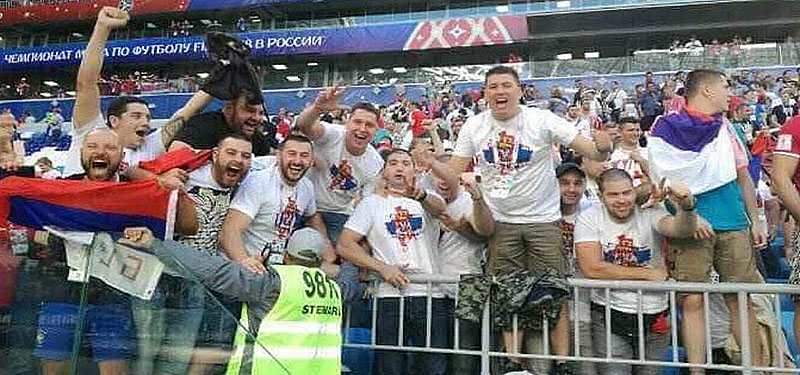
After the 156th eternal derby played on December 13, 2017 in a fight on the south stand of the JNA stadium, apart from Partizan fans, mercenaries from Croatia, Greece, Bulgaria and Russia participated on both sides. As it was stated in the public at the time, it was an attempt to "seize the tribune" behind which was the skalarian Filip Korać, and it was "defended" by Veljko Belivuk and "Janjičari", representatives of the Kavački clan.
At the Partizan stadium, there were three fans' pits: "Janjičari" (later "Principi") in the south, and the "Partizanovci" group with Miloš Radisavljavić Kimi at the head and "Zabrenjeni" held the eastern tribune - the first was its northern part, and the second was its southern part. Three different songs and three different chants were characteristic.
The organization of the matches during Partizan's visit was a special hell. Then a huge number of policemen and gendarmes had to be engaged to separate the fan groups, organize the parking of their vehicles in pre-determined places, escort them to the stadium... And to all this we should add the fans of the home team and Partizan who are not members of the organized groups.
Partizan's visit to Manchester against United was interesting. The law enforcement authorities there were not at all impressed by the "graveyard" divisions, so all three groups of organized fans and ordinary fans were packed into the same box. As expected, even before the referee's first whistle, a fight broke out. However, it all ended quickly thanks to the size of the event and the coolness of the stewards - they were far more enthusiastic about admonishing fans who would light up cigarettes (smoking is not allowed at Old Trafford) than engaging to prevent a brawl.
photo: flash / Oliver Bunić
IN PRINCIPLE
After being released from custody, Veljko Belivuk continued where he left off. Although his team continued to lead "Janjičare", for some reason he decided to change the name of the "brand". Perhaps it was a confirmation of the already many years of "experience" at Partizan's stands, and perhaps a desire for a new beginning. Only, "Janissaries" became "Principes".
The beginning of the global corona virus pandemic is welcomed as the only kop at the JNA stadium. There was no room for anyone: "Partizans" left the stand in the middle of the second half of the UEFA League match against Astana on December 12, 2019, leaving behind a banner with the message "This stadium is no longer a place for Partizan fans", and since the beginning of the spring part of the season even the "Forbidden" did not come anymore.
For Belivuk and the team, it was just one less obligation. Instead of at the stadium and its surroundings, they intercepted rivals from the fan-criminal milieu in cafes, streets, broke into their apartments... What happened then?
Social networks are full of short videos where Belivuk asks two key questions to various sufferers. The first is "Who are you?" and the second is "The principles are?". He only accepted two answers. To the first question you should say "We are pussies", and to the second "Principles are the real story". It is not known what happened to those who did not give the requested answers. However, it is known that these clips have hundreds of thousands of views on popular internet platforms, portals and the press broadcast them, but the police and the prosecution did not see any problem...
If not already, Belivuk and his team became a branch or at least an associated member of the Kavački clan during this period. The cocaine business brought him a lot of money, but also new obligations. These are, among other things, confrontations with the rival Skaljar clan and other groups of drug dealers due to the struggle for the preservation of "territories", their expansion, access to "goods" and primacy in the underground.
That's why the beginning of the summer of 2020 is marked by shootings and Belivuk's support for the Kavačka clan in the eternal fight with Škaljarski: "Principi" hung a banner in the stadium with coded text of support for Radoj Zviter when this important Kavačan survived the wait in Ukraine, and there was also talk of their celebration of the liquidation in Corfu, Alan Kožar and Damir Hadžić, supposedly close to Škaljarci...
At the same time, horrifying stories about the kidnappings and brutal liquidations of competitors, the extortion of apartments and bars, the racket paid by businessmen, investors, entertainers... One didn't have to be a well-informed person to know any of this - things like this. stories have the function of intimidating both rivals and the public anyway.
Belivuk started to poke his eyes more and more. The first indications that he was getting more and more out of the lee of the windstorm came immediately after the derby played on October 18, 2020. Then a part of the pro-government media reported that Belivuk was insulting and threatening the Red Star players from some kind of Tito's armchair in the ceremonial box of the Partizan stadium.
Something else is important. Dijana Hrkalović was certainly not Stefanović's staff, but her departure from the MUP in mid-2019 is today interpreted as the beginning of the weakening of Belivuk's position. Then, after the arrival of Vulin as Minister of the Interior, a whole series of shifts in the police force followed. Among others, Goran Papić, Stefanović's godfather, and some others who were really his personnel. You don't need to know the local political scene to be clear that it is not Vulin but Vučić who is behind those changes. The real question is therefore: can this, along with the rotation of Stefanović to the position of Minister of Defense - with an obvious political conflict - be interpreted as damage control related to Belivuk. That is, is there a whole structure in Nevolja that coordinated, calculated and traded with Velja and teams similar to his for years?
If so, it is quite possible that in a whole series of conflicting interests, they mixed up their priorities and lost Vučić's trust. It also seems that this process culminated in the "Jovanjica" case. The latter's ritually proclaimed fight against crime as a priority of the second government of Ana Brnabić, the affair with the wiretapping of Vučić, the tabloids' vain interest in Hrkalović and Belivuk, represent only the preparation of the public and who knows what kind of campaign aimed at boosting the ratings of the President of Serbia.

ORNI FOR A FIGHT WITH THE POLICE: Belgrade, June 2020.
Before the coming to power of the Serbian Progressive Party, the importance of the stadium tribune was either exaggerated or underestimated. The truth, as usual, is somewhere in the middle.
Namely, the tribune offers infrastructure and logistics for various activities. Control over it can easily enable the management of trade in fan props and equipment, lucrative club security jobs, but also super-profitable jobs like drug trafficking. Namely, the dominant "fan" groups are able to keep under control and "defend" different territories of the city, monitor the entrances to the clubs, but also effectively collect racket from restaurants, construction companies and many others.
Also, the political role of fans can be significant. Legend has it that on the evening of March 9, 1991, when the police slowly brought the central city streets back under their control, the only real resistance was provided by the teams from the stadium, ready to fight with the police. This was repeated many times later. The last time, last summer, the street fights with the police mainly involved young fans of different clubs.
Of course, not everyone in the stadium is a hooligan, nor are all hooligans criminals. For the majority in the side stands - where there are also a lot of small children - the biggest problem is not security, but boredom due to the low quality of domestic football.
photo: tanjug / andrija vukelic
EPILOGUE
As in everything, there are limits to organized crime. If it didn't occur to him from writing the tabloids that he had crossed them, Belivuk could have realized that after being detained for an informative interview ten days ago - then he returned from Kotor where he and Zvicer were also interrogated by the police. In fact, it wouldn't have meant anything to him even if he had realized that he is no longer "who has gone as far as the past": he can't go back even if he wants to, and there is nowhere to go forward.

The media write that in the last few days he has been trying to destroy numerous evidences of kidnappings, mutilations, brutal liquidations and various other criminal acts. It's a swan song: prime-time television and newspaper pages are now filled with footage of his "stealths", victims, associates, seized drugs...
As things stand, Belivuka faces at least forty years in prison. On the other hand, the question is whether he could survive on the street for a few more years. Because the crime he became the face of is one of the most brutal and primitive from which there are only two ways out - prison and death. It's only a matter of time if there will be faster police officers or enemies from other clans.
Eventually, Veljka Belivuk expired. Spreading through the underground, leaving corpses behind, he was less and less part of the solution and more and more the problem. And what is most disastrous for people like him is the political one. Simply, there comes a moment when they start to attract too much attention (not only in the country) and open up issues that the government can no longer ignore without the risk of serious compromise. That's exactly what happened to Belyvuk, and that's why he fell.
Apart from the Student List, which convincingly won, and the United Serbia, no other list even came close to the parliament, except for the minority

Why is there nothing else between the overcome regime and the changes? What does the regime mean when it says it is defending Serbia? Why is the Student Movement indomitable? Who has the knowledge and real experience, and who leads without a day of work experience outside of politics? And why students win

After almost two years of protests, hundreds of kilometers walked, arrests, persecution and unprecedented social mobilization, Serbia is holding elections that could mark the end of a political era. Sociologist Marija Babović tells "Vreme" that the hope for change has not been so great since October 5, 2000, but she also warns of the danger that, if changes are not made, the country will face an even tougher authoritarian regime.

Their only weapon now is the media they control: like, we don't have an agenda, which is not true; as, we will betray the national interest, which is not true. One of their arguments is that we are afraid to go to the debate with Vučić. They do not understand that it is their punishment. This is a punishment for Aleksandar Vučić, who for 14 years conducted exclusively a monologue. For fourteen years he did not allow anyone any kind of dialogue, and now he would like to be rewarded or pardoned with the opportunity to talk to us. Well, he won't be able to. What he sowed is now reaping

These elections are not elections about Serbia's membership in the European Union, Kosovo and Metohija, gay marriage, tax policy or any other single political issue. Although parties on the fringes of political power try to impose these themes, at the heart of the upcoming political election is a much simpler dilemma: change or preserve the existing order. For more than a year now, surveys have shown that this is the primary dilemma on the ballot
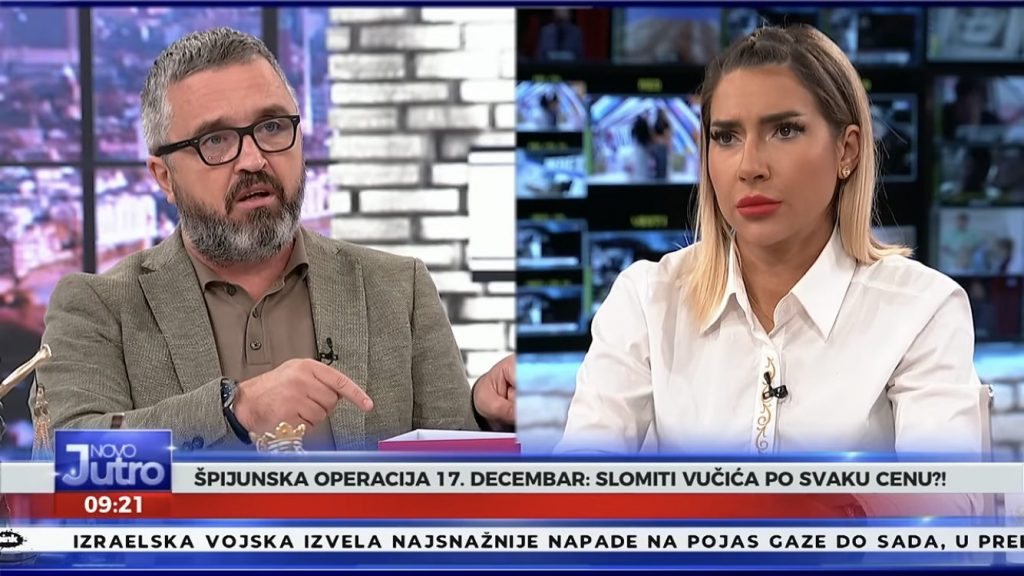
Requiem for evil does not have to be solemn. Sometimes it sounds like a shaky voice on a morning program and like a story about winter tires.

It is necessary, first of all, to somehow get to the act of handing over power, if there is anyone from the Essenes who would hand over power. We want to say: Vučić and his team must not be trusted for even two seconds until the government is constituted

Majority Serbia carried by students must now find the strength to forgive ordinary people and appease those who voted for Vučić for years. And for higher echelons – court and Zabela

The archive of the weekly Vreme includes all our digital editions, since the very beginning of our work. All issues can be downloaded in PDF format, by purchasing the digital edition, or you can read all available texts from the selected issue.
See all



