Four years after the beginning of the implementation and harmonization of the Bologna Declaration with the system of higher education in Serbia, the most common assessment that can be heard is - half-hearted
The implementation of the Bologna Declaration officially began in Serbia in 2005. We already have the first "Bolognese" graduates, so the effects and results of the new higher education system can be seen more precisely and reliably than in previous years. According to what can be seen now, on the one hand, we have faculties that have succeeded in achieving their primary goal: to shorten the study time and increase the passing rate from one year of study to the next. On the other hand, there are faculties that do not manage to do it at all, and this sharp division into very successful and completely unsuccessful ones is additionally toned by the fact that since 2005, when the application of Bologna began, not a single autumn has passed without student protests.
Incomplete information shows that only every second student manages to collect 48 ESPB points, which are prescribed by law as the minimum for the condition. Everyone is probably to blame for such poor results - the Ministry of Education, higher education institutions, but also the professors themselves. And there are voices that claim that the secondary school system is to blame. An analysis of passing rates at faculties in Serbia was recently completed, but it is very difficult to get data for all faculties, because it turned out that for many the results are a painful topic that they do not want to talk about. "I'm afraid the situation is much worse than it appears." Colleges don't want to provide passing data, so we're even considering contacting the Commissioner for Information of Public Importance. I spoke with my colleagues from Novi Pazar and Kragujevac and they told me that they have the same problem. Some enforced the law and some did not. I don't believe that we will get better until everyone understands that Bologna should be the same for everyone," said Jovan Lopušina, president of the Student Parliament, recently.
Faculty of Law, Kragujevac
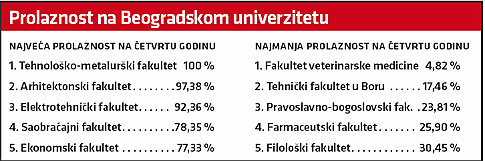
The most drastic example of poor passing rates is the Faculty of Veterinary Medicine in Belgrade, where only four students out of 83, who attended the third year, met the requirements for fourth-year enrollment. At this faculty, they justify themselves with low-quality high school education and say that less educated students come to them than before. "In Europe, a professor works in a group with seven to ten students, and we don't even have enough professors." In fact, we are conditioned by a large number of students to receive salaries. Operations are performed here, exercises are very important, and quality is almost impossible in large groups. We need a fundamental reform of the educational system, but we should not start from higher education", these are the words with which Velibor Stojić, dean of the Faculty of Veterinary Medicine, commented on the bad situation.
According to him, the program has been revised as much as possible, but some things cannot be simplified. Students lack work habits, which makes it difficult for them to master certain subjects. Students, on the other hand, accuse professors of interpreting Bologna arbitrarily.
One of the faculties that managed to achieve an excellent result, where the passing rate in the fourth year of study is as high as 92,3 percent, is the Faculty of Electrical Engineering in Belgrade. The dean of this faculty, Miodrag Popović, explained to the daily newspaper "Blic" what the secret of success is: "We don't need to make studies easier, but to shorten the time it takes to complete them." This means that the student has to be more engaged, just like the professor. We had the problem of reducing the two-semester exams to one-semester ones, which is one of the principles. We used that job to modernize the material. We reduced the number of students in groups, increased the number of colloquiums, tests and homework. All this forces students to study continuously. In the previous system, our faculty lasted five years, and on average it was completed in eight. Now, basic studies last four years and are completed in five years. In the first year, a selection is made because the passing rate there is about 50 percent, while in the higher years it exceeds 70 percent."
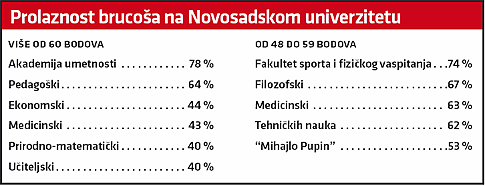
At the University of Novi Sad, the situation is better than in Belgrade: the passing rate of the first generation, enrolled in 2006/2007. in 68 it was 63 percent, the following year it was only 77,79 percent, but the third generation of students studying according to the Bologna scoring system achieved a passing rate of 60 percent. Milan Simić, vice-rector for teaching at the University of Novi Sad, says that such good results show that the students "really got serious" and that with regular attendance at lectures, exercises and high-quality work, "they can fulfill the set conditions": "The data also show that the largest success achieved at those faculties where work is done individually or in smaller groups. By the way, the legally prescribed number of points for the transition to the next year of study is 40, but the Ministry of Education corrected the conditions every year and reduced that figure to 42, 48, and then 60 points. "During the past school year, a fifth of freshmen obtained less than the prescribed minimum, while the passing rate in the second and third years was 50 and XNUMX percent, respectively," says Simić.
No matter how much you wander and are not sure about the effects of the implementation of Bologna in Serbia, at the regular conferences of the ministers of education of the signatory countries of the Bologna Declaration, Serbia receives solid marks for progress in the field of education. This year in April, in the Belgian city of Louvain, a conference was held at which Serbia received a rating of 3,8. The Minister of Education, Žarko Obradović, said that according to the score it received, Serbia belongs to the top half of the total of 46 countries that apply the Bologna Declaration. "It still speaks of the quality of our education, because we must not forget that we started implementing the Bologna Declaration later than some other countries," Obradović said.
So far, Serbia has been evaluated three times for the implementation of the Bologna Declaration. The first grade in 2005 was 2,2, while in 2007 in London, Serbia's progress in higher education was rated 4,2. The assessment is based on a report submitted by the national education council of the country whose progress is being assessed. The report that each country submits on what it has achieved during the two years of implementing Bologna has a standard form and consists of 30 questions in which it is asked to describe what it has done in certain fields. Upon submission of the report, what is stated in the report is scored, the points are added up, and thus a final grade on the progress of a country is obtained.
It has nothing to do with the EU.
The Bologna Process is a term that denotes the political purpose of creating the European Higher Education Area by creating standard academic degrees.
The Bologna process was created after the education ministers of 29 European countries signed the Bologna Declaration in the Italian city of Bologna on June 19, 1999. At the following meetings in Prague 2001, Berlin 2003, Bergen 2005, London 2007 and Louvain 2009, the list of members expanded so that today almost all European countries and Russia participate in this process. Serbia became a signatory to the Bologna Process in Berlin in 2003.
Contrary to popular belief, the Bologna Process is not an initiative of the European Union. 46 countries participate in it, which is far more than the number of EU members. The signatory countries of the Bologna Declaration since 1999 are: Austria, Belgium, Bulgaria, Czech Republic, Denmark, Estonia, Finland, France, Netherlands, Germany, Greece, Hungary, Iceland, Ireland, Italy, Latvia, Lithuania, Luxembourg, Malta, Norway, Poland , Portugal, Romania, Slovakia, Slovenia, Spain, Sweden, Switzerland and Great Britain; since 2001: Croatia, Cyprus, Liechtenstein, Turkey; since 2003: Albania, Andorra, Bosnia and Herzegovina, Russia, Serbia, Macedonia and the Vatican; since 2005: Armenia, Azerbaijan, Georgia, Moldova and Ukraine; since 2007: Montenegro.
What is happening in the country and the world, what is in the newspapers and how to pass the time?
Every Wednesday at noon In between arrives by email. It's a pretty solid newsletter, so sign up!
How were the cases kept out of control, the investigations directed towards the citizens who sought protection, and the prosecutors were left without answers from the police? Branko Stamenković talks about the findings of the commission of the Supreme Public Prosecutor's Office, the responsibility of his colleagues and what is needed for the institutions to work according to the law again
Who now decides on the Government and the program, the plenum or the deputy? There are different views on this in the Student Movement and among the people on the list, but a middle solution is being sought, "Vreme" learns. Be that as it may, the program of over a thousand pages already exists
The outgoing government treats the state like an apartment from which it moves out after losing a dispute. And all the time she shouts loudly that her neighbors are demolishing the building
"The main priority of the new government should be the preservation of employment and the growth of the standard of the population. And this will not be easy to achieve at all, because we will have a decline in employment in clientelistic companies that cooperated with the former regime. Some will close, but the important thing is that many people will lose their jobs. In the case of large private companies that are experiencing difficulties, the government should commit to better owners taking over these companies in order to save thousands of jobs. We will already have this case with Davora Macure's companies, among which is "Idea"
How much money from the Growth Plan has been irretrievably lost for us, how much has been frozen and how much is still waiting for us? What should Serbia do in order to receive these European funds and what will the citizens get from it? Is a new chapter in Brussels-Belgrade relations beginning?
At the moment when the institutions of the Republic are destroyed, when Vučić's octopus is still alive, when people are disgusted by the injustice and the stench left behind by the Essenes regime, we have, as Machiavelli said, only civic virtue as the fuel with which we can return to the beginning
The four independent members of REM are an example of perseverance and civic responsibility. Rodoljub Šabić even, upon leaving the premises of REM, after the sentencing of the Informer, experienced that the Essenes insulted him, hit him with their hands and feet. But that too will soon be over
Vučić pardoned the batterers and Dijana Hrkalović. The election winners should abolish the sultan's power that allows one man to run afoul of the entire judicial system
The archive of the weekly Vreme includes all our digital editions, since the very beginning of our work. All issues can be downloaded in PDF format, by purchasing the digital edition, or you can read all available texts from the selected issue.