Namely, according to the RIK assessment, the elections were repeated at 15 polling stations, while at 99 "severe logical and arithmetical errors" were discovered, at 88 the voting was verified, and at 11 polling stations it was annulled ("statistical zero"). The central question from the repeated elections in 15 polling stations was whether the DSS-Dveri list would pass the census, which it did, bearing in mind that in the repeated elections they won 22,58 percent or a total of 5,03 percent of the votes. Professor Jovo Bakić assessed that "never and nowhere in the history of parliamentarism has it happened that a man who has absolute power and who won 48 percent of the votes in the elections claims that he was stolen from a totally disintegrated and broken opposition." This testifies to a very specific political culture, but also to the insecurity and psychological instability of the absolute winner, which has now come to light. The fact that Vučić will not have 158 MPs, but a few dozen less, basically means nothing, because he has his blackmailed people among the opposition who can always come over to his side."
THE MAJORITY, THE MINORITY AND VIEWING OF REALITY SHOWS: The assessment of participants and observers is that more and more relevant parties and political options entered the Serbian parliament. All the participants in the election expressed their satisfaction with the results and declared victory, on the other hand, one could hear assessments that "democracy was the only one defeated" in these elections, primarily because of the work of the Republican Electoral Commission, which spent days determining how many people voted, in order to ultimately decided that the elections should be repeated in 15 polling stations, and because of the "unprincipled coalition" that the opponents called the "census coalition", which was created by an ad hoc association of opposition parties for the purpose of "defense the will of the voters" and with the goal that in the repeated voting the DSS and Dveri coalition will win a sufficient number of votes to pass the contested census.
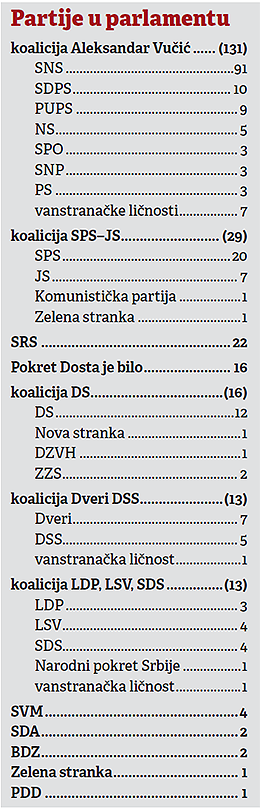
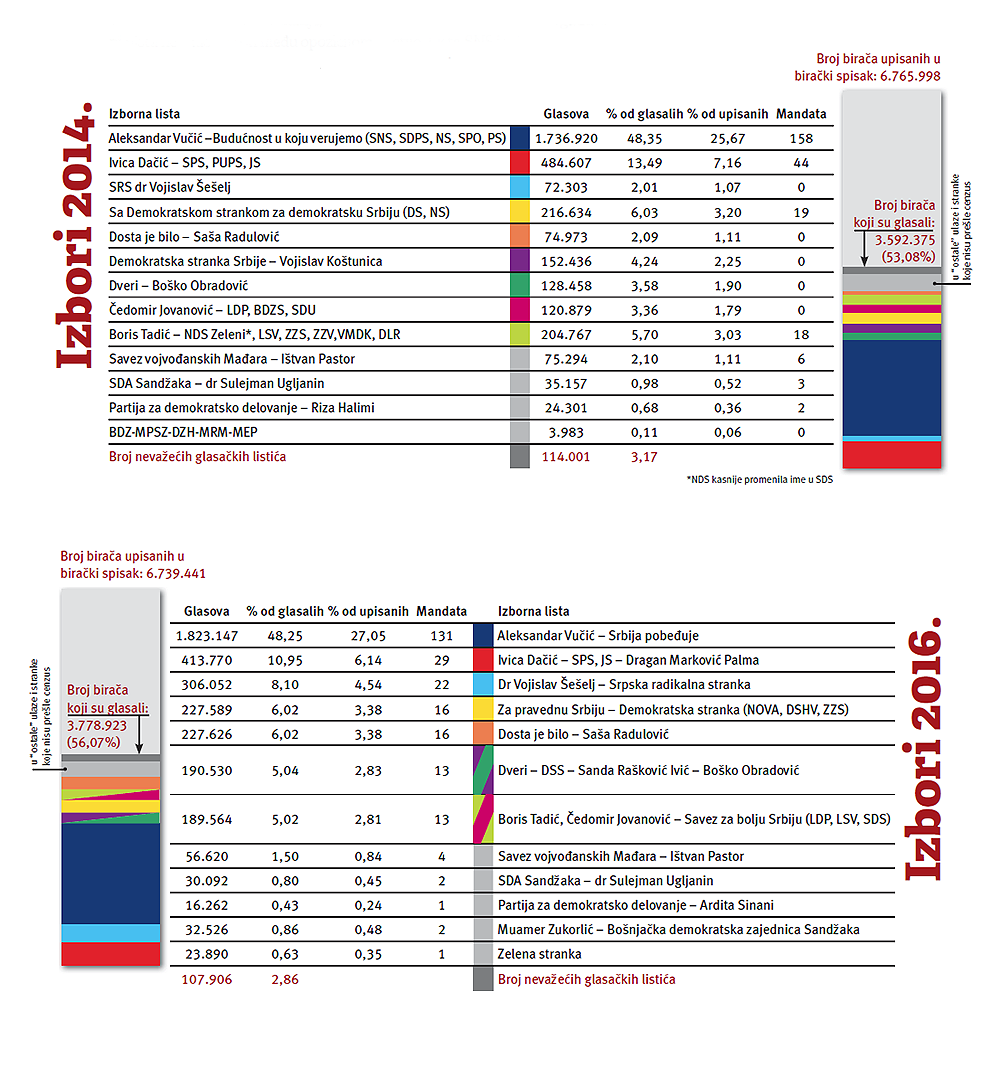
After these extraordinary parliamentary elections, everyone has reason to be happy. The SNS list received a hundred thousand more votes and will form the government again, but it lost 27 mandates, so the main party of the coalition will have 91 parliamentary seats in the new convocation of the Assembly, and the rest from the quota of their list will go to the coalition partners (see the table Party composition of the parliament) . The SPS remained second in strength, despite the fact that it lost 70.000 votes, Seselj's radicals because they returned to the parliament as the third list that will have 16 deputies, the DSS-Dveri coalition also succeeded, but with 13 mandates. The movement "Enough is Enough" of former minister Saša Radulović became a party with 16 MPs, and the list of the Democratic Party got that many. Minority parties (SVM, SDA, Green Party and former mufti Muamer Zukorlić, leader of BDZ and PDD) can also feel like winners because they entered the parliament as minority lists. In 2014, Zukorlić's BDZ appeared on the list with LDP and SDU, which did not pass the census.
It is worth recalling some of the results of the past elections. Then Tadić appeared as the New Democratic Party - Greens in a broad coalition with six other political organizations, including LSV. They entered the parliament and changed their name after that.
Saša Radulović and his movement "Enough is Enough" won 2014 percent of the votes in the 2,09 elections. DSS and Dveri remained below the census, winning 4,24 and 3,58 percent of the vote, respectively.
The list around the Democratic Party with Bojan Pajtić at the head got 2014 percent less than in 0,01, but three seats less.
During the 2014 campaign, Vojislav Šešelj was a prisoner of the Hague Tribunal, and his SRS won only 72.303 votes and no mandate in the elections.
Early parliamentary elections returned the right wing (radicals and the Dveri-DSS coalition) to parliament. Now the voices of those parties that are against European integration and in favor of an alliance with Russia will be heard from the parliamentary benches. The differences between the opposition parties are vividly described by Seselj's statement in "Kurir": "I will enter the Parliament like a steamroller, but there is no capitalist there." Simply, there is no man for which the sword should bleed. No one is my equal, but I focus primarily on the progressives, but their Aleksandar Martinović is not even up to my knees. He is handsome to be pulled by the ears and nothing more. I'm going to peck Sanda like a chicken, and I can tear that Ched to pieces whenever I want. The time has come, it seems, when there is a third category of politicians in the parliament. I'm not satisfied," Seselj said.
In the dissolved parliament, all parties were for the EU. The opposition is more numerous in the new than in the last convocation of the Assembly, there are five opposition lists: SRS, DSS-Dveri, Dosta je bilo, DS, SDS-LDP-LSV, but they are ideologically different, often more than some of the parties are different from SNS. Advisor to the President of the Serbian Chamber of Commerce and former LDP official Bojan Đurić believes that the past elections were the final end of the era of political parties from the 1990s.
In the Democratic Party, rumors have already started announcing the fight at the upcoming election assembly, which should evaluate the performance of the leadership after these elections. The fate of Bojan Pajtić is not clear because he lost power in Vojvodina, and in the Republic of DS remained at the level of 2014 in terms of the number of votes, but strong complaints and protests are heard in the party due to the ad hoc census coalition and the "introduction" of DSS and Dvera in Assembly.
Vučić said that the progressive majority in the Assembly is absolutely stable and cannot be threatened due to the broad coalition in which the SNS is present. He claims that the majority has nothing to do with the number of coalition partners, but with the legitimacy someone has received. "It is not a matter of technique and mathematics. Many use this as a reason to justify their failure, which is pointless. The parliamentary majority will be stable, much more than in 2012, we will function without any problems," said Vučić.
He says that is why he is not afraid of new relations in the parliament: "Why should I? Even more often than in the previous period, I will come to parliamentary debates to talk with representatives of the opposition", and adds that he is afraid of Vojislav Šešelj and his return to the parliament because he was "somewhat more intelligent than some others", but he estimated that the rating of the radical leader could to fail if he starts a harsher and dirtier campaign against the Prime Minister and the Government. When asked about the return of SRS and Dveri's entry into the parliament, Vučić replied: "I'm happy to see that reality TV shows are declining in viewership, so this will also be interesting for a few months."
Unlike the previous convocation, the parliament will now have a larger number of party leaders. The parliamentary mandate should belong to Ivica Dačić, Dragan Marković Palma, Milan Krkobabić, Josip Broz aka Joško, Boško Obradović and Sanda Rašković Ivić, Vojislav Šešelj, Zoran Živković, Saša Radulović, Čedomir Jovanović, Nenad Čanko, Sulejman Ugljanin, Goran Čabrada, the president Green Party, and to Muamer Zukorlić, leader of BDZ.
Regionally, it can be seen that the progressives won in the vast majority of municipalities in Serbia, in 110 they have more than half of the votes won. If by any chance the majority, personal election system is valid, based on the results achieved, the SNS list would have 230 to 240 mandates.
POST-ELECTION COMBINATORIES: According to the election law, the REC will have to assign mandates to new MPs no later than 10 days after the announcement of the final election results, and the deadline for the constitution of the republican parliament is 30 days after the announcement of the final results. The new government must be formed no later than 90 days after the constitution of the parliament. After listening to the opinion of the representatives of the selected electoral lists, the President of the Republic proposes to the Parliament a candidate for Prime Minister.
The President of Serbia, Tomislav Nikolić, said (May 9, 2016) that he would entrust Vučić with the mandate to form the new government. "I don't think that I will even have to carry out consultations, since everything depends on whether someone secured 126 deputies who vote for the government, and as soon as I receive evidence that they have secured, the consultations stop and I entrust the mandate," said Nikolić to " Sputnik" and added that it was obviously Aleksandar Vučić.
The convincing parliamentary majority held by the Serbian Progressive Party means that it will not be necessary to form a coalition government, because the Progressives have an over half majority of MPs and can govern independently. However, Vucic announced that he will seek wider support for his government. The SVM is confident of participating in the position with the progressives, and the president of this party said that specific talks with the SNS on the formation of the government are expected. The coalition around SNS and SVM has a total of 135 mandates and a fairly comfortable majority for decision-making. Vučić also announced that there will be at least six new ministers in the new government. Velimir Ilić (without portfolio), Srđan Verbić (education) and Zlatibor Lončar (health) will most likely remain without ministerial positions in the new government, as "Novosti" has learned. According to the same source, the new government will not include socialists either - Ivica Dačić (foreign affairs), Aleksandar Antić (energy) and Snežana Bogosavljević Bošković (agriculture). The future president ruled out the possibility of a coalition with part of the opposition - DSS-Dveri, DS, DJB. Boris Tadić said on behalf of his party that he will not join the coalition with the progressives, and added that he is not sure about his coalition partners, the League and the LDP. Vojislav Šešelj's radicals will most likely remain in the opposition.
Vučić's previous coalition partner SPS did not advertise, but did send messages that, if they are not in the government, they will be a "constructive and loyal opposition". According to analysts, Vučić will probably call the Socialists into the government, but only at the end of the negotiations. SNS vice-president and police minister Nebojša Stefanović responded to that type of speculation, saying that it will be difficult for Vučić to convince his party colleagues of the need for renewed cooperation with the socialists. "In SNS, people love and respect Vučić, and we are completely unique there. But even so, it will not be easy for him to convince us that the SPS, Ružić and Dacić are necessary for a better future for Serbia and that those who often insult and belittle us are good partners in the new government." More will be known about renewed cooperation with the socialists. after the upcoming assembly of progressives scheduled for May 28.
WHO WILL ENTER THE BANOVINA?: The progressives triumphed in Vojvodina and thus achieved the electoral goal of removing the Democrats from power. Out of 1.729.376 voters in Vojvodina, 963.208 or 55,70 percent went to the polls, and nine election lists entered the Assembly of AP Vojvodina, while six lists remained below the census. Deputies in the provincial parliament will have nine electoral lists.
PIK announced the final results of the provincial elections held on April 24 for members of the Assembly of Vojvodina. The list "Aleksandar Vučić - Serbia wins" won 44,48 percent of the votes and 63 parliamentary mandates. The second in order is the SPS-JS-PUPS coalition list, which won 8,86 percent of the votes, i.e. 12 mandates. The list "For Vojvodina of Work and Knowledge - DS, DSHV, Nova, Zeleni - Dr. Bojan Pajtić", which won 7,24 percent of the votes, and the list "Dr. Vojislav Šešelj - SRS", which had 7,66, have ten mandates each. percent of votes. The list "Nenad Canak - LSV - Raise your head" won 6,43 percent of the votes, that is, nine parliamentary mandates. Then, DJB with 5,54 percent of votes and seven mandates, followed by "SVM - Ištvan Pastor" with 4,88 percent of votes and six mandates. Members of the "Hungarian Movement for Autonomy - Dr. Tamas Korhec - DZVM - Aron Čonka" list with 1,71 percent of votes and two mandates, as well as the Green Party with 1,14 percent of votes and one mandate, will also sit in the provincial parliament.
The progressives intend to form a wider ruling coalition in Vojvodina, which should mean that potential partners are Pajtic's allies so far. The Union of Vojvodina Hungarians has already secured a place in the new provincial government, but it is still uncertain whether Nenad Čanka's league members will also join Banovina, in whose ranks there is a strong suspicion that they will be part of the progressive government in the province. On the other hand, the leader of the Union of Vojvodina Hungarians, István Pastor, according to the "Novosadski Reporter" newspaper, said that "the SNS-LSV-SVM coalition in the province would lead to relaxation of the Vojvodina autonomy issue and its resolution outside the domain of daily politics."
That's why the media is widely speculating that the League of Social Democrats of Vojvodina could be part of the Government of Vojvodina. However, for some of the parties from the pre-election alliance SDS-LDP-LSV to be part of Vučić's policy, the interlocutors of the newspaper "Danas" assessed it as a reversal that could be reduced to expectations that "the crocodile becomes
vegetarian".