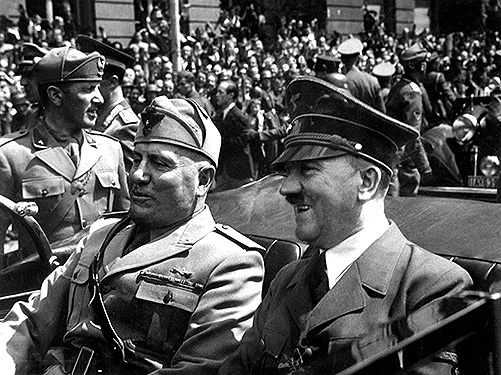
"There is no need to worry about socialism in Italy as long as there are guys like Benito Mussolini," said Lenin in May 1914 in Switzerland. The occasion was that Mussolini (1883–1945), as the editor of the newspaper of the Socialist Party of Italy "Avanti", held a fiery speech in the suburbs of Bern before a large gathering of workers, explaining to them what socialism is. He did not dare to appear in the city because the Swiss police were looking for him.
Lenin (1870–1924) was wrong. Comrade Mussolini was expelled from the party in 1917 due to nationalism. When Vladimir Ilyich found out about it, he reprimanded the Italian socialists: "Why did you lose Mussolini?" Mussolini confirmed that he had heard about Lenin's statement. When asked if he met him personally, he said: "I don't know if I met him together with others in Zurich." They kept changing their illegal names then. We all discussed a lot then."
THE FUHRER AND THE DUCE
Although he was the founder of fascism, gave the movement its name and was its leader, Mussolini never renounced his socialist past, even emphasizing that he was close to the communists. He carried a medal with Marx's image with him as a charm.
Adolf Hitler (1889–1945) could not even imagine such an attitude towards socialism, even though his party was called the National Socialist German Workers' Party. When talking about fascism, many put these two dictators in the same basket. However, the differences between the two are huge, although their movements have similarities.
Mussolini was an educated man, he spoke seven languages, he read a lot, he played the violin; Compared to him, Hitler was primitive and ignorant. Mussolini's movement is older, he managed to seize power in Italy nine years before Hitler in Germany. At first they did not like each other, and they seriously clashed because of the events in Austria in the mid-1933s. There, in 1892, Engelbert Dollfuss (1934–25) came to power and proclaimed a class state based on Mussolini's ideas. He was assassinated on July 1934, 1938 on Hitler's order with the idea of replacing him with a man close to German National Socialism. Only when Germany annexed Austria in XNUMX and when Berlin and Rome agreed on South Tyrol did Hitler send Mussolini a telegram: "Dude, I will never forget that!" He became more and more powerful, Mussolini became weaker and weaker.
FROM POET TO POLITICIAN
Calling fascism everything we don't like is dangerous, because resistance to that ideology is lessened if we call less pernicious views of the world by the same name. Not every nationalism, every autocratic regime, every undemocratic order is fascist.
The basic characteristics of fascism are the class state, nationalism as the glorification of one's own and the contempt and, if necessary, the destruction of other peoples and the cult of the leader. In recent times, we call "fascist" political systems or movements that take on only some, but not all, of these elements.
Because of his support for the class state, I see in the Greek philosopher Plato the forerunner of the ideology that Mussolini baptized as fascism, because he imagines and recommends the state as an organism in which poets are the brain, soldiers are the hands, and workers are the belly. Dionysius II, the ruler of Syracuse, a city-state on the island we call Sicily today, invited Plato to organize the state according to that model and to be a king-poet, but he changed his mind when power really began to be exercised according to that principle. Plato had to save his head and run back to Athens. If we replace the term "poet" with the term "politician", we get Mussolini.
FOURTH ELEMENT
German national socialism is worse than Italian fascism because it adds a fourth element - anti-Semitism. At the beginning of his reign, Mussolini explicitly emphasized that fascism was not an anti-Semitic movement, Italian Jews were welcome in his order. He said that "Italian Jews" fought bravely in the First World War when fifty generals of Jewish origin commanded the Italian army.
Some of Mussolini's generals were Jews, for example, the commander of Sardinia, General Modena. During the Fascist era in Italy, Jews held important positions in universities, banks and the film industry. Since Hitler came to power in 1933, Italy has been accepting Jewish refugees from Germany.
That changed when Mussolini and Hitler began to get closer to each other, especially with the start of World War II. Then Mussolini's press announced that Italians are Aryans, emphasized that Jews do not belong to the Italian nation. Although mixed marriages were forbidden from then on, and Jews were expelled from important positions, until Mussolini was in power in Italy they were not arrested and imprisoned in concentration camps full of opponents of the regime.
The Holocaust spread to Italy only when the German army occupied part of its territory after the fall of Mussolini. For Hitler, the persecution, emigration and later extermination of Jews were an essential element of politics. From the beginning of 1942, the "final solution of the Jewish question", as the Nazis called the Holocaust, even took precedence over the fighting on the Eastern Front.
It is interesting that "revisionist maximalism", a branch of "revisionist Zionism" which operated under the name "Brit Ha-Birionim" in Israel (then Palestine under British administration), from 1930 to 1933 connected fascism with Zionism, explicitly advocating for the establishment of a Jewish state modeled after Mussolini's Italy. The British police arrested some members of that movement, the others isolated themselves and the idea died down.
In Yugoslavia, Dimitrije Ljotić founded the "Zbor" movement in 1935. His ideas of the class state are closer to Mussolini's fascism, his anti-Semitism to Hitler's Nazism. Berlin's assessment at the time of World War II was that "Zbor" was a "National Socialist" party.
INDIANS FOR GOOD NIGHT
As an excellent propagandist, a connoisseur of what we would today call marketing, Mussolini decided to call his movement fascist, his supporters fascist, relying on fascis, a symbol of ancient Roman power. These are rods tightly connected in a bundle on which an ax is placed. Lictors, officials of the old Roman state, today we would say representatives of the protocol, wore this sign in front of the embodiment of power - emperors, consuls and military leaders when they celebrated their victories - that is, all those who had the power to pronounce death sentences as a warning to everyone to avoid from the road. Mussolini said he did fascis a symbol of "discipline and authority", and that an individual rod can easily be broken, but a bundle of rods cannot. Each rod symbolized one class, individually weak, but in the fascist community indomitable and victorious.
Mussolini wanted everyone to address him only as "leader", in Italian "Duce", not sir, let alone Excellency. Hitler took it from him, and even emphasized it by demanding that he be greeted with "Heil Hitler".
Mussolini read a lot, allegedly every night, in several languages. He emphasized that he read Shakespeare and Byron in English, Nietzsche and Goethe in German, Poincaré in French, and kept notes on what he read. In his youth he wrote plays, some titles are A lamp without light i Engine fight, he later claimed that he only wanted to check his ideas in writing. He also wrote a play about Napoleon, which was performed in the theater in Weimar in January 1933 in the presence of Hitler. Mussolini was not present, it would have been too complicated for him as head of state, and Hitler was not yet chancellor at the time.
Hitler passively knew French and English, he read newspapers in those languages in the original, but he did not publicly use foreign languages, he let translators translate. He had a large library, boasted that he read a book every night, but he loved the stories about Indians by Karl May the most.
FUTURISM
Creating a fascist movement, preparing to conquer power, Mussolini also relied on famous artists. Particularly important for fascism were the symbolist Gabriele d'Annunzio (1863–1938) and the futurist Filippo Tomazino Marinetti (1876–1944). Both of them were rivals of Mussolini for some time from different positions, but he skilfully managed to calm them down and harness them to his wagon.
Before the First World War, D'Annunzio was an internationally recognized writer who was counted among the greats of his era. He was also known as a great lover in a relationship with countless women and an avid pilot. When, after the war, the victorious powers decided to leave Dalmatia to the still formally unfounded kingdom of Serbs, Croats and Slovenes and ordered the Italian army to withdraw from Istria, D'Annunzio organized a paramilitary unit, invaded Rijeka (then still Fiume) and proclaimed his republic. He recommended himself to King Victor Emmanuel as prime minister, but Mussolini preceded him with his march on Rome. He then showered the writer with kindness and gratitude for everything he had done for Italy, presented him with a huge appanage and thus persuaded him to withdraw into private life with the recognition of the new, fascist government.
As a poet, Marinetti started from symbolism, but then he rejected everything that existed in art until then and in 1909 he published the "Manifesto of Futurism" which was accepted by numerous writers, musicians, but above all painters. He preached that man should expose himself to all dangers, be brave, energetic, defy death, reject everything that existed and be ready to perish and make way for an even more radical generation to come.
He liked Mussolini at first, but later rejected him, because he considered that he was too condescending to the petty bourgeoisie, the church, and the holders of capital, so he founded the Futurist anti-capitalist, anti-clerical party with which he aspired to power. Since he did poorly in the elections, Mussolini approached him and in 1924 appointed him Minister of Culture, although he himself did not like futuristic art, he leaned towards brutal naturalism like Hitler. (We can observe a similar development in Russia. Ideas and works, which are actually futurist, appear since 1908, but they distance themselves from Marinetti. The most famous bearer of those radical ideas is Vladimir Vladimirovich Mayakovsky (1893–1930). Russian futurists accept the October revolution and were an important artistic direction in the USSR until Lenin's death, after which Stalin enthroned socialist realism, which resembles naturalism as it is forced by Mussolini and Hitler.)
Both Mussolini and D'Annunzio and Marinetti referred to the German philosopher Friedrich Nietzsche, but they misread him. They mostly relied on works published by his sister Elisabeth Förster-Nietzsche, who would later prove to be a loyal supporter of Hitler, after his serious illness and death. I am convinced that a mature, healthy Nietzsche would have contemptuously rejected fascism and Nazism, he did not imagine "supermen" as Duce and Führer.
Today, both D'Annunzio and Marinetti are forgotten and dismissed as fascist artists. However, their very different art is by no means fascist, even though they were fascists, just as Günther Grass's books can by no means be called social democratic, even though he was an important pillar of the Social Democratic Party of Germany and a great propagandist of Willy Brandt.
EIGHTY EIGHT
It is impossible to cover in one article where and in what way we encounter the glorification of fascism and Nazism in the countries today, but I am citing some interesting facts for the countries in our environment. This should be taken into account when we call a person or a country fascist.
In Germany and Austria, there are laws that prohibit "repeated National Socialist activity" and describe quite precisely what is meant by that, and it is prosecuted ex officio as a criminal offense. So, in those countries anyone who uses signs such as the swastika, a symbol, can be called a fascist or a Nazi SS in familiar old Germanic letters, a greeting with an outstretched raised hand and much more, but also someone who "downplays National Socialist crimes", for example, claims that there was no mass killing in Auschwitz. However, in both countries there are neo-Nazis, that is, neo-fascists, who cheat the law in various ways, for example by greeting each other with "eighty-eight!" - the letter H is the eighth in the alphabet, thus saying HH, meaning "Heil Hitler". It is understood that it is unthinkable to sell anything reminiscent of Hitler as a souvenir in Germany.
It is not unimportant that the first decrees in this sense were passed by the victorious, from the German and Austrian point of view, occupying powers, which, each in their own zone (Germany and Austria were divided into the American, British, French and Soviet zones), established the first authorities, organized the first trials of war criminals and carried out "denazification", which meant the removal of supporters of the Nazi authorities from positions in politics, the media, the judiciary and culture, which we would call today lustration. Decisions on this were made by the victorious powers at the conferences in Yalta in February and Potsdam in August 1945, that is, before the start of the Cold War. How successful it was is another, rather long, and not always happy story.
HONOURABLE CITIZEN HORTI
Unlike those two countries, in Italy, small busts of Mussolini and similar items are sold unhindered. Mussolini's granddaughter Alessandra Mussolini (born in 1962) is acting on behalf of her grandfather's politics and was elected to the European Parliament in 2004 with the party "Social Alternative: Mussolini List". She ran for mayor of Rome in 2006, but received only 0,65 percent of the vote. One of its slogans is: "It is better to be a fascist than a homosexual!" There is no prohibition of such or similar actions. She supported the Berlusconi government.
In Hungary, the Constitution condemns "inhuman actions during the Nazi and Communist dictatorship" - "Nazi" and "Communist" in the same paragraph. The word "communist dictatorship" continues to be condemned in ten articles of the law, and in none of them is there any reference to the rule of the dictator Horthy, and especially not to the rule of the Hungarian fascists who called themselves "njilaš" ("crusaders"), their sign was arrow cross.
Regent of Hungary from 1922 to 1944 Miklós Horthy (1868–1957) was an ally of Hitler, but in the spring of 1944 he tried to leave that alliance and German forces occupied Hungary. However, he was overthrown from power only on October 15, 1944, when he tried to conclude peace with the Soviet Union and was interned in a castle in Bavaria. He died in emigration, but his remains were returned to Hungary in 1993 and placed in a special mausoleum at the cemetery of his hometown, Kenderes.
Today's Prime Minister of Hungary, Viktor Orbán, calls Horthy a "meritorious statesman", believes that his rule "saved Hungary from chaos". Under that rule, three quarters of Hungarian Jews were killed, and mass murders were carried out in Vojvodina, which was under Hungarian occupation, meaning under his responsibility. As a curiosity, I note that one of his grandsons, engineer Sharif Horti, converted to Islam and lives in England. Some observers call Hungary's far-right Jobbik party fascist, but it vigorously refuses to have anything to do with Nazism or the Nazis.
READY FOR HOME
Not only in Serbia, but also in part of the international public, there is a lot of talk about the revival of fascism in Croatia. I am quoting a paragraph of the current constitution of the Republic of Croatia. In the preamble, after listing the earlier facts about Croatian statehood, it is said that its constitutionality rests, among other things, on "... the establishment of the foundations of state sovereignty in the period of the Second World War, expressed against the declared Independent State of Croatia and in the decisions of the National Anti-Fascist Council of People's Liberation". It is the only place in the constitution where the word "anti-fascist" exists, otherwise neither those words, nor the words fascism or national socialism, nor any other mention, approval or removal of the Ustasha regime exists. I think it is not disputed that the ruling regime in the Independent State of Croatia proudly considered itself fascist, because the Ustasha movement originated and was always supported by Mussolini's state, and it can also be called Nazi because of its close cooperation with Hitler's Germany and committing genocide.
Is it forbidden in Croatia to display fascist symbols or refer to the Ustaše movement? Here I am happy to use the word from the Croatian variant of my common language - "rather". It is even positive among the public, although the greeting "Ready for home" sounds like the Nazi "Heil Hitler" in the ears of many. Croatian President Kolinda Grabar Kitarović publicly corrected herself, she admitted that she was wrong when she called "Za dom spremni" an old Croatian greeting, but that was her entire fence. She added that every crime should be condemned, that one crime must not be justified by another crime, but she did not go into details about what she considers a crime related to that Ustasha salute.
The popular singer-songwriter Marko Perković Thomson openly and directly approves and propagates the Ustasha movement, on one occasion he was indicted for this, but he was never convicted. President Grabar Kitarović stated that Thomson is her "favorite singer" and on one occasion she personally sang his song.
And all this despite the paragraph of the Croatian Criminal Code, which in Article 325, among other things, states: "Whoever publicly approves, denies or significantly minimizes the criminal act of genocide, crime of aggression, crime against humanity, can face a sentence of up to three years in prison." Croatian Ombudsman ( ombudsman) Lora Vidović announced that Ustasha signs in Croatia "are becoming more and more visible" and that "politicians and the media minimize the crimes committed by this pro-fascist movement during the Second World War". I have not come across any information that anyone has been convicted under the criminal law because of Ustasha symbols, but sometimes they have been fined, for example for graffiti with Ustasha symbols or slogans.
MEIN KAMPF
Just as in Serbia the Croatian authorities are called Ustasha, therefore fascist, in Croatia the authorities in Serbia are said to be fascist.
In the Constitution and Criminal Code of Serbia, I did not find any provision that would specifically prohibit or even mention fascism or National Socialism. Adolf Hitler's book Maine Kampf (My struggle) has long been printed in Serbia in translation and with polemical comments by Radomir Smiljanić. Newer books can be bought in our bookstores, and pirated editions can be bought on the street. There was no reaction from the prosecution or the police. In Germany, that book was banned until 2016 with a bizarre reference to copyright protection. Namely, after World War II, the province of Bavaria was declared the heir to Adolf Hitler's property and copyright. The copyright expired 70 years after the author's death, so a new edition of that book appeared in Germany in 2016. When it was printed in Croatia in 2008 Maine Kampf, Bavaria requested a ban before the court there, but it is interesting that Bavaria did not request a ban on publishing in Serbia in 1990, 2001, 2010 and 2014. Maybe the Serbian publisher didn't even ask for copyright, but it's unlikely that Germany didn't know about that edition. Today in Croatia Maine Kampf, can be bought in the Serbian edition, the new Croatian, as far as I know, has not been printed.

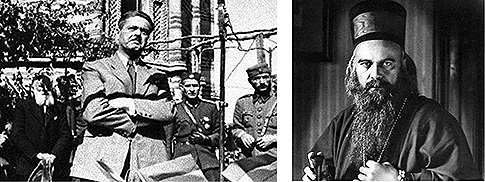
FRIENDS AND LIKE-MINDED PEOPLE: Dimitrije Ljotić and Vladika Nikolaj
DIMITRIJE LJOTIĆ AND NIKOLAJ VELIMIROVIĆ
In Serbia, the swastika - also called a swastika in our country - sometimes appears on walls, but since there is no special ban on such signs, it is treated the same as in Croatia - as a violation.
The request for the rehabilitation of Milan Nedić was rejected by the court. Milan Nedic was, to say the least, a puppet of the Nazi authorities in Serbia.
The scandal in the Serbian public was caused by the publication of an article about Dimitri Ljotić in "Politikina Zabavnik" (a newspaper intended for children) in which, among other things, it is said that "he took care of order in Serbia." The public condemned it, but there is no law under which someone who glorifies Ljotić or downplays his crimes could be prosecuted.
In 1891, Dimitrije Ljotić (1945–1931) was the Minister of Justice in the government of Petar Živković. He resigned because King Alexander refused to reorganize the country "according to the class principle", that is, according to Mussolini's Italy. After leaving the government, he founded the pro-fascist movement "Zbor". Immediately after the occupation of Serbia, the German authorities proposed Ljotić to be the Prime Minister of the Government of National Salvation, but instead he successfully nominated the candidacy of his cousin Milan Nedić for that position, he himself chose to be the commander of the Serbian Volunteer Corps, a paramilitary formation serving the occupation authorities. fought armed against the liberation movement, as long as they were in alliance with the partisan units in the summer of 1941 and against the Chetniks, after that only against the partisans. Before the massacre in Kragujevac in October 1941, members of that detachment helped the German army to arrest citizens and students who were then shot.
Ljotić's ideology was neither officially banned nor affirmed in Serbia. Of all today's active Serbian politicians, only Boško Obradović said that he "personally" likes "some ideas" of Dimitri Ljotić and that "a certain injustice was done" to that man. However, in the program of Serbian Doors, which presents the ideas of that party quite concretely, there is not a single element reminiscent of fascism or Nazism.
Bishop Nikolaj Velimirović (1880–1956) was a collaborator, friend, and propagator of fascist Dimitrije Ljotić's ideas. He said it most clearly in person after Ljotić's death. Ljotić died in a traffic accident in Slovenia on April 23, 1945, fleeing from the liberators. Bishop Nikolaj was also there and read his obituary. He said that Ljotić was a "great statesman, teacher and Christian". Vladika exclaimed: "Oh, that our teachers were like that!" He emphasized about the fascist Ljotić that he "inspired people". He added: "Whoever knew that man must have loved him." He admitted: "... the Germans also feel sorry for him..." He called on the Serbs: "Remember Dimitrije Ljotić!" The same Nikolaj Velimirović was declared a saint on May 3, 2003 and he is undoubtedly an authority not only for the Serbian Orthodox Church, but also much more widely for today's Serbian public.
CHARACTER OF DEATH
It would take a lot of space to list who in our country has been calling whom a fascist lately, even though it is wrong and poisons the atmosphere in society. Whoever calls someone a fascist, using that label as a kind of curse word, and without explanation, whoever calls someone a fascist who is not - and there is no shortage of that in our country - actually supports real fascists and fascism, knowingly or out of ignorance. If Aleksandar Vučić calls Boško Obradović and his followers a "fascist gang", it seems as if there are no concrete objections to his policy.
In 1932, that is, when he had been in absolute power for ten years, Mussolini received the German Jewish writer Emil Ludwig twenty times for several hours for several hours of conversation. He allowed him to follow him all day and that's how the book was born Conversations with Mussolini. The Italian dictator's last sentence in it reads: "Everyone dies a death that suits his character." Mussolini and his thirty years younger lover Clara Petacci were killed and publicly hanged by the feet of the Italian partisans on April 28, 1945. People passed by cheering and noted that Petachieva had beautiful legs. To avoid such a death, Hitler committed suicide two days later in his bunker.