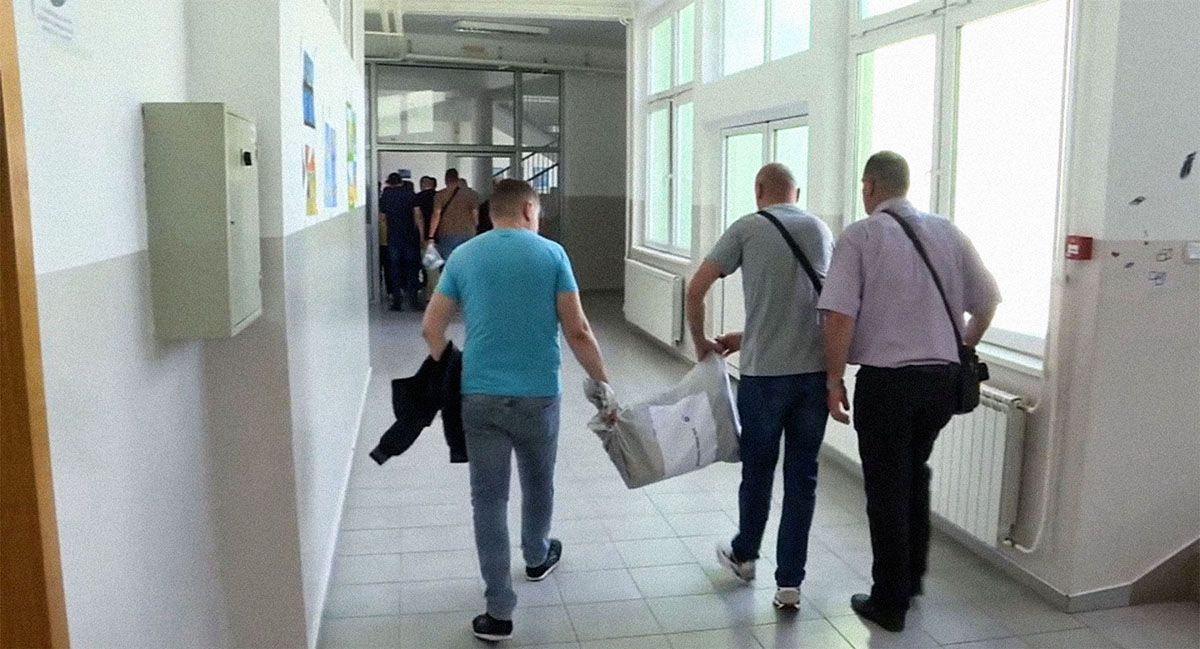
On the day when this issue of Vremen goes on sale (Thursday, June 30), it will be known whether the famous polling station number 6 in Veliki Trnovac is open. And how will the voting take place, will it happen at all, who will win that one mandate because of which Serbia still has neither an assembly nor a government, and will we finally see the end of the parliamentary elections after almost a hundred days, judging by what has happened so far? experience, no one living in this country knows that. Or, maybe one man and his close associates know, as the technical prime minister was "informed" even before the decision of the Administrative Court that Veliki Trnovac will vote for the fourth time on June 23.
And indeed, last Thursday everything was ready for another "Groundhog Day" in "Muharem Kadrije" elementary school, except that the groundhog did not poke its head out of the ballot box to tell us whether the Coalition of Albanians of the Valley, or rather its leader Shaip Kamberi, will enter the Assembly and thus "tear off" one mandate from the Socialist Party of Serbia. However, the Iraqi polling station was not even opened on June 23 due to the conflict between the members of the polling committee since early morning. A little later, a false bomb report arrived, enough for another election day for 1.089 voters in Veliki Trnovac near Bujanovac, the largest Albanian village in Serbia. According to the 2002 census, it has close to 7000 inhabitants, exclusively ethnic Albanians, and according to the estimates of the locals themselves, at least 40 percent of them live and work in Western European countries.
It seems that the endless repetition of the parliamentary elections made Veliki Trnovac etched in the consciousness of even those people who are not interested in politics, and that the village of some six thousand souls, a significant part of which is the diaspora, continues to inherit the myths and legends that have followed it for years .
MONUMENT ON THE HILL ABOVE THE VILLAGE

photo: tv n1NOTORIOUSNESS WITHOUT A REASON: The place that makes a Balkan drug-dealing center
Before the elections, the Serbian public, primarily thanks to the multi-decade state policy with the thirding of the nationally aware media and "public workers", created a prejudice about this village as the breeding ground of the biggest drug cartels "in this part of Europe", where they can be found at any time. tons of drugs that even the locals themselves produce in special laboratories. Of course, such claims have never been proven.
On the hill above the village, the locals placed a memorial plaque in memory of April 23, 1999, when the security forces, during the NATO bombing, brought all the locals to this place in order to search their houses:
"They thought there were facilities for the production of drugs and large stocks in the village, but of course they found nothing," one resident told Vreme, then immediately added:
"We also have people involved in drug trafficking, as there are in Belgrade, Vranje or Niš, but we are certainly not the center of the drug mafia."
Even today, one can read texts about how masked Albanians with long pipes will wait for you at the entrance to the village, where the police are not even allowed to cremate, although the truth is quite different. It goes without saying that in the village the police do their work like anywhere in Serbia, just like other public services.
Veliki Trnovac (as well as the entire Land Security Zone towards Kosovo and Metohija) was outside the state system from November 2000 until the beginning of June 2001, during the rebellion of armed Albanians gathered in the Liberation Army of Preševo, Medveđa and Bujanovac (OVPMB). The conflict with the official security forces ended with the mediation of NATO and the international community, and during the retreat the most famous Trnov resident, Ridvan Ćazimi, better known as Commander Leši, was killed. His compatriots erected a monument to him in the center of the village, and a museum at the local stadium.
Speaking of the stadium, the local FC Ternoci successfully competes in the "South" Zone, where they play football with clubs from the south and east of Serbia. Every match here is a real party, the guests never lacked "a hair on their head", just like the people of Trnov never lacked when visiting the surroundings of Leskovac, Prokuplje or Pirot. Although several football players born here have successful European careers, the most popular and successful athlete from Trnovac is currently the boxer Shefat Isufi, world champion in the WBF category since April, who also got his own mural in the center of the village.
The people of Trnov, like the majority of citizens of Serbia, suffer from the same problems, unemployment and poverty above all, so the locals believe that a large factory here, in which both Serbs and Albanians would be employed, would solve not only the economic but also the inter-ethnic tensions that still they exist, although not to the same extent as during conflicts and wars.
Now they are hurt by the impression that the public in Serbia brands them "as thieves who steal elections".
In such and such an atmosphere, on June 30, Trnovac awaits the continuation of the election saga - the fifth in a row - since the elections did not even take place a week earlier, and there are several schools of thought that interpret everything that is happening - from the one that Vučić is right that because of the sanctions Russia, Serbia and the issues of Kosovo the longer it is without legislative and executive power, to the point that "someone" does not want Albanians in the parliament and their integration, which is represented by Albanian leaders.
Ragmi Mustafa, the president of the National Council of Albanians (NSA) has no qualms when he says that the endless repetition of elections in Veliki Trnovac only means that the state does not want Albanians in the Parliament and in public life.
"It is a clear message that Albanians do not have any rights in Serbia, even though we are its citizens," Mustafa told Vreme.
Šaip Kamberi, who was the only opposition to the ruling coalition in the last convocation of parliament, expects to be in parliament again "despite state discrimination and pressure from Belgrade".
Because MP Kamberi did not speak as an "Albanian from the Presevo Valley", but as a Citizen of Serbia, the Serbia of "Dimitrije Tucović, Danilo Kiš, Bogdan Bogdanović, Ivan Đurić, Borka Pavićević", who cares about the country he lives in as much as the rest of us. whose names and surnames are slightly different.
He emphasizes the importance of the presence of Albanians in the Assembly because, as he says, throughout the Western Balkans, important decisions are expected that should lead the entire region on the path of Euro-Atlantic integration.
"The fight against state discrimination, which encompasses all spheres of life and narrows the space for a better perspective, should be continued by all political means, so the fight for dignified parliamentary representation remains one of the main goals of our political activity," says Kamberi.
He reminds that the Coalition of Albanians of the Valley received support from the "institutions of the Republic of Kosovo" and the authorities and the opposition, from the Republic of Albania, but also from the Albanian political leaders of North Macedonia.
CAMBERS ON VETROMETINA
However, the impression is that Kamberi and his Party for Democratic Action (PDD) remained at the tail end of this battle. The coalition of Albanians of the valley, in addition to the PDD, also consists of the Democratic Party of Nagip Arifi, president of the Municipality of Bujanovac, and the Movement for Democratic Progress (PDP) of his deputy Šćiprim Musliju, founded by his father Jonuz, one of the commanders of the OVPMB.
Since after the vote on April 3, it turned out that only Kamberi has a chance to enter the parliament, these two leaders have continued to deal with their usual jobs - Arifa to pave the streets around Bujanovac, and Musli to visit the diaspora and pay respect to his father's fallen comrades. .
The election campaign is run only by Kamberi and his party comrades, they make statements to the media, write announcements, visit voters and point out the importance of winning the elections.
At the last vote (prior to this one, which was not even held) on May 27, the Coalition of Albanians lacked 12 votes for the parliament, and Kamberi declared that the "devils in the Albanian ranks" were also to blame for the failure, alluding to the fact that at that time the SPS received 6 votes, but also to the sabotage carried out by the supporters of another Albanian faction led by Šćiprim Arifi, the leader of the Alternative for Change and the president of Preševo.
Kamberi, in fact, only discovered hot water: if all Albanian parties had gone to the elections on April 3 with one list, Albanians could comfortably count on at least three parliamentary seats. However, they did not agree on who would be the candidate, so over 3000 votes won by Arifi's "Alternative for Change - Albanian Democratic Alternative" were scattered to the wind, and the disunity dissuaded many Albanians from voting.
Nejat Behluli, the owner of the local TV Spektri in the Albanian language, pointed out this problem at the time, telling the political leaders that the voters had punished "their laziness":
"It turned out that you are not interested in the benefit of the people, but only in personal benefit! You could not agree on the order of the list, that is, who will be the deputy and now you are all left with empty hands, or rather, empty pockets! Fifteen thousand euros per month went to the list that has MPs and another two thousand euros monthly salary for the MP... Now you have nothing! Of course, I don't feel sorry for you, but I am worried, I know that you will make up the money by taking money from municipal funds, from the money of all of us Bujanovac citizens. And since I can see from the statements you make these days that you have by no means understood what has befallen you, I will teach you: the voters, the Albanians from the Preševo Valley, punished you because they are not sheep as you think of them, they will not forever blankly they are voting for you", said Behluli.
After the vote on May 27, when Kamberi lacked 12 votes, Behluli nevertheless found words of understanding for the parliamentary pretender, when he said that the real loser of the election was the state and not the Albanians. In an interview with Vreme, he emphasizes that with this election fraud, the state rejects the outstretched hand of the Albanians:
"First of all, the law must be respected, and there must be no exception, neither for Serbs, nor for Albanians. We all know that the government can influence the electoral process in various ways, and that all remains within the law, and we know that every government has done this so far, both in areas where only Serbs live, and where minorities also live. and Hungarian, Romanian, Slovak and Albanian. That is why the result of the three repeated elections in Veliki Trnovac is the result of a political decision by the authorities in Belgrade, and not an expression of the will of the people. And here we come to the essence: the relations between the Albanians living in Serbia and the Serbian state were quite strained in earlier decades, so the Albanians living in the Preševo Valley even boycotted the elections several times. That's why their decision to nominate their candidates for the elections that were held on April 3 has a special weight, and represents a hand out to the Serbian authorities. And what did those authorities do when they arranged for the elections in Veliki Trnovac to end the way they did? They refused the extended hand!", explains Behluli for "Vreme".
INTEGRATION OF ALBANIANS
The eventual non-entry of Albanians into the parliament will, no doubt, slow down their integration into state institutions, which the current (technical) government insists on, even verbally.
Back in 2013, the Government of Serbia adopted a 7-point plan for the integration of Albanians, but some concrete steps were taken just before the vote on April 3.
The government delegation (Gordana Čomić, Mirsad Đerlek, Darija Kisić) promised the employment of Albanians in state institutions at the local level (Hospital in Vranje, inspections, Cadastre...) at a dialogue with Albanian representatives in mid-March, Gordana Čomić repeated the same in May. in Bujanovac, but all that somehow remained in the shadow of the election.
"There are no Albanians in the prosecutor's office. In the judiciary at the municipal level, we have about 12 percent of employees from the Albanian community, and at the district level, 2,7 percent. Today, there are no Albanians at the head of health institutions in Bujanovac and Preševo. We have the will to cooperate and jointly treat these topics", said Ragmi Mustafa.
Today, Albanians in the south of Serbia are waiting to see if they will get their representative in the Parliament, which is certainly part of the integration process, not hiding the opinion that both depend on Belgrade.
It seems paradoxical that instead of the Socialists, the interests of this party in Bujanovac are most passionately represented by the local SNS, even though the parliamentary mandates of this party are unquestionable.
At each session of the Municipal Electoral Commission, the progressives voted against the Coalition of Albanians, just as they appointed their strongest cadres to the electoral committee at each of the repeated votes. During that time, the SPS sent people from other cities to Trnovac, the last time during the failed elections, for example, Vanja Vukić, a close associate of Ivica Dačić and former state secretary in the MUP.
By the time this number goes to press (Tuesday afternoon) the composition of the electoral committee for Thursday's vote will be known, but those in the know have no doubt that the matrix will remain the same.
"Zoran, Slavica, Goran and Vesna from Vranje, Surdulica, Bosilegrad, Trgoviste are just as poor and unemployed as Ilir, Teuta, Vjollca, Alma and Muhamed from Bujanovac, Tutin, Preševo and Sjenica."
The coalition of Albanians remains to mobilize all those who have the right to vote, in order not to collect 609 votes for the parliament, so that we can again hear a sentence like the one uttered by Shaip Kamberi, a law graduate from Veliki Trnovac, in one of the parliamentary discussions in 2020.
The rest of us have to wait and see what will happen on Thursday and if and when we will get the parliament and the government. And then let's see it around Russia and Kosovo.
After the elections held on April 3, the Coalition of Albanians of the Valley lacked 300 votes for the parliamentary mandate, so they filed a complaint asking for re-election in two polling stations, of which only the one for polling station number 6 in Veliki Trnovac was accepted.
The elections were repeated in this place on April 23, and the Coalition of Albanians won 677 votes and has already started celebrating the electoral victory. However, after objections from the SPS, the vote was held again on May 27, when the Coalition received 598 votes, 12 less than required. Then the Coalition of Albanians files an objection for the same reason as the SPS after the previous vote: allegedly, the voter's signature on the voter list is that he voted, but he had no right to do so because he has no document. First, the Municipal and then the Republican Electoral Commission rejected the Coalition's complaint, but in the end the Administrative Court ordered a vote on June 23, which was not even held.
The author is an associate of the "Bujanovačke" portal.