"At dawn on May 29, 1903, a knock on the window first woke up the woman from Pišče, Jelena," writes Živan Živanović. "That was typed by Mrs. Sofija Milutina Stepanović, a close neighbor on Svetog Sava Street. At the woman's loud exclamations, the writer wakes up and shouts in surprise himself: 'What is it?' 'What's the matter,' was the answer, we're sleeping, and downstairs there's slaughter in the town, the army is fighting, the King and the Queen are dead, damn me, is our man (Dragutin) here!'

And he went alive to his room where Dragutin was sleeping. The bed was untouched; Captain Dragutin was not there. If what Mrs. Stepanović said was true, then it was clear where Dragutin was. In the small room where the candles were (because there was no electricity then), fragments of them were also found later, because the captain had broken them last night and carried them in his pocket, so that they would be at hand just in case.
Immediately the whole house woke up and the writer ran out into the street, which was quiet and almost deserted, where Milutin Stepanović himself was standing in front of his house and to the question: 'What is that neighbor, is it true that the King and Queen have died?' 'Truth, truth neighbor; I watched it from the window of the clerk's cooperative (which is on the opposite corner of where the Ministry of Foreign Affairs is now (1923)), and here, look down at Terazije, that's the army.' And in fact, the entire room of the street near the court itself and the adjacent ministry was pressed by the army tightly packed, like some anthill, whose individuals were scattered towards 'London' and to Jovan Ristić's house. Stepanović's statement had to be believed; and he could know and hear before others; both of the last Obrenovićs had taken Stepanović by eye, as a well-known Karađorđević. Therefore, the fact could not be doubted. Instead of the answer itself, the writer just crosses himself, saying: 'God be with us, this is like a thousand and one nights!' Stepanović then left calmly, even though he had a boat ready for escape on the Sava, just in case luck failed the conspirators..." writes Živan Živanović (liberal, minister of education in 1903) in the book Political history of Serbia in the second half of the 19th century. veka, in which he deals with the period of the second part of the reign of King Aleksandar Obrenović, 1897–1903, events in which Živanović himself participated and which were literally sealed by his brother-in-law Dragutin Dimitrijević Apis.
Two uncertainties pressed the writer of those lines, the first him personally as yesterday's minister; and him and his family another - what about Captain Dragutin.
Živan finds Dragutin in the hospital, roughly where the entrance to the third gymnasium building is now. "Captain Dragutin T. Dimitrijević Apis", writes Živan, "was found in the basement of the old palace, while it was still dark, wounded in several places, leaning against the wall and covered in blood, before the King died and the others with him, He was immediately taken to the palace guardhouse, where Živan Gašić, whose house is opposite the palace, put the first bandages on him, but Captain Dragutin forbade him to be carried anywhere, before it was known what would happen. the end of being. Lying on the bench, with the revolver in his right hand, which was still healthy and intact (the left one had been cut in two by a bullet, below the shoulder joint), he remained like that until the break of day, when with the first bandage, without a suit, which had to to be cut, so that the doctor could come to all his wounds, wrapped in a kind of mackintosh, carried in a car to the hospital and given a place in the pavilion, where some other wounded officers were brought and placed.
There were three wounds: one on the thigh of the right leg, deep, with no exit, which meant that lead was inside; the other on the side of the left hip, a large open wound in the flesh to the bone, which could not be known how it became, until his weapons, (saber and revolver) were brought from the court. The pierced brass hilt of the saber, which had a flowered hole of cursum, explained this second wound, below the left hip. Fortunately, the bullet hit the handle, pierced it, but it broke itself and lost its penetrating power, so it could tear the tissues, but fortunately, it did not pierce the hip and injure the internal organs.
The third wound was the most dangerous in terms of the direction, where the lead went and the injuries it caused. The bullet struck in the middle of the chest, pierced the sternum, and as it came from somewhere on the right, it passed diagonally through the chest on the entire left side, above the heart and the tangle of blood vessels, then through the armpit and coming out on the ribs, passed through the muscle of the left arm , and below the shoulder joint broke the muscle bone in two and came out from under the shoulder.
This wound therefore: pierced the chest, passed through the left lung, penetrated - God alone will know how! – through the veins and arteries above the heart…”
Živanović describes how Apis was wounded:
"The keys were no longer in the mood, which should have been given by Mihajlo Naumović, (the son of Jove Naumović, the former district chief, and the grandson of that Naum, who came from Russia with Karađorđe, and was killed together with him on the morning of July 13, 1817, in the village Radovanja, in one of the fields, where Karađorđe was hiding, with the knowledge of Bujica Vulićević).
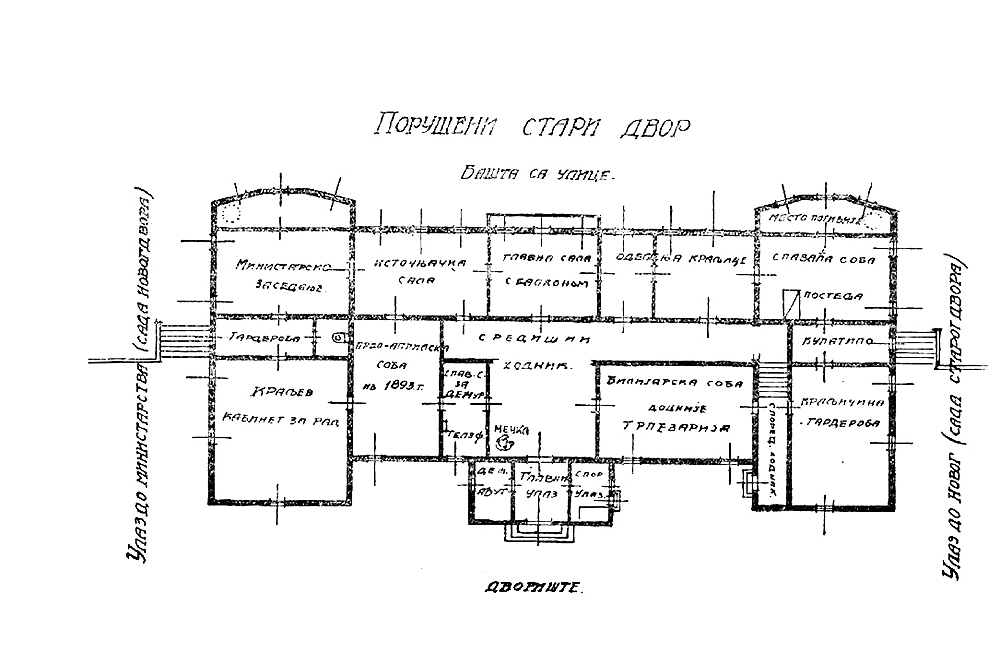
It could not be debated for long. For that, they immediately proceeded to break the door with dynamite cartridges, also prepared for all cases and which had been at the disposal of Lieutenant Milutin Lazarevic since Niš. First, it started with the rast decorated door, which led to the main hall (where the balcony is). And when the lighted wick, hung on the doorknob, began to burn, Dimitrijević noticed something again, which was also fateful for him.
In the semi-dark depth of the right corridor, and near the king's bedroom, Drag. T. Dimitrijević noticed a human opportunity, which was lost somewhere in the depths. And leaving the work around the door to his comrades, he flew there, and near the end of the corridor, he saw wide stone steps to the right that led from the first floor to the ground floor of the palace. There, that opportunity was lost, for which it was impossible to know who it was; and it was not an impossible assumption that it could have been the King himself, but also from the fact that it was near the bedroom; and it concerned salvation at the last moment.
However, it was a guard, always posted at night in that important place. Dimitrijević with a revolver, went down the stairs into the lower corridor (which, like a tunnel, cut through the entire court in a straight line from end to end, and divided the front rooms, which looked into the garden, and the back rooms under the hill, mostly cellars). All of a sudden, there was a lot of shooting in the lower corridor: it was two guards, the one from above and one from the lower corridor, who in the dark opened fire on Dragutin and he on them, all at close range. It was established that the guards fired about 25 bullets (five 'chargers'), and the writer also saw bullet impact marks on the walls. While the upper floor was resounding with dynamite explosions, rifles were firing in the lower one, as was another part of the "internal guard" with one sergeant, who with the exclamation: "this is how the pallets flow" shot into the crowd of officers, but he himself immediately fell. Then the conspirator Mladen Mlađa Milivojević was wounded and lost his arm.
The result of that on the bottom line was: that Dragutin T. Dimitrijević Apis was wounded in three places, as it has already been exposed. Covered in blood, leaning against the wall, Dragutin remained there - and the soldiers - one of whom was also wounded - were lost in the darkness - and awaited their fate. When the air hissed through the opening on his chest when he breathed: 'I remembered, he says, a similar scene from the French Revolution', described in 'Ninety-three' (by Haig).
When the writer who was about to enter and inspected the entire deserted palace, and the place where Dimitrijević was wounded below, asked him: why didn't he take shelter in one of the many doors, where the walls were in the doorposts a meter thick? Dragutin replied: 'Well, it's a shame that an officer, even in this difficult position, hides in front of the ranks!'"
NAME AS CHORUS: Apis was born in 1876 in Belgrade, but since his father and two uncles were urgently employed as tinsmiths in the ammunition factory in Kragujevac during the Serbian-Turkish war, he moved to Kragujevac; when his sister Jelena got a job in Kraljevo in 1881, she took her mother, sister and brother Dragutin with her; when she got a job in Niš in 1884, the whole family moved to Niš; when, after her father's death in Niš in 1886, she married the Serbian politician Živan Živanović, they lived for several years in Pirot, where Živanović was the director of the high school and where Dragutin graduated from the junior high school, and when the family moved to Belgrade in 1890, Dragutin was there lived permanently in Živanović's house with his brother-in-law and sister.
It can be said that Paschenog's description romanticizes, "heroizes", Apis's psychological profile. Far more reserved about Apis and his companions in the book The second government of Aleksandar Obrenović writes Slobodan Jovanović, who cannot be said to be against Apis:
"The twenty-ninth of May turned out to be much bloodier than the conspirators intended. At their last agreement, they decided only to kill Alexander and Draga. The killing of Prime Minister Cincar-Marković and Minister of Military Pavlović was decided only after the invasion of the court - and that in the fear and nervousness that gripped the conspirators when they did not find the king in his bedchamber. The killing of the Lunjevica brothers was carried out without prior agreement, on the personal initiative of one of the conspirators. The killing of General Petrović, one orderly and one adjutant, happened by itself in the fire of battle... And that is not the end of the list of victims.
The conspirators did not work with the composure of the old masters of crime, but with the enthusiasm and rush of people who whip themselves into acts beyond their nervous strength. At two o'clock in the morning, a group of twenty-eight was supposed to go to the court with one battalion of the sixth regiment. The battalion did not arrive at the appointed time. The officer felt hesitation and apprehension. To cut the matter short, Captain Dimitrijević ordered his comrades to rush to the palace at a running pace, even without a battalion, and in that race they rushed to the palace gate, wickedly blinded and irresistible, like a man who commits a crime out of love's passion. Everything they did further, was in the same rush, in the same half-sleep(...)
Colonel Mašin (who hated his former sister-in-law Draga), who was in charge after that, was a quiet Czech with smooth gentlemanly skin and a cold cat's gaze. The conspirators would later talk with admiration about the composure with which he issued orders 'as if he was in command of manoeuvres'. The Austrian deputy, who saw him the next day, also mentions his calmness and self-control: 'Correct and elegant in a new, expensive uniform, as if he were getting ready for a court ball without a speck of dust on his suit, without the slightest sign of excitement or fatigue on his face. He is the one who, with his sobriety, prevented the demolition of the palace, and he is the one who ordered the killing of Cincar-Marković and Pavlović without any real need, and out of pure premeditation...'" (Slobodan Jovanović, Government of Aleksandar Obrenović, book III)
After the May Revolution, Apis's name was "repeated like a chorus", writes Slobodan Jovanović in the essay "My Contemporaries", published in Windsor in 1961. David McKenzie, looking back on that study by Jovanović, observes that Apis's importance became greater when the older conspirators were replaced request of the British government in 1906. Then Apis became the undisputed leader of a conspiratorial group in the army, whose confidence had to be enjoyed by the ministers of war.
Slobodan Jovanović describes Apis as follows: "Tall and big, a little overweight, he fully corresponded to the name Apis, given at school, with his physical strength. I never saw him alone, neither on the street nor in a tavern, but in the company of a larger or smaller number of officers, who seemed to be his escort. Seen like that among his people, he gave the impression of a ringleader not only with his physical appearance, but with his entire demeanor..."
"Guided by patriotic feelings, but without real political understanding, he thought that terrorist methods were the only suitable way to achieve our national goals." Those ways had success in Turkey, but he did not understand that Austria was not Turkey. He tried to act as a terrorist there too, and his play with fire, reckless to the point of imprudence, caused an immediate war."
David McKenzie, who reports those words, notes that Slobodan Jovanović accused Apis of the Sarajevo assassination at that place.
At the beginning of the First World War, Slobodan Jovanović was designated as the head of the War Press Bureau and was, Mackenzie writes, instructed to report to the head of the intelligence section of the Serbian General Staff in Kragujevac, where Colonel Apis was.
"He welcomed me," writes Jovanović, "as kindly as I later saw him welcoming the whole world." He expressed himself quite vaguely, did not finish his sentences, when he would suddenly remember not to say everything he had in mind. He had not yet recovered from his illness, he was still carrying traces of poison in his body. He wasn't quite sure on his feet yet. He had an unhealthy dark green color and his head was completely bald. Sitting at the table with his huge body, overweight rump and bald head, he looked like some kind of Mongolian. He had a more friendly attitude towards the 'civilians' than the officers. He spoke most often in that semi-serious tone in which coffeehouse conversations are conducted... Apis loved company... He knew how to enliven society and create a coffeehouse atmosphere... He loved women and song, but not wine.
He drank only water and stayed sober in the most cheerful company...
There was a constant coming and going from Apis's office as in a coffee shop. There were all kinds of visitors. First of all, there were the black-armed men, none of whom would come from the front without first saying goodbye to Apis(...) Because he was always in a good mood and ready to talk. Apis had a rule to receive everyone, to make promises to everyone, and if he could, he did. That's why his office looked like a brokerage office..."
Slobodan Jovanović also says: "Apis loved his friends, but he did not spare them(...) He zealously involved them in the most dangerous ventures in which they could lose their heads." Like all fanatics, he valued the success of things more than the lives of people...
He was a nationalist, enthusiastic and not quite balanced, which was not rare in our country at the beginning of the twentieth century. Apis, like all those nationalists, overestimated the power of conspiracies and assassinations, but he had rare abilities for affairs of that kind..."
SECRET REPORT AND SHOOTING: "Apis was shot at dawn on 13/26. June 1917, just two days, two hours and 50 minutes later than the fourteenth anniversary of the murder of King Alexander and Queen Draga Obrenović (May 29/June 11, 1903). As it has been said many times (especially after the First World War), he should in fact have been 'killed' by the writings that he drew up and submitted to the court on March 28, 1917. That document was his report to the court, which concerned the murder of Austrian Crown Prince Franz Ferdinand in Sarajevo," Vasa Kazimirović writes in the Black hand, personalities and events in Serbia since the 1903 coup. until the Thessaloniki process in 1917.
In his book, Živan Živanović devotes many pages to Dragutin, he writes that with the last platoon at dawn on July 13, 1917, in a remote valley not far from Thessaloniki, with which the lives of the condemned were extinguished, the matter was not over:
"There was a crisis in the government due to the issue of pardons, which resulted in the resignation of the ministers of the Independent Party, (Milorad) Drašković and (Ljuba) Davidović, followed by the third, the representative of the Progressive Party, Dr. V. Marinković. The government now remained with the Radicals, until the end of the war and the conclusion of peace...
According to this entire state of affairs, the Government considered it necessary to publicly mark its views on the outcome of the Thessaloniki process, especially with regard to the condemned, and those who were excluded from amnesty and executed.
This was done in a very extensive act of the Prime Minister himself, which was entitled: "Communique of the Royal Serbian Government" published in the official "Serbian Gazette" no. 75. on June 26, 1918...
It talks about the crisis, the resignation of three ministers and the change of government in Corfu on June 10, 1917 - five days after the final verdict of the Great Military Court (June 5), during which time the issue of pardon was discussed in the consultations.
There it is pronounced: 'In the opinion of the new radical cabinet, and after the competent Ministers were heard and the verdict was read, only three people were exempted from the death penalty: two officers, ringleaders, and one Austrian citizen, for whom not only did there not exist mitigating circumstances, on the contrary, there were many aggravating circumstances (words in the original underlined!), which inevitably had to prevent the Council of Ministers from proposing them for pardoning. K. His Highness the Crown Prince...'
Those 'aggravating circumstances' were no doubt known to the government, when it mentions them and even underlines those words alone in the entire huge communiqué...
But the Thessaloniki phantom could not go underground so quickly. It entered the next year as well, and almost in all of Europe it was an open question, it was discussed on all sides, especially among the public of the great allies. That debate continued into the next year, 1918, even after the end of the year since the execution of the verdict.
In London, our people, in addition to so many others, also had one excellent friend. That's Seton Watson, the founder of the paper The New Europe. In no. 97 of August 9, 1918, was published under the title: 'Serbs have to choose', an analysis of Serbian mutual party-political relations. And that English article has the merit, that it made a competent Serbian side lift the curtain a little and glimpse something of the truth.
Stojan Protić, after N. Pašić, was by far the first in the Radical Party, who was also not only committed to the depths of the Thessaloniki process, whose influence on affairs, both when he was a minister and when he was not, was actively felt, including those in Thessaloniki. Stunned by the above article in Watson's 'New Europe', Stojan Protić soon sent his letter to Seton Watson in particular, dated August 22, 1918, in order to, among other things, explain the 'difficult circumstances from the government communiqué'. However, that was not enough for Protić to personally inform his London friend, but it was a significant letter from his intellectual point of view, which he immediately published in the unofficial part no. 102. 'Srpskih novina' from August 28, 1918..." writes Živanović.
"As it appears from everything that follows, with this confidential report, as it is said, Colonel Dimitrijević issued a 'deed of the head', and that it will be the fatal document, to which St. Protić places so much importance in his letter to Seton Watson and it is as if the entire session of April 25 was staged, to emphasize this 'confidential report', that it exists."
The original of the confidential report dated March 28, 1917, written by Apis in Thessaloniki, was published by Vladimir Dedier in the book Sarajevo 1914:
"To the military court for officers,
With the announcement of the lawsuit for the assassination of H.J. I saw that Rade Malobabić and Muhamed Mehmedbašić were being blamed for that assassination, and that I was also being accused of complicity in that act. My complicity in this part is mainly determined by a strong interest in both of these defendants and constant intercession for them.
Forced in this way to justify this interest of mine with real reasons before the court, I will have to state one thing that binds me to these two defendants and for which I was so careful towards them. Exactly, I have to explain why my whole conscience is engaged around these two personalities.
The point is this:
I am Radu Malobabić as head of the Reporting Department. Đ. staff to organize a reporting network for me in Austria-Hungary, and he accepted it. I did this in agreement with the Russian military attaché, Mr. Artamonov, who personally met with Rada in my presence. Since the Rade had begun work, I, feeling that Austria was preparing for war with us, thought that with the disappearance of the Crown Prince Ferdinand of Austria, the military party and current, which he was at the head of, would lose its strength and that in this way the danger of war would be removed from Serbia, or at least it will be postponed for a while, and that is why I hired Malobabić to organize the assassination of Ferdinand during his scheduled arrival in Sarajevo...
Muhamed Mehmedbašić is the only Serb Muslim who was a participant in that assassination and who managed to escape first to Montenegro, and then during the war he came to me in Užice. In addition to this, he went from Corfu to Athens with my cooperation, and according to the part known to the court from the investigation...
Being bound by such moral obligations towards these persons, I did everything for them without paying much attention to rules and regulations....
As there are many inconvenient moments for the state's interests in all of this, and I am forced to use it in my personal defense and in defense of the main defendants in the assassination of Her Majesty. KV of the Crown Prince, I consider it my duty as a Serb to inform the court in advance. It is impossible for me to give up this intention, because I believe that the investigation was guided, starting from me, by those inexplicable moments of my relationship with Mr. Malobabić, to find out the circumstances that brought him and Muhamed Mehmedbašić to the dock, and I would not be able to rest in my grave at the thought that, for whatever reason, I could have allowed the Serbian Military Court for Officers to conclude and finalize the verdict of the Austrian court in Sarajevo and that on that occasion the only Serbian Muslim who was a participant in the protest of the Serbian people and youth in Bosnia against the Austro-Hungarian tyranny over the Serbian tribe would be sentenced by a Serbian court."
"There is no doubt," says Dedier, "that Colonel Apis exaggerated Malobabić's role in the assassination in his report." This can only be explained by his upset at the moment when he was writing the report. He was completely convinced that based on this admission of participation in the Sarajevo assassination, the Thessaloniki process would immediately be suspended."
The "killer document", as Krsta Cicvarić will say about this act, was an important document, but - when every word in it is carefully analyzed - it still documented little. Apparently, Apis himself was aware of this. He created it with a clear goal - to confuse the court and those on whose instructions the court acted. He even said that - in prison, to the supervising officer, Captain Stojković, on March 30, 1917 according to the old calendar. "It will be a coup for the court," Apis said. "The court will not know what to do now." Now they're swallowing me whole, kids..." Then, Apis said that everything could still end well, that "the trial be stopped in the state's interest", and that he and his comrades "be put under a disciplinary court that can , if he wants, he can also take off their uniforms, and that's it." Two days earlier, on March 28/10. on April, however, he told Captain Stojković: "This is what a perfidious policy can do, that the Sarajevo assassins are tried by a Serbian court, that is terrible. Do they know that it will be written about? Why don't they immediately say 20 years in prison, but they are making a circus", writes Vasa Kazimirović, in the work "Black hand, Personalities and events in Serbia from the coup of 1903 to the Thessaloniki process in 1917".
"In his report, Colonel Apis not only proved once again that he has no talent for political tactics and combinations, but also that he underestimates his opponents and their perfidy," says Dedier.
In his book, Živan Živanović draws attention to six lines in the minutes of the 41st session of the first military court, on April 25 at 15.30:28 p.m.: "It was a very short session, the minutes of which do not fill a whole page of the book." (...) " The court moves on to the examination of the accused Colonel Dragutin Dimitrijević: When asked, does he stand by his confidential report of March XNUMX of the current year and does he intend to use that report even now? in your defense? - the accused Colonel Dimitrijević declares that now he finds that he is not forced to use that report, and that he is changing his first intention and giving it up."
"What state of mind Apis was in is best shown by the letter he sent to Alexander on April 12, 1917, in which he not only begs for mercy for Malobabić and Mehmedbašić, but at the same time capitulates before Alexander, asking in the most humble way for mercy and forgiveness and for myself. "That unusual letter, as if it was not written by Colonel Apis," says Dedier.
Historian David McKenzie pays attention to how Slobodan Jovanović, in his essay on Apis and the "Black Hand", described in detail the relations between Alexander and Apis, which were good at first, but later, especially when there was a split between the "Black Hand" and conservative "White Hands" (Peter Živanović) they argued. "I was surprised that Apis, who knew how to deal with people, was not able to preserve the friendship of the Crown Prince, which in the beginning he had to the greatest extent." Apis replied to Jovanovic: "Aleksandar is a Karađorđević, and the Karađorđevićs do not know how to make friends." He does not value anyone's friendship. He asks for loyalty from people, but courtship, and I am not a courtier."
Aleksandar, on the other hand, in response to Jovanović's question about Apis, stated some of his faults that seemed minor, but he also mentioned some deliveries that seemed more convincing. That's how, Jovanović says, Aleksandar found out that the officers call Apis "the second Crown Prince", without whom the first Crown Prince cannot do anything...
"He had his flaws, and those flaws were not small, just as his opponents were people who did not choose many means...", Jovanović writes about Apis.
"He was brought down by higher forces, those forces that together make up what we call a 'confluence of opportunities' or a 'given situation'." Those forces destroy all those who stand in their way, regardless of whether these people are good or bad, right or wrong..."
Apis's cousin, Živan's son Milan Ž. Živanović, to whom Apis wrote a touching farewell letter and left everything he had, defended his doctoral thesis in Belgrade in 1953 "Colonel Apis: the Thessaloniki process of 1903: contribution to the study of the political history of Serbia from 1918 to 2." were the revolutionary and post-war high-ranking official Moša Pijada (at one time the editor of the newspaper "Piedmont", which was started by the organization "Unification or Death", and for which the regent Aleksandar allegedly also contributed), Milan Bartoš and Jovan Đorđević. The defense of that doctorate coincided with the review of the Thessaloniki process, which took place before the court in Belgrade from June 13 to 1953, 16, and the verdict was handed down on June XNUMX.
Vasa Kazimirović in the book Black hand: Personalities and events in Serbia since the coup of 1903. until the Thessaloniki process in 1917, writes that with that review, which was extensively reported by "Politika", "Borba", "Oslobođenje" and "Dnevnik", the Thessaloniki process was characterized as a gross violation of law and justice, as a trial that opened a major problem in Serbia's internal political relations and as the end of the conflict between two militaristic groups over supremacy, which began to manifest itself especially in 1911, when the "Black Hand" was founded...