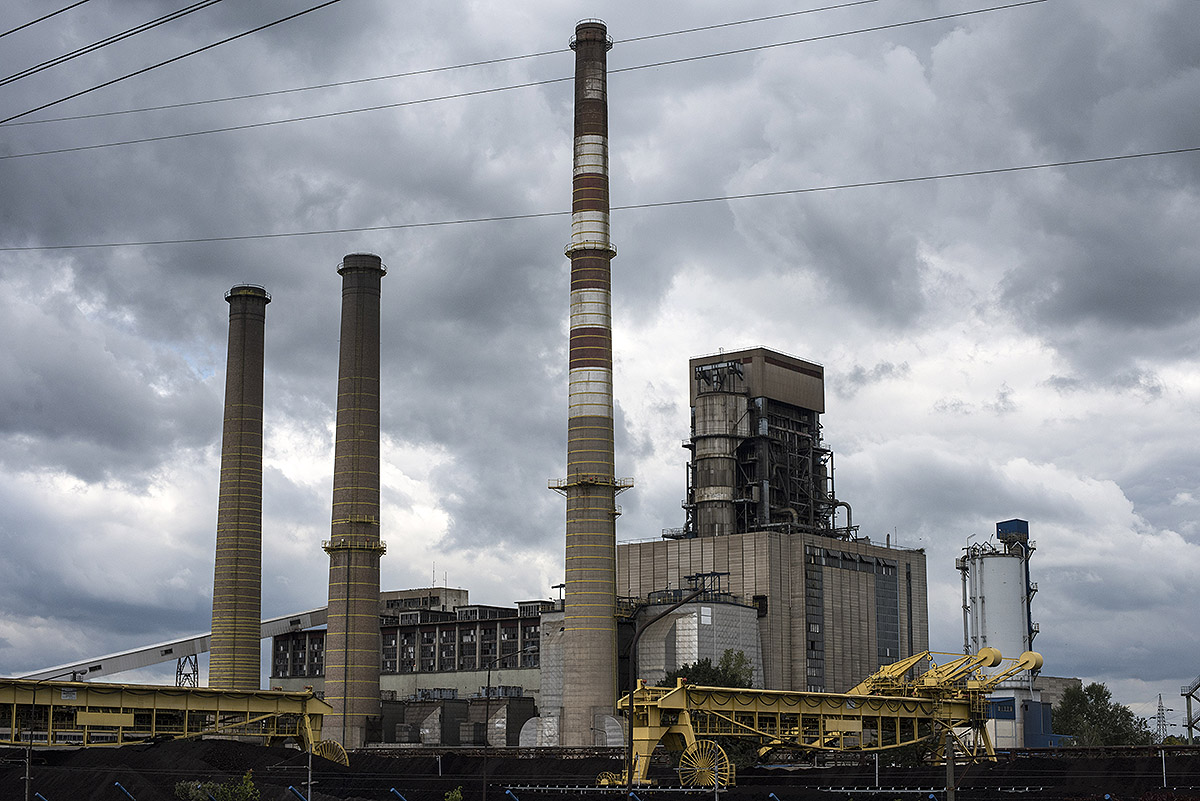
As part of the largest Serbian energy giant known as TENT, i.e. the "Nikola Tesla" Thermal Power Plant, "Kolubara" also operates, which is also the oldest among the active ones in the entire system of the Electric Industry of Serbia. Put into operation back in 1956, it was the pride of accelerated industrialization in socialism, but also the largest energy facility in the country. The years passed, the capacities increased, so from the original 64 MW thermal power plant in 1971, it was increased to 270 MW, which is still there today. It, in itself, has not changed much, and it is still irresistibly reminiscent of the period when it was built. Only the windows were cracked.
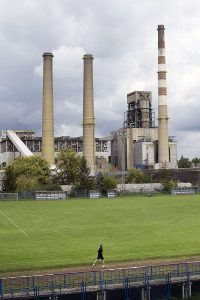
It is located in Veliki Crljeni - a place with about 4.300 inhabitants, which belongs to the Belgrade municipality of Lazarevac, although it is more than 40 kilometers away from the center of the capital. Contrary to common sense, the thermal power plant was built in the very center of the town, and is surrounded on all sides by the houses of the residents. The parameter of a few hundred meters, which is the minimum distance such a facility should be from the first houses, does not apply here.
In 2020, the Institute for Public Health "Dr. Milan Jovanović Batut" prepared the study "Improvements in the management of contaminated sites in Serbia". According to their findings, which did not become public until a year later, there are several black spots in Serbia, i.e. localities where business entities, as polluters, question the health of people living in the area. TE "Kolubara", as well as the surrounding mines from which coal trucks and wagons are delivered for the production of electricity, are recognized as the causes of environmental devastation in Veliki Crljeni and other, smaller villages that were swallowed up by the coal mines.
LIFE ONE HUNDRED METERS FROM THE POWER PLANT

21 - 03MARATHON FIGHT FOR A HEALTHY LIFE: Veliki Crljeni
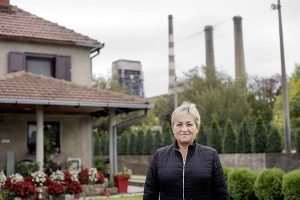
Right next to the power plant, on the side towards Stepojevac, lives Svetlana Jovanović with her family. They are in the first row of houses to the plant, it is not even a hundred meters as the crow flies. The fence of the power plant abuts their field, and some power lines are even on their land.
Neatly mowed grass and hand-made pots with flowers give the impression that they are somewhere else, far from the scourge created by TE "Kolubara". However, when you look closely at the soil, when you scratch under the pots, you can see a deep layer of black, charcoal dust. Svetlana agrees to talk, she says that she is not afraid, she is certainly among those who are conducting court proceedings against the power plant. Over coffee, he explains what problems everyone is facing. "There is too much dust, slag, fruit trees, crops are drying up"... He says that they cut down the cherries in the yard, they certainly "can't eat them", because everything is "polluted". They don't even plant a garden anymore. "There are a lot of asthmatics", she adds that she herself is sick, while pointing to the houses across the bridge where, she says, "four, five people have cancer or have died from it".
He says that the situation is the same as before, although they supposedly have filters. Smoke from the power plant, as she explains, always drifts over her house towards Stepojevac. When there are dust deposits, "you can't dry your laundry outside" because "if it's white, you'll bring it black in." It also leads us to the utility building, where we climb to the attic. There is so much dust that, he says, "it's not even worth cleaning anymore".
To the northeast of her house is a crematorium. "Now they seem to have some tapes where the crematorium is", but "when the wind blows, it's a disaster, it can't be passed".
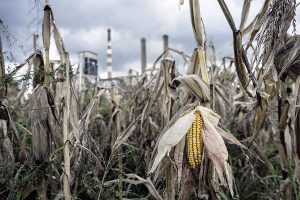
21 - 05LIFE IN THE SHADOW OF THE POWER PLANT: Cornfield...
A canal with waste water from the thermal power plant passes through their field. In addition to acids, oils and various other harmful substances, the interviewee says, faeces from the power plant are also discharged there. The channel was dug when the factory was built, and it was originally covered with concrete slabs, which have not been changed to this day. The ravages of time have finished them off. Some are cracked, so care must be taken not to fall into the channel, while in some places there are none at all. The channel flows into something that is difficult to define - is it a small river or just a larger channel that serves as a drain.
There is a strange smell, and with the naked eye you can see that everything growing next to it has been completely destroyed. The corn is black and stunted. They say that they have been giving it only to chickens for a long time, and that is because they have nothing else to give them. On the wall of the house, some seventy meters from the ground, he shows the firing line. He says, during the floods of 2014, the water from that canal reached there. Everything that is released from the thermal power plant ended up at their door.
From time to time, thermal power plant turbines emit an unbearable noise. Svetlana Jovanović explains that it is so strong that two people sitting half a meter apart cannot talk. When asked how long it lasts, he answers that it can be "for half an hour", then stops for five minutes, "and then again". For children, he says, it is especially terrible.
She adds that she does not want her son to stay here because, as she says, "raising children here is terrible."
FOR A HEALTHIER TOMORROW
21 - 01...and Svetlana Jovanović in front of the family house
A group of citizens from Veliki Crlje joined together for the common fight against the thermal power plant and founded the association "For a healthier tomorrow". Their president, Radisav Jovanović, is one of the natives of this place. In an interview with "Vreme", she complains about similar problems as the previous interviewee. He also lives near a thermal power plant. He says that he has an orchard, but that he only makes brandy from the fruits because nothing "can be eaten". Soil samples, he explains, were taken for examination, and the results were disastrous - the concentration of nickel, lead, zinc and other heavy metals is "three or four times higher than the upper limit", adds the interviewee disappointedly. "They are building our sewers, as if we are going to live here for 300 years, and most of the people died of cancer," he says angrily. "The wells are polluted, the water is not even for washing," explains Jovanović. "We are powerless", he adds, "those who are paid to work in the thermal power plant poison themselves, and we who do not work are the most endangered - we are not paid, but we are poisoning ourselves", says the interlocutor. "There is not one percent of people here who have lived to a very old age."
Radisav Jovanović also mentions surrounding villages that were evicted due to the expansion of the mines, such as Veliko Bork, Cvetovac, Kalenić, partially Zeok, as well as Vreoc. A good part of this last village was evicted with the opposition of the locals, not only because of the eviction itself, but also the way in which it was done. At that time, it was estimated that the expansion of open pit "D", which abutted Vreoce, would open up a new 55 million tons of lignite. Today, the EPS website states that coal in the "Kolubara" mining basin is currently being exploited in four surface mines: field "B/C", field "E", "Tamnava-Zapadno polje" and field "G". Field "D", for which the village of Vreoci was evicted, does not exist at all. It seems that the assessment was wrong, that there was no coal.
CITIZENS AGAINST THERMAL POWER PLANT
Fifteen members of the association "For a healthier tomorrow" decided to continue the fight for their existence through legal means. Last year, they filed four lawsuits against Elektroprivreda Srbije and TE "Kolubara". Lawyer Luka Đorđević from the law office that represents them tells "Vreme" that none of the four proceedings "passed the stage of the preliminary hearing".
Đorđević explains that the claim for damages "is not a central part of the procedure", and that the focus is on "stopping human rights violations" and "removing the source of danger". The problem is that under the Serbian legal system it is not possible to ask for eviction, but it can only be done by the investor, in this case EPS and TE "Kolubara", in the expropriation procedure, if they need that land for the expansion of the mines. Since the plaintiffs are located in the immediate vicinity of the thermal power plant, this will not happen. However, this lawyer explains that they put an "optional authorization" in the lawsuit, that the defendant will be released from a part of the lawsuit "if he evicts them."
Referring to the practice of the Court of Human Rights in Strasbourg, but also to the Constitution of Serbia, which guarantees citizens the right to a healthy environment, to health, as well as to the removal of sources of danger, they demand "the closure of the 'Kolubara' TPP", which Serbia has already done before and obliged. However, Đorđević believes that "it is not realistic in this kind of system". That is why, as he says, the thermal power plant must switch to the best available technology, use filters, but also protect landfills and open coal depots. The latter, which are located between the power plant and the center of Veliki Crljeni, are constantly "self-igniting", which, as the lawyer claims, releases huge amounts of pollution into the air, while "EPS conceals this information".
The thermal power plant "Kolubara", explains the interlocutor, "does not have a construction or use permit", as well as a permit for "waste management and wastewater discharge". It is, concludes Đorđević, "an illegal object". The High Court in Belgrade declared itself incompetent in all four proceedings, and three cases are now being heard before the First Basic Court in Belgrade, and one before the same in Lazarevac. The problem, says the attorney for the plaintiffs, is that it can happen that the trial lasts for ten years, and "upon appeal, the verdict is overturned, because the court was not competent."
WHAT IS ROTTING IN "KOLUBARI"
A few days before the publication of this text, on November 20 to be exact, the measuring station of the Environmental Protection Agency (SEPA) measured catastrophic results in Veliki Crljeni regarding suspended PM10 and PM2,5 particles. Around nine o'clock in the morning, the number of the former was 711, and the latter 864. The limit value is 50, that is, 25. This is also the biggest peak in the last month.
Dr. Mira Aničić Urošević, Doctor of Chemical Sciences and Scientific Advisor of the Environmental Physics Laboratory of the Institute of Physics in Belgrade, explains to "Vreme" that one of the problems that thermal power plants in our country burn is mainly lignite, a low-calorie coal with a large proportion of impurities, which during combustion " emits a lot of smoke", and at the end of the process leaves a "large amount of ash".
The interlocutor says that there are numerous by-products of incomplete combustion of low-calorie lignite coal, referring primarily to "soot, suspended particles, sulfur and nitrogen oxides, polycyclic aromatic hydrocarbons, toxic metals, as well as radioactive elements". He adds that most of the mentioned polluting substances have a carcinogenic, mutagenic or teratogenic effect on the human body. In order to reduce pollution, "large investments and resources" are needed. Dr. Mira Aničić Urošević says that there is no knowledge of the extent to which purification strategies are applied in our thermal energy sector, but adds that she "justifiably suspects that they are not at a high level." Skepticism is supported by official measurements of the concentration of suspended particles and toxic elements in Veliki Crljeni, Lazarevac and Obrenovac, which often exceed the permitted values, certainly more often than at stations that are outside the zone of direct influence of the thermal power plant. Solving the problem, says the interlocutor, could begin with "larger investments in the purification of coal combustion by-products", but also in the process of preparing raw fuel (lignite) for combustion, and with subsequent recultivation and remediation of tailings and ash dumps.
Soot, black dust, ash pits, self-igniting coal in open depots, the increased presence of heavy metals, as well as various other toxic gases that leave the chimneys of the "Kolubara" thermal power plant, are only part of the misfortune of the residents of Veliki Crlje. In addition to the unbearable noise from the turbines that they have to endure, their land is devastated, their water is polluted, and their normal life is denied.
We also stopped by the thermal power plant. At the main gate, which is guarded by armed security, we show our press credentials and ask to speak with the person in charge of communications or the media. The receptionist looks at us strangely, adding that there is no such thing. A middle-aged man, who seems to be the "chief" of security, seeing that the woman in question was confused, intervened in the conversation and said in a pleasant tone that he did not believe that anyone would want to talk, but that he would call one of the managers. After a few minutes he came back, shrugged his shoulders and quoted: "Pass the order: we don't have a person who can talk to them".