Dr. Mirna Zakić is a professor of history at Ohio University, USA. In his research, he deals with modern Germany, Nazism, relations between ideology, society and war, issues of occupation and collaboration, ethnic Germans (Volksdeutsche), other ethnic minorities in the 20th century, relations between the center and the periphery in national expansion and nation building.
The prestigious academic publishing house Cambridge University Press published her book in 2017 Ethnic Germans and National Socialism in Yugoslavia in the Second World War (Ethnic Germans and National Socialism in Yugoslavia in World War II). The book deals almost exclusively with the Banat Germans in the Second World War and their attitude towards Nazism.
"WEATHER": What was the position of the German minority in the Kingdom of Yugoslavia?
DR. MIRNA ZAKIĆ: Members of the German minority, the so-called Volksdeutschers, in the Kingdom of Yugoslavia were the descendants of mostly German-speaking settlers, who were settled by the Habsburg Monarchy from Central Europe along the natural border with the Ottoman Empire, on the Danube, in the 18th century. Until the moment when the Kingdom of Serbs, Croats and Slovenes was created, however, one cannot speak of a united German minority in the territories that belonged to the Kingdom of the Slovak Republic in 1918. Although the majority lived in the north of the country, in Slovenia, Slavonia and Vojvodina, some lived under Austrian and some under Hungarian rule in previous decades.
There were Catholics and Protestants among them, and there were also German-speaking Jews. Some Germans were wealthier, some poorer, but they mostly belonged to the same class and were engaged in agriculture, animal husbandry, trade, food processing, and various crafts and light industry. Educated Germans often worked in cooperatives and organizations created by Germans themselves, to provide their community with needed services and facilitate foreign trade. Although all spoke dialects of the German language (some easily spoke two or more languages), some experienced Hungarianization before 1918, while others developed a stronger national identity at the beginning of the 20th century, considering themselves members of a larger German nation that transcended political boundaries ( what is implicitly called "Wolk" in German). During the existence of the first Yugoslavia, the German minority was still going through the process of creating a unique, group, ethno-national identity.
The different attitudes of the Yugoslav authorities towards the German minority, depending on the part of the country where the Germans lived, also contributed to this. Since Slovenia previously belonged to the Austrian part of the Dual Monarchy, in the early years of the Kingdom of SHS, the authorities viewed the Germans there with greater suspicion than was the case with the authorities' attitude towards the Germans in Vojvodina, where the German minority was seen as a counterweight to Hungary's desire to regain that territory .
During the 20s of the last century, the relations between the Germans from Vojvodina and the authorities in Belgrade were quite good. That changed in the 30s, especially during the year and a half between the start of World War II in September 1939 and the April War of 1941. Differences can again be seen in various parts of Yugoslavia where Germans lived. In my book, I mostly deal with the Banat, so I will talk mostly about the Banat Germans. Changes are caused by several events, some domestic, some international, some generational. The point is that it is a process, the relations between the Yugoslav authorities and the German minority do not change overnight, nor because of just one factor.
How was the process of nazification of the Banat Germans?
The coming to power of the Nazis in Germany in January 1933 had an echo among the German minorities in Europe and the world, including among the Yugoslav Germans. It was not a universal change of attitude, but the fact that the aggressive attitude of the Nazis in Germany, their success in leading their country out of the economic crisis by the end of the 30s and achieving numerous diplomatic successes amazed many members of German minorities, regardless of whether they were interested for the Nazi ideology or understood it. At the same time, relations between the Yugoslav authorities and the German minority deteriorated during the 30s, partly due to German efforts to turn the Yugoslav economy and diplomacy to their advantage, partly due to the suspicion that Nazism would alienate Yugoslav Germans from Yugoslavia.
It is important to emphasize that, while the Nazis expected German minorities in other countries to embrace Nazism, they did not want the agitation of German minorities to damage German relations with the countries where these minorities lived and whose citizens they were. In Yugoslavia, the Nazis expected members of the German minority to become ardent Nazis, but to refrain from any behavior that would spoil Hitler's attempts to ally Yugoslavia. As part of preparations for war, during the 30s Adolf Hitler created a network of allies: Italy, Romania, Finland, Hungary, and from 1939 to 1941 the Soviet Union. Yugoslavia was supposed to be one thread in that network.
Although they sound contradictory, these mutually opposing expectations - that the Yugoslav Germans will be Nazified, but not in such a way as to spoil the relations between their state (Yugoslavia) and the state to which they were bound by language, origin, now and ideology (Germany) - are very typical of the attitude of the Nazis towards German minorities. They wanted them with them, to enlarge the German people and strengthen the influence of Nazism in the world, but always only in a way that suited the Third Reich, demanding that members of German minorities prove themselves again and again as "real" Germans, which in this period usually meant to prove themselves as Nazis.
In the Kingdom of Yugoslavia, a group of Germans reluctantly accepted Nazism and openly advocated closer cooperation of their national group with the Nazi regime. They were called Erneurer, the Restorers, and they were mostly younger people (for example, Jozef "Sep" Janko, the official leader of the Yugoslav, later only Banat Germans during World War II, was only 1933 years old in 28). Their Nazism was not only about ideology, but also a generational conflict for jobs and prestige in the German minority between younger, nazified Germans and older, more conservative, already established minority leaders.
The restorationists did not have much success in convincing all or most of the Yugoslav Germans - half a million of them, according to the 1931 Yugoslav census - to accept Nazism as the only ideology or political position. When Sepp Janko became the Volksgruppenführer of the Yugoslav Germans in August 1939, i.e. the official leader of the Kulturbund, but according to the Nazi criterion of belonging to that racially defined German community, his new position had more to do with the Hitler government's attempts to encourage the nazification of the German minority than with any great enthusiasm for Nazism among the Yugoslav Germans themselves. However, from the moment the Restorationists took control of Germany's minority institutions, they were able to dictate how and what Germans spoke in public, so that Nazi ideology and worldview became part of everyday public discourse. At the same time, the nazified Kulturbund had to continue to maintain the balance between Nazi Germany and Yugoslavia. Only in the period immediately before the April War, it can be seen that Janko and his closest collaborators decided to completely turn their backs on Yugoslavia.
What were the expectations of the Banat Germans after the occupation of the Kingdom of Yugoslavia?
Less than a month passed between the demonstrations against the signing of the Triple Pact and the end of the April War, i.e. the defeat of the Kingdom of Yugoslavia and its dismemberment into German, Hungarian, Bulgarian and Italian occupation zones, and the Independent State of Croatia. In that very short period, many Banat Germans, and certainly their leaders, solved complications in their relations with Germany and Yugoslavia. Sepp Janko and other leaders openly hoped for German occupation and the creation of an independent state of the Danube Swabians, which would include all the Danube regions inhabited by Germans, under the protection of the Nazis. Some ordinary Volksdeutschers, with the support of Berlin, defected to Romania to avoid the Yugoslav mobilization. In Perlez, residents of Serbian, Croatian and German origin together drew up a moving declaration that all villagers are honest and loyal to Yugoslavia and should be protected from violence. Most of the Banat Germans were waiting to see what would happen and hoped for the following outcome: just not the Hungarians!
Both in Banat and in Bačka - the headquarters of the Kulturbund was in Novi Sad - many Germans feared that they would fall under Hungarian rule, which finally happened in Bačka. Hitler had to reward Horthy, an ally in the attack on Yugoslavia and the planned attack on the Soviet Union, with the return of part of the territory that Hungary had lost in 1918. Hitler also wanted to create a buffer zone between Hungary and Romania, to prevent his own allies from going to war because of the desire for territorial expansion. Satisfying the Volksdeutsche dream of their own state, which would have somewhat equated the German minorities on the Danube with the Third Reich, was also not a priority for Hitler.
Although it disappointed them a lot, among the Banat Germans in the spring and summer of 1941, while Hungary was still threatening to annex the Banat, there was some relief that the Banat was annexed to Serbia in one, German occupation zone. Sepp Janko moved from Novi Sad to Petrovgrad (today's Zrenjanin) to preside over the Volksdeutsche administration, in favor of the German occupiers.

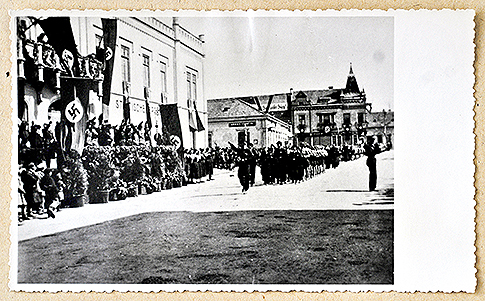
photo: archives of the Museum of VojvodinaBANAT DURING WORLD WAR II: Hitler Youth ("Hitlerjugend")
How the occupation regime worked and who made it?
The German occupation regime in Serbia and Banat was very complex. Formally, the most important German institution in Serbia was the Wehrmacht, the German army - a series of German and Austrian generals commanded the German forces in the country and they made all major decisions - but there was also the German civil administration, the SS (which included the Gestapo and ordinary German police), and special offices and plenipotentiaries in charge of the economy (actually economic exploitation) and diplomacy. This interweaving of jurisdictions is very typical of the Nazi approach to power in both Germany and occupied Europe. Moreover, just as Hitler made - and sometimes broke - alliances with other countries, the Nazi authorities looked everywhere in Europe for collaborators, who would take on some tasks for which the Germans themselves did not have enough manpower (for example, day-to-day administration) or did not always want to. to carry them out themselves, even though these tasks were a priority for the Nazi government (for example, killing Jews).
In the occupied Banat, the role of collaborators was assumed by local Germans under the leadership of Sep Janko. The reason for this is not only the cultural-linguistic connection between the occupiers and the Volksdeutsche, nor the fact that parts of the Banat German community accepted Nazism even before the occupation. Equally important factors include the lack of manpower from the Reich, because Serbia was not Hitler's first priority even before, and especially after the attack on the Soviet Union, so the occupier in Serbia was forever scrambling to fill jobs in the administration, police, etc.; the need to find collaborators in the Banat who are neither Hungarians nor Romanians (Hitler did not want any of them to become too strong), nor Serbs, whom the Nazis considered racially inferior, violent and unfaithful; the inability of the Nedić government to control both Old Serbia and the Banat, and the desire of the Nazis to raise the German minority, as their racial-national kind, to a high position and give them more power in the Banat, but again so that the Germans of the Banat primarily satisfy the needs of the Third Reich, so only then, possibly, own desires and ambitions.
The German administration of the Banat did not function as an independent agent equal to the Third Reich. On the contrary, the paradox of the Banat Germans under occupation is precisely that they remained subordinated to the Nazi wishes and needs, but within those limitations they had great power over the members of other ethnic groups in the Banat. Banat Germans became bureaucrats, teachers, policemen, border guards, guards in concentration camps, all thanks to and for the benefit of the Third Reich. As peasants, they - sometimes forcibly - made an economic contribution to Hitler's war, feeding the German army in Serbia, but also selling crops and livestock at favorable prices. They got more German schools, they were better supplied than others, they could buy more land, but all these privileges could not measure up to the demands imposed on them by the Reich, nor did these privileges guarantee that the Banat Germans would forever enjoy a certain status there, in Banat.
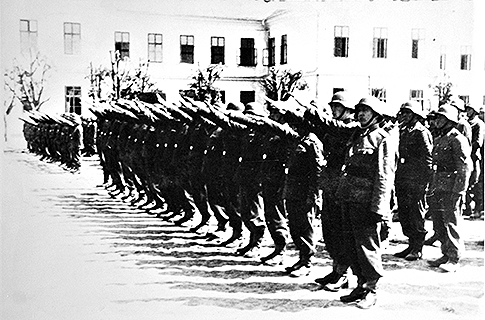
photo: archives of the Museum of VojvodinaVRŠAC, 1942: Members of the SS Division "Prince Eugen"
Although the Nazis did not intend to displace the Banat Germans during the war, that fear remained, and the privileges they enjoyed remained just that – privileges that the Nazis could always take away. Thus, the Nazi regime kept German minorities in limbo and encouraged them to prove themselves both as Germans and as Nazis. This became particularly evident in the Banat when, at the beginning of 1942, the Waffen-SS division "Prince Eugen" was created, officially full of volunteers, but actually full of mobilized Banat Germans, who then participated in Nazi violence, first in Serbia, and then in Bosnia and Croatia. The mobilization of the Banat Germans and other German minorities in the Waffen-SS also confirmed that the German minorities were useful to the Third Reich as peasants, as subjects for propaganda, as collaborators - but also as cannon fodder.
What role did Banat Germans play in the Holocaust in Banat?
There is no doubt that the Holocaust in Serbia and Banat, as well as the Holocaust in the whole of Europe, was the work of the Nazi regime. The Nazis designed and implemented it because of their conviction that the Jews are the root of all evil (or at least of all anti-Nazi), that the Jews are the real power in the world, and that the systematic, mass killing of Jews is the way to win the war, to defeat the enemies of Germany, and to prove the superiority of Germans over all others forever.
However, although the Holocaust was designed and carried out by Germany, it was not only citizens of the Third Reich (including Austria) who participated in the killing, humiliation and looting of Jews. For such tasks, the Nazis often sought and found willing collaborators. Such was the case in Banat as well. The presence of Germans in other countries in World War II often served as a "trigger" for the persecution of Jews, encouraged local anti-Semites, and was a way for potential collaborators to convince the Nazis that they deserved a place in Hitler's Europe. For example, Vichy France passed anti-Semitic laws even before the Nazis asked them to, in parts of Poland and the Baltic Soviet republics the local population bloodily attacked their Jewish neighbors immediately after the German invasion began, while in the Independent State of Croatia the Ustasha authorities began persecution and Serbs and Jews before Hitler and his collaborators decided on the "final solution of the Jewish question" for the whole of Europe.
The surviving Jews and some Germans, later settled in West Germany, testified after the war that in the Banat, in the days immediately after the end of the April War, some Volksdeutsche attacked and robbed neighbors of Jewish origin. Some did it because of ideology, some because of greed, some because of oppression, and some because of all three factors. When, in the late summer of 1941, all the Jews of Banat were to be arrested and taken to Belgrade, where the vast majority ended up, either shot, or suffocated in the "dushegupka", or died in the Sajmište camp, those plans were not hatched by the Banat Germans, but many did help to put those plans into action. Often the Volksdeutsche were the first to have access to the movable property and some of the real estate that the Jews had left behind. For the German occupation authorities, allowing the Banat Germans to materially benefit from the Jewish misfortune was one way to bind the Banat Germans to themselves - they thus gained another privilege, but also became complicit in the worst crimes of the Nazis.
What was the position of other ethnic groups in Banat during the war?
Although the propaganda of the Banat Germans during the war insisted that the Banat was actually German, because supposedly only Germans plowed, cultivated and cultivated it, the German administration of the Banat could not ignore the fact that their community represented only one fifth of the Banat population. I have already briefly spoken about the suffering of the Jews, I will also mention that the Roma were also persecuted in the Banat. As for the other groups, I will focus on three.
Both the Hungarian and Romanian minorities in the Banat benefited from the fact that Hungary and Romania were Hitler's allies, so the German authorities in Serbia had to provide certain privileges to these minorities. Both minorities jealously watched what and how much the other received and regularly complained to the Germans. The Hungarians usually got a little more than the Romanians because, unlike Romania, Hungary participated in the occupation of Yugoslavia and still hoped to one day get the Banat. However, the fact that the Banat remained under German occupation partly to prevent conflict between Hungary and Romania meant that neither Hungarians nor Romanians in the Banat could demand too much from the German authorities, nor hope for equal status with the German minority. .
The German occupation authorities understood that the contribution of the Serbian peasants was necessary in order to "get" everything the Germans wanted from the Banat. Not only is the Banat fertile, but the supply of food and other necessities in the Banat was generally not interrupted by the operations of the resistance movement, unlike the situation in Old Serbia. Serbs and Croats also made up almost half of the Banat population. On the other hand, the Nazi attitude towards the Serbs was very negative, and we know of numerous examples of violence against individuals and property. However, precisely because the Nazis wanted peace in the Banat, in order to more easily exploit it economically, and because, compared to Old Serbia and Bosnia, the partisans and Chetniks operated relatively little in the Banat, the Nazi tendency to see all Serbs as communists and bandits it manifested itself mainly in propaganda and in the behavior of Germans in other parts of occupied Yugoslavia. It was not easy for the Banat Serbs under occupation, but neither were they as residents of parts of rural Bosnia, Croatia and Serbia.
How do you evaluate the policy of the German Nazis towards the Banat Germans?? Did the Nazis take care of their interests or did they just instrumentalize and subordinate them to the interests of the Reich?
Although not all Germans considered themselves Nazis, the behavior of the Third Reich and many who, for whatever reason, chose to side with it somewhat flattened those shades during the war. To assert one's right to be part of the Volk, the German people as the Nazis envisioned them, very often meant proving oneself as a Nazi. The Banat Germans had to find a way through these tensions. I emphasize this in order to point out that the Yugoslav Germans were neither speechless puppets nor "natural", inevitable Nazis. They made choices and decisions, as individuals and as groups of people, of their own free will and for various reasons, but the end result was that most found ways to adapt or even profit and stand out as collaborators.
As for the Nazis from the Reich, their attitude towards the German minorities, including the Banat Germans, remained ambivalent until the very end of the war. On the one hand, they wanted to boast of the great German people - great culturally and numerically - on the other hand, they maintained prejudices and a certain resistance towards people of German origin, who were not born in Germany or Austria. Although the Nazis claimed that "Volk" was more important than citizenship, origin, place of residence and citizenship remained very important to the diplomacy of the Third Reich, but also to their relationship with people they wanted as allies or claimed to be their racial kin, let alone to people they hated. Thus, the Third Reich always required German minorities to prove themselves - whether they were German and/or Nazi enough to be accepted into the "Volk" - but it also made new demands on them. One had to go to Nazi rallies, make an economic contribution, show oneself to be anti-Semitic, go to war as a member of the Waffen-SS, etc. Being German was not an absolute category, something for which people could claim "well, now it's safe and done, we don't have to worry about it anymore".
The Nazis certainly subordinated the interests and wishes of the Banat Germans to their own interests. That relationship remained unequal, and in favor of the Reich. Nevertheless, I note once again that the Banat Germans decided what to do and how to behave, both as individuals and as a group, within the limits of what the Third Reich allowed them to do.
What was the fate of the Banat Germans after the liberation of Banat in 1944?. years?
Approximately two-thirds of Banat Germans remained in Banat in the fall of 1944. The rest had already been mobilized or had decided to flee, when the news arrived about the approach of the Red Army and partisans. The reasons why more people did not try to flee are, among other things, fear of the unknown, the inability to understand what kind of treatment the Germans - from the Reich and natives - could expect, disbelief that the war was really lost, the desire to preserve property, the memory that the end The First World War was not so bad, but also the fact that the German occupation authorities defended the organized evacuation from the Banat until the last moment, because it was not their priority.
Life under partisan rule meant for the Banat Germans first unsystematic persecution - violence, rape, robbery - and then, from 1945 to 1948, mass imprisonment in camps, where forced labor, violence and harsh conditions were routine. Since the Potsdam Agreement, by which the Soviets, British and Americans agreed on the organized expulsion of Germans from Poland, Czechoslovakia and Hungary, did not cover Yugoslavia, the camps served as a temporary solution while Yugoslavia lobbied to be allowed to expel the German minority as well, but and as an opportunity to take revenge on a group of people that the government of the other Yugoslavia declared traitors, collaborators and even a fascist. At the same time, socialist Yugoslavia confiscated all property from the Volksdeutsche, not only to reward partisan veterans and their families, but also to implicitly enable itself to assert that Vojvodina was always a Slavic region, in which the Germans were only a foreign element for many years. .
While during the war the Germans in Serbia and the Banat called themselves the Banat, post-war Yugoslavia - as well as, for example, Poland in relation to the western parts of that country or Czechoslovakia in relation to the Sudetenland, from which the German minorities were expelled - established its legitimacy through the ideology of brotherhood and the unity of the Yugoslav peoples united in the fight against fascism, but also through the exclusion of Germans from the ranks of those same Yugoslav peoples. Soon, the government allowed the Banat Germans released from the camps to leave the country forever, which the majority did. The Yugoslav census from 1948 records that barely 10 percent of the Yugoslav Germans who lived there before the war remained in the country.
The Second World War and the years immediately after it left their mark on Eastern and Southeastern Europe, among other things, by the fact that the diverse population of these regions was somewhat "simplified", as some groups were destroyed or displaced. During the war, this happened especially through the mass murder of Jews, as well as the general violence committed in Poland, the Soviet Union and Yugoslavia. After the war, the expulsion, flight or semi-forced emigration of people of German origin, as a group linked to the Nazi regime regardless of individual deeds and misdeeds, removed the Germans and their cultural heritage from the national narrative of "who we are and our country". Although not all Germans were self-proclaimed Nazis, enough of them acted like Nazis that their collaboration condemned the entire national group in the eyes of their neighbors and victims.