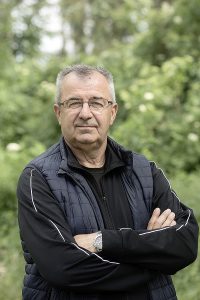
"I know from experience - it is not possible to train a tank driver for engagement in combat in three months. All those who advocate it should sit in a tank, a confined space, and see what it's like when the first shell is fired, that feeling in the ears and brain, a kind of contusion. And that on training ground conditions, and imagine in battle, where you expect to be hit by a projectile like "zolja" or these modern devices. And you don't have infantry protection, because it has retreated. The same is true for all other branches, from infantry onwards"
"The current situation in the conflict between Russia and Ukraine and the physiognomy of war indicate the dynamic introduction of new means, especially unmanned armed and reconnaissance aircraft, and then the problem of countering such means arises, as well as the massive use of means for close anti-armor combat. Such circumstances confirm the need to introduce and develop a professional army, which is capable and trained to use these means and fight against them, which is not possible to achieve with soldiers who need to master them in three months of mandatory military service", he said in an interview for "Vreme". ” Retired Serbian Army Major General Dragan Kolundžija, former commander of the Operational Forces, and then head of the Directorate for Operational Affairs of the General Staff.
"VREME": Many retired officers are guests on television from morning to evening, they even know in advance what moves the Russian army and the president of that country, Vladimir Putin, will take...
DEAR KOLUNDZIJA: I would not like to comment on that, everyone has the right to express their opinion, but they should answer for their words, because the people perceive the Army through their discussions.The conflict is difficult to comment on based on the unavailability of relevant information. I am disappointed that there was a conflict at all, but also the fact that almost nothing is being done to stop the war.
As a man who spent his military career in armored and mechanized units, what is the first thing that comes to your mind when you watch footage from Ukraine?
From a military point of view, I was surprised by the grouping and engagement of Russian forces in the initial phase. Large marching columns of combat equipment came under the attack of units of the Ukrainian Territorial Defense with means for close anti-armor (PO) combat and armed drones of the Army of Ukraine, where, according to available photos and videos, they suffered heavy losses. Especially when one takes into account the newly achieved development of active-reactive armor protection from means for close PO combat in the Russian army. I'm a bit amazed at the ineffectiveness of it or maybe it wasn't applied to those tanks and armored personnel carriers to a sufficient extent. Obviously, without infantry, trench units are extremely vulnerable. "Armor" is necessary in such space occupation operations, but the number of infantry soldiers protecting it in a populated place is not sufficient. I was also surprised by the insufficient supremacy of Russia in the airspace, which was obviously not established at the required level. Air defense protection at low and medium altitudes is also problematic, which indicates the massive use of armed drones.
My general impression is that the intelligence services of Russia have totally failed and that there are big surprises. This is also indicated by the extensive regrouping of Russian forces, which moved from the northeast to the south.
In addition to Ukraine, "general practice analysts" hold daily lectures on what the Serbian Army should look like and its numerical increase, propose their models for the introduction of mandatory military service, and accuse those who implemented the transformation and reduction of the Army. You were part of the closest team that implemented the transformation since 2006. Do you feel called out?
While the Army of Serbia and Montenegro still existed, I was the head of the Department for Operational Affairs in the Pristina Corps Command (the command was in Leskovac), the reform process began, in which the commands of the then armies, the Kragujevac Corps and two divisions were practically disbanded. In 2005, the first major step in the reform was started - the Land Forces Command, headquartered in Niš, and the Operational Forces Command, whose headquarters were in Belgrade, were formed, and in the second half of the year, they were redeployed to Kragujevac, when the corps commands were disbanded.
I was the deputy commander of the Operational Forces from March 2005, and in October 2006 I was promoted to the position of commander. In December, at a meeting at the General Staff, I was involved in the team for the first time in connection with the further transformation of the Armed Forces of Serbia and Montenegro, when I realized that there was no intention in the military structures of Montenegro to participate in the work of the team. Sometimes the Chief of the General Staff asked me in passing: "How is the transformation going?". At the meeting, analyzes of the General Staff were presented - the current state of the Armed Forces of Serbia and Montenegro, infrastructure, resources and financial situation, needs and possible directions for reforms. The basic conclusion was that the transformation process must be started urgently. I was especially motivated by the set goal to actively get involved and join the process of building a sustainable system, with the perspective of long-term, medium-term and future management of the system and its improvement. After extensive analyzes and a presentation of the situation, a proposal for the organization of the Army was drawn up, which I represented. It was concluded that there should be four Army brigades, a Special Brigade, an Artillery Brigade, a Guard, a Central Logistic Base, seven territorial brigades and Training Centers. It was a realistic option under the circumstances.
Having on paper strong brigades without soldiers or with a very low level of manning only deceives us about the strength of the Army as a whole. The structure of budget costs (personnel, operational and investments) was totally unfavorable. Personnel expenses reached as much as 85 percent, and should not be higher than 55 percent to fit modern standards. Funds for investments and operating expenses were extremely small.
There was also a need to abandon a large number of buildings, which were included in the Master Plan of sale and planned for alienation, in order to partially provide a solution to the housing issue of a large number of members of the Army and the purchase of new weapons and equipment. Why didn't that happen? It is known that the world economic crisis had a negative impact on the economic conditions in the country and the world, and also on the budget for the Army. As for the nebula about melting tanks, I wouldn't waste words.
Who first mentioned professionalization?
While I was still on duty in Leskovac, then Chief of General Staff Branko Krga and Generals Kosovac and Pantelić came for a tour, when Kosovac asked me what I thought about professionalization. I told them, based on my experience, that in Kosovo in 1998 and 1999 and in the south of Central Serbia (entering the Land Security Zone), the 63rd Parachute and 72nd Special Brigades performed their tasks best and meant a lot to the other units, in which more than 90 percent were professionals. I would like to add one impression: when I was on duty in Manjaca, a series of M-84 tanks came for field tests from the "Đuro Đaković" factory. A revolving transporter filled with ammunition, professional crew, shooting from the movement, the maximum speed that the terrain allows, the result is 70 percent hits on the target. That's when I realized that only professionals can make the most of the combat capabilities of the M-84 tank.
Later, as the chief operative of the Army, you advocated for that concept?
By shortening the military service to nine, then to six months, the Army had almost no operational benefits. Individual, crew and service training lasts five months and 22 days, plus leave and that ends military service, there are no requirements for training for additional VES, military courses and unit exercises.For me, there was no dilemma of yes or no, I was "for", with certain conditions. The key question that arises concerns the status of a professional soldier - what are the motivating factors for a young man to decide on it, the possibility of developing his career and life status, what the Army will provide him, and what is expected of him.We estimated in the planning documents that in order for the Army to have a sufficient number of candidates, the salary of the lowest category of professional soldier should be the average salary in Serbia, plus 10-15 percent. Also, the training system and contract model, duration of the contract, food, travel expenses, development path in the Armed Forces and others should be defined. If it had succeeded, I think that today there would be lines of young people waiting to submit applications in front of every barracks. Maybe someone will say: General, those are too high salaries? Whoever says that just needs to be driven for an hour in a tank with closed arches in winter or summer.
If you want a strong, capable and well-trained Army, you need to equip and pay for it. I give credit for the acquisition of modern means, but those means need excellent professionals. I know that we have educated and capable senior staff, but they need people, that is the responsibility of the Ministry of Defense and the Government.
The President of Serbia, Aleksandar Vučić, recently complained that 70 percent of professional soldiers are from the south of Serbia, and there are none from Belgrade and Vojvodina.
If the aforementioned questions or theses had been properly resolved, I am sure that the situation would have been better. Even today, I believe that the only sustainable solution is a professional army. Obviously, the process of professionalization is incomplete in many respects. Instead of soldiers serving their military service, professionals were hired in their places, the units were of different development and the staffing was inadequate. At first, the response was quite good, but later a problem arose. The generation of a "war army" through active and passive reserves, which is foreseen by the Law, has not been resolved.
What is the solution?
A realistic way to solve the problem is to analyze the situation due to which professional members of the army, of all structures and ranks, leave the army, and then start defining realistic and sustainable ways of solving the problem with constant monitoring and response. A realistic assessment of the situation should be done by the Supreme Court, whose expertise I have no doubts about, and not by former officers who appear from morning to night on television or in tabloids and offer their 90-day solutions. Some of them are already announcing some meetings of "their teams" where they will propose a model for the return of compulsory military service. Gentlemen, do not underestimate the General Staff of the Armed Forces, the platoon commanders and their subordinates, I know for a fact that they are professional and capable people.
What is your opinion about that mandatory military service, since during the SFRY you were a commander in the school of reserve military officers in Banja Luka, and then in the troop, especially for four years in Manjaca. One of your colleagues told me that the M-84 tank is an "expensive toy" to be given to operate in combat conditions to some young man who has three months of training on it...
The solution proposed by politicians and the so-called analysts, the mandatory military service of 90 days has several unknowns in it, such as the number of soldiers in each annual "batch", so it is not an effective solution. The basic issue is the lack of professional soldiers and officers, and that problem cannot be solved by reintroducing mandatory military service, because the problem of filling professionals still remains. The key thing is to find a solution for the lack of staffing of units with professional staff, and through the active and passive reserve program (which did not take off, see DL) to solve the situation of the wartime army.
I know from experience - it is not possible to train a tankman for engagement in combat in three months. All those who advocate it should sit in a tank, a confined space, and see what it's like when the first shell is fired, that feeling in the ears and brain, a kind of contusion. And that on training ground conditions, and imagine in battle, where you expect to be hit by a projectile like "zolja" or these modern devices. And you don't have infantry protection, because it has retreated. The same applies to all other branches, from infantry onwards.The Army is not a toy, it is a living organism and as conditions change, it should also be transformed through the processes of long-term, medium-term and annual planning. When the "famous" fifteen-day military service was introduced, a journalist called me for a comment. My answer was: "In 15 days, not even military boots can be stepped on"!
In 1998 and 1999, you were the chief of staff of the mechanized brigade in Kosovo. "Battleships" were a favorite target of NATO bombers because they radiate heat and "attract" bombs. The tacit agreement is not to talk about the war, and you participated in all of them in the former Yugoslavia, but how did the soldiers perform during their military service?
Photo: Marija Janković...
They are proof of why military service should not be shorter than 12 months, although the circumstances of the introduction of new assets and the application of new technologies call that time into question. The March Class of 1998 one-year military service ended in March 1999 and due to the expected aggression of the NATO pact, they were transferred to the reserve and kept in the unit. Those guys have shown unprecedented courage and reliability and are one of the most important factors in the internal strength of the units. If it is already decided to cancel the suspension of military service, from my experience as a long-term tank driver, the optimal one-year military service for the type of combat unit is a one-year military service because that was the optimal time for training the individual, then the crew-services and, in the further course, the realization of the concrete training of the unit, from the tank platoon to a company or battalion, finally with a joint exercise as the crown of the unit's training.
Every day we witness that the Minister of Defense - and the current Nebojša Stefanović, and especially the former Aleksandar Vulin - visit the units and carry out inspections, often the commander-in-chief of the army, Aleksandar Vučić, also does this. In reports, television is often the main news, especially when it comes to Vučić. Especially when it comes to the so-called displays, where military equipment is brought from all over the country, like the last one at Batajnica. How many efforts and sacrifices of the members of the units are behind it?
I believe that these displays are necessary to a certain extent, in order to show the people the state and capabilities of the army. But it is necessary to emphasize the exercises and training of the units in real conditions, without the large presence of those "officials", because the presence of the so-called high-ranking guests requires greater involvement of us "hosts" than the effective forces participating in the display. Setting up the tent for the "officials", protection from the sun, the stage, the sound system, the road sign that shows how many kilometers there are to Belgrade and other cities... All this needs to be done by someone, and it has nothing to do with the exercise. So the frequent presence of "high" guests does more harm than good, because the focus is on them and not on what is being done.
I know that from personal experience. When I was the commander of the 243rd mechanized brigade in Vranje, during the Albanian rebellion in the south of Serbia, then the president of the FRY, Vojislav Koštunica, the Prime Minister of Serbia, Zoran Đinđić, the Chief of the General Staff, the Commander of the Army, came at least once a month. Each visit had its positive aspects, because all the demands we submitted were resolved, especially by the NGŠ General Pavković and the commander of the 3rd Army, General Lazarević, but the number of events was still a burden, because the army, no matter how well-trained and superb it was, exhausted in the preparations. Plus they were performing tasks in the Ground Security Zone.
You became famous in your town after you welcomed the presidential candidate Zdravko Ponoš and said goodbye to him.
I was in Ponoš's closest team of associates when he was Chief of the General Staff, and what kind of person would I be if I didn't contact him and welcome him when he came to my place. It has nothing to do with politics.Sometimes I'm bothered by totally baseless stories (lies) about him from people who never worked with him or know him. Every person has something valuable in him, some more, some less, let's respect each other at least in an elementary sense.
The sixth general from his village
Kolundžija is from the village of Vodičevo near Novi Grad (Bosanski Novi) and since the Second World War he is the sixth general from his village, because Potkozarje has given many first-time fighters. He graduated from the High Military School of the Ground Forces in Sarajevo, then the Military Academy, and in the ladder of advancement passed all corps duties in order from platoon commander, company, deputy, armored battalion commander, commander and all the commanders that followed. Command staff training and the School of National Defense are taken for granted.
What is happening in the country and the world, what is in the newspapers and how to pass the time?
Every Wednesday at noon In between arrives by email. It's a pretty solid newsletter, so sign up!
How were the cases kept out of control, the investigations directed towards the citizens who sought protection, and the prosecutors were left without answers from the police? Branko Stamenković talks about the findings of the commission of the Supreme Public Prosecutor's Office, the responsibility of his colleagues and what is needed for the institutions to work according to the law again
Who now decides on the Government and the program, the plenum or the deputy? There are different views on this in the Student Movement and among the people on the list, but a middle solution is being sought, "Vreme" learns. Be that as it may, the program of over a thousand pages already exists
The outgoing government treats the state like an apartment from which it moves out after losing a dispute. And all the time she shouts loudly that her neighbors are demolishing the building
"The main priority of the new government should be the preservation of employment and the growth of the standard of the population. And this will not be easy to achieve at all, because we will have a decline in employment in clientelistic companies that cooperated with the former regime. Some will close, but the important thing is that many people will lose their jobs. In the case of large private companies that are experiencing difficulties, the government should commit to better owners taking over these companies in order to save thousands of jobs. We will already have this case with Davora Macure's companies, among which is "Idea"
How much money from the Growth Plan has been irretrievably lost for us, how much has been frozen and how much is still waiting for us? What should Serbia do in order to receive these European funds and what will the citizens get from it? Is a new chapter in Brussels-Belgrade relations beginning?
At the moment when the institutions of the Republic are destroyed, when Vučić's octopus is still alive, when people are disgusted by the injustice and the stench left behind by the Essenes regime, we have, as Machiavelli said, only civic virtue as the fuel with which we can return to the beginning
The four independent members of REM are an example of perseverance and civic responsibility. Rodoljub Šabić even, upon leaving the premises of REM, after the sentencing of the Informer, experienced that the Essenes insulted him, hit him with their hands and feet. But that too will soon be over
Vučić pardoned the batterers and Dijana Hrkalović. The election winners should abolish the sultan's power that allows one man to run afoul of the entire judicial system
The archive of the weekly Vreme includes all our digital editions, since the very beginning of our work. All issues can be downloaded in PDF format, by purchasing the digital edition, or you can read all available texts from the selected issue.