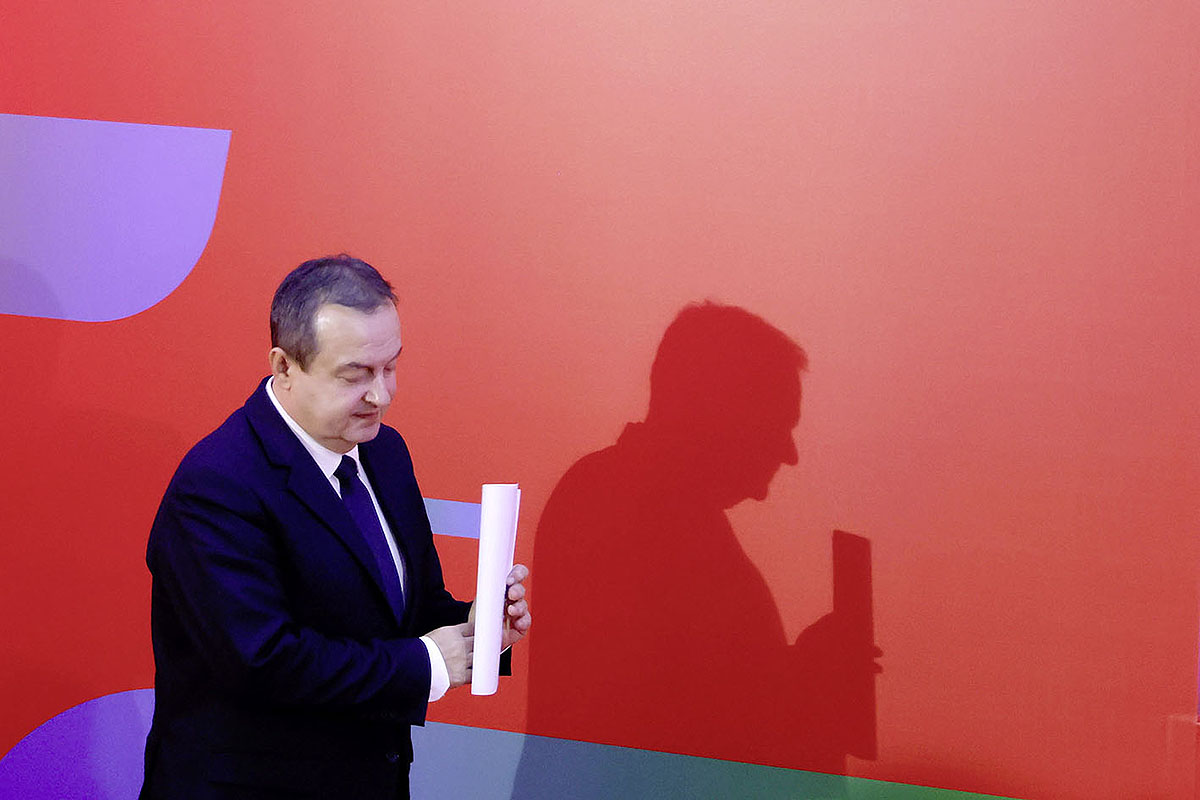
Sa Vučić's resignation all the highest state functions are in the technical mandate.
The law puts the state on hold during that time, as those acting as acting officials actually have very limited powers.
Kada the President of the Republic resigns or is prevented from performing his duties, he is temporarily replaced by the President of the National Assembly for a period of up to 30 days, but may be longer. In this case, it is Ana Brnabić.
In that status, the President of the Assembly assumes only the necessary powers - promulgating laws, commanding the army, receiving credentials. However, he cannot exercise all the regular political powers of an elected president.
On the other hand, according to the Law on Government, the Government whose mandate has ended can only carry out current affairs. As prescribed by law, such executive power cannot propose laws and other general acts to the National Assembly or pass regulations, unless their adoption is related to a legal deadline or is dictated by the needs of the state, the interests of defense or a natural, economic or technical accident.
It cannot appoint civil servants to positions in state administration bodies, and when exercising the founding rights of Serbia, it can only appoint or consent to the appointment of acting directors and members of the administrative and supervisory board.

Photo: Tanjug/Rade PrelićAleksandar Vučić and Ana Brnabić: Handover of duties at Andrić's wreath
When the country was without both governments
The period during 2003 and the beginning of 2004 was the longest period in the history of modern Serbia when both key functions were in temporary status, and it was the period of the biggest political crisis in the country, because the first democratically elected Prime Minister was killed.
After Milan Milutinović's mandate expired in December 2002, the presidential elections failed several times due to insufficient turnout (50 percent of the vote at the time). The function of Acting President of the State was first performed by the President of the Assembly Nataša Micić until January 2004, and then briefly by Dragan Maršićanin, Vojislav Mihailović and Predrag Marković.
After the assassination of Prime Minister Zoran Đinđić in March 2003, Zoran Živković took over the government. At the end of the year, the parliament was dissolved, so Živković's government entered a technical mandate.
Thus, from November 2003 to March 2004, Serbia was governed by a government in a technical mandate without the full legitimacy of the parliament, while the head of the state was the acting president of the Republic.
Photo: Tanjug/ Rade PrelićAna Brnabić in the presidential chair that was held by Aleksandar Vučić for 10 years
We had a situation similar to today's in the spring of 2012, when Serbia found itself in a situation where both the office of the president and the office of the prime minister were transferred to a temporary status.
The then president Boris Tadić resigned in April 2012. He shortened his five-year term by a few months so that presidential elections could be held at the same time as regular parliamentary and local elections.
By announcing parliamentary elections, the Government automatically entered into a technical mandate.
Thus, for a few months, the position of Acting President of the Republic was taken over by the then Speaker of the National Assembly, Slavica Đukić Dejanović. The government was led by the prime minister in a technical mandate. Mirko Cvetković remained at the head of the technical government, without the right to propose new laws or make long-term political decisions.
When will the presidential elections be held?
Vučić's presidential mandate ends when the resignation reaches the National Assembly. In that case, the presidential elections must be called so that the voting takes place no later than three months after the end of his mandate.
Elections are announced by the President of the National Assembly, and a minimum of 30 and a maximum of 60 days must pass from the date of the announcement to the day of voting. The law also stipulates that voting day must be a non-working day.
Thus, the deadline for holding presidential elections will be December 27. That date falls on a Sunday, so if the maximum deadline is used, the elections could be held right then.
On the other hand, elections could be held no earlier than 30 days after their announcement. If the President of the National Assembly were to call the elections immediately after Vučić's resignation, the earliest date for voting would be October 27. Since the law stipulates that the voting day must be a non-working day, the first following week would be the first of November, that is, the two-year anniversary of the fall of the roof of the Railway Station in Novi Sad.
Real journalism costs money, and we will not be bought by tycoons and corporations. Support us with a one-time or monthly donation. The time for it is now!