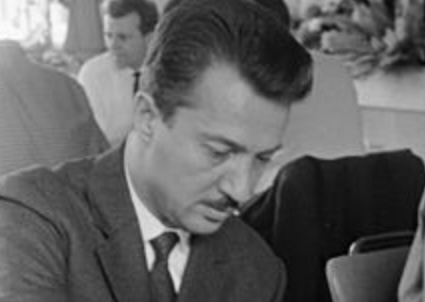
Svetozar Gligorić with chess met relatively late, at the age of thirteen. Two years later, in 1938, at only 15 years old, he won the competition of the Belgrade Chess Club. He received the title of grandmaster in 1951 and for the next twenty years he was among the world's best chess players and a candidate for world champion. He is one of the most active chess players in history.
At the time when Gligorić was active, chess was very popular. Chess games were analyzed in the sports section of the RTS daily. The World Chess Championships were global events.
Thanks to Svetozar Gigorić, Yugoslavia was considered the second chess superpower in the world, after the USSR. He participated in a huge number of international tournaments, many of which he won. Among his most significant victories are the tournaments in Warsaw 1947, Hastings 1951, 1956, 1959, 1961, Mar del Plata 1953, Stockholm 1954, Belgrade 1964 and Manila 1968, Lone Pine 1972 and 1979. Three times at international tournaments, he qualified for candidate matches in the world championship cycle.
In the 1958s and XNUMXs, Gligorić was a regular participant in world championships and was regarded as the best player outside the Soviet Union. One of his greatest achievements was his participation in the Interzonal Tournament in Portorož in XNUMX, when he lost a victory in one game and came in second place behind Talj.
In the same year, at the Munich Olympics, he won the gold medal for the result on the first board, ahead of Botvinnik. At the Interzonal Tournament in Sousse in 1967, he shared second place without defeat. In Argentina, at the tournament in Mar del Plata in 1953, Godine won and was ahead of Najdorf. It was then that Gligorić's "patent" in the theory of the chess game was born - the famous "Mar del Plata variant of the king's Indian defense".
Gligorić was one of the few lifelong friends Robert Bobby Fischer. In the final score, Fischer and Gligorić had a score of 6:4, with six draws. Between 1950 and 1982, he represented Yugoslavia fifteen times at the Olympics, winning 12 medals (one gold, six silver and five bronze). Twelve times he won first place at the championship of Yugoslavia.
Svetozar Gligorić is also known for his journalistic career. He was a regular correspondent for "Chess Review" and "Chess Life" magazines. He also wrote a large number of books on chess.
RV
Read daily news, analysis, commentary and interviews at www.vreme.com