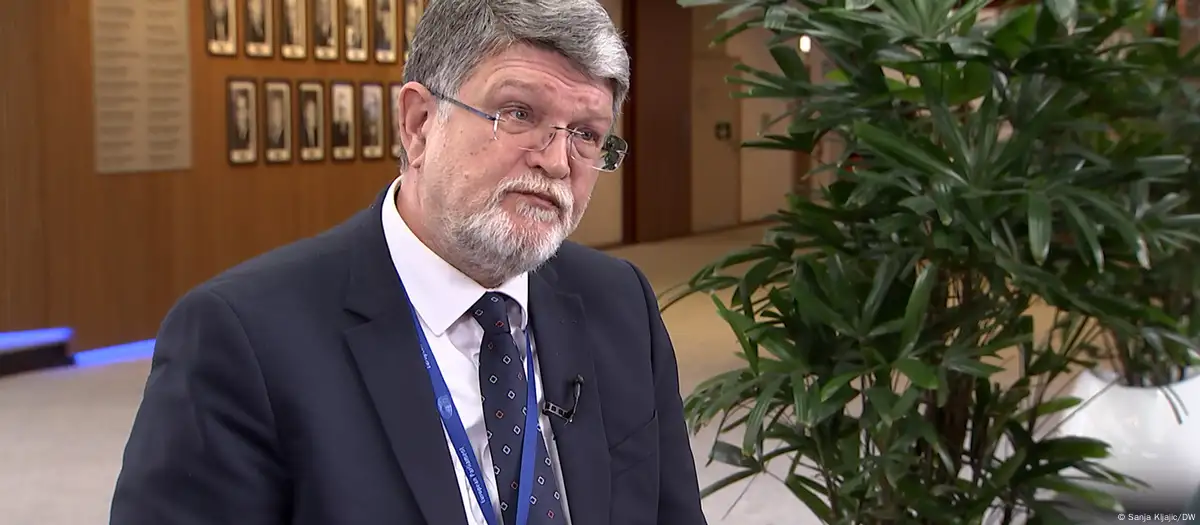
Tonino Picula, reporter of the European Parliament for Serbia, will include the student protests in Serbia and the reactions of the authorities in its annual report, he writes Deutsche Welle (DW).
Picula confirmed this in an interview with DW, saying that he expects many amendments from other colleagues.
Asked about support for the authorities in Belgrade from foreign capitals, Picula says that he is not surprised by support from Beijing or Moscow, while the European Union is not a single political space when it comes to institutions.
"The European Parliament very early and very clearly expressed some views on what is happening in Serbia." In particular, we were quite clear - and I personally - about the violence recorded on the streets of Belgrade," says the Croatian parliamentarian.
"I said very clearly that no one can question the constitutional right of citizens to express their dissatisfaction with government decisions, whether they exist or not," he added to DW.
There is no consensus.
Picula reminds that various party families from the European Parliament have expressed similar assessments, but that the European Commission and the European Council are "reserved".
"In fact, it is very difficult, and in fact it is necessary, to reach some kind of consensus, so that any spokesperson of the Council and the European Commission can say anything to your fellow journalists."
"Obviously, such a consensus is not easily reached. I would like to remind you that, unfortunately, the European Union has been divided for a long time about what is actually happening in the Middle East in the Gaza Strip, because different member states have some national dioptres, channeling events in certain parts of the world, including in Serbia," adds Picula.
He assessed the decision of the authorities in Belgrade to expel 13 activists from Croatia and other EU countries who participated in a conference in Serbia as "politically motivated". Picula advocates a more concrete reaction from Brussels.
According to Picula, the authorities in Belgrade attributed the events in Serbia to "some kind of power centers that operate with an invisible hand from abroad."
"Of course, that is not true, because if anyone has been helping Serbia for a number of years, it is the European Union, and with very tangible funds from the funds supporting various areas of work in Serbia."
Picula says that because of all this, he will not give up his trip to Serbia before he completes the report for the European Parliament. "I am open to dialogue, and we will see who will respond."
He says that if the Serbian authorities do not want to talk to him, it would be a failure of the European Parliament. "And then, the day after tomorrow or for some period in the future, we shouldn't be surprised, perhaps, at the same response from EU citizens when Serbia's candidacy for membership comes up."
Fulfill ODIHR recommendations
When asked by DW whether the European Parliament could mediate in Serbia after the resignation of the Government and dilemmas about the interim government or new elections, Picula reminds that the European Parliament's mediation has yielded results in North Macedonia, but not in Serbia so far.
He says that it is important for the Serbian authorities to implement the 25 recommendations of the ODIHR in order to make the elections of higher quality.
"If there are elections - it is, of course, a completely legitimate decision of the authorities in Serbia - those elections will be measured precisely through the prism of what was done or not done to reform the electoral system," says Picula.
"Serbia is, in fact, a record holder in holding elections in regular and extraordinary terms." However, social tensions after those elections only grew. After all, if elections do not resolve social dilemmas and conflicts, but only intensify them, then it is better not to hold them," he adds.
Kosovo is important, but not the only one
Speaking about the fact that the European Union has not yet opened the negotiation Cluster 3, although the European Commission said that the conditions have been met, Picula states that the opening of the cluster is also a political message.
"Obviously, a number of member states have assessed that there are not enough political preconditions to grant Serbia that concession, given the situation in the country." And the events that happened later seemed to justify exactly that kind of caution towards the continuation of Belgrade's negotiations with Brussels," the reporter says.
Picula reminds that Serbia has not imposed sanctions on Russia, that it is poorly aligned with the EU's foreign policy, and that chapter 35, that is, relations with Pristina, is above the whole process.
When asked by DW if the authorities of Aleksandar Vučić are right when they say that if Serbia recognizes Kosovo, all other problems would be forgotten, Picula claims that they would not, although the final agreement between Belgrade and Pristina would remove a large part of the obstacles.
"However, there are still a number of open problems for Serbia, which, I say, will not disappear, and work on them is certainly as important as this issue with Kosovo."