

News
Part of the ZLF presidency distanced itself from Rastislav Dinić's statements
After agreeing with SNS deputy Milenko Jovanov in the Debate show on TV Insider, the former ZLF deputy encountered resistance from his party colleagues

While Aleksandar Vučić wants to show that he enjoys the support of at least part of the EU by hosting the Prime Minister of Slovakia Robert Fitz, the students are not looking for support from abroad. The question is whether the idea of his "friends" around the world still earns the former president of Serbia some points with the voters.
The key thing for the outcome of the upcoming of choice je turnout. A comparative analysis of previous election cycles shows a clear upward trend in voter turnout, which corresponded with the declining performance of the ruling coalition. Public opinion surveys, as well as a significant jump in the number of registered voters in the diaspora, indicate that such a trend will intensify.
The expected increase in voter turnout is primarily the result of the victory Student list already achieved. They defeated the apathy that the regime systematically served. With their actions, walking and riding bicycles through the villages and cities of Serbia, they woke up those who are eager for change. They defeated the long-term scourge that the current government has nurtured, which is an aversion to political activism, and encouraged hundreds of thousands of citizens to join the campaign.
Both centralism and the lack of intra-party democracy both in the government and in the opposition won, so the candidates for the Student List were elected in what is certainly the most democratic and thorough process based on the plenary approach (of course, with certain limitations that this approach entails).
All together - they overcame the fear that this government is immutable and infected every body of voters with optimism, so it is often said that "fear has changed sides".

It was the perception of the immutability of the government that was one of the key factors in the stability and longevity of the government Serbian Progressive Party (SNS) and its coalition partners. The strength of this perception largely stemmed from its external component, i.e. the entrenched attitude among the public that the current government is supported by key international actors and that without them it is impossible to change anything in Serbia.
In the simplified collective memory of a large number of citizens, the change of government in Serbia in 2000 was primarily related to the actions of the West in that field. Error congratulating the victory Tomislav Nikolić before the closing of polling stations in Serbia by EU, contributed to the fact that the change of government in 2012 was attributed to external actors. After Tadic's rejection of the ultimatum Angela Merkel in connection with the withdrawal of Serbian institutions from the north of Kosovo and Metohija, European leaders allegedly decided to support or encourage the coming to power of those who will be more flexible.
Starting from this simplistic belief among a part of the opposition-oriented citizens, the regime tried to often demonstrate the support it enjoys from foreign statesmen, thereby further blunting any edge of change. Also, in addition to discouraging the disaffected, this also consolidated support among sympathizers. Because a good part of Serbian citizens, due to the trauma of isolation and stigmatization during the nineties, especially appreciated the support and show of respect from high representatives of other countries.

This was especially the case if that support came simultaneously from different parts of the world, which subtly nurtured the legacy of the Non-Aligned Movement, as well as the wider identity narrative of Serbia as a country that is "East to the West and West to the East". A cult of personality was built on all that Aleksandar Vučić, and very similar to the Titoist model.
While they were in the radicals, the future leaders of the Serbian Progressive Party did not attach much importance to this component, despite occasional meetings with Vladimir Zhirinovsky, Jean-Marie Le Pen and other leaders of the radical right-wing parties. However, the 2012 campaign, the first they led as progressives, was also marked by the visit of Rudy Giuliani, the former Republican mayor of New York, who came to support the candidate for mayor of Belgrade, Aleksandar Vučić. This did not help much either, so Vučić lost the election with almost ten percentage points less than the list of Dragan Đilas. However, the victory of Tomislav Nikolić not only kept him in political life despite the defeat, but also soared to the top of the political power of the state.
The victory of Tomislav Nikolić raised the attention of some neighbors, but not the political leader of Montenegro. Milo Đukanović. Namely, Nikolić and Vučić had officially met Đukanović in Podgorica about half a year earlier, at a meeting that was accompanied by a tone of mutual respect and a discourse of cordial cooperation, so Đukanović's optimistic congratulations on his victory were not a big surprise. Their meeting in a Paris hotel also became known to the public To Ritz from 2008, which Nikolić claimed was accidental and that everyone was there for their own business, while others speculated that the creation of the Serbian Progressive Party in a wider society was then agreed upon.
But let's put that aside - it is certain that between SNS and DPS "hands caressed" in the first years of government, so Nikola Selaković returned the support with a hearty speech at the 7th Congress of DPS in 2015.
That Đukanović is not the only one of the former sworn political enemies with whom the SNS will establish cordial relations, was shown by the rapprochement with the actors who are directly responsible for the aggression against the FRY in 1999.
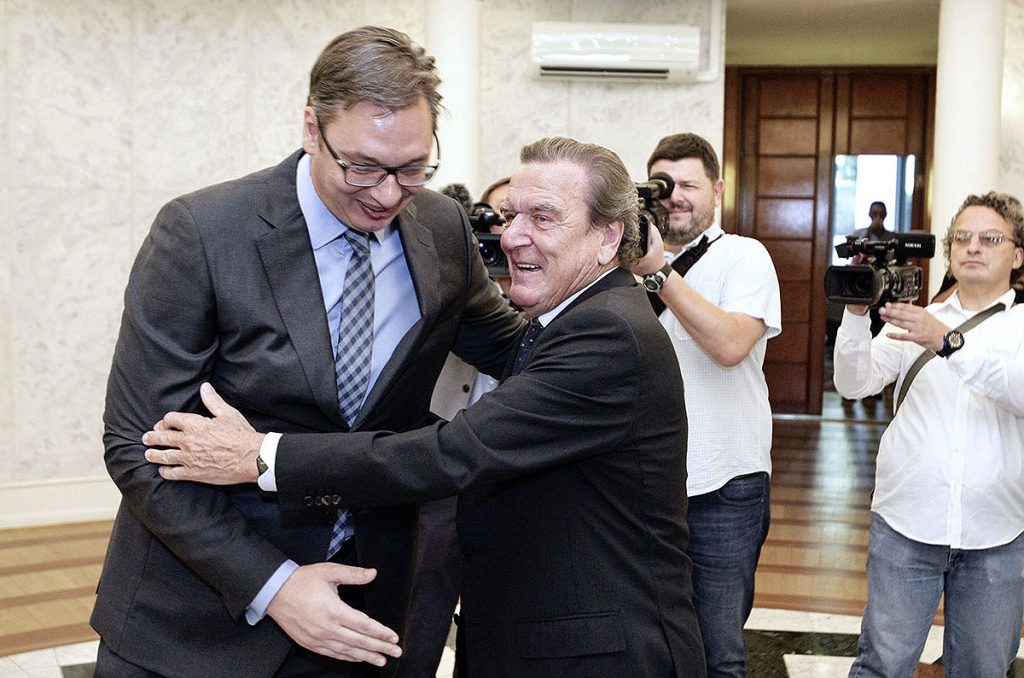
First of all, it is a consulting firm. Tony Blair engaged to improve the work of the Government of Serbia (introduction of the famous "delivery units"). After that, Prime Minister Vučić also spoke at the annual meeting of the "Clinton Global Initiative", on a panel with former US President Bill Clinton and the then mayor of Srebrenica, Ćamil Duraković, all at the time of Hillary Clinton's campaign for US President.
But what is most important for the internal campaign aspect is the arrival of Gerhard Schroeder, the German chancellor at the time of the bombing, to the pre-election rally of Aleksandar Vučić as a presidential candidate - on March 24, 2017.
While many found such an act humiliating and devastating, his constituents didn't seem to mind. In the middle of the last decade, Vučić tried his best to demonstrate in public his closeness with German politicians, especially with the then chancellor Angela Merkel, who was a favorite and frequent guest of Belgrade, just as Vučić was happy to be seen in Berlin. The visits were regular even on campaign days, as was the case in March of 2017.
This was also a message to the critics that Vučić and the SNS are now accepted everywhere and that the shadow of the nineties no longer hovers over them, that they have the full support of the West for everything they do - and that one should not hope too much for changes soon. The price of this kind of support was clear - on the one hand, making huge compromises and giving way to the authorities regarding the interests of Serbs in Kosovo and Metohija, and on the other hand, special treatment of German investments. We recently learned that the German government also financed a special adviser for German economic interests in Serbia in Vučić's cabinet.
A very important element of campaign activities was balancing through close meetings with officials from the East during the campaign period. So, for example, shortly before meeting Angela Merkel in Berlin during the 2017 campaign, Vučić also traveled to Moscow and met with the President of Russia Vladimir Putin. This pattern in meetings with Western, Russian and Chinese officials will be repeated almost before every next election, as well as in crisis situations. It is indicative of how Putin's visit in January 2019 was used as a context for a kind of "counter rally" of the SNS in front of the Saint Sava Temple, with the aim of opposing the opposition wave of "Stop bloody shirts" protests.
A similar maneuver was attempted last year, in order to dampen the political consequences of the largest gathering in the history of Serbia, held on March 15, organized by students in the blockade, and thereby sending a message about the alleged "geopolitical checkmate" that will defeat the "colored revolution". From Andrić's wreath, it was announced that the then president of Serbia will be a guest of the president of Russia at the parade in Moscow on May 9 (for the first time since the beginning of the war in Ukraine), but also that he will meet with the president of the USA "several times" beforehand Donald Trump in Florida. It is known that the meeting with Trump did not take place, and Vučić explained the mysterious interruption of the visit to health reasons.
In this campaign, such an approach was tried again. A kind of support came from the East for Putin, who at a conference, answering a question about Serbia, addressed Vučić as a "former president and, I hope, future prime minister." They were looking for a way to balance it with the support of some statesman from the EU, so the Slovak Prime Minister was announced as a guest in the Belgrade Arena at the beginning of October. Robert Fico. However, he did not appear then, but two weeks later he attended the SNS rally in Novi Sad. His presence served to show that we still have close friends both in the East and in the West - or at least in part of the West.
Unlike the visit of the Slovak prime minister, which was expected, the surprise in the last week of the campaign was the announcement of the American Conservative Political Action Committee (CPAC), a political platform close to the American Republican Party, that in November it will organize the inaugural conference of its Balkan section in Belgrade, where the special speaker will be the "president" Vučić. In the announcement, there is no explicit support for Vučić before the elections, but, in the context of the decision to be the speaker, his advocacy for progress in relations with the USA is praised. It is interesting that he is also addressed by the title of president, which is a function he no longer performs, nor will he ever be able to perform again according to the Constitution of the Republic of Serbia. This could certainly be a consequence of the American habit of addressing former presidents with this title in their political discourse, even though their mandate has expired, but it could also indicate a lack of interest in the internal context in Serbia - especially bearing in mind that Vučić would then like to speak as prime minister.
Despite this, SNS presents this announcement as a form of Donald Trump's support for the current authorities, pointing to the undoubted importance of CPAC and the American Conservative Union - the organization behind the committee - for Republicans.
It is interesting, however, that this is the first year out of the last ten in which Trump did not attend the annual convention of CPAC, which, by the way, is increasingly losing primacy in influence compared to the organization "Turning Point USA" of the murdered Charlie Kirk.
Certainly, even if it does not seem like an open support of the Republicans, SNS certainly hopes that this kind of announcement can dampen some of the negative tones from the previous period that came from the Republican camp as well. The best example is the criticism of the state of democracy and human rights contained in the "Western Balkan Democracy and Prosperity Act", a law passed by a bipartisan majority in the US Congress at the end of last year, as well as regular criticisms of the state of democracy and the proposal of a special act in this regard by Republican Congressman Joe Wilson.
Although we have seen that SNS still tries to apply them, such campaign activities are no longer of great importance. There are several reasons for this.
The first and basic one is that the students, through their activities, managed to abandon the feeling of subordination in relation to foreign actors and the belief that they should wait for the green light for some kind of activity. Even when they went to Strasbourg and Brussels, they explicitly asked the officials of the European Union and the Council of Europe not to help the current authorities and to respect their norms and values in relation to Serbia. The battle for the favor of external actors was not their priority, so it can be said that they succeeded in mobilizing enormous support of citizens despite certain external actors from the East and West, and not thanks to them. The Student List campaign remained primarily oriented towards hot domestic political issues. Deterring and demotivating citizens who want change by highlighting the support of a foreign factor by the government has become ineffective.
Another reason is that the performance of the progressive campaign this time is much more modest. While in 2023, as part of her regular visit to the Western Balkans, Ursula von der Leyen actually participated in the (official) campaign activity of the opening of the highway, this time she decided to skip the scheduled visit to Serbia. There was no interaction with former closest friends from Berlin either. The recent fall from power of Viktor Orbán in Hungary has thrown another standard campaign ally out of the game. There were no more important bilateral meetings with the statesmen of key major powers - except for the picture of the married couple Vučić with Donald Trump from the reception on the sidelines of the UN General Assembly session, which many claim is a cardboard model of the American president. But even if it is not, it is not exclusive, because almost all the rulers from the region have an identical image.

Also, CPAC's announcement, in which there is no explicit support for the elections, does not seem particularly exclusive in the wider regional context, if you consider that Orban was recently addressed by US Vice President JD Vance at the closing rally (and that did not help him win either).
Finally, Putin's indirect support is far from the former closeness and frequent meetings at the highest level, so much so that the meeting with Zelenski during his visit to Belgrade this year seemed more cordial.
As expected, messages of support do not arrive from the Chinese before the elections, because they do not interfere in internal affairs in this way. All in all, it is no longer enough to deter opponents, and especially not to win new votes.
The third reason is that it has become very clear that - even when he organizes a high-level meeting, as was the case with Vučić's recent visit to Paris - it does not represent a strategic success of the state's foreign policy, but rather a short-term tactical transaction. Behind the gestures of support of various foreign officials in the previous period were mainly the economic interests of the other party (the purchase of "bursts", agreements regarding concessions for the subway or nuclear power plants), dubious private combinations or non-transparent projects (General Staff, Belgrade on the water), overpaid projects of foreign companies (Belgrade-Budapest railway, Moravian Corridor) or, on the other hand, the abandonment of our national interests such as the preservation of a healthy environment (the Jadar, Bor project) or the protection of state institutions and our citizens (Kosovo and Metohija). None of that was the result of a strategically thought-out and successful foreign policy.
It is clear that CPAC's motive for organizing the meeting in Belgrade is primarily transactional and realpolitik, so the announcement clearly indicates the desire to place American energy products (primarily LNG) in the region and thereby reduce the dependence of countries in the region on "malicious suppliers" (hostile suppliers).
About how our foreign policy stands, a separate text would be needed, but let's mention only illustratively what the situation is in relation to some of the proclaimed "pillars" of foreign policy. The European Union has not opened a new cluster for us since 2021 and leaves us out of any early membership projection.
Russia does not want to sell us our oil industry or sign a long-term gas supply contract on which we are still dependent.
The United States of America is not planning to remove sanctions on our oil industry (although they affect us much more than the Russians), they are imposing sanctions on certain Chinese companies in Serbia, and until recently we had the highest tariffs on US imports in the region.
As for the mentioned Chinese companies, it is clear that many of them in Serbia do not take into account environmental protection standards, and there were also serious suspicions of forced labor.
Because of all this, it is clear that Serbia's current foreign policy resembles "Potemkin's village", which hides the threat of national interests in relations with almost all actors, rather than successful balancing.
A large number of citizens have matured the opinion that a healthy foreign policy rests primarily on a normal and orderly society. That is why the students, whom the regime's propaganda shamefully denounces as "Ustasha" or agents of the "colored revolution", actually bring foreign policy back home, to its source - to the citizens and institutions of Serbia. There will certainly be opportunities in a more open, transparent and free context for discussions and decisions about which direction to go in key future watersheds. The first step in that direction is to go to the polls as massively as possible.
Robert Fico, Vladimir Putin, American conservatives, and all other foreigners are only cameos in this film. We are the protagonists.
The author is an associate professor at the Faculty of Political Sciences
Election time! And someone has to report to you independently. That's why it's in October annual subscription the digital edition of "Vremena" even 2.500 dinars cheaper. Choose now!
After agreeing with SNS deputy Milenko Jovanov in the Debate show on TV Insider, the former ZLF deputy encountered resistance from his party colleagues

Belgrade councilors will decide tomorrow on the dismissal of Mayor Šapić, who is supported by 41 councilors. 56 are needed

Written evidence is expected to be examined at tomorrow's hearing on the General Staff case. Although the testimony of Dubravka Đukanović points to the involvement of Aleksandar Vučić, it is not part of the indictment
The Government of Serbia, in its technical mandate, plans to allocate an additional 11 million euros through the state agency AOFI for the needs of Expo 2027, claims lawyer Ivan Ninić, who also published the documentation

Thirty years since the student protests in 1996/97, citizens gathered on the Academic Plateau in Belgrade and started a media walk under the slogan "Students have won!"

Why did an unusual group of people led by Aleksandar Vučić, at the constitutive session of the Assembly of Serbia, go berserk because of yogurt spilled on the head of a member of parliament, a "reputable artist" and, of course, a woman?

How Aleksandar Vučić convinced the public that progressives are not worthy of the position of vice-president of the National Assembly and how its president - Aleksandar Čupić - explained to him theoretically and practically what parliamentarism is in front of everyone

For years, European conservatives patronized the SNS and turned a blind eye to violence and corruption. Now, after the electoral defeat of the progressives, they are being let down the drain. Too late, but still…

Change of power in the National Assembly
Majority, minority and high expectations subscribeThe archive of the weekly Vreme includes all our digital editions, since the very beginning of our work. All issues can be downloaded in PDF format, by purchasing the digital edition, or you can read all available texts from the selected issue.
See all




